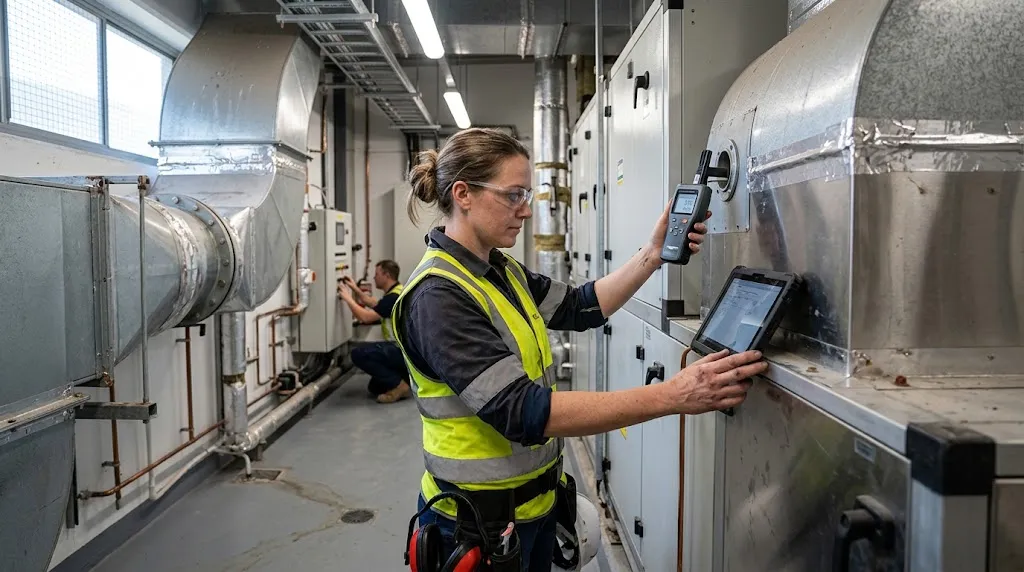
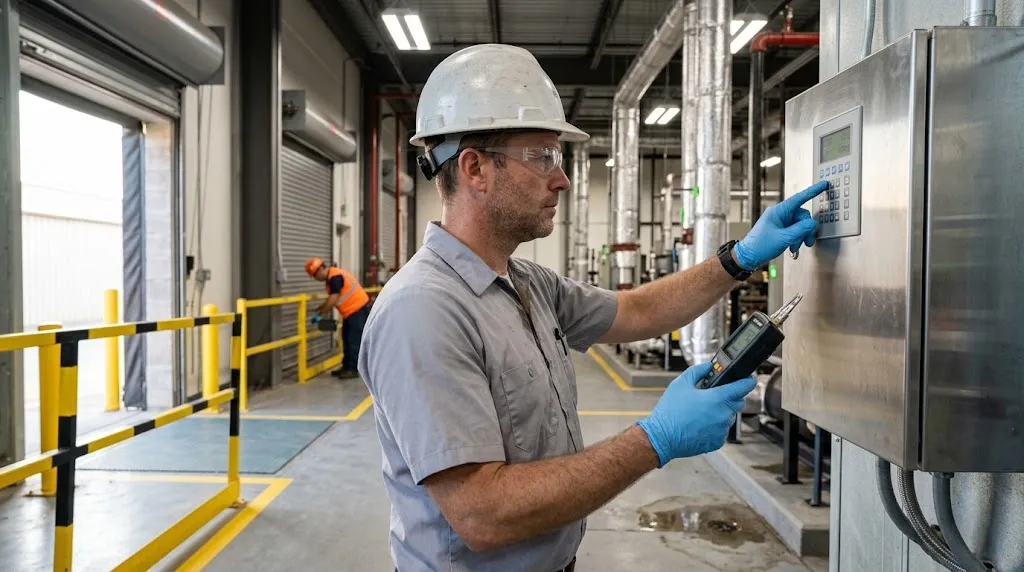
- Most industrial facilities target 40 to 60% RH, though pharmaceutical manufacturing cleanroom environments operate at tighter setpoints governed by temperature and humidity requirements for pharmaceutical manufacturing and ISO 14644 cleanroom standards.
- Relative humidity below approximately 40% increases surface resistivity and accelerates electrostatic discharge (ESD) risk on electronics, semiconductors, and substrates carrying combustible dust.
- Adiabatic humidification systems add moisture without heat input, producing a cooling effect that reduces HVAC cooling load in appropriate conditions; steam systems add heat to the supply air and increase cooling demand.
- Non-wetting adiabatic systems that produce an equal-sized droplet grid can maintain RH up to 99% with plus or minus 1 to 2% precision without wetting surfaces, equipment, or ductwork under proper system design.
- Industrial humidity control systems integrate with building automation systems for closed-loop feedback, remote monitoring, and compliance logging; this is a design requirement, not an optional feature.
- System selection criteria include required RH precision, acceptable surface wetting risk, water quality at the facility, available infrastructure, maintenance interval requirements, and applicable regulatory standards such as ASHRAE standards, GMP, or ISO 14644.
What Is Industrial Humidity Control and Why It Matters
In industrial environments, humidity is a process parameter, not a comfort parameter. The distinction matters because it changes what precision, duty cycle, and consequence look like in practice. General commercial building humidity management tolerates broad seasonal swings and operates on intermittent cycling. Industrial humidity control maintains RH within a specified tolerance band continuously, across a 24-hour operational cycle, because deviations create measurable losses in product quality, equipment reliability, or regulatory standing. Three factors separate industrial-grade humidity control from standard HVAC humidity management:- Precision requirements: industrial applications routinely require plus or minus 2 to 5% RH control rather than a broad comfort band.
- Duty cycle: industrial systems run continuously and are integrated with building automation systems for real-time feedback, not adjusted seasonally by facility staff.
- Consequence severity: an RH deviation in a pharmaceutical plant or semiconductor fabrication environment is a compliance event with documentation and remediation requirements, not a comfort inconvenience.
Relative Humidity as a Process Parameter
Relative humidity is the ratio of actual vapor pressure to saturation vapor pressure at a given temperature. This measure, rather than absolute humidity, is the standard used in industrial specifications because it directly predicts the physical and chemical behavior of materials, surfaces, and processes. Psychrometric control in industrial settings means maintaining RH within a continuous tolerance band, not merely keeping the environment within a broad range.When Humidity Becomes a Compliance Issue
Several regulatory frameworks treat humidity as a controlled, documented parameter. ASHRAE Standard 55 and ASHRAE 9.9 govern thermal comfort and data center environments. GMP requirements mandate that pharmaceutical manufacturing humidity be monitored and recorded as a critical process variable. ISO 14644 cleanroom standards specify environmental controls for cleanrooms and controlled environments. NFPA 77 addresses static electricity hazards, including RH thresholds relevant to combustible dust environments. In these contexts, humidity control is a compliance requirement, not a facility preference.Consequences of Poor Humidity Control in Industrial Environments
Understanding the failure modes that RH deviations produce is the foundation of any business case for industrial humidification investment. Each failure mode has a mechanism, a threshold, and a set of industries where the consequence is most operationally significant. Recognizing these mechanisms also clarifies why different industries target different RH ranges and what happens when those targets are missed.Low Humidity Risks: ESD, Static, and Material Damage
When RH falls below approximately 40%, surface resistivity increases and charge dissipation slows. Static charges accumulate on plastics, circuit boards, moving substrates, and operators, creating conditions for electrostatic discharge events. In environments with combustible dust or flammable solvents, static buildup at low RH is also an ignition risk governed by NFPA 77 guidance on static electricity. In electronics and semiconductor manufacturing, ESD causes two distinct types of damage:- Latent failures that pass initial testing but appear later in field use
- Catastrophic immediate damage that destroys components on contact
- Print registration errors in offset and digital printing
- Cut-line inaccuracies in textile operations
- Part-fit failures in precision assembly
High Humidity Risks: Condensation, Corrosion, and Microbial Growth
RH above approximately 70% creates surface conditions that support electrochemical corrosion on ferrous components, structural steel, and tooling. Corrosion prevention in manufacturing and storage environments requires maintaining RH below the threshold where surface moisture accumulates. The same moisture accumulation that enables corrosion also creates conditions favorable to mold and microbial growth on surfaces, insulation, and stored organic materials. Mold and microbial growth prevention at sustained high RH is both an operational and a compliance concern in pharmaceutical, food processing, and healthcare environments. Condensation prevention on cold surfaces, piping, and equipment in facilities that transition between temperature zones adds another dimension to high-RH risk management. Neither disinfection nor sterility claims are appropriate here: the goal is maintaining RH ranges that do not support these conditions, not eliminating organisms after growth has occurred.How Industrial Humidity Control Systems Work
The core architecture of an industrial humidity control system is a closed-loop feedback circuit. Humidity sensors placed in the controlled zone or return air stream measure RH continuously, feeding readings to a controller that adjusts humidification output to hold the target band without manual intervention. Water quality also affects performance: high mineral content creates scaling risk in steam systems and mineral dust dispersion in ultrasonic systems, while adiabatic fogging systems that fully evaporate their output leave no residue, provided proper evaporation distance is maintained. For sensor types and placement, see our guide on humidity sensors types and selection.Sensors, Controllers, and Closed-Loop Feedback
Industrial-grade capacitive polymer, chilled mirror, and resistive humidity sensors carry tighter calibration tolerances and longer service intervals than commercial-grade sensors. Placement matters as much as sensor type: sensors positioned in the return air stream capture zone-averaged RH, while sensors placed near process areas capture localized conditions that supply air averages may miss. Dew point monitoring supplements RH sensing in data centers and pharmaceutical environments because dew point is temperature-independent and more stable as a control parameter across varying conditions.In-Duct vs. Direct-Space Humidification
In-duct systems introduce moisture into the HVAC airstream upstream of supply registers, distributing humidified air through existing air handling infrastructure. Direct-space systems mount within the occupied zone and deliver moisture independent of the HVAC airstream. Delivery point- In-duct: upstream of supply registers, into the HVAC airstream
- Direct-space: within the occupied zone, independent of HVAC
- In-duct: adequate absorption distance in the duct for complete evaporation before supply air reaches the space
- Direct-space: none; moisture is released directly into the room
- In-duct: facilities with existing ductwork and centralized air handling
- Direct-space: facilities where duct modification is impractical or zone-level control is needed
- In-duct: zone-wide, tied to air handler capacity
- Direct-space: more localized
Industrial Humidification Technologies Compared
Technology selection for industrial humidity control involves trade-offs across five dimensions: energy consumption, surface wetting risk, installation complexity, water quality sensitivity, and maintenance burden. No single technology wins on all five; the right choice depends on which dimensions the facility's process makes non-negotiable. See our guide on commercial humidifiers types and technologies for the full landscape. This section covers three technology categories suited to industrial applications. Note that industrial dehumidifiers are a separate equipment category addressing excess moisture removal, not covered here. Facilities with seasonal swings between under- and over-humidification need both system types specified separately.Steam Humidification in Industrial Settings
Steam systems generate humidity by heating water to vapor using electrical resistance or gas energy. The output is thermally driven and mineral-free, meeting clean steam requirements in pharmaceutical environments where sterile process air is mandated. The main trade-off is heat load: steam humidification raises supply air temperature and increases HVAC cooling demand, a concern for facilities with heat-sensitive processes or tight temperature tolerances. Steam systems also require dedicated electrical or gas service, condensate drainage, and regular descaling of heating elements.- Energy consumption: Steam requires significant electrical or gas energy to convert liquid water to vapor; this heat input adds to the HVAC cooling load.
- Surface wetting risk: Properly designed steam distribution minimizes surface wetting; condensation at supply points is a risk if distribution is undersized or absorption distance is insufficient.
- Installation complexity: Requires dedicated electrical circuits or gas service and condensate drainage infrastructure; certified installation is typically required.
- Water quality sensitivity: Mineral scale accumulates on heating elements; descaling intervals depend on inlet water hardness.
- Maintenance burden: Heating elements require regular descaling and periodic replacement; maintenance intervals are shorter than for adiabatic systems.
Evaporative and Adiabatic Humidification
Adiabatic systems add moisture to air without introducing heat, producing a slight evaporative cooling effect that can reduce HVAC cooling load, the core energy efficiency advantage over steam. Media-based evaporative systems pass air over wetted pads or wicks, relying on airflow to carry moisture into the space. Precision adiabatic fogging systems instead combine compressed air and water through engineered nozzles to produce self-evaporating droplets that convert to vapor before reaching surfaces. For more on these mechanisms, see our guide on humidity control systems and how they work.- Energy consumption: Adiabatic systems require no heat input for evaporation; energy is consumed by compressed air systems or fans, not heating elements.
- Surface wetting risk: Media-based systems distribute moisture through airflow with low surface wetting risk; precision fogging systems engineered with proper absorption distance achieve non-wetting performance under correct design.
- Installation complexity: Connects to existing compressed air and water supply infrastructure; does not require certified technician installation in all configurations.
- Water quality sensitivity: Systems that fully evaporate output leave no mineral residue on surfaces; mineral content affects maintenance intervals but not surface contamination under full-evaporation designs.
- Maintenance burden: No heating elements to descale; engineered industrial fogging systems with no moving parts in the humidification process can extend maintenance intervals significantly.
Ultrasonic Humidification: Where It Works and Where It Falls Short
Ultrasonic systems use piezoelectric transducers vibrating at high frequency to produce a visible water mist. They're quiet, energy-efficient at small scale, and suited to smaller spaces with low mineral content water. In industrial settings, two limitations constrain their use: minerals in the water deposit on surfaces as white dust when droplets evaporate, disqualifying them from most cleanroom, electronics, and pharmaceutical environments, and scaling to large areas requires significant unit multiplication with consistency challenges across the humidified zone.- Energy consumption: Low electrical consumption at unit level; scaling to large zones multiplies energy demand proportionally.
- Surface wetting risk: Visible mist can settle on nearby surfaces if placement or airflow is not carefully managed; mineral dust deposition is a separate and more persistent risk.
- Installation complexity: Individual units are simple to deploy; large-area coverage requires extensive placement planning and water supply distribution.
- Water quality sensitivity: Highly sensitive; minerals in inlet water are dispersed with droplets, producing white dust deposits on equipment and surfaces.
- Maintenance burden: Transducer fouling and mineral deposits require regular cleaning; water quality management is ongoing.
Target Humidity Levels by Industry
RH targets vary by industry because different materials, processes, and regulatory frameworks create different failure thresholds. A 40 to 60% RH range is a broadly applicable industrial starting point, but it is not a universal answer. The following targets are derived from applicable standards and industry guidance; facilities should confirm specific setpoints against the standards governing their process.Why Industry-Specific Targets Vary
Pharmaceutical environments are regulated by GMP, which treats humidity as a documented critical process variable. Cleanrooms follow ISO 14644 environmental classifications. Data centers reference ASHRAE 9.9 guidelines, which specify dew point ranges rather than fixed RH percentages. Hospitals follow ASHRAE 170, which sets different RH requirements for different care areas. The standards framework, not a general comfort preference, determines what precision means in each environment. Industry-specific RH targets and relevant standards:- Data centers: ASHRAE A1-class environments commonly target 40 to 60% RH with specific dew point limits per ASHRAE 9.9; our page on data center humidification covers these requirements in detail.
- Pharmaceutical manufacturing: GMP guidance requires humidity to be a controlled and documented parameter; 45 to 60% RH is a common range in solid dosage manufacturing areas, with tighter setpoints for specific product types. Facilities evaluating pharmaceutical manufacturing humidification systems should align setpoints with their validated process requirements.
- Electronics and semiconductor manufacturing: 40 to 60% RH is commonly targeted to suppress ESD; tighter control is required in Class 1 cleanrooms per ISO 14644. Our pages on electronics manufacturing humidification and cleanroom humidification cover these application requirements.
- Food processing and cold storage: Cold storage produce environments commonly target 90 to 95% RH to minimize moisture loss from product surfaces; our pages on food safety and processing humidification and cold storage humidification address product-specific targets.
- Aerospace and defense manufacturing: Composite layup and bonding operations typically require 45 to 55% RH to ensure bond quality and prevent moisture absorption in composite materials. Our page on aerospace manufacturing humidification details these process requirements.
- Printing facilities: 45 to 55% RH is the standard target to prevent paper curl, static buildup, and ink transfer problems; our page on printing facility humidity control covers substrate-specific requirements.
- Healthcare and hospitals: ASHRAE 170 specifies 30 to 60% RH for general patient care areas, with tighter ranges for operating rooms and critical care spaces. Our page on healthcare facility humidification addresses compliance-specific configurations.
- General manufacturing: 40 to 55% RH is a broadly applicable target for reducing ESD risk, maintaining material dimensional stability, and corrosion prevention on metal components and tooling in process manufacturing environments.
How Smart Fog Addresses Industrial Humidity Control Requirements
Adiabatic humidification that produces an equal-sized droplet grid eliminates the surface-wetting and mineral residue problems that define ultrasonic and some evaporative technologies. This is the operating principle behind Smart Fog's industrial humidifier systems: compressed air and water combine through a proprietary nozzle to produce uniformly sized droplets, each carrying a slight charge that prevents re-aggregation, so they self-evaporate before reaching any surface. The system maintains RH up to 99% with plus or minus 1 to 2% precision under proper system design. Non-wetting performance depends on system design and placement; direct exposure to the fog stream, such as placing a hand into the output, will wet the surface.Non-Wetting Performance and Precision in Demanding Environments
The equal-sized droplet grid produced by Smart Fog's nozzle technology ensures complete self-evaporation before surface contact, under proper system design. This addresses two failure modes identified earlier in this article: condensation prevention on sensitive equipment and surfaces in electronics, pharmaceutical, and food processing environments, and the absence of mineral residue on surfaces that disqualifies ultrasonic systems from those same environments. For a detailed explanation of the mechanism, the Smart Fog technology page covers the nozzle design, droplet behavior, and control precision in full. Key performance characteristics of Smart Fog industrial systems:- Maintains RH up to 99% with plus or minus 1 to 2% precision under proper system design
- No moving parts in the humidification process
- Maintenance intervals extending to every two years
- 100% water efficiency: every droplet evaporates into the air
- Continuous 24-hour industrial operation without manual adjustment
- No requirement for constant nozzle cleaning