- Steam humidifiers heat water past its boiling point using a resistive, electrode, or gas-fired element, making them among the most energy-intensive humidification technologies in commercial and industrial facilities, as documented by ASHRAE and the U.S. Department of Energy.
- Humidity control can account for 25 to 40 percent of a facility's total energy consumption, making technology selection a primary operating cost decision rather than a secondary one.
- Steam humidifiers produce sterile vapor, which is a legitimate compliance requirement in ISO Class 5 and above cleanrooms and certain pharmaceutical manufacturing contexts governed by Good Manufacturing Practice (GMP) protocols.
- Adiabatic humidification systems add moisture through evaporation driven by compressed air rather than heat, operating at a fraction of the thermal energy cost of steam systems.
- Steam systems require scheduled descaling, electrode or element replacement, and steam trap inspection at intervals that exceed the maintenance demands of well-designed adiabatic systems.
- Ultrasonic humidifiers disperse mineral deposits as white dust, creating contamination risk in sensitive environments; evaporative humidifiers avoid this but carry their own filter and wick replacement cycles.
How Steam Humidifiers Work
A steam humidifier applies electrical or gas energy to heat water past its boiling point, converting it to vapor that is discharged into an air stream or directly into a conditioned space. The heat source does the work of phase change, rather than relying on ambient air conditions or compressed air to drive evaporation. This mechanism produces sterile vapor, which is steam's primary and most defensible hygiene advantage. In environments where contamination risk from the humidity source itself is a regulatory concern, that sterility matters.The Heating Element and What It Costs to Run
The heating element converts electrical energy to thermal energy at a continuous rate for as long as the system is producing vapor. The U.S. Energy Information Administration industrial electricity pricing data places the average industrial electricity rate at approximately $0.122 per kWh. A steam system running continuously in a large commercial facility applies that rate against a sustained thermal load, not a brief duty cycle. When humidity control accounts for a substantial share of total facility energy use, the choice of humidification mechanism has a measurable effect on the annual electricity bill.Steam Humidifier Configurations: Electrode, Resistive, and Gas-Fired
Commercial steam humidifiers fall into three main configurations: electrode boiler, resistive element, and gas-fired. Electrode units pass electrical current directly through water to generate heat; resistive units use an immersed heating element; gas-fired units combust natural gas to produce steam at scale. All three configurations share the same fundamental characteristic: heat generation is the humidification mechanism. Regardless of fuel type, that means the energy profile of a steam system is defined by the cost of continuous thermal input.Where Steam Humidifiers Perform Best
Honest technology comparison requires naming the scenarios where steam is the correct answer. There are facility types where steam's sterile vapor is not merely preferred but required by compliance protocol, and where its higher operating cost is accepted as the cost of operating to specification.Pharmaceutical and Cleanroom Applications
In pharmaceutical manufacturing environments governed by GMP humidity requirements, and in ISO-classified cleanrooms at ISO Class 5 and above, the contamination risk from the humidity source itself is a compliance variable.- Ultrasonic humidifiers atomize water directly, dispersing mineral deposits and white dust as fine particulate into the air stream
- In a cleanroom context, that mineral dispersion can compromise product integrity or patient safety
- Steam's sterile vapor eliminates this risk at the source
Healthcare and Hospital Environments
ASHRAE Standard 170, which specifies relative humidity ranges for healthcare facilities, sets humidity targets for operating rooms, patient care areas, and sterile processing at 20 to 60 percent relative humidity (RH), depending on space type. The standard does not mandate steam as the delivery method. In some healthcare contexts, steam is specified for the sterility argument; in others, adiabatic systems meet the humidity range requirement at lower operating cost. The technology choice in healthcare depends on whether the specific space classification and infection control protocol require sterile vapor, or whether precision humidity control within the ASHRAE 170 range is the operative requirement.The Disadvantages of Steam Humidifiers: Energy, Water, and Maintenance
For facilities outside the sterility-required use cases described above, steam's disadvantages are real and compound over time. Energy consumption, water loss, and maintenance frequency each carry a direct cost, and each is driven by the same root cause: the heating mechanism at the core of steam humidification.Energy Consumption: What a Heating Element Actually Costs at Scale
An evaporative or adiabatic humidifier introduces moisture through phase change driven by ambient conditions or compressed air pressure. A steam system, by contrast, must continuously supply enough thermal energy to boil water, a fundamentally more energy-intensive process. The U.S. Department of Energy identifies steam humidification among the most energy-intensive HVAC humidification methods in commercial facilities. For an industrial facility running humidity control 24 hours a day, 7 days a week, that gap compounds significantly across a 12-month operating year:- Steam carries the thermal cost of continuously boiling water
- Adiabatic and evaporative systems carry only the mechanical cost of compressed-air evaporation
Water Use and System Losses
Steam humidification systems lose water beyond the humidity output they deliver. To control mineral concentration in the boiler, steam systems require periodic blowdown cycles that discharge water to drain. The International Association for the Properties of Water and Steam documents water consumption rates for steam humidification systems that exceed the theoretical humidity load because of these blowdown and scale management cycles. The result is a water consumption figure higher than the moisture actually delivered to the space. This is a recurring operational cost with no efficiency ceiling, because scale management is a function of water chemistry, not system tuning.Maintenance Requirements and Service Intervals
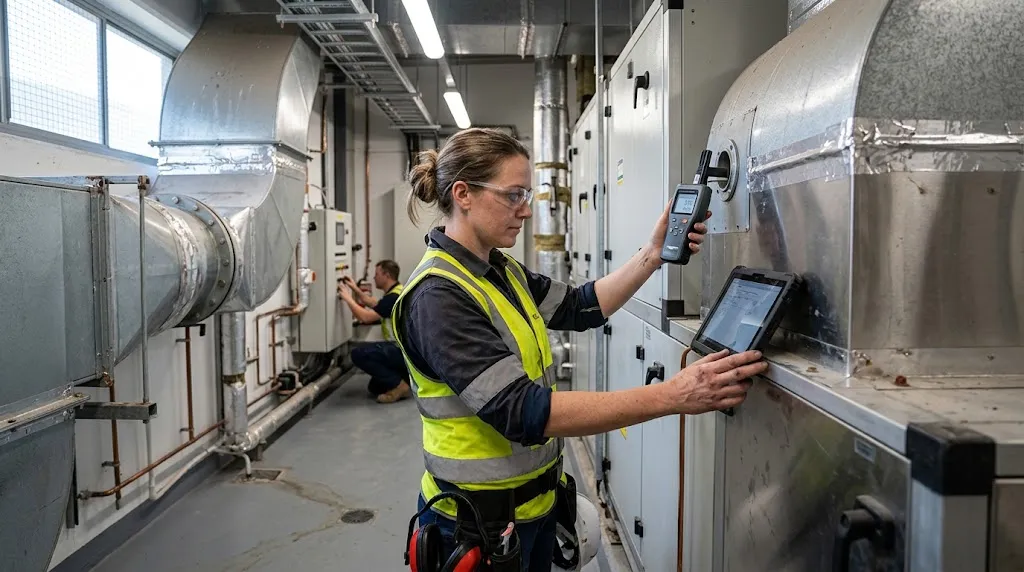
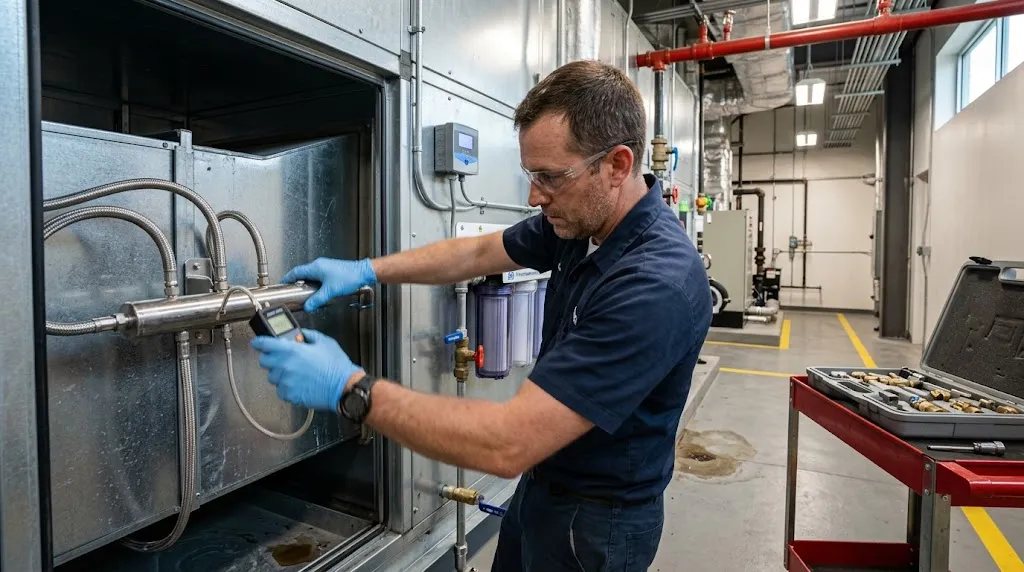
ASHRAE's documented maintenance guidance for steam humidifiers covers descaling of heating elements and distribution headers, electrode replacement in electrode-boiler configurations, inspection of steam traps, and periodic inspection of steam lines and discharge assemblies. Each of these tasks requires scheduled downtime and, in many configurations, a technician qualified to service pressurized steam equipment. The humidifier maintenance process for steam systems is more frequent than comparable adiabatic systems operating without a boiling mechanism. For facilities where humidity control must run continuously, scheduled steam maintenance represents planned production interruption.Adiabatic Humidification vs. Steam: A Direct Comparison
Adiabatic humidification uses compressed air and water to drive evaporation without a heating element. The moisture enters the air through phase change at ambient conditions, not through boiling. This operating principle produces a fundamentally different cost and maintenance profile than steam. For commercial humidification systems overview decision-makers comparing the two technology types, the differences are structural, not marginal. Humidification Mechanism- Steam: A heating element or electrode boils water to produce vapor, requiring continuous thermal energy input proportional to humidity output.
- Adiabatic: Compressed air and water are mixed to produce self-evaporating droplets, with phase change driven by air conditions rather than heat.
- Steam: Thermal energy cost scales directly with humidity load; continuous operation in a large facility accumulates a significant electricity or gas cost over a full operating year.
- Adiabatic: Energy cost is the compressed air supply, which is substantially lower than the sustained thermal load of a boiling mechanism.
- Steam: Blowdown cycles and scale management consume water above the actual humidity output delivered to the space.
- Adiabatic: Systems designed for 100 percent evaporation introduce no water losses beyond the moisture delivered to the air.
- Steam: Descaling, electrode replacement, steam trap inspection, and distribution header service are recurring requirements at intervals driven by water chemistry and operating hours.
- Adiabatic: No boiling mechanism means no scale accumulation in a heating element; well-designed adiabatic systems extend service intervals significantly beyond steam.
- Steam: Capable of precise relative humidity control, but precision management adds operational complexity around steam pressure regulation and discharge calibration.
- Adiabatic: Industrial-grade adiabatic systems are designed to maintain tight RH tolerances continuously, with humidistat-compatible operation and no pressure variable to manage.
- Steam: Poorly sized or calibrated steam discharge systems can produce condensation at outlet points, creating surface moisture in the distribution zone.
- Adiabatic: Systems using self-evaporating droplets are designed to prevent surface contact under proper system design; this eliminates the condensation risk at the discharge point.
Where Each Technology Fits
Steam is the appropriate technology when sterile vapor is a compliance requirement:- Pharmaceutical manufacturing governed by GMP protocols
- ISO Class 5 and above cleanrooms, where mineral or biological particulate from the humidity source is a disqualifying contamination risk
How Smart Fog Addresses the Steam Comparison
Adiabatic humidification that produces an equal-sized droplet grid eliminates the sustained thermal load that defines steam's energy profile. Each droplet is slightly charged to prevent re-aggregation, and the droplets self-evaporate before reaching any surface. There's no heating element, no boiling, and no steam pressure to manage. This is the operating principle behind Smart Fog's industrial systems, and it's the mechanism that drives the differences in energy cost, water efficiency, and maintenance demand identified in the comparison above. For further reading:- Adiabatic humidifiers covers system design and application scope
- Industrial humidifiers complete buyer's guide and commercial humidifiers types guide offer structured selection criteria for facilities building a full technology shortlist
Precision and Continuous Operation
Smart Fog systems maintain relative humidity up to 99% RH with plus or minus 1 to 2 percent precision. The system is designed for 24/7 continuous industrial operation and is compatible with humidistat-based controls, enabling set-and-forget operation without manual intervention between service cycles. For facilities where humidity must remain within a narrow band continuously, including data centers, pharmaceutical manufacturing floors, and printing facilities where substrate stability depends on consistent RH, the absence of a pressure variable or thermal overshoot condition matters operationally. Key performance specifications:- Maintains RH up to 99% with plus or minus 1 to 2 percent precision
- Designed for continuous 24/7 industrial operation without moving parts in the humidification process
- Humidistat-compatible for automated control without manual adjustment
- Non-wetting under proper system design; direct exposure to the fog stream will wet a surface
Maintenance Interval and Total Cost of Ownership
With no boiling mechanism, Smart Fog systems accumulate no heating element scale, require no electrode replacement cycle, and have no steam traps to inspect. Maintenance intervals extend up to every two years, compared to the more frequent scheduled service that ASHRAE-documented steam humidifier maintenance requires. The operational impact is fewer service calls, no requirement for a steam-qualified technician, and no planned production downtime tied to pressurized system maintenance. Key maintenance distinctions:- No moving parts in the humidification process
- Maintenance intervals designed to extend up to every two years
- No descaling, electrode replacement, or steam trap inspection cycle
- 100 percent of water introduced into the process evaporates, eliminating blowdown water losses