 Made in USA

- Fog humidification suppresses airborne particulate by raising relative humidity (RH) to levels where fine dust particles absorb moisture, increase in mass, and settle from the air column before becoming respirable hazards.
- Non-wetting fog systems can maintain RH between 60% and 85% for effective dust suppression without depositing liquid on conveyors, floors, or sorting equipment, under proper system design.
- Spray and misting-based dust suppression introduces surface moisture that accelerates corrosion on metal handling equipment, creates slip hazards on walking surfaces, and promotes microbial growth on organic waste material.
- Fog humidification systems sized for waste facilities must account for facility volume, air exchange rate, ambient temperature, and the specific dust generation intensity of the waste stream being processed.
- Systems with no moving parts in the humidification process and extended maintenance intervals reduce operational burden in environments where downtime tolerance is low and particulate conditions are harsh.
- Legionella risk in humidification systems is managed through continuous-flow operation, reverse osmosis (RO) water treatment, and line flushing protocols, not through sterilization claims.
Why Dust Control Is a Critical Engineering Problem in Waste Processing Facilities
Waste disposal facilities are among the most particulate-intensive industrial environments in operation. Each stage of operation contributes to an airborne particulate load that exceeds what passive ventilation can manage:- Mechanical shredding
- Sorting line agitation
- Compaction
- Material transfer drops
- Pneumatic conveyance
Types of Particulate Generated in Waste Disposal Operations
Particulate categories differ by waste stream, and particle size determines both respiratory risk and suppression difficulty.- Paper and fiber dust: Generated during shredding and sorting of municipal solid waste and recyclables. Fine paper fines are lightweight and remain suspended for extended periods.
- Organic fines: Produced in food waste streams during compaction and transfer. These particles carry biological load in addition to respiratory risk.
- Construction and demolition (C&D) dust: Generated during processing of mixed C&D debris. This stream includes silica-containing mineral dust, which carries elevated health risk at respirable particle sizes.
- Mixed fine particulate: Present in materials recovery facilities (MRFs) sorting general municipal solid waste, where stream composition is variable and particle size distribution is broad.
Regulatory and Safety Drivers for Dust Suppression
OSHA's PEL for total nuisance dust in general industry is 15 mg/m³, with a 5 mg/m³ limit for the respirable fraction, established under OSHA Table Z-1 air contaminant standards. For waste streams containing silica or other specific hazardous materials, stricter substance-specific standards apply. Beyond regulatory thresholds, the general duty clause of the OSHA requires employers to address recognized hazards that cause or are likely to cause serious harm, which positions dust-generating operations without active engineering controls as an identified compliance exposure.How Fog Humidification Suppresses Dust: The Physical Mechanism
The suppression mechanism operates through hygroscopic particle growth. As RH increases, fine airborne particles absorb water vapor, gain mass, and settle from the air column faster. This effect becomes operationally meaningful for most industrial dust types above approximately 60% RH. For effective suppression of fine respirable particulate in waste processing environments, facilities typically target 65% to 85% RH, depending on particulate type and facility air volume. A fog humidification system achieves this through two operating principles that separate it from spray-based suppression:- Airborne droplets: self-evaporating droplets remain airborne long enough to evaporate and raise ambient humidity before reaching any surface.
- Humidity added to air, not surfaces: the fog humidification system technology produces an equal-sized droplet grid that ensures consistent RH distribution across the treated space, rather than creating localized saturation near nozzle outlets.
Why Relative Humidity Level Matters for Effective Suppression
The suppression effect is not binary. Facilities operating at 30% RH will see negligible particle settling from humidity alone. Facilities at 65% to 75% RH will see meaningful agglomeration and settling for most fine industrial dust types. The engineering goal is controlled, precise RH in the target suppression range, not maximum saturation. Overshooting the target creates the surface wetting conditions the approach is designed to avoid. Relative humidity control within a narrow tolerance band is therefore a specification requirement, not a preference, according to temperature and humidity requirements for pharmaceutical facilities. A system that cycles between 55% and 90% RH will alternate between ineffective suppression and surface wetting, defeating the purpose of non-wetting fog humidification.The Difference Between Fog Humidification and Spray Suppression
High-pressure fogging systems and conventional spray systems both suppress dust, but they create very different outcomes:- High-pressure fog: produces self-evaporating droplets that add humidity to the air column without depositing liquid on surfaces, under proper system design.
- Spray and conventional misting: introduces larger droplets whose mass exceeds what the ambient air can absorb in the available travel distance, so surfaces and equipment get wet before the droplets evaporate.
Why Surface Wetting Creates Secondary Hazards in Waste Disposal Environments
Facilities that have used spray-based dust suppression systems recognize the secondary hazard pattern. Resolving airborne particulate by saturating the environment introduces a distinct set of operational and safety problems that must be managed separately.Equipment Corrosion and Mechanical Wear
- Conveyors and sorting equipment: Continuous moisture exposure accelerates oxidation on metal frames, rollers, and drive components. In waste facilities where conveyors run continuously, moisture-accelerated corrosion shortens component service life and increases unplanned maintenance frequency.
- Metal grating and structural elements: Elevated moisture in combination with organic waste contact creates conditions favorable to accelerated structural corrosion, particularly in facilities where the waste stream contains acidic organic material.
- Electrical and control systems: Moisture infiltration into motor housings, control enclosures, and sensor arrays introduces failure modes that are not present in dry operating environments.
Worker Safety and Floor Conditions
- Slip and fall risk: Wet concrete floors in areas with fork truck traffic and manual sorting operations create a documented slip hazard. In multi-level conveyance systems, wet grating and platforms increase fall risk in already physically demanding work environments.
- Microbial growth on organic waste: Organic waste held at elevated moisture in a warm facility creates conditions favorable to bacterial proliferation. This generates both a worker health concern and an odor management problem that extends beyond the immediate sorting area.
- Combustible dry waste streams: In facilities processing paper, textile, or other combustible dry material, uncontrolled surface wetting can complicate processing by altering material weight, conveyance behavior, and downstream handling requirements.
Sizing and Designing a Fog Humidification System for a Waste Processing Facility
A fog humidification system for a waste disposal facility is an engineered system, not an off-the-shelf product. System capacity must be matched to the specific facility before installation. The key design inputs are:- Facility volume in cubic feet or cubic meters
- Air exchange rate (air changes per hour) in the treated space
- Ambient temperature range across operational seasons
- Target RH range for effective dust suppression in the specific waste stream
- Dust generation intensity of the primary waste stream and processing operations
In-Duct vs. Direct-Space Deployment in Waste Facilities
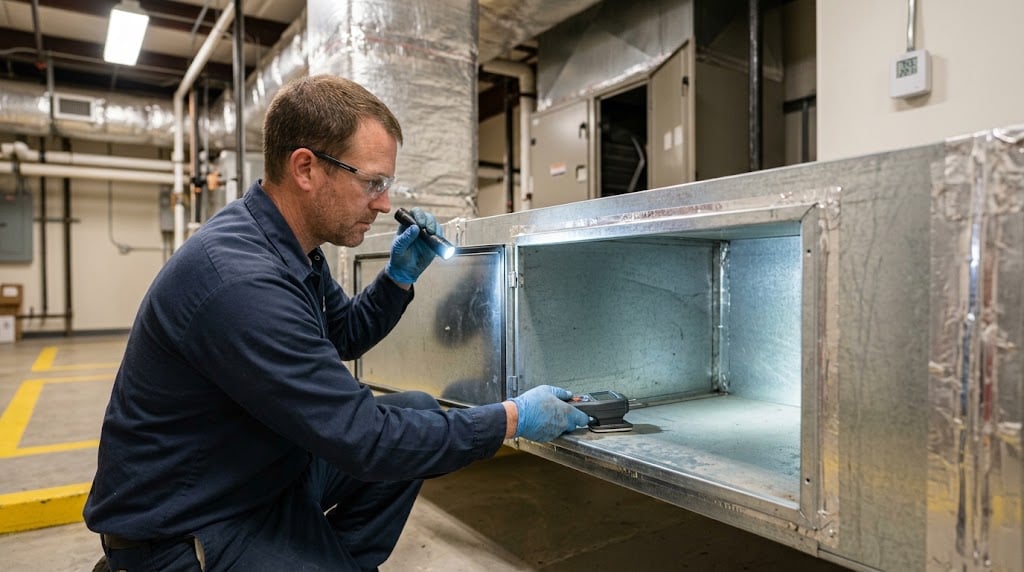
Two primary deployment configurations apply to waste processing facilities:- In-duct humidification via an HVAC system, such as the TS100 in-duct humidifier: appropriate for facilities with centralized air handling where the humidified airstream can be distributed uniformly through existing ductwork. Offers precise RH control across the treated zone and integrates with existing HVAC controls.
- Direct-space deployment using a unit such as the ES100 industrial humidifier: appropriate for large open facilities without centralized air handling, where fog is introduced directly into the facility volume. Offers greater installation flexibility but requires careful nozzle placement to achieve uniform coverage and avoid localized oversaturation.
Water Quality Requirements for Fog Humidification Systems
Feed water quality is a standard design variable in any industrial humidifier systems specification. High mineral content in the water supply leads to mineral deposits on nozzles and within distribution lines, reducing nozzle atomization performance over time and increasing maintenance frequency. A reverse osmosis water supply upstream of the humidification system removes dissolved minerals and reduces organic load, extending nozzle service life and protecting system performance. Water treatment and filtration are included as standard elements of engineered system design, not optional additions.Maintenance Requirements and Operational Reliability for Fog Systems in Waste Environments
Waste disposal environments run continuously under harsh particulate conditions with limited downtime tolerance, which makes maintenance burden a real specification criterion when evaluating commercial and industrial humidifiers. Systems with no moving parts in the humidification process and nozzles designed for extended service intervals carry a direct operational advantage here. This is because humidifier maintenance and service intervals for spray and misting systems show frequent nozzle cleaning and pump servicing is required due to mineral buildup and particulate contamination.Legionella Prevention in Industrial Fog Humidification Systems
Stagnant warm water in humidification system distribution lines is a documented Legionella growth condition. The risk isn't specific to fog systems; it applies to any water-bearing system where flow is intermittent and temperatures favor bacterial proliferation. The standard engineering controls, identified in CDC guidance on Legionella prevention in building water systems, are design-based:- Continuous-flow operation: prevents stagnation in distribution lines.
- RO-treated water supply: reduces the mineral and organic load available for bacterial growth.
- Regular line flushing protocols: removes accumulated material before it creates a growth condition.
Fog System Maintenance Schedule in High-Particulate Environments
Waste processing environments introduce elevated particulate loads into the facility air, which can affect nozzle atomization performance over time if nozzle design does not account for this condition. Nozzle design and maintenance schedule must be specified with the operating environment in mind. Systems designed for extended industrial operation, with proper water treatment upstream, can achieve maintenance intervals up to every two years. This contrasts with spray-based suppression systems that typically require more frequent servicing due to nozzle fouling and pump wear. For an overview of how fog systems and mist machines for industrial applications manage maintenance across demanding environments, facility engineers should evaluate system design alongside the claimed service interval.How Smart Fog Addresses the Specific Challenges of Waste Disposal Humidification
Adiabatic humidification that produces an equal-sized droplet grid, where each droplet carries a slight electrostatic charge, is the operating principle that makes non-wetting fog humidification viable in waste disposal environments. This is the mechanism behind Smart Fog's in-duct humidification systems and direct-space industrial configurations.Self-Evaporating Droplets and the Non-Wetting Mechanism
Smart Fog's proprietary nozzle mixes compressed air and water to produce an equal-sized droplet grid. The slight electrostatic charge on each droplet prevents re-aggregation, which would otherwise cause smaller droplets to combine into larger ones that fall out of suspension and wet surfaces. Because every droplet in the grid is sized to self-evaporate before reaching any surface, the system adds humidity to the air column without depositing liquid on conveyors, floors, sorting equipment, or structural elements, under proper system design. Key operating characteristics for waste disposal applications:- Self-evaporating droplets raise ambient RH to suppression-effective levels without surface deposition
- Equal-sized droplet grid provides consistent distribution across the treated facility volume
- Slight electrostatic charge on each droplet prevents re-aggregation during transit
- High-pressure fogging through a proprietary nozzle requires no moving parts in the humidification process
- Non-wetting applies under proper system design; direct exposure to the fog stream will wet surfaces in contact with it
Precision Humidity Control for Dust Suppression Targeting
Smart Fog systems maintain RH within plus or minus 1 to 2% of the target setpoint. In waste facilities, this precision is operationally significant: the operator needs to hold the suppression-effective RH range without overshooting into conditions that wet organic waste, promote microbial growth on wet material, or create condensation on cold metal surfaces during seasonal temperature swings. Key system specifications relevant to waste disposal applications:- RH control up to 99% RH with plus or minus 1 to 2% precision
- 100% water efficient: every droplet evaporates into the air with no liquid waste
- No moving parts in the humidification process, reducing failure points in particulate-heavy environments
- Maintenance intervals designed to extend up to every two years under proper system design and water treatment
- Complete engineered system, not a component kit, validated for the specific facility before installation
- Energy-efficient humidification through adiabatic process requiring no heating element
- Made in the USA; designed for 24/7 continuous industrial operation