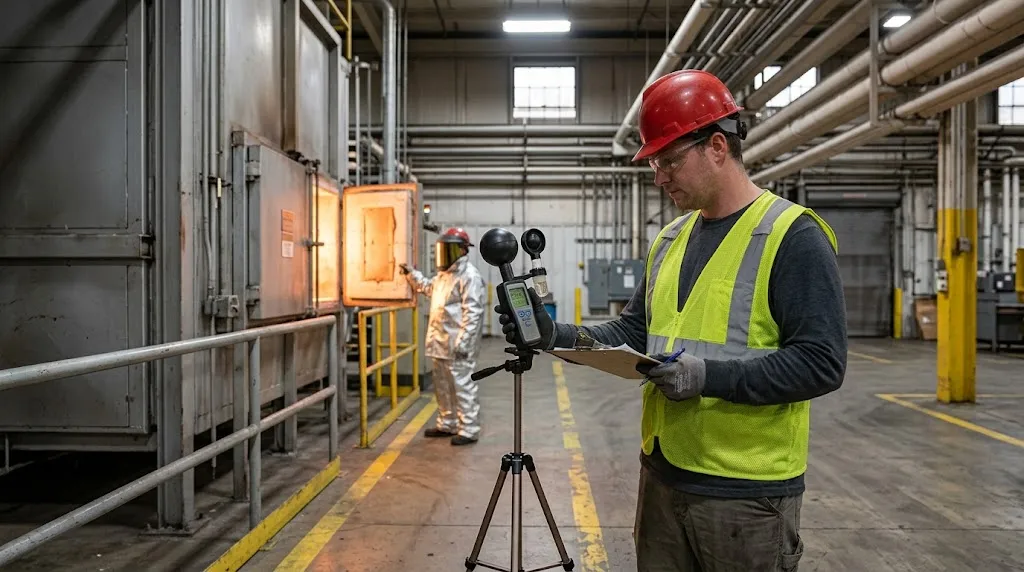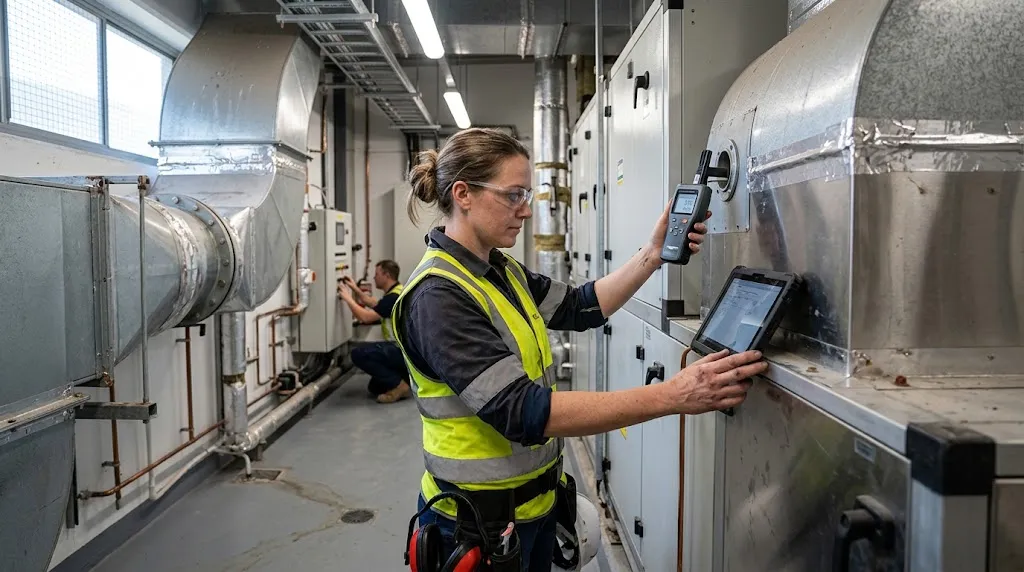


- Dew point temperature is the temperature at which air reaches full saturation and water vapor converts to liquid condensation; it is set by the actual moisture content of the air, not by relative humidity alone.
- Relative humidity (RH) changes whenever air temperature changes, even when no moisture is added or removed; dew point temperature stays fixed unless the moisture content of the air changes.
- Any surface in a facility cooled to or below the ambient dew point temperature will attract condensation, regardless of what the room-level RH reading shows.
- ASHRAE Standard 55-2020 identifies 16.8°C (62.2°F) as the upper dew point limit for acceptable indoor thermal comfort, and sustained surface condensation above this threshold is a recognized condition for mold colonization risk.
- Dew point and wet-bulb temperature are distinct measurements: dew point predicts condensation thresholds; wet-bulb temperature predicts evaporative cooling capacity and is the relevant parameter for heat stress assessment.
- Cold storage facilities are especially prone to condensation because warm, moist ambient air contacting cold surfaces instantly drops below dew point temperature, creating persistent surface wetness on pipes, walls, and refrigeration coils.
What Is Dew Point? A Plain-Language Definition
Air can hold water vapor, but its capacity to do so is limited by temperature. Warm air holds significantly more moisture than cool air. When air cools to the point where it can no longer contain the moisture already present, that excess water vapor condenses into liquid. The temperature at which this conversion happens is the dew point. A cold glass of water sweating on a warm summer day is the most familiar example of this principle. The glass surface has cooled the air immediately around it to below the ambient dew point temperature. The surrounding air cannot hold all its moisture at that reduced temperature, so condensation forms on the glass exterior. The glass did not generate water. It simply dropped below a threshold that was already set by the moisture content of the surrounding air. Understanding dew point vs. humidity requires recognizing what each measurement actually reports. Relative humidity tells operators how full the air is relative to its current capacity at a given temperature. Dew point tells operators how much moisture is actually in the air. These are related but not interchangeable, and the difference has real operational consequences.The Difference Between Dew Point and Relative Humidity
Relative humidity is a ratio, and ratios change when either the numerator or denominator changes:- Temperature drops, moisture unchanged: if a room at 70°F holds air at 50% RH and the temperature drops to 50°F with no moisture added or removed, RH climbs sharply. The air holds the same absolute quantity of water vapor, but its capacity at the lower temperature has shrunk.
- Dew point stays constant: dew point temperature doesn't move through that same drop, because the actual moisture content didn't change.
The Physics Behind the Saturation Curve
The saturation curve describes the maximum amount of water vapor air can hold at any given temperature. This relationship is nonlinear: as air temperature falls, the saturation point drops steeply, meaning relatively small temperature decreases can produce large increases in relative humidity without any change in actual moisture content. This is why surface cooling in a facility is not a minor variable, it's a direct trigger for condensation. A concrete example makes this tangible:- Air condition: 72°F and 50% RH, carrying a dew point of approximately 52°F.
- Surface condition: a chilled water pipe running through that space at 50°F surface temperature.
- Result: air immediately contacting the pipe has been cooled past its saturation point, so condensation forms on the pipe, even while the room RH reading still displays 50% at the sensor location, showing nothing unusual.
Why Cold Surfaces Are Condensation Targets
Any facility surface cooled below the ambient dew point temperature will collect condensation, regardless of the room's displayed RH reading. This applies to chilled water pipes, refrigeration lines, cold storage room walls, and HVAC supply ducts carrying cooled air through warmer ambient spaces. The risk is not elevated humidity levels in isolation. It is the temperature differential between a surface and the surrounding air. Atmospheric moisture does not need a "high humidity" environment to condense. It needs only a surface cold enough to push the local air past its saturation point. Fog formation in outdoor environments follows exactly the same physics: air cooling below its dew point temperature, typically near the ground at night, produces visible condensation suspended in the air column.A Worked Example: When Warehouse Walls Sweat
A warehouse in a humid summer climate receives outdoor air infiltration at 85°F and 70% RH. The dew point of that incoming air is approximately 72°F. The interior wall surface nearest the building envelope has been cooled to 68°F by air conditioning on the interior side. That wall surface is 4°F below the dew point of the infiltrating air. Condensation forms on the wall. Moisture content of the air has not changed. No humidification system is running. The warehouse is simply experiencing a temperature-dew point gap. This scenario repeats seasonally across warehouses, distribution centers, and manufacturing facilities in humid climates. The solution requires managing both the dew point spread between exterior infiltration air and interior surfaces, and the surface temperatures themselves. Treating this as a simple "humidity is too high" problem misses the mechanism.Dew Point in Facility Environments: Where Condensation Becomes a Problem
The saturation curve and dew point spread interact across several distinct facility scenarios, each with a different physical mechanism and a different damage pathway. The common thread is a surface temperature falling below the dew point of the surrounding air.- Cold storage and refrigerated warehouses: Warm ambient air meets cold room surfaces; dew point is frequently reached on walls, floors, ceilings, and refrigeration coils, causing persistent wetness, ice formation, and structural corrosion. Controlling the humidity and dew point of air entering cold storage zones is a core environmental management challenge. See our page on cold storage humidification for facility-specific guidance.
- Manufacturing and warehouse facilities: Seasonal temperature swings cause exterior walls to drop below the dew point of interior air, creating surface sweating that can damage stored materials, corrode metal shelving, and promote mold growth.
- Piping and mechanical systems: Chilled water pipes running through unconditioned spaces are a classic condensation target. Without insulation rated to keep the pipe surface above the ambient dew point temperature, water drips continuously onto surrounding infrastructure.
- HVAC supply ducts: Ducts carrying cooled air through warm ceiling plenums can sweat externally if the plenum air dew point exceeds the duct surface temperature.
Cold Storage Challenges
Cold storage facilities operate at temperatures that create steep dew point differentials between interior cold zones and adjacent corridors or receiving areas. When warm, moist ambient air enters a cold storage room, it immediately contacts surfaces at or below its dew point temperature, producing condensation and accelerated ice buildup on coils, walls, and floor surfaces. That creates three compounding consequences:- Compromised product integrity
- Increased slip hazards
- Elevated refrigeration system load from ice accumulation on evaporator coils
Pipe Condensation and Structural Risk
Pipes carrying cold water or refrigerant through ambient-temperature spaces will condense moisture on their outer surfaces whenever the pipe surface temperature drops below the dew point of the surrounding air. Over time, this produces dripping, corrosion on pipe supports, ceiling tile damage, and mold growth in wet insulation and ceiling materials beneath the pipe run. Pipe insulation is rated based on keeping the outer insulation surface above the ambient dew point at expected operating conditions. Changes in ambient humidity levels or air temperature can render previously adequate insulation insufficient, particularly in facilities that experience significant seasonal variation or process changes that alter interior moisture content.Dew Point, Mold Risk, and Indoor Air Quality Thresholds
Mold does not grow in mid-air. It colonizes surfaces. The enabling condition is sustained surface moisture, which occurs when surface temperatures remain at or below dew point long enough for liquid water to accumulate and persist. ASHRAE Standard 55-2020 upper dew point limit for thermal comfort establishes 16.8°C (62.2°F) as the upper boundary of its acceptable indoor humidity comfort zone. EPA guidance on indoor mold and moisture identifies sustained surface condensation as a primary condition enabling mold establishment. A facility can display a moderate relative humidity reading at sensor height and still have surfaces in cooler zones, wall cavities, or near HVAC components that regularly reach or drop below dew point. Those surfaces are mold risk locations even when the room-level humidity reading appears acceptable. Monitoring room-level RH alone is insufficient for facilities with cold surfaces, mixed-temperature zones, or significant seasonal air infiltration. Accurate mold risk assessment requires tracking surface temperatures against ambient dew point temperature, not simply observing a single-location RH display.Why Room Humidity Readings Can Mislead
A thermometer-hygrometer displaying 50% RH reports the moisture status of the air at that sensor's exact location and temperature. It does not report whether surfaces in the same room are above or below dew point. A cold pipe at 45°F running through a room where air temperature is 65°F and RH is 55% has a local dew point of approximately 47°F. That pipe is condensing moisture continuously. The room-level hygrometer shows nothing alarming. Building and facility professionals should evaluate condensation risk in terms of surface temperature versus ambient dew point temperature, not room RH alone. Sensors placed at a single location cannot capture the dew point conditions that exist near cold surfaces, inside wall assemblies, or at supply air diffusers. See our breakdown of humidity sensors for guidance on sensor placement in mixed-temperature environments.Dew Point vs. Wet-Bulb Temperature: Clearing Up the Confusion
Dew point temperature and wet-bulb temperature are frequently conflated in weather data, building system readouts, and facility management discussions. They measure fundamentally different things. Dew point temperature reflects the actual moisture content of the air. It is the temperature to which air must be cooled for condensation to begin. Wet-bulb temperature reflects the cooling effect that evaporation produces when a wet surface is exposed to that air. Wet-bulb temperature depends on both actual moisture content and the air's remaining capacity to accept additional moisture through evaporation. When air is saturated, wet-bulb and dew point temperatures converge. When air is dry, they diverge significantly. The OSHA Technical Manual heat stress guidelines reference wet-bulb temperature in heat stress calculations because it captures the combined effect of heat and humidity on the body's ability to cool through perspiration. Dew point appears in building science and facility moisture management because it predicts surface condensation thresholds. Wet-bulb temperature appears in heat stress assessments and evaporative cooling capacity calculations. Both are useful in facility management. They answer different questions. Use dew point when evaluating condensation risk on cold surfaces. Use wet-bulb temperature when evaluating worker heat exposure or evaporative cooling system performance.Which Measurement Matters for Your Facility
For condensation risk on cold surfaces and pipes, facility engineers should track dew point temperature against measured surface temperatures. For evaluating worker heat exposure in warm production environments, wet-bulb temperature is the relevant parameter per OSHA guidance. For HVAC systems commissioning and psychrometric calculations, both measurements appear on a psychrometric chart and serve distinct analytical roles. Absolute humidity describes the total mass of water vapor in a given air volume and provides a third useful reference when comparing air conditions across different temperatures.How Dew Point Is Measured in Facility Environments
Dew point is measured directly using instruments that chill a surface until condensation forms, a method known as chilled-mirror hygrometry and considered the reference standard for accuracy. More commonly in facility environments, dew point is calculated from relative humidity and air temperature readings using the Magnus formula approximation, which most building automation systems perform automatically. The practical limitation is sensor placement. Sensors located at a single room position do not capture dew point conditions near cold surfaces, inside wall cavities, or at supply air diffusers where temperature differentials are greatest. Understanding what is a hygrometer and how it derives dew point from RH and temperature readings is useful context for evaluating the reliability of existing monitoring data. The main instrument approaches used in facility environments are:- Chilled-mirror hygrometers: Direct measurement of the condensation point; highest accuracy; used for critical monitoring in pharmaceutical, cold storage, and calibration applications.
- Capacitive RH sensors with temperature compensation: Most common in building management systems; dew point is calculated rather than directly measured; accuracy is adequate for general commercial and light industrial use.
- Psychrometric calculations from dry-bulb and wet-bulb temperature pairs: Used in HVAC commissioning; requires accurate wet-bulb measurement and appropriate calculation method.
Dew Point Sensors vs. RH Sensors in Practice
Sensor choice depends on how much condensation risk the environment carries:- Commercial and light industrial facilities: capacitive RH sensors with temperature inputs provide sufficient data for general humidity management.
- Condensation-sensitive environments (cold storage rooms, cleanrooms, pharmaceutical manufacturing suites, data centers): direct dew point transmitters or chilled-mirror instruments provide more reliable data, since they measure the condensation threshold directly rather than deriving it from a secondary calculation.
How Smart Fog Humidification Avoids Dew Point Problems That Other Systems Create
Humidification systems that release moisture unevenly or in concentrated bursts can drive the local dew point temperature of the air upward at the point of release, increasing condensation risk on nearby cold equipment, structural elements, or HVAC components. The mechanism that prevents this is uniform moisture distribution throughout the air volume, with no localized saturation zones. Smart Fog systems use compressed air and water through a proprietary nozzle to produce an equal-sized droplet grid. Each droplet carries a slight charge that prevents re-aggregation. The droplets self-evaporate before reaching any surface, absorbing directly into the air volume rather than depositing moisture on walls, racks, ducts, or equipment under proper system design. This is the operating principle behind the Smart Fog technology overview. Note: non-wetting performance applies to surfaces under proper system design. Direct exposure to the fog stream will result in wetting. For facilities managing condensation risk alongside humidity requirements, the relevant capability is in humidity control systems that add moisture to the air uniformly without creating the localized high-moisture zones that compound dew point problems on cold surfaces.Precision Humidity Control and Dew Point Management
The relationship between RH and dew point temperature is direct: higher RH at a given air temperature means a higher dew point, which means more surfaces in the facility become potential condensation targets. A humidification system that overshoots its RH set point raises the ambient dew point temperature of the air and expands the number of surfaces at risk. Smart Fog systems maintain humidity at a set point with plus or minus 1 to 2 percent RH precision. This means the system does not overshoot toward higher humidity levels and does not inadvertently raise the dew point temperature of the facility air in a way that puts cooler surfaces at increased condensation risk. In warehouse sweating scenarios and cold storage environments described earlier in this article, that precision directly limits the dew point spread between ambient air and cold surfaces.Non-Wetting Operation and Facility Surface Safety
Self-evaporating droplets that absorb into the air before reaching surfaces add moisture to the air volume without wetting walls, equipment, racks, ducts, or products under proper system design. In facilities where surface condensation is already a managed risk, introducing a humidification system that wets surfaces would compound the problem by adding liquid to surfaces that are already at or near dew point thresholds. Key performance characteristics relevant to dew point management:- Set point precision: Plus or minus 1 to 2 percent RH, preventing overshoot that would raise ambient dew point temperature.
- Surface contact: Self-evaporating droplet grid reaches no surfaces under proper system design, avoiding added surface moisture in condensation-sensitive zones.
- Moisture distribution: Uniform dispersion into the air volume prevents localized saturation zones near release points.
- Maintenance interval: No moving parts in the humidification process; maintenance intervals extend up to every two years.