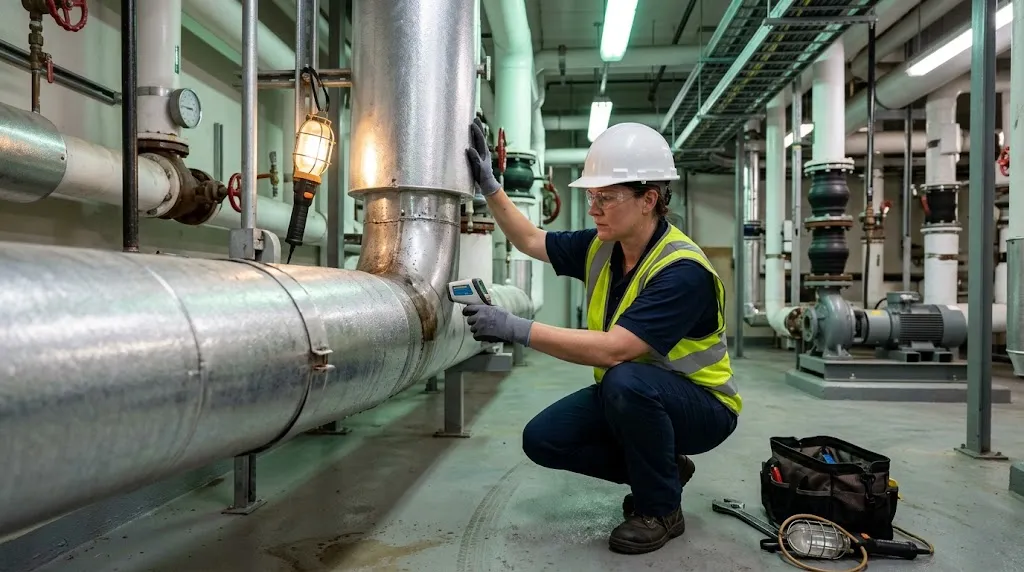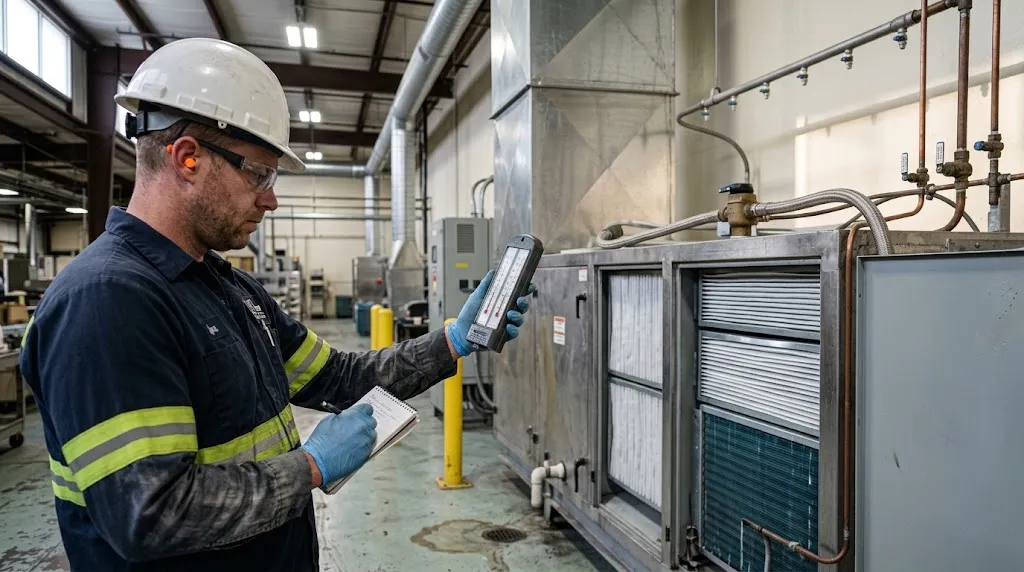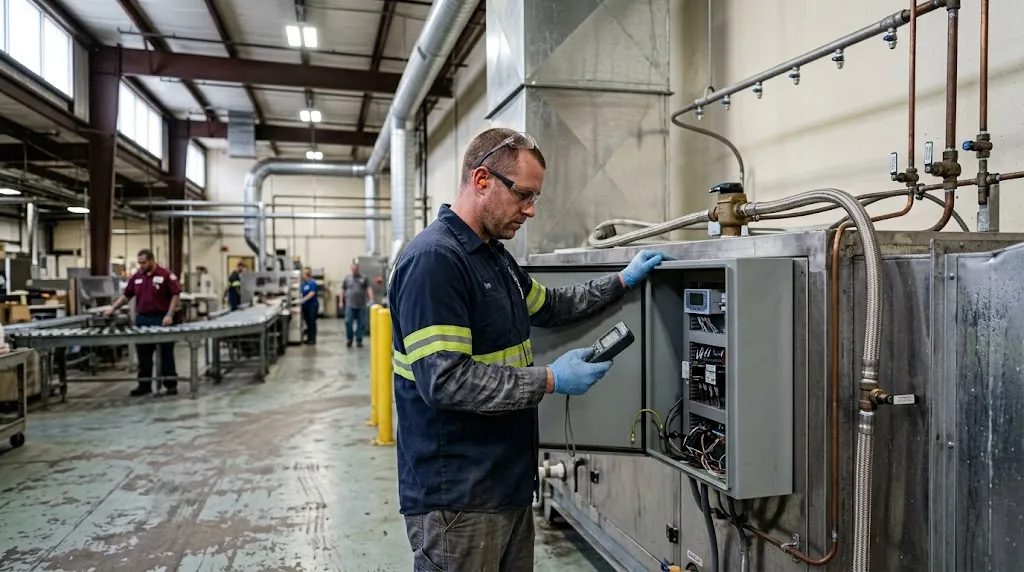


- HVAC humidifiers integrate with heating and cooling system infrastructure to maintain relative humidity levels, with ASHRAE guidelines recommending 30 to 50% RH for occupied commercial and residential spaces.
- Bypass and fan-powered furnace humidifiers are the most common whole-house humidifier options for residential and light commercial HVAC, but both require water panel replacement at least once per heating season.
- Steam humidifiers offer tighter RH control than evaporative types but draw significantly more electrical power and require regular descaling of the heating canister.
- In-duct adiabatic fog systems inject self-evaporating droplets directly into the airstream, requiring no drain connection and no droplet filter, with maintenance intervals extending up to every two years.
- Smart Fog in-duct systems maintain RH from 1% to 99% with plus or minus 1 to 2% precision, a performance range that conventional whole-house humidifier types cannot approach.
- Maintaining indoor humidity above 40% RH produces measurable static electricity reduction, a factor relevant in electronics manufacturing, printing facilities, and data centers where electrostatic discharge (ESD) causes equipment damage or production defects.
What Is an HVAC Humidification System?
An HVAC humidification system adds controlled moisture to the air supply managed by a building's heating, ventilation, and air conditioning (HVAC) infrastructure. Relative humidity is treated as a critical environmental variable because it affects thermal comfort, indoor air quality, material stability, and the reliability of sensitive equipment. ASHRAE guidelines recommend maintaining the optimal humidity range of 30 to 50% RH in occupied commercial and residential spaces, while many industrial environments require considerably tighter control. Humidification can be introduced at two primary integration points:- Centralized: at the air handler or supply plenum
- Distributed: at zone level
Why HVAC Systems Need Humidity Control
When outdoor air is drawn into an HVAC system and heated, its relative humidity drops sharply. This produces the familiar dry air symptoms: static charge buildup, cracked materials, paper curl, airway irritation, and equipment degradation from electrostatic discharge. The 30 to 50% RH range establishes the floor for occupied building comfort, while pharmaceutical cleanrooms, electronics manufacturing lines, and printing facilities often require tolerances far tighter than this range.How Humidification Integrates with Existing HVAC Infrastructure
In-duct HVAC humidifiers mount at the air handler or supply plenum and introduce moisture into the moving airstream before it reaches the occupied space. Direct-space or zone-level systems introduce moisture at specific locations without modifying the central duct. The method of moisture introduction matters for ductwork integration because conventional spray and evaporative systems can produce condensation on duct surfaces if the moisture does not fully absorb before contacting metal, insulation, or downstream equipment.Types of HVAC Humidifiers: How Each System Works
System type determines humidity precision, maintenance frequency, infrastructure requirements, and the risk of condensation or surface wetting in the duct. The five categories below cover the full range of options available for residential, commercial, and industrial HVAC humidification.Bypass Humidifiers (Furnace Humidifier)
A bypass humidifier diverts a portion of heated air from the supply plenum through a water-saturated evaporator pad, then returns the humidified air to the main duct. Output depends on furnace operation because no independent airflow exists in the bypass design: when the heating system is not running, the humidifier does not produce moisture. This type is among the most widely installed whole-house humidifier configurations for residential and light commercial HVAC:- Humidistat settings govern output, but RH precision across large spaces is limited by airflow patterns and pad saturation consistency
- Water panel replacement is required at least once per heating season
- A drain connection is needed to remove the continuous bleed-off water
Fan-Powered Humidifiers
Fan-powered humidifiers use an integrated fan to draw air through the evaporator pad independently of furnace airflow. This allows humidity output even when the heating system is not actively running, giving fan-powered units a higher effective output capacity than bypass types across a given season. Maintenance requirements mirror those of bypass units:- Water panel replacement at least annually
- Drain and water supply connections required
Steam Humidifiers
A steam humidifier heats water using electric elements to produce water vapor, which is injected directly into the airstream. Because steam is fully vaporized before entering the duct, this design offers tighter humidity control than evaporative types and does not depend on duct air temperature or velocity for moisture absorption. The trade-off is electrical consumption:- Steam humidifiers draw significantly more power than evaporative or adiabatic alternatives because heating water to vaporization requires continuous electrical input
- Descaling of the heating canister is required at intervals that depend on local water hardness, making maintenance costs higher in areas with hard water
Evaporative Humidifiers
Evaporative humidifiers, whether standalone or duct-integrated, pass air across a wet wick, pad, or media to introduce moisture through natural evaporation.- Output varies with air temperature and flow rate, making RH precision lower than steam injection
- Filter or wick replacement is required as a routine maintenance task
- Output declines as the media becomes saturated with mineral deposits from the water supply
In-Duct Adiabatic Fog Humidification
Compressed air and water are combined through a nozzle to produce an equal-sized droplet grid. The droplets are slightly charged to prevent re-aggregation, and they self-evaporate before contacting duct surfaces. This design has a couple of direct consequences:- Eliminates condensation risk and removes the need for a drain connection or a droplet filter in the duct, distinguishing adiabatic fog from conventional in-duct misting systems, which produce larger droplets requiring both drain infrastructure and filtration to prevent surface wetting
- Allows this category to operate at humidity levels and precisions that evaporative and bypass types cannot reach, making it the appropriate choice for applications where surface wetting, imprecise RH, or high maintenance frequency are unacceptable
How to Choose an HVAC Humidifier for Your Application
System selection should begin with the humidity target because that single factor eliminates most options immediately. Facilities that need to maintain a general 30 to 50% RH range with reasonable stability can typically use bypass or fan-powered systems. Facilities that require tighter tolerances, or that operate 24 hours a day without seasonal shutdown, need systems designed for continuous precision output. The five decision dimensions below give facilities managers and HVAC engineers a structured framework for evaluating options against their actual operational constraints. Humidity precision required:- Bypass and fan-powered: Suitable for 30 to 50% RH targets in residential and light commercial spaces, as outlined in ASHRAE guidance on humidifier performance; stability across large areas is limited by airflow distribution.
- Steam: Better RH control than evaporative types; appropriate where moderate-precision targets above the standard comfort range are required.
- Adiabatic fog: Maintains RH from 1% to 99% with plus or minus 1 to 2% precision; appropriate for pharmaceutical, cleanroom, data center, and printing environments.
- Bypass and fan-powered: Require an active furnace humidifier installation on existing ductwork; best matched to residential and small commercial HVAC footprints.
- Steam: Requires dedicated electrical supply and a drain; suitable for medium commercial HVAC where electrical capacity is available.
- Adiabatic fog: Installs into existing ductwork; requires compressed air and water supply; no drain; scales from single-zone to facility-wide humidity control systems.
- Bypass and fan-powered: Water panel replacement at least annually; drain inspection each season.
- Steam: Canister descaling frequency tied to water hardness; higher labor and parts cost in hard-water regions.
- Adiabatic fog: Filter element changes for compressed air and water supply; service intervals extend up to every two years.
- Bypass and fan-powered: Humidifier installation is straightforward for licensed HVAC technicians; drain and water supply lines required.
- Steam: Dedicated electrical circuit required; higher installation complexity.
- Adiabatic fog: No certified technician required for installation; no drain required; ductwork modification is typically limited to the nozzle mounting point.
- Standard HVAC applications: ASHRAE comfort guidelines apply; humidistat settings are the primary control mechanism.
- Pharmaceutical: Current Good Manufacturing Practice (cGMP) requirements govern humidity control in production environments.
- Electronics and ESD-sensitive manufacturing: ANSI/ESD S20.20 standard for ESD control programs specifies RH management as a component of ESD mitigation.
Residential and Light Commercial Applications
Bypass, fan-powered, and standard whole-house humidifier configurations are appropriate for occupied spaces where the 30 to 50% RH target applies, HVAC infrastructure is already in place, and seasonal maintenance is operationally acceptable. Humidistat settings calibrated to the occupied zone provide adequate control for these environments, and humidifier installation cost remains relatively low compared to steam or adiabatic alternatives.Industrial and Commercial Precision Applications
Conventional whole-house humidifier types fall short where RH tolerances are tight, operation is continuous, or surface wetting is unacceptable. Pharmaceutical manufacturing, data centers, cleanrooms, printing facilities, and cold storage environments all require performance that evaporative and bypass designs cannot reliably deliver. In-duct fog and direct-space fog systems are the appropriate category for these conditions. Facilities evaluating options for these environments should review the commercial humidifiers types guide and the industrial humidifiers buyer's guide for more detailed selection criteria.Installation and Maintenance: What to Expect by System Type
In-duct HVAC humidifiers require connection to the air handler or supply plenum, a water supply line, and in most cases a drain. Installation complexity varies considerably by type, and total cost of ownership changes significantly when maintenance burden is factored alongside upfront humidifier installation cost. For Smart Fog in-duct systems specifically, no drain connection is required and no certified technician is needed for installation. The compressed air and water supply lines are the primary infrastructure requirements, and the nozzle assembly mounts directly into existing ductwork. Maintenance expectations by system type:- Bypass and fan-powered: Water panel replacement at least once per heating season; drain line inspection each season; water supply valve check annually.
- Steam humidifier: Heating canister descaling required at intervals depending on local water hardness; more frequent service in hard-water regions; electrical element inspection recommended annually.
- Evaporative humidifier: Wick or pad replacement required; frequency depends on mineral content of water supply and hours of operation.
- Smart Fog in-duct adiabatic fog: Filter element changes for compressed air and water inputs; maintenance intervals extend up to every two years; no drain servicing required.
What Affects HVAC Humidifier Installation Cost
Installation cost varies with system type, ductwork access, water line distance, drain availability, and whether dedicated electrical work is required.- Steam humidifiers: carry the highest installation complexity because of the electrical circuit requirement
- Bypass and fan-powered units: among the more straightforward installations in residential HVAC
- Adiabatic fog systems: require compressed air infrastructure, which may already exist in commercial and industrial facilities but represents an addition in residential contexts
Maintenance Intervals and What They Require
The contrast between conventional HVAC humidifier maintenance and Smart Fog's service interval is specific and material:- Bypass and fan-powered units: water panel replacement at a minimum once per heating season, meaning most facilities perform this service annually
- Steam humidifiers: canister descaling at variable intervals, with water hardness being the primary driver of service frequency
- Smart Fog in-duct systems: only filter element changes for compressed air and water, with intervals extending to every two years, and no drain servicing required at any interval
How HVAC Humidification Affects Energy Consumption
Properly humidified air at 40 to 50% RH feels warmer at a given temperature than dry air at the same temperature. This is a physical property of humid air: occupants and HVAC controls may not need to drive the heating system as hard to reach a target comfort level when RH is maintained in the appropriate range. The benefit is a function of physics, not proprietary technology. Steam humidifiers consume significant electrical energy to heat water to vaporization. Evaporative and adiabatic systems add moisture through phase change without the same electrical load, which means their contribution to a facility's energy bill is lower for the humidification function itself. For Smart Fog systems specifically, the humidification process adds minimal electrical load because moisture delivery relies on compressed air and the self-evaporation of water rather than electric heating elements.Adiabatic Humidification and Cooling Effect
Adiabatic humidification absorbs heat from the surrounding air as water evaporates, producing a slight cooling effect as a byproduct of the evaporation process. This is distinct from the thermal comfort benefit of humidity and is relevant for facilities evaluating humidification in combination with evaporative cooling strategies. It’s especially relevant in warm-climate facilities where the cooling load overlaps with a humidity control requirement.How Smart Fog In-Duct Humidification Systems Work with HVAC Infrastructure
Adiabatic humidification that produces an equal-sized droplet grid eliminates the surface-wetting risk that defines both conventional evaporative and steam technologies. This is the operating principle behind Smart Fog adiabatic humidifiers. Compressed air and water are combined through a proprietary nozzle, producing droplets that are slightly charged to prevent re-aggregation. The droplets self-evaporate before contacting duct surfaces, racks, or downstream equipment under proper system design. This removes the need for a drain connection and a droplet filter. Non-wetting applies to surfaces under proper system design. Direct exposure to the fog stream, such as placing a hand directly in the nozzle path, will wet the hand. Within a correctly configured duct installation, however, surfaces remain dry throughout the humidification process. Performance characteristics that differentiate this category from conventional HVAC humidifier types:- Humidity control range from 1% to 99% RH
- Plus or minus 1 to 2% precision with minimal fluctuation
- 100% water efficiency: every droplet evaporates into the air
- No moving parts in the humidification process
- Designed for 24/7 set-and-forget industrial operation without seasonal shutdown
- Maintenance intervals extending up to every two years
TS100 In-Duct Configuration
The TS100 in-duct humidifier mounts directly into existing ductwork. No drain is required. No certified technician is required for installation. Constant nozzle cleaning is not a maintenance requirement. Smart Fog designs and delivers the full engineered system, not a component kit, so facilities receive a configured solution rather than parts that require on-site engineering to function.Precision and Operational Range
The TS100's performance specifications address the specific gaps that conventional HVAC humidifier types leave open:- RH control across the full 1 to 99% range with plus or minus 1 to 2% precision
- 100% water efficiency
- Continuous industrial operation without the seasonal shutdown and restart cycle that bypass and fan-powered systems require
- Pharmaceutical manufacturing operating under cGMP humidity controls
- Data centers, where humidity fluctuation risks ESD events and corrosion
- Printing facilities, where substrate moisture content must stay within a narrow band
- Cold storage environments, where surface wetting from a conventional humidifier would damage product or infrastructure