 Made in USA

- A dew point temperature above 60°F (15°C) is generally considered high; above 65°F (18°C), condensation risk and mold conditions become operationally significant.
- Dew point measures the actual amount of water vapor in the air and remains constant as temperature changes, making it a more stable moisture metric than relative humidity.
- ASHRAE Standard 55 sets an indoor dew point ceiling of 62°F (16.7°C) for occupied spaces, aligning with the lower uncomfortable tier of the National Weather Service dew point scale.
- In facility environments, dew point temperature exceeding the surface temperature of any object causes condensation on that surface, creating corrosion, mold, and equipment reliability risks.
- Industries including electronics manufacturing, pharmaceutical production, food processing, and data center operations carry the highest operational exposure to high dew point conditions.
- Smart Fog industrial humidification systems maintain RH at a precise setpoint with plus or minus 1 to 2% precision, preventing the humidity overshoot that can create localised condensation in sensitive environments.
What Is Dew Point Temperature?
Dew point temperature is the temperature at which air, cooled at constant pressure, reaches saturation and water vapor begins to condense into liquid. A common illustration is a cold glass on a humid summer day: the glass cools the surrounding air below its condensation point, and moisture appears on the outer surface. That film of water did not come from inside the glass. It came from atmospheric moisture already present in the room air. Dew point is a direct measure of how much water vapor is actually in the air, not a measure of how "full" the air is relative to its maximum capacity at a given temperature. That distinction matters for facility assessment. The higher the dew point, the more moisture is already present in the air, and the smaller the temperature drop required before condensation forms on any cooler surface.Dew Point vs. Relative Humidity
Relative humidity and dew point behave very differently as temperature shifts through the day:- What each measures: RH expresses water vapor content as a percentage of what the air could hold at its current temperature; dew point measures the actual moisture content directly, expressed as a temperature.
- Why they diverge: the same absolute moisture level produces a different RH reading at dawn than at midday, because air's capacity to hold water vapor increases with temperature. Dew point stays constant through those same swings.
- Concrete example: a facility with a 60°F dew point at 7 a.m. still has a 60°F dew point at 2 p.m., even though the RH reading will have dropped significantly as the air warmed.
What Is Considered a High Dew Point?
Meteorologists and the National Weather Service dew point comfort scale use a tiered dew point scale to characterise moisture conditions. That same scale translates directly into building science and heating, ventilation, and air conditioning (HVAC) design, because the physical thresholds that define human discomfort outdoors also define condensation and mold risk indoors.- Below 55°F (13°C): Comfortable and dry. Atmospheric moisture is low, and condensation risk on typical building surfaces is minimal.
- 55 to 60°F (13 to 15°C): Noticeable but acceptable. Moisture in the air is perceptible; no significant condensation or mold risk under normal conditions.
- 60 to 65°F (15 to 18°C): Somewhat uncomfortable. Elevated moisture in the air begins to affect perceived temperature. ASHRAE Standard 55 sets its indoor dew point ceiling at 62°F (16.7°C), placing the upper end of this range above the recommended threshold for occupied spaces.
- 65 to 70°F (18 to 21°C): Very humid and uncomfortable. The NWS classifies this range as producing uncomfortable humidity levels. Condensation risk on cold surfaces increases significantly.
- Above 70°F (21°C): Oppressive. The NWS describes conditions above 75°F as "extremely uncomfortable." Condensation, mold proliferation, and equipment damage risk are all elevated.
How Dew Point Relates to Heat Index and Feels-Like Temperature
Heat index calculations account for both dry bulb temperature and dew point temperature because high dew point slows sweat evaporation from the skin. When the air already contains a high concentration of water vapor, moisture cannot leave the skin surface efficiently. At a dew point above 65°F, this effect becomes significant, which is why a 90°F day with a 70°F dew point produces a far more oppressive feels-like temperature than a 90°F day with a 50°F dew point. Both OSHA and NIOSH heat stress guidance recognise heat index as a key metric in occupational heat stress standards, making high dew point a direct concern for outdoor exercise safety and worker health in warm months.What Causes High Dew Point Conditions?
High dew point originates from three main sources. Geographic proximity to large water bodies is the most significant: Gulf of Mexico air masses drive the most severe dew point conditions in the United States, regularly pushing readings above 70°F during summer months in the southeastern and midwestern states. Tropical air mass intrusions driven by large-scale weather patterns carry saturated air deep into interior regions. Local sources, including cooling towers, open process water, floor drains, and wet production environments, add water vapor to indoor air independently of outdoor conditions. In industrial facilities, internal moisture generation compounds outdoor conditions. HVAC systems that introduce outside air during summer can import high-dew-point air directly into the facility envelope. Production processes that generate steam or moisture, inadequate vapor barriers, and poor air sealing all contribute to elevated indoor dew point even when outdoor conditions are moderate. Indoor high dew point is a controllable variable, which makes understanding its sources the first step toward managing its consequences.Seasonal and Regional Variation in Dew Point
Dew point conditions are most severe during summer in the southeastern and midwestern United States, where readings above 70°F are common. Summer weather discomfort peaks in these regions because ambient air already carries near-maximum moisture loads before it enters a building through any HVAC outside-air intake. Facilities in these regions face the highest risk of moisture infiltration and should treat seasonal dew point monitoring as a standard operational practice.What High Dew Point Does to Buildings and Industrial Facilities
When indoor dew point temperature exceeds the surface temperature of any object in a facility, condensation forms on that surface. The consequences are not cosmetic. Persistent surface moisture drives corrosion, microbial growth, material degradation, and equipment failure in ways that compound over time and are difficult to reverse once established. Facility failure modes associated with high dew point include the following:- Surface condensation on cold pipes, equipment panels, and HVAC ductwork: Water accumulates on any surface below the ambient dew point, creating corrosion pathways and potential water damage to electrical components and structural elements.
- Mold and microbial growth on porous surfaces: Once sustained dew point exceeds 60°F and surface moisture is present, gypsum board, insulation, cardboard packaging, and other porous materials provide conditions for mold proliferation. The EPA guidance on mold and moisture in buildings links surface moisture to mold growth risk in occupied buildings.
- Accelerated oxidation and corrosion on exposed metal components: Moisture accelerates electrochemical corrosion, particularly relevant in electronics manufacturing, defense storage, and precision instrument environments where metal degradation affects function, not just appearance.
- Moisture absorption by hygroscopic materials: Paper, pharmaceuticals in powder or tablet form, and food products with moisture-sensitive packaging all absorb water vapor at elevated dew points, affecting product integrity, weight, and shelf life.
- Reduced effectiveness of electrostatic discharge (ESD) protective measures: Humidity that is mismanaged in either direction disrupts ESD control, but high dew point introduces the additional risk of condensation on sensitive assemblies.
High Dew Point in Sensitive Industrial Environments
Specific industries carry the highest operational risk from elevated dew point conditions:- Electronics and semiconductor manufacturing: Condensation on printed circuit boards and solder joints causes short circuits and corrosion. Most facilities target 40 to 60% RH to balance ESD risk and condensation risk. See our page on electronics manufacturing humidification for application-specific detail.
- Pharmaceutical manufacturing: Hygroscopic active pharmaceutical ingredients and excipients absorb moisture rapidly above threshold dew points. Good manufacturing practice (GMP) regulations require documented humidity control with defined limits. See our page on pharmaceutical manufacturing humidification for further context.
- Food processing and cold storage: Condensation on cold surfaces creates microbial risk consistent with FDA food safety moisture management expectations. Check out our page on cold storage humidification for cold storage applications.
- Data centers: Server hardware is vulnerable to condensation when cold airflow contacts high-dew-point supply air. Our data center humidification page provides data center-specific guidance.
How Facility Humidity Is Measured and Monitored
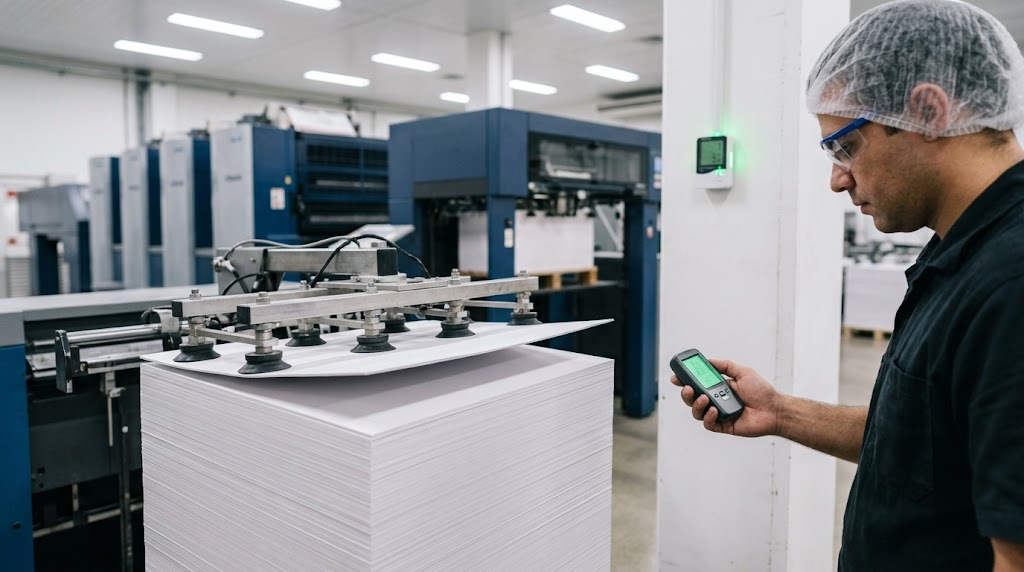
Dew point in a facility is measured with a hygrometer or dew point transmitter. Modern building automation systems log dew point alongside dry bulb temperature and relative humidity continuously. Handheld instruments serve spot-checking needs during audits or troubleshooting, while fixed transmitters provide continuous monitoring with configurable alarm thresholds. For instrument selection guidance, see our articles on hygrometers and humidity sensors. ASHRAE 55's 62°F dew point ceiling serves as a practical alarm setpoint for occupied commercial and industrial spaces. Dew point is a more reliable monitoring metric than RH alone because RH changes as supply air is heated or cooled. A facility reading 50% RH at the supply diffuser may be introducing outdoor air with a dew point well above the ASHRAE limit, invisible in the RH reading until condensation has already begun somewhere in the distribution path.Setting Dew Point Thresholds for Your Facility Type
Threshold targets vary by facility type. ASHRAE 55 covers occupied spaces at 62°F dew point. Pharmaceutical manufacturing under GMP regulations typically targets 45 to 55% RH, with corresponding dew point targets tied to room temperature and the specific materials handled. Electronics manufacturing typically operates between 40 and 60% RH to balance ESD risk against condensation risk. "High" is relative to what the facility requires, not a single universal number.Managing Dew Point in Facility Environments with Precision Humidification
Precision humidity control maintains RH at a target setpoint without exceeding it, preventing the facility from swinging into either damaging extreme. A humidification system that adds too much moisture, or distributes it unevenly, can create localised high-dew-point conditions and surface wetting even when the area-average RH appears within range. The operating mechanism of the humidification system determines whether that risk exists. For a broader evaluation of system types, see our guide on humidity control systems.Precision Humidity Control Without Surface Wetting
An equal-sized droplet grid that produces self-evaporating droplets eliminates the localized condensation risk that occurs when droplets or steam contact cold or low-temperature surfaces. Each droplet is sized and slightly charged to prevent re-aggregation, absorbing into the air before reaching any surface, the operating principle behind Smart Fog's industrial humidification systems. This matters most in facilities managing tight dew point windows:- Pharmaceutical manufacturing rooms
- Electronics assembly areas
- Cold storage environments
Set-and-Forget Precision for Dew-Point-Sensitive Operations
Smart Fog systems maintain humidity at a precise setpoint continuously, with plus or minus 1 to 2% RH precision. This enables facility managers to hold indoor conditions within the ASHRAE 55 dew point limit or any facility-specific humidity specification without manual adjustment. Key operational characteristics include:- Continuous operation: Designed for 24/7 set-and-forget performance in environments where moisture control cannot be interrupted.
- Maintenance intervals: Engineered for service intervals extending up to every two years, reducing operational burden in regulated or production-critical facilities.
- No moving parts in the humidification process: Reduces mechanical failure risk and contributes to consistent long-term performance.