

 Made in USA

Keeping relative humidity (RH) above 40% significantly reduces static charge buildup on paper and substrates in printing facilities. The stable operational target is 45 to 55% RH, held continuously across every production shift.
This article explains the physics behind that threshold and how it applies to sheet-fed versus web offset presses. It also covers what a humidification system must do to hold that range without damaging paper or equipment.
Key Takeaways
The points below summarize the threshold, the mechanism, and the press-type differences this article covers. Each point is expanded in the sections that follow.
- Relative humidity at or above 40% significantly reduces static charge accumulation on paper. The recommended operating band is 45 to 55% RH for most printing environments.
- Paper is a hygroscopic material. Its surface resistivity rises sharply at low humidity, which lets electrostatic charges accumulate instead of dissipating.
- Sheet-fed presses generate triboelectric charge at every sheet-separation event. That makes static more acute and immediate when RH drops below the threshold.
- Web offset presses face different failure modes below the threshold. They include ink transfer inconsistency and increased web-break risk, rather than misfeeds.
- A humidification system must hold RH within a narrow band continuously. Swings above 60% RH cause paper curl, cockling, and ink spread. Those effects create a separate class of print quality problems.
- Non-wetting humidification suits print environments under proper system design. It raises ambient RH without depositing moisture on paper stock, press rollers, or electronic press components.
The Short Answer: 40% RH Is the Floor, 45 to 55% Is the Target
Three RH values define the answer. They are summarized below.
- Floor (above 40% RH): Static charge buildup on paper and most print substrates drops to levels that do not disrupt handling or press operation.
- Target (45 to 55% RH): This is the stable operational target for most printing facilities, maintained continuously rather than seasonally or reactively.
- Ceiling (about 60% RH): Above roughly 60% RH, paper absorbs excess moisture. That introduces a different class of print quality problems.
Placement within that band varies by press type, substrate mix, and facility conditions. The sections below address each variable directly.
What Happens Below 40% RH
When RH falls below 40%, static electricity becomes a production problem with specific failure modes. The list below names the most common ones. For the root causes behind these symptoms, see our explainer on why static electricity is common in printing rooms.
- Sheets stick together: Charged sheets cling at the feeder, causing multi-sheet feeds and paper jams.
- Misfeeds and misalignment: Misfeeds interrupt production. Misaligned sheets produce print defects that reach finished product.
- Pile lean: Charged sheets in the delivery pile attract and repel each other, causing misalignment and pile lean.
- Discharge events: Electrostatic discharge (ESD) events near sensitive electronic press components become more frequent.
Why 45 to 55% RH Is the Recommended Operating Band
The upper boundary of this band matters as much as the lower. Above roughly 60% RH, paper absorbs excess moisture, which leads to curl and cockling. These conditions also alter ink absorption and reduce dimensional stability across the sheet.
Reviewing ideal humidity levels for printing facilities provides further detail on how both boundaries affect production outcomes. The 45 to 55% RH band prevents both failure modes within a single system specification.
Why Humidity Suppresses Static: The Physics of Paper and Charge Dissipation
Paper is a hygroscopic material that absorbs and releases moisture from the surrounding air. Its electrical surface resistivity changes with that moisture content. At low RH, a drier sheet becomes a poor electrical conductor.
When dry sheets contact press rollers or guides and then separate, electrons transfer between the surfaces through tribocharging. In a high-resistivity condition, those charges cannot dissipate and accumulate on the sheet. At and above 40% RH, the moisture film on the paper surface lowers resistivity enough for charges to dissipate as fast as they form.
That breaks the static accumulation cycle before it disrupts handling or equipment. This mechanism applies to paper because of its hygroscopic nature. Synthetic substrates such as polyvinyl chloride (PVC) and polycarbonate do not absorb moisture in the same way.
Facilities running mixed-substrate jobs may need to evaluate humidity targets alongside additional ESD control measures. Research on static electricity in printing and packaging production processes documents the triboelectric mechanism and the role of humidity control.
Tribocharging in the Printing Process
Tribocharging occurs whenever two surfaces contact and then separate. In press operations, that happens constantly. The mechanical events below generate charge that has nowhere to go in dry air.
- Sheet removal: Sheets pulled from a stack separate from the sheets beneath them.
- Roller and guide contact: Paper moving over rollers and guides contacts and separates from each surface.
- Delivery separation: Substrate separates from press components at delivery.
- Web movement: The web contacts and separates from rollers along the entire press path.
Surface Resistivity and the 40% Threshold
The 40% RH floor is not arbitrary. It marks the approximate point where the moisture content of standard paper stock lowers surface resistivity enough. At that point, charge dissipation keeps pace with charge generation under normal press operating speeds.
Below that point, charge accumulates faster than it dissipates. Static-related print defects and handling failures follow.
Sheet-Fed vs. Web Offset: How Static Behaves Differently by Press Type
Static behavior in the printing process is not uniform across press configurations. The mechanism, the failure modes, and the optimal humidity position within the 45 to 55% RH band all differ between sheet-fed and web offset environments. Knowing which environment applies to your facility changes how you specify and position humidity control.
Sheet-Fed Press Environments
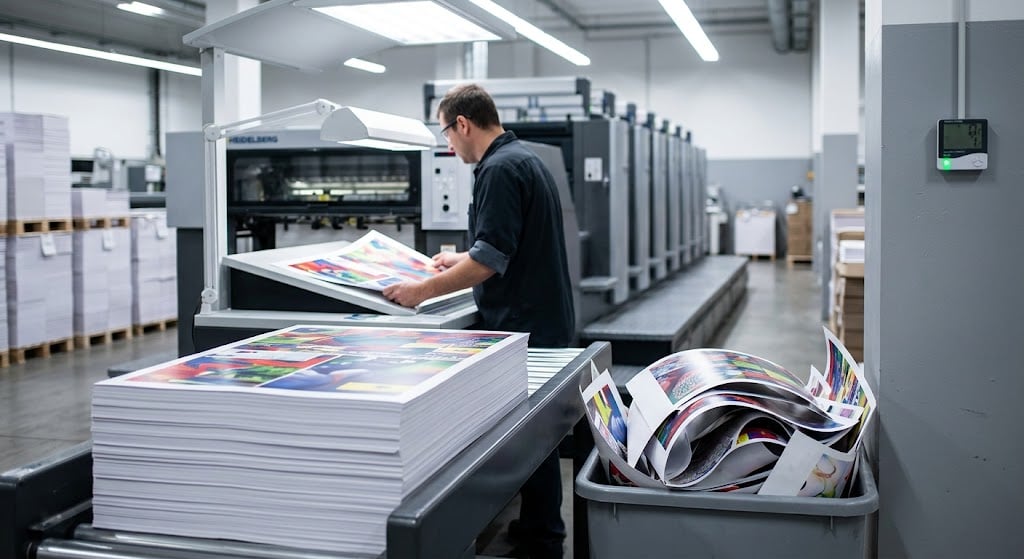
In sheet-fed presses, every sheet pulled from the feeder stack generates triboelectric charge at separation. That charge makes sheets stick together. The result is multi-sheet feeds, paper jams, and creased stock that cannot run cleanly.
- Primary static mechanism: Triboelectric charge forms at every sheet-separation event, at both the feeder and the delivery pile.
- Failure modes below threshold: Sheets stick together and cause multi-sheet feeds, misfeeds, and jams. Charged sheets in the delivery pile misalign and cause pile lean. Misaligned sheets then produce print defects.
- Recommended RH positioning: Aim toward the upper end of the 45 to 55% band. Sheet-fed operation has frequent separation events that generate charge more rapidly than continuous-web configurations.
- Substrate considerations: Mixed-stock jobs that combine coated or synthetic sheets with uncoated paper may require zone-level monitoring. Coated stocks have lower moisture uptake than uncoated grades.
For the full sequence from RH drop to reject rate increase, see how low humidity causes print quality issues.
Web Offset Press Environments
Offset printing on continuous-roll web presses generates static differently. Charge builds along the entire web path as paper moves at high speed over rollers and press components. Static generation is continuous rather than discrete.
- Primary static mechanism: Continuous triboelectric charge accumulates along the web path from unwind to rewind. Charge intensity rises with web speed and press length.
- Failure modes below threshold: Static-attracted ink mist settles outside the intended print area and reduces print quality. Web tension becomes inconsistent as static affects roller adhesion. In severe cases, web-break risk increases.
- Recommended RH positioning: Hold the 45 to 55% RH band with particular attention to uniformity across the full press length. Charge accumulates progressively along longer web paths.
- Substrate considerations: Newsprint and lightweight uncoated stocks are more hygroscopic. They respond more readily to humidity correction than coated papers.
Digital Printing Considerations
Digital printing environments, particularly those using electrophotographic processes, operate differently. The press process itself relies on controlled electrostatic charge to transfer toner to the substrate. Ambient humidity that is too high can interfere with imaging rather than simply preventing static buildup.
In digital print environments, humidity calibration requires more care than targeting the upper end of the RH band. A position toward the lower end of 45 to 55% RH is typically more appropriate. Operators should consult equipment manufacturer specifications alongside general guidance on humidity and static control in industrial printing rooms.
What Proper Humidity Control Looks Like in a Printing Facility
A humidification system in a printing facility has requirements that go beyond general facility humidity management. Three requirements matter most. They are summarized below.
- Continuous band control: The system must hold RH within the 45 to 55% band continuously, not raise it intermittently. Static problems return quickly when RH drops below the threshold. Paper quality problems emerge when it exceeds the upper boundary.
- No surface wetting: The system must not deposit moisture on paper stock, rollers, or press electronics. Any system that wets surfaces risks paper damage, ink contamination, and equipment corrosion.
- Fast response: The system must respond quickly to seasonal outdoor air changes and press heat load. It must also respond to heating, ventilation, and air conditioning (HVAC) behavior. Those factors can drive RH down during production runs.
Sensor placement also matters. The list below covers the two common placement errors and the recommended practice.
- Too close to the output: Sensors placed too close to the humidification output read higher than the actual RH at the press zone.
- Too far from the press: A sensor placed too far from the press may miss localized RH drops caused by press heat.
- Recommended practice: Zone-level monitoring at press height, near the feeder and delivery stations, gives the most operationally relevant readings.
Why Precision Matters More Than Average RH
A system that averages 50% RH but swings between 35% and 65% creates both static problems and paper quality problems within the same production run. Static-related downtime at the low end and curl-related rejects at the high end can both appear on the same shift. Precise humidity held within a narrow band matters more than a favorable daily average.
Stability depends on the control approach a facility chooses. Our guide to methods to control static in printing rooms compares the relative effectiveness of different approaches.
The Surface-Wetting Risk in Print Environments
Any humidification technology that deposits water on surfaces creates specific risks in a printing facility. Surface wetting is therefore a primary consideration in print-room humidification selection, not a secondary one. The list below names the three most direct risks.
- Wet paper stock: Wet stock is unusable and must be discarded.
- Ink viscosity changes: Moisture on ink systems changes viscosity, which alters ink transfer and color consistency.
- Press electronics: Electronic press components exposed to moisture face maintenance and reliability risk. Moisture may also void equipment warranties.
How Smart Fog Humidifies Printing Facilities Without Wetting Paper or Press Components
Smart Fog systems mix compressed air and water through a proprietary nozzle to produce self-evaporating droplets. That mechanism addresses the three requirements established above: a continuously held RH band, zero surface wetting, and tight precision. Humidification systems from Smart Fog have been installed in printing facilities, where surface wetting is a direct production risk.
Self-Evaporating Droplets and Why They Matter for Paper Handling
Each droplet in the equal-sized grid carries a slight electrical charge that prevents re-aggregation. The droplets then self-evaporate before reaching any surface. That adds humidity to the air rather than to paper, rollers, or ink systems.
This non-wetting property makes the system appropriate for a print environment. Non-wetting performance applies to surfaces under proper system design. Direct exposure to the fog stream will wet a surface.
Print-room installations position nozzles and distribution to maintain the evaporation distance between nozzle output and any paper stock, press component, or work area. This is an engineering specification, not an assumption. For related applications where the same non-wetting requirement applies, see how to prevent static electricity in electronics manufacturing and our comparison piece on ESD control methods.
Holding the 45 to 55% RH Band Across Production Shifts
Precise humidity control in a print facility requires a system that holds the target band without fluctuation across multiple shifts. The systems maintain humidity up to 99% RH with plus or minus 1 to 2% precision. In a 45 to 55% RH print environment, that precision prevents swings that reintroduce static or paper curl.
Four operational characteristics matter most in a pressroom. They are listed below.
- Continuous operation: These systems run 24/7 in set-and-forget mode across multiple shifts without manual adjustment.
- No moving parts: The humidification process has no moving parts, which reduces mechanical failure points in a production-critical environment.
- Maintenance intervals: Maintenance intervals extend up to every two years, which reduces scheduled downtime for humidification servicing.
- Complete engineered system: Each installation is a full system design, not a component kit. Nozzle placement and distribution are designed for the specific facility layout.
For application-specific detail, see our pages on ESD control systems and printing facility humidity control.
Final Thoughts
Static electricity in printing facilities is a humidity problem with a specific numeric solution. Maintain RH at or above 40%, with 45 to 55% as the stable operational target. The threshold works because moisture lowers paper's surface resistivity enough for charges to dissipate as fast as they form.
Where the target sits within that band depends on press type, substrate mix, and how the facility manages heat load and seasonal air changes. The system that holds that band matters as much as the target itself. Intermittent humidification, surface-wetting technologies, and wide RH swings all reintroduce the failure modes the threshold is designed to prevent.
A precision humidification system that is non-wetting under proper system design is the engineering specification that makes the threshold work in practice. If static is disrupting your pressroom, contact Smart Fog to discuss your print facility's humidity requirements.
FAQ
What relative humidity level prevents static electricity in a printing facility?
Maintaining RH at or above 40% prevents most static charge buildup on paper and standard print substrates. The recommended operating target is 45 to 55% RH, held continuously across all production shifts. Below 40% RH, electrostatic charges accumulate faster than they dissipate. Misfeeds, jams, and print defects follow.
Why does low humidity cause static in print shops?
Low humidity causes static in print shops by increasing the surface resistivity of paper. Dry paper has high surface resistivity because it loses the moisture it normally absorbs from the air. When dry sheets contact press components and then separate, electrons transfer between surfaces through tribocharging. The transferred charges accumulate on the sheet instead of dissipating, which causes static-related handling and print quality failures.
Is static electricity worse in low humidity environments?
Yes, static electricity gets worse as humidity falls. Low humidity is the primary environmental driver of static on paper and most print substrates. Below 40% RH, the moisture film that normally lets charge dissipate from the paper surface is insufficient. Charge then accumulates with each press interaction. The lower the RH below 40%, the more severe the buildup becomes.
What is the ideal humidity range for ESD protection in printing operations?
The ideal humidity range for ESD protection in printing operations is 45 to 55% RH. This range prevents static charge accumulation on paper. It also stays below the 60% RH level where excess moisture causes curl, cockling, and ink absorption changes. By press type, sheet-fed environments typically benefit from the upper end of the range. Digital electrophotographic environments require more careful calibration.
Do humidifiers reduce static electricity on paper and substrates?
Yes, a properly specified humidifier reduces static on paper and substrates by raising ambient RH to the level where charge dissipates continuously. The key qualification is system type. A humidifier that wets surfaces, deposits moisture on paper stock, or cannot hold RH within a precise band introduces its own production problems. Precision systems that stay non-wetting under proper system design address static without adding surface moisture risk.
How does static electricity affect print quality and paper handling?
Static electricity disrupts paper handling and print quality in several ways. Sheets stick together, producing multi-sheet feeds and paper jams. Charged sheets in the delivery pile attract and repel their neighbors, which destabilizes the pile. In web offset environments, static attracts ink mist outside the intended print area and contributes to web tension inconsistency. Severe low-humidity conditions can also cause electrostatic discharge events near electronic press components, creating equipment reliability risks.
Does the required humidity level differ between sheet-fed and web offset presses?
Both press types need continuous, precise control within the 45 to 55% RH band, though the recommended position differs. Sheet-fed presses generate charge at every sheet-separation event, as described in research on static electricity in printing and packaging production processes. Static therefore shows up faster and more acutely on sheet-fed presses as RH drops, which makes the upper end of the band appropriate. Web offset presses generate charge continuously along the web path. Their failure modes center on ink transfer inconsistency and web-break risk rather than misfeeds.
What type of humidification system is best for a printing facility?
The best humidification system for a printing facility holds RH within the 45 to 55% band without wetting surfaces under proper system design. Systems that wet surfaces or produce wide RH swings introduce production failures alongside the static they are meant to solve. Tight RH precision and continuous 24/7 operation are the other key specifications. The design should also maintain evaporation distance from sensitive press surfaces and paper handling zones.