

 Made in USA

Electrostatic discharge (ESD) damage costs the electronics manufacturing industry an estimated $5 billion to $33 billion annually. This article breaks that figure down by failure type and explains why estimates vary so widely. It closes with a return on investment (ROI) framework for prevention that includes humidity-based ESD control.
Where a study lands in that range depends on which failure categories it counts and how it attributes warranty and latent failure losses. The spread isn't imprecision but a genuine methodological divide.
Some studies count only catastrophic failures caught during testing. Others capture the full lifecycle cost of every ESD event, including field returns and regulatory exposure.
Key Takeaways
The points below summarise the cost picture this article builds. Each one is covered in more detail in the sections that follow.
- The $5 billion to $33 billion annual ESD damage estimate originates from ESD Association (ESDA) research and industry loss surveys. That wide range reflects whether latent failures, warranty returns, and rework labour are included alongside catastrophic failures caught at test.
- ESD produces three economically distinct failure modes: catastrophic failure, latent defect, and soft error. ESDA technical literature indicates latent defects represent the majority of total ESD-related loss. Latent defects escape inspection and generate warranty, recall, and liability costs on top of component cost.
- A latent ESD defect in a defense or medical device circuit board carries regulatory and recall liability. That liability can exceed the annual ESD control programme cost for an entire mid-sized facility.
- Maintaining relative humidity (RH) between 40% and 60% has long been cited as desirable in ESD-protected areas. The guideline traces to MIL-HDBK-263, the U.S. military's former ESD control handbook. ESD Association guidance confirms that humidity helps reduce charge accumulation.
- Wrist straps, conductive mats, and grounding infrastructure protect individual workstations. Humidity control works at the ambient level. It provides continuous, facility-wide charge dissipation that point-of-use tools can't achieve at scale.
- In regulated verticals, an ANSI/ESD S20.20 compliant ESD control programme costs less per unit protected than latent failures that escape inspection and reach the field.
The $5 to 33 Billion Figure: Where It Comes From and Why It Varies
The $5 billion figure originates from ESDA research and industry loss surveys. ANSI/ESD S20.20 and associated ESDA technical reports form the primary standards body literature behind most published estimates. Even so, most published articles repeat the number without tracing it to a methodology or issuing body.
That gap matters because the figure is an informed industry estimate, not an audited total. The ESDA builds its cost analyses from member survey data and manufacturing yield studies rather than insurance records or revenue audits. As a result, facilities across segments and reporting disciplines feed very different data quality into the aggregate.
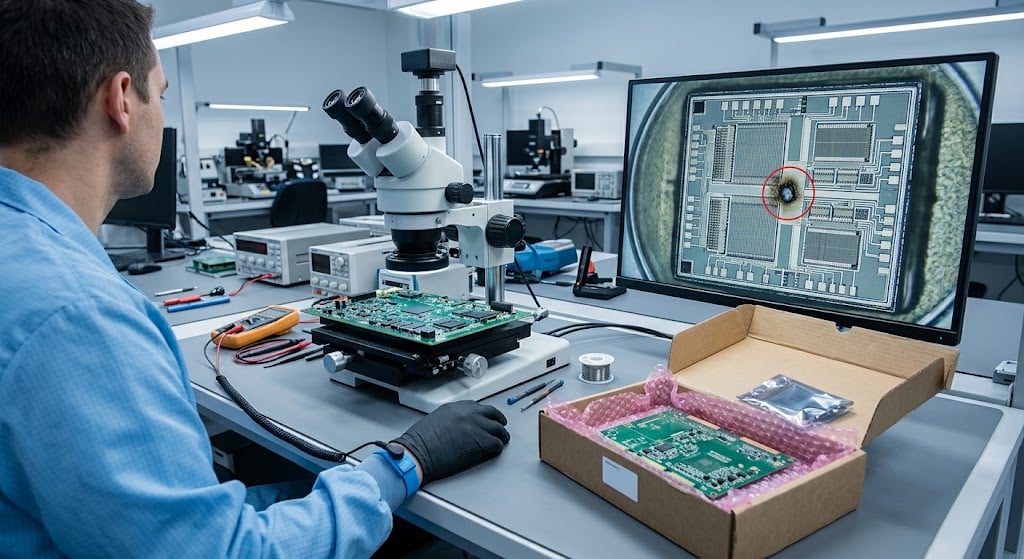
What each estimate counts explains the width of the range. The lower end typically counts only catastrophic failures detected during in-process testing. Those failures are visible, attributable, and measurable.
Higher estimates try to capture the full lifecycle cost of every ESD event. Beyond catastrophic failures, they add rework labour and warranty returns, plus field replacement logistics and downstream liability in regulated verticals. Once those categories are counted, the total rises substantially.
What the ESD Association Measures and Why Totals Differ
The ESDA's published standards and technical reports are the closest thing the industry has to a primary source on aggregate ESD loss. Survey participation still varies by company size and sector. That variation shapes the data behind every published estimate.
A semiconductor fabrication facility with rigorous quality tracking contributes different data than a contract electronics assembly shop without a formal ESD control programme. For that reason, the figure is best cited as a range with noted methodology limits.
Why the $33 Billion Estimate Exists Alongside $5 Billion
The key methodological difference is how studies treat latent failures. A latent defect passes inspection at the factory and fails later, during field use. Studies that include latent failures and their downstream warranty, recall, and liability costs produce totals several times higher than catastrophic-only counts.
Latent damage is invisible at inspection and may not show up for hours, days, or months. That structural invisibility leads to systematic underreporting in lower estimates. Yet latent damage represents the majority of real cost exposure.
Three Types of ESD Failure and What Each One Costs
Not all ESD failures carry the same cost profile. The failure mode decides whether a loss lands on this week's rework report or on a warranty return report six months from now. Understanding the three categories is the foundation for applying any industry-wide cost figure to your own facility's exposure.
- Catastrophic failure: An ESD event destroys the circuit outright. In-process testing catches it before shipment.
- Latent defect: Partial damage lets the device pass inspection. It can then fail in the field hours, days, or months later. That delay makes it the highest total cost failure mode.
- Soft error: A discharge causes a temporary upset without permanent damage. Facilities often misdiagnose it as a software or firmware fault.
Catastrophic Failures: High Visibility, Easier to Count
Catastrophic failures are the most studied failure mode because they generate clear, attributable data. By most ESDA analyses, they're also the smaller portion of total ESD-related cost.
- Failure mode: A catastrophic failure is immediate and complete. An ESD event destroys the circuit or integrated circuit outright. As a result, the device fails functional test.
- Detection point: Detection happens in-process, before the device ships.
- Cost profile: The cost is component replacement plus labour for rework and retest.
- Risk of escape to field: Catastrophic failures rarely reach the field because they're visible at test.
Latent Defects: The Majority of Total ESD Loss
Latent defects drive the largest share of ESD loss because the damage stays hidden until the product is in use. ESDA technical literature consistently positions them as the highest total cost failure mode.
- Failure mode: A latent defect is partial damage. The discharge degrades the electronic component without stopping its function immediately.
- Detection point: The device passes inspection and ships. It may run normally for hours, days, or months before failing.
- Cost profile: A latent defect generates warranty return logistics, replacement component cost, and customer labour for reinstallation. In regulated verticals, it can also trigger regulatory investigation.
- Risk of escape to field: The inspection escape is the defining cost driver. A single latent failure that reaches the field carries more financial consequence than several catastrophic failures caught at test.
Prevention starts with understanding the mechanism. Our guide to the environmental causes of ESD in electronics manufacturing covers the conditions that drive latent damage.
Soft Errors and Attribution Difficulty
Soft errors are the hardest ESD failures to attribute. That attribution gap makes them an economic problem as well as a technical one.
- Failure mode: A soft error is a transient ESD-induced malfunction. The electrostatic discharge event causes a temporary upset without permanently damaging the circuit.
- Detection point: Soft errors are frequently misdiagnosed as software or firmware faults.
- Cost profile: Soft errors generate diagnostic labour costs that never appear in ESD damage tallies.
- Reporting impact: Facilities that can't identify a soft error as ESD-related don't count it as ESD damage. Their reported ESD loss figures therefore run lower than their actual exposure.
How ESD Damage Costs Differ by Electronics Segment
The aggregate industry figure hides a critical variable: where the damaged component ends up. On a consumer PCB assembly line, an ESD event may cost only a few cents in component replacement. The same event can cost orders of magnitude more in a defense or medical device manufacturing process.
What changes isn't the physics of the discharge. It's the regulatory and liability environment surrounding the end product.
Consumer and Industrial Electronics: Component Cost Dominates
In high-volume consumer electronics assembly, the per-unit component cost of a catastrophic ESD failure is often low. At scale, though, the financial risk is meaningful.
- Failure visibility: Catastrophic failures are caught at test. Each one generates measurable rework and retest cost per unit.
- Latent failure exposure: Latent defects in consumer devices still generate warranty returns and brand reputation costs, even when component value is modest.
- Scale multiplier: High production volume means even a small ESD-related yield loss rate adds up to significant annual loss.
- Regulatory exposure: Consumer electronics face limited regulatory recall risk compared with medical or defense verticals. That keeps total liability closer to direct component and warranty cost.
Defense, Medical, and Automotive: Regulatory Liability Multiplies the Loss
In regulated verticals, a latent ESD defect that reaches the field triggers a categorically different cost profile. The regulatory framework for each vertical shapes how that liability builds up.
- Defense electronics: Defense ESD programmes were historically built on MIL-STD-1686 and MIL-HDBK-263. The Department of Defense cancelled both in 2021 and named ESD Association documents, including ANSI/ESD S20.20, as their replacements. Latent ESD failures in defense systems still carry contractor liability that extends well beyond component value.
- Medical device manufacturing: Facilities operating under FDA 21 CFR Part 820 face regulatory investigation and recall risk when latent ESD failures cause field malfunction. That makes the liability profile structurally different from consumer electronics.
- Automotive electronics: Safety-critical electronic components built under ISO 26262 functional safety requirements face similar liability escalation when ESD-related field failures occur.
- Cost multiplier: In each regulated vertical, a single field failure can cost more than a mid-sized facility's annual spend on a comprehensive ESD control programme.
What a Formal ESD Control Program Costs Versus What It Prevents
A formal ESD control programme is a structured cost that a facility chooses to carry. The cost categories listed below can each be estimated against your facility's production volume and physical footprint.
Programme Cost Components Under ANSI/ESD S20.20
ANSI/ESD S20.20 defines the requirements for a complete ESD control programme. Investment categories under that standard include the following.
- Grounding infrastructure: Floor systems, workstation bonding, and equipment grounding provide continuous charge dissipation paths.
- ESD-safe workstation design: This category covers conductive or dissipative surfaces, properly grounded tooling, and shielding for sensitive components.
- Wrist strap and footwear programmes: These per-operator compliance tools require consistent use and periodic verification testing.
- Personnel training and certification: Structured training under ANSI/ESD S20.20 makes sure operators understand ESD risk and programme requirements.
- Environmental controls: Humidity management, ionisation, and other ambient controls address charge accumulation at the facility level.
- Audit and verification: Periodic testing confirms that programme elements stay effective over time.
Early split-lot studies put numbers on that trade-off. An ESD Association review of programme cost studies cites a 1981 Western Electric study that estimated ROI at 900% to 2,300%. A second Western Electric study from 1983 reported ROI as high as 950%.
That 1983 study also found a threefold drop in outgoing defect rates. Spread across production volume, a programme's per-unit cost is consistently lower than that of uninspected latent failures reaching the field. See ESD control methods compared for a closer look at the trade-offs between these approaches.
Where the ROI Is Strongest: Latent Defect Prevention
The ROI case for an ESD control programme is strongest when it's framed around latent defects. A catastrophic failure generates a clear and bounded cost of rework, retest, and replacement.
Latent defects, on the other hand, generate an unbounded cost that depends on where the device fails and in whose hands. In regulated verticals especially, preventing even a small number of latent defects per production run can recover the programme's annual cost. The savings come from avoided warranty returns, regulatory investigation, and customer liability alone.
That financial logic justifies programme investment at the facility level, not just compliance motivation. Facilities evaluating why traditional anti-static measures fall short should also consider whether point-of-use tools alone address latent defect risk. Environmental controls, including ambient humidity management, are the programme-level investment that extends coverage across the whole facility.
How Humidity Control Addresses ESD Risk at the Facility Level
Dry air is a poor conductor of electrostatic charge. ESD Association data shows walking across a floor generates far higher static voltages at 10 to 25% RH than at 65 to 90% RH. That isn't a conditional risk but a physical consequence of low air conductivity.
Raising ambient RH into the 40% to 60% range increases air conductivity continuously. Humid air also keeps surfaces slightly moist and more conductive.
Together, those effects dissipate surface charge across the whole facility without relying on per-operator compliance at each workstation. Our full analysis of how humidity control prevents ESD in PCB facilities covers the mechanism and implementation requirements in detail.
Why Precision Matters in Electronics Manufacturing Environments
Electronics assembly areas need stable, precise RH control within the 40% to 60% target band. Humidity that cycles too low lets electrostatic charge build up. At the other end, humidity that climbs toward condensation thresholds risks surface moisture on sensitive components and circuit boards.
Swinging between those two conditions creates unpredictable ESD risk that's hard to manage. Any system used for electronics manufacturing humidification has to hold the target band without cycling through unsafe conditions.
Smart Fog systems maintain RH within plus or minus 1 to 2%. Under proper system design, their self-evaporating droplets leave surfaces and equipment dry, including racks and electronic components. Direct exposure to the fog stream will still wet a surface.
That non-wetting performance is operationally essential, because any surface moisture in an electronics assembly environment is unacceptable. A humidification system that can't guarantee dry delivery isn't suitable for the application.
Facility-Wide Coverage vs. Point-of-Use Controls
Wrist straps, conductive mats, and ESD-safe footwear protect individual operators at individual workstations. They don't address charge building up on floors, equipment surfaces, or racks. Materials moving between workstations stay exposed as well.
Even an operator's own movement creates risk. Walking across an ESD-sensitive production floor generates charge whether or not a wrist strap is worn at the destination workstation.
Humidity control closes that gap by working at the ambient level. It provides passive, continuous charge dissipation across the whole production environment. Every surface and every person in the space is covered at once.
That doesn't make humidity control a replacement for grounding and personal protective equipment. It's the programme-level environmental layer that supports those tools and extends effective ESD control beyond what they cover.
Smart Fog ESD control systems are designed for continuous industrial operation in exactly this role. The humidification process has no moving parts. Maintenance intervals extend up to every two years.
Knowing how to prevent static electricity in electronics manufacturing starts with identifying which control layers are already in place and which gaps remain. System design requirements for PCB manufacturer humidification differ from general electronics assembly and are addressed at the facility level. Smart Fog delivers each installation as a complete engineered system, not a component kit.
Final Thoughts
ESD damage costs the electronics manufacturing industry between $5 billion and $33 billion annually. Most of that loss isn't visible on the factory floor.
Latent defects escape inspection and reach the field. There, they generate warranty, regulatory, and liability costs that catastrophic failures caught at test never produce.
The cost calculus shifts again by vertical. A latent failure in a consumer device generates a warranty return. The same failure in a medical or defense electronic component generates a regulatory event.
Prevention investment structured under ANSI/ESD S20.20 consistently costs less per unit than latent defects cost per field failure. Ambient humidity control is one component of that investment. It's also the one that extends coverage to every surface and every operator across the facility at once.
Facilities evaluating ambient ESD control as part of a broader programme can contact Smart Fog engineers to assess humidification requirements for their production environment.
FAQ
What is the estimated annual cost of ESD damage to the electronics manufacturing industry?
ESD damage costs the electronics manufacturing industry an estimated $5 billion to $33 billion a year, based on ESD Association research and industry loss surveys. Lower estimates count only catastrophic failures caught during in-process testing. Higher estimates add latent defects and warranty returns, plus rework labour and downstream liability. Neither the $5 billion nor the $33 billion figure is an audited total.
Why do ESD damage cost estimates range from $5 billion to $33 billion?
ESD damage cost estimates range from $5 billion to $33 billion because studies disagree on which failure categories to count. Studies at the low end count only catastrophic failures caught during testing. Estimates at the high end also include latent defects. Latent defects escape inspection and carry warranty, recall, and liability costs on top of component cost.
What is the difference between a catastrophic ESD failure and a latent ESD defect?
A catastrophic ESD failure destroys a circuit immediately, unlike a latent ESD defect that causes hidden partial damage. Catastrophic ESD failures are caught during in-process testing. A latent ESD defect passes inspection and can fail in the field hours, days, or months later. Latent ESD defects cost more because they generate warranty returns, replacement logistics, and potential regulatory exposure.
Is ESD damage permanent?
ESD damage is permanent in two of its three failure modes: catastrophic failures and latent defects. Catastrophic ESD failures destroy the circuit at once. Latent ESD defects cause permanent partial damage that degrades the component over time. Soft errors are the one exception, because these transient upsets don't permanently damage the circuit.
What are the two most common types of ESD damage?
The two main types of ESD damage are catastrophic failure and latent defect. ESD Association guidance classifies ESD damage into catastrophic failures and latent defects. A catastrophic failure shows up at test, unlike a latent defect that passes inspection and fails later in the field. ESDA technical literature identifies latent defects as the larger contributor to total industry loss.
In which conditions is ESD the highest threat to electronics manufacturing?
ESD is the highest threat to electronics manufacturing when relative humidity is low and insulating materials are present. Dry air lets electrostatic charge build up on surfaces, personnel, and equipment until a discharge occurs. ESD Association guidance on humidity confirms that humidity helps reduce charge accumulation. Plastic packaging, synthetic flooring, and ungrounded workstation surfaces make ESD events more likely in dry conditions.
Can static discharge damage electronics without the operator feeling anything?
Yes, static discharge can damage electronics without the operator feeling anything. Few people notice a discharge below about 1,000 volts. Most people only start to feel an unpleasant effect at around 2,000 volts. According to the ESD Association, many electronic components can be damaged at less than 100 volts. Operator-perceived sparks are therefore not a reliable indicator of ESD risk.
What is the return on investment for a formal ESD control programme in electronics manufacturing?
The ROI of a formal ESD control programme is strongest when measured against latent defect prevention. In medical device and defense electronics, one latent field failure can cost more than a mid-sized facility's annual programme investment. Early programme studies reviewed by the ESD Association reported returns on investment as high as 2,300%. Avoided warranty returns, regulatory investigation, and customer liability make up the savings.