

- When indoor RH drops below 40%, the rate of transepidermal water loss increases, weakening the skin barrier and causing dryness, flakiness, and increased sensitivity to irritants.
- The American Academy of Dermatology recommends maintaining indoor RH between 40% and 60% to support skin hydration and reduce irritation from conditions such as eczema and contact dermatitis.
- Cool mist humidifiers, including ultrasonic and evaporative types, are generally preferred over warm mist units for skin health because they do not raise room temperature and can operate for longer periods.
- Bedroom humidifier placement near the sleeping area, rather than in a distant corner, ensures humidified air reaches the occupant's skin during the hours of longest exposure.
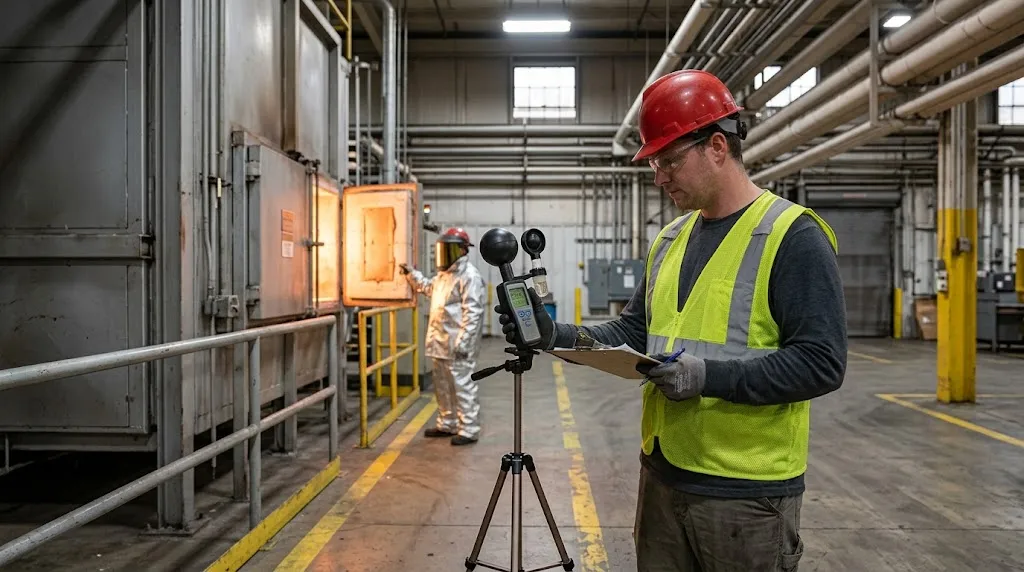
- In industrial and commercial facilities, HVAC systems routinely suppress indoor RH below 30% in winter, placing workers in conditions that actively stress the skin barrier for eight or more hours per day.
- Industrial humidification systems that maintain precise RH within a narrow tolerance are better suited to continuous facility-wide skin protection than portable consumer units, which cannot sustain target RH in large or open-plan spaces.
Why Indoor Air Becomes So Dry, and Why It Gets Worse in Winter
Cold outdoor air holds significantly less water vapor than warm air. When that cold air enters a building and is heated by an HVAC system, the same absolute amount of moisture spreads across a larger volume at a higher temperature, so relative humidity drops sharply even though no moisture has been removed. In practice, this plays out predictably:- Outdoor air entering a building at 80% RH can drop to 25 to 30% RH after heating to typical indoor temperatures.
- In cold climates during winter, indoor RH in heated buildings without active humidification regularly falls below 30 to 35%.
- Sealed modern buildings with forced-air heating accelerate this effect, since there's less natural air exchange to introduce fresh outdoor moisture.
What Happens to Indoor Humidity When You Turn the Heat On
Relative humidity is a ratio, not a fixed quantity. As air temperature rises, the capacity of that air to hold water vapor increases. If the actual water content stays constant and the temperature rises, the RH falls. A concrete example makes this clear: outdoor air at 0°C and 70% RH, when heated to 21°C indoors, drops to approximately 25% RH with no change in absolute moisture content. No water has left the building; the physics of the temperature-humidity relationship has simply shifted the ratio downward.How Dry Air Damages Your Skin: The Barrier Mechanism Explained
The skin's outer layer, the stratum corneum, isn't a sealed barrier. It continuously loses water vapor to the surrounding air through a process called transepidermal water loss (TEWL), and when ambient humidity is low, the moisture gradient between skin and air steepens, pulling water from the skin faster than deeper layers can replace it. Over time, this plays out in a specific sequence:- Lipid depletion: sustained TEWL depletes the lipid layer that holds skin cells together.
- Barrier weakening: this leads to dryness, tightness, flaking, and in severe cases, cracking.
- Increased reactivity: a compromised barrier also makes skin more reactive to irritants and allergens, since the structural layer that filters environmental contact is thinner and less intact.
Specific Conditions Made Worse by Low Indoor Humidity
Low indoor air moisture worsens several chronic and seasonal skin conditions by intensifying the rate of TEWL and reducing the skin's ability to recover.- Eczema: Low indoor RH reduces moisture in the stratum corneum, triggering the inflammation and itch cycle that characterizes eczema flare-ups. Eczema and dry air have a well-documented relationship; maintaining indoor humidity above 40% reduces one of the primary environmental triggers.
- Psoriasis: Dry air increases skin dryness and scaling in psoriatic skin, where the barrier is already compromised. Low RH extends recovery time between flare-ups and increases surface irritation.
- Contact dermatitis: A weakened skin barrier is more permeable to chemical irritants. Workers in environments with both low humidity and chemical exposure face compounded skin stress from both directions.
- General winter skin care challenges: Seasonal dryness, tightness, and itchy skin and low humidity are common complaints that are directly tied to the drop in indoor RH that accompanies cold-weather heating cycles.
What Humidity Level Is Best for Skin Health?
Optimal humidity levels for skin hydration and general indoor comfort fall between 40% and 60% RH, the range dermatologists, including the American Academy of Dermatology, point to as where TEWL rates normalize and the skin barrier retains adequate moisture without environmental depletion. Below 30% RH, TEWL accelerates and barrier function degrades with extended exposure. Above 60% RH, dust mites and mold find conditions that support growth, a different indoor air quality concern. The lower bound matters more for skin health; the upper bound matters more for overall air quality, and precision in that range matters more than simply running a humidifier at maximum output. Our article on how humidity is measured covers the tools for confirming actual indoor conditions rather than estimating based on comfort.How to Know If Your Indoor Humidity Is Too Low
Several physical indicators signal low indoor air moisture before a hygrometer is consulted:- Skin tightness after washing
- Static electricity on clothing and surfaces
- Cracking of wood furniture or musical instruments
- Frequent nosebleeds or dry sore throats
Cool Mist vs. Warm Mist Humidifiers for Skin: Which Type Performs Better?
Humidifier type affects more than moisture output volume. It affects ambient temperature, operational safety, maintenance burden, and how consistently the unit holds the target RH range. For skin health specifically, the operating conditions the humidifier creates matter as much as the moisture it adds. The information on our cool mist humidifier benefits guide covers the broader case for cool mist operation. The comparison below addresses each type across the dimensions most relevant to skin health use. Output temperature effect on ambient conditions:- Cool mist (ultrasonic and evaporative): Adds moisture without raising room temperature, allowing longer operation periods without thermal discomfort.
- Warm mist: Boils water before releasing steam, raising ambient temperature and potentially reducing the net benefit of humidification in already-heated rooms.
- Cool mist: Generally preferred by dermatologist recommendations for bedroom and long-duration use because it does not compound dryness through convective heat.
- Warm mist: Suitable for short-duration use but less appropriate for overnight or continuous operation where temperature rise becomes a factor.
- Cool mist: No boiling water or hot surfaces; suitable for unattended operation in occupied rooms.
- Warm mist: Carries a burn risk from hot water and steam; less appropriate for bedrooms or spaces with children.
- Cool mist: Lower energy consumption because no heating element is required.
- Warm mist: Higher energy draw from continuous boiling; less efficient for sustained operation.
- Cool mist (evaporative): Self-regulating output as RH rises, but requires more frequent filter or wick replacement.
- Warm mist: Heating element collects mineral scale that must be descaled regularly to maintain efficiency.
- Cool mist: Effective for single rooms or small spaces; portable units cannot maintain target RH in large or open-plan environments.
- Warm mist: Similarly limited to small spaces; scale limitations are more pronounced because heat output becomes a compounding problem in larger rooms.
Ultrasonic Humidifiers for Skin: What to Know
An ultrasonic humidifier uses high-frequency vibration to break water into a fine cool mist. The units are quiet and energy-efficient, making them well-suited for bedroom use. The primary operational consideration is mineral dust: when hard tap water is used, mineral particles can be dispersed into the air along with the mist, leaving white residue on nearby surfaces. Using distilled or filtered water eliminates this issue and is the standard recommendation for ongoing ultrasonic humidifier use.Where to Place a Humidifier for Maximum Skin Benefit
Bedroom humidifier placement near the sleeping area gives the humidified air the best opportunity to reach the occupant's skin during the hours of longest continuous exposure. Two placement rules apply, one for bedrooms and one for larger workspaces:- Bedroom: the unit shouldn't sit so close that the mist stream is directed at the bed or face. A few feet away with the output aimed toward open air is appropriate.
- Workspace: placement near the occupied zone, rather than in a corner of a large room, is similarly important.
- Open-plan offices or large rooms: a single portable unit won't maintain RH across the whole space. Multiple units or an integrated system are needed to hold the target range consistently.
Skin Health in the Workplace: Why Facility Humidity Control Matters
Workers in many industrial and commercial environments spend eight or more hours per day in spaces where HVAC systems actively suppress indoor humidity. In winter, these conditions regularly produce RH below 30%, far below the 40 to 60% range associated with healthy skin barrier function. This isn't a minor comfort variable, it's a consistent environmental stressor applied to skin barrier function for every person in the facility, every working day of the heating season. The environments where this is most acute include:- Manufacturing floors with forced-air heating
- Electronics and printing facilities, where humidity is often permitted to drop to prevent condensation
- Healthcare settings, where frequent handwashing further compounds skin barrier stress
Why HVAC Systems Alone Don't Maintain Adequate Indoor Humidity
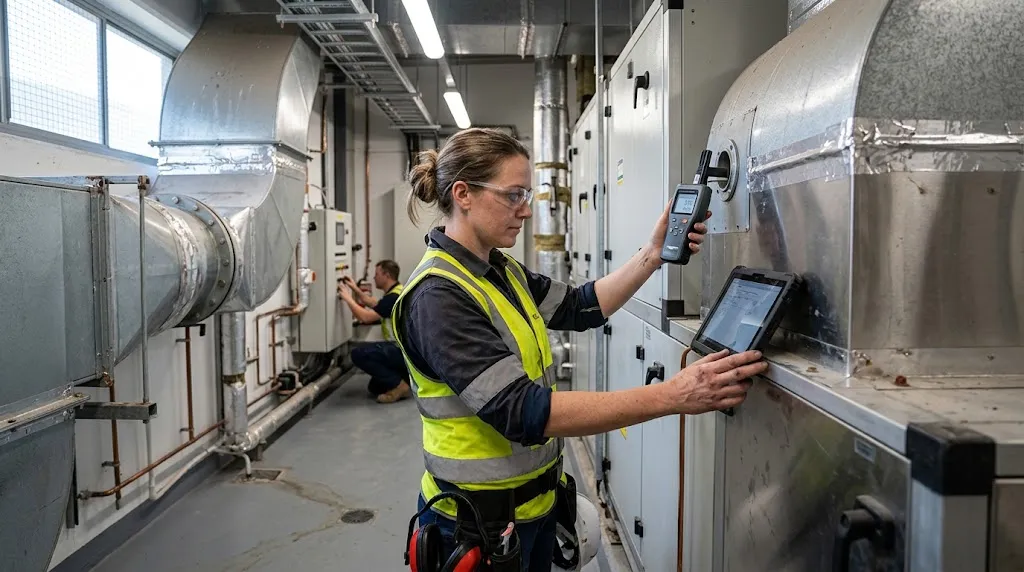
Standard HVAC systems are designed primarily for temperature control and air circulation. In winter, heating raises air temperature and drops relative humidity, and the HVAC system has no mechanism to compensate unless active humidification is integrated into or added to it. The result is that facilities operating standard HVAC in cold climates will routinely see indoor RH fall to levels that are comfortable in summer but problematic in winter. This is the operational gap that industrial humidification systems are designed to close.How Smart Fog Maintains Precise Indoor Humidity for Facility Environments
Compressed air and water, mixed through a proprietary nozzle, produce an equal-sized droplet grid of self-evaporating droplets that absorb into the air before reaching any surface, making precision humidification possible where surface wetting would damage equipment, materials, or products. That delivers:- Humidity control up to 99% RH
- Precision held within plus or minus 1 to 2%
- No condensation or surface wetting, under proper system design
Non-Wetting Humidification and Why It Matters in Occupied Workspaces
Self-evaporating droplets humidify the air without depositing moisture on equipment, floors, desks, or products under proper system design. In facilities where surface wetting would cause safety hazards, equipment damage, or product quality issues, this property is an operational requirement, not a convenience feature. The non-wetting caveat applies here: direct exposure to the fog stream will cause wetting, and system design determines where the fog stream is directed. Proper installation ensures the stream is aimed into open air space, not toward occupied surfaces or sensitive equipment.Continuous, Precision Humidity Control at Industrial Scale
Smart Fog systems are engineered for 24/7 set-and-forget operation, maintaining target RH without manual adjustment or continuous monitoring. Key operational characteristics relevant to facility managers responsible for skin-protective environmental conditions include:- Precision hold within plus or minus 1 to 2% RH across the full operating range, up to 99% RH.
- 100% water efficiency: every droplet evaporates into the air, with no water waste or pooling.
- No moving parts in the humidification process, reducing mechanical failure risk.
- Maintenance intervals extending to every two years under normal operating conditions.
- Complete engineered system delivery: Smart Fog designs and delivers the full system, not a component kit requiring on-site integration.