- ASHRAE Standard 62.1 recommends maintaining indoor relative humidity between 30% and 60% RH in commercial buildings, with tighter tolerances required in healthcare, pharmaceutical, and electronics environments governed by separate standards.
- Standard commercial HVAC systems have no humidification mechanism. Heating cycles reduce RH by increasing air temperature at fixed absolute humidity, and cooling cycles can over-dehumidify in dry climates or high-ventilation buildings.
- In-duct humidifiers integrate with an existing air handler and distribute moisture through the duct network. They are suited to buildings where central air distribution already reaches all occupied zones.
- Condensation inside ductwork is the primary failure risk in commercial humidification systems where absorption distance calculations are not performed at the design stage.
- Adiabatic in-duct humidification adds moisture through evaporation with no heat addition, which reduces energy load compared to steam systems and avoids the scale and corrosion risks of heating-element-based approaches.
- Precision moisture control at commercial scale requires closed-loop sensor feedback and a system capable of maintaining target RH within plus or minus 1 to 2 percentage points continuously, not simply delivering moisture volume.
Why Commercial HVAC Systems Cannot Handle Humidity Alone
Most commercial HVAC systems are designed around sensible heat management: they raise or lower air temperature and move that conditioned air through a building. Latent heat management, the regulation of moisture content in air, is a fundamentally different engineering problem that standard air handlers are not configured to solve. Four gaps explain why HVAC alone underperforms on humidity:- Standard air handlers have no humidification mechanism. Moisture delivery requires a separate system.
- Ventilation air dilutes indoor RH in dry climates. High outdoor air change rates pull in low-humidity air that reduces indoor moisture levels continuously.
- Heating cycles consistently drop RH below 30%. Heated air at fixed absolute humidity has lower relative humidity, so the building dries out every time the system heats.
- Cooling cycles can over-dehumidify in certain conditions. Moisture condenses on cooling coils as a byproduct of temperature reduction, potentially undershooting RH targets in dry climates or high-ventilation-rate buildings.
How Heating and Cooling Cycles Affect Indoor Relative Humidity
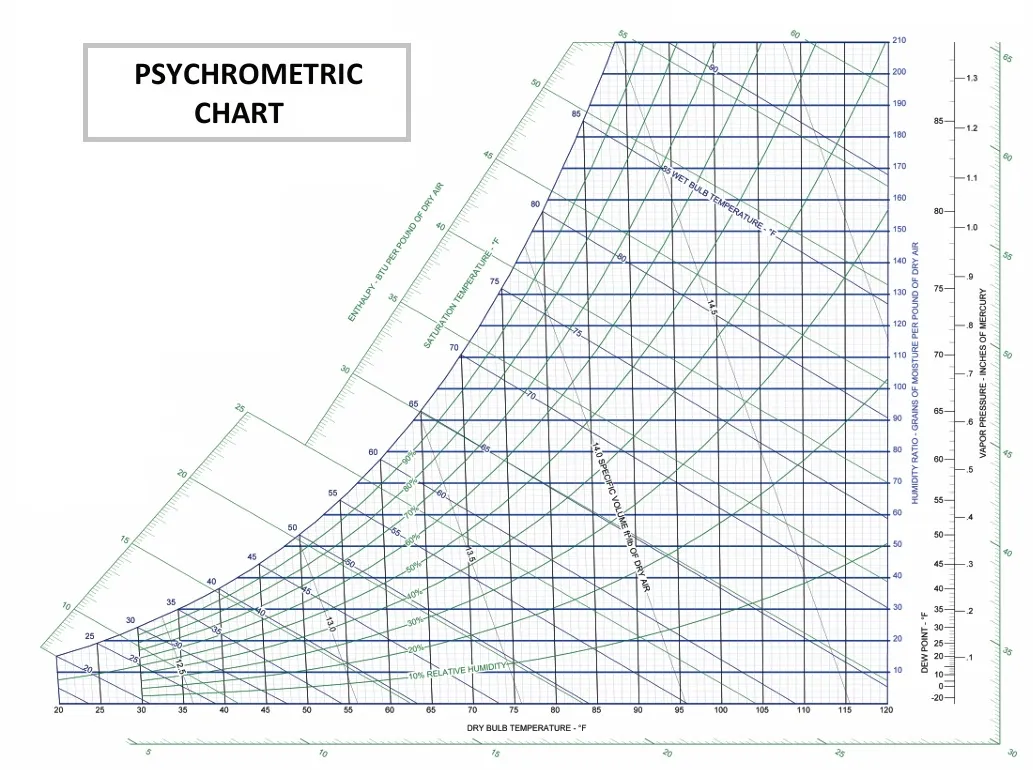
Psychrometrics explains the core problem. As air temperature rises, its capacity to hold moisture increases. Air at fixed absolute humidity therefore has lower relative humidity when heated, which is why buildings dry out during winter heating cycles without any change in actual moisture content. Cooling works in the opposite direction: cooling coils remove moisture as a byproduct of reducing air temperature, which can drive RH below target in facilities with aggressive cooling loads. Understanding these relationships is prerequisite to sizing any commercial humidification system correctly.ASHRAE Humidity Targets and Why They Differ by Facility Type
ASHRAE standards set the baseline for commercial humidity control. ASHRAE Standard 62.1 specifies a general commercial indoor RH range of 30% to 60%. Beyond that baseline, specific industries operate under tighter or different requirements tied to product stability, equipment protection, and patient safety.- General commercial offices: 30 to 60% RH per ASHRAE 62.1. The primary risks outside this range are occupant comfort and static buildup below 30%; mold and mildew growth risk increases significantly above 60%.
- Data centers: ASHRAE TC 9.9 Thermal Guidelines for Data Processing Environments define an expanded operating envelope with a dew point upper limit of 17°C and a maximum RH of 80%. Maintaining RH above the lower dew point threshold prevents electrostatic discharge (ESD) events that damage servers and storage hardware.
- Hospitals and clinical spaces: ASHRAE 170 specifies 45 to 60% RH for operating rooms and 30 to 60% RH for general patient areas. Humidity outside these bands affects infection control protocols and the efficacy of certain sterilization processes.
- Pharmaceutical and biotech facilities: FDA current Good Manufacturing Practice (cGMP) guidance and USP standards tie humidity directly to product stability, particularly for hygroscopic compounds. Target ranges vary by product but are typically specified to plus or minus 5% RH or tighter.
- Electronics and cleanroom environments: ANSI/ESD S20.20 ESD control program requirements specify humidity thresholds for ESD-controlled areas. Many facilities target 40 to 60% RH to suppress ESD events during handling of sensitive components.
What Happens When RH Falls Below 30% in a Commercial Building
Three consequences follow when RH drops below 30%. First, ESD risk increases sharply, damaging sensitive electronics and disrupting automated processes. Second, hygroscopic materials, including paper, wood, and certain substrates, desiccate and dimensionally distort. Third, occupant comfort levels decline and productivity is affected by dry-air respiratory irritation. All three are operational and equipment protection issues, not simply wellness concerns.What Happens When RH Exceeds 60% in a Commercial Building
Exceeding 60% RH introduces condensation on surfaces and inside ductwork, creates conditions for mold and mildew growth on building materials, and accelerates corrosion of metal components and electrical enclosures. This is why precision control matters as much as moisture delivery capacity. Overshooting target RH creates different but equally serious operational problems. For a deeper treatment of how moisture content and temperature interact, the dew point vs humidity comparison guide covers the psychrometric relationship in applied detail.Commercial HVAC Humidity Control Systems: Types and How They Compare
Four system categories address commercial HVAC humidity control needs. Each delivers moisture through a different mechanism, which determines its energy profile, surface wetting risk, maintenance burden, and appropriate facility type. Understanding the category differences is the necessary first step before engaging a supplier.- Steam humidifiers use resistance or electrode boilers to heat water into steam for injection into the air stream. They produce high moisture output regardless of air temperature, but require mineral management because scale accumulates on heating elements, and carry the highest energy consumption of any humidifier category due to the heat required to vaporize water.
- Evaporative bypass humidifiers pass air over a wetted media pad, allowing moisture to evaporate into the moving air stream. Energy consumption is low because no heat is added, but output is limited by airflow volume and inlet air temperature, making these systems less suited to high-precision or high-load applications.
- High-pressure spray systems atomize water at pressure and inject it into the air stream or space. Moisture output is high, but if absorption distance is insufficient, unevaporated droplets contact duct walls and downstream components, creating condensation and potential mold and mildew growth.
- Adiabatic precision systems use compressed air and water through a nozzle to produce an equal-sized droplet grid that self-evaporates before contacting surfaces. No heat is added, which reduces energy load relative to steam. Under proper system design, surface wetting is eliminated because droplets are engineered to fully evaporate within the available absorption distance. Note: non-wetting applies to surfaces under proper system design; placing a hand directly into the fog stream will wet the hand.
- Steam humidifiers: Highest energy draw. Electric heating is required to vaporize water, making steam the least efficient category by operating cost.
- Evaporative bypass humidifiers: Lowest energy draw. Evaporation is driven by airflow, with no added heat required.
- High-pressure spray systems: Moderate energy consumption. Pump energy is required to maintain operating pressure, but no heat addition.
- Adiabatic precision systems: Low energy consumption relative to steam. Compressed air and water are the only inputs. No heat addition is required.
- Steam humidifiers: Low wetting risk at the surface level, but high condensation risk in ductwork if steam is not fully absorbed before contacting cooler surfaces.
- Evaporative bypass humidifiers: Low wetting risk when airflow is adequate. Risk increases at low airflow velocities where evaporation rate drops.
- High-pressure spray systems: Moderate to high wetting risk. Absorption distance must be calculated precisely; an undersized duct run produces condensation and downstream wetting.
- Adiabatic precision systems: Low surface wetting risk under proper system design. Self-evaporating droplets are engineered to evaporate fully before surface contact.
- Steam humidifiers: Good precision where output is modulated. Response time is limited by the time required to produce steam.
- Evaporative bypass humidifiers: Lower precision. Output is dependent on airflow and ambient conditions, making fine RH control difficult.
- High-pressure spray systems: Moderate precision. High output capacity is available, but fine modulation is harder to achieve at low moisture demand.
- Adiabatic precision systems: High precision. Systems designed for plus or minus 1 to 2% RH maintenance with closed-loop sensor feedback.
- Steam humidifiers: High. Scale accumulation on heating elements requires regular descaling. Electrode boilers require cylinder replacement on a schedule tied to water hardness.
- Evaporative bypass humidifiers: Moderate. Wetted media pads require periodic replacement. Mineral deposits accumulate on pad surfaces over time.
- High-pressure spray systems: Moderate to high. Nozzles require periodic inspection and cleaning to maintain droplet consistency and prevent blockage.
- Adiabatic precision systems: Low. No constant nozzle cleaning is required. Maintenance intervals can extend to every two years under normal operating conditions.
- Steam humidifiers: Facilities with high moisture demand, easy access to electrical capacity, and tolerance for scale management costs, such as large office buildings or food processing facilities.
- Evaporative bypass humidifiers: General commercial offices and lower-precision applications where RH targets are broad and energy costs are a primary concern.
- High-pressure spray systems: Large industrial spaces where high moisture output is needed and sufficient absorption distance is available by design.
- Adiabatic precision systems: Data centers, pharmaceutical facilities, electronics manufacturing, hospitals, and any environment where precision, non-wetting operation, and low maintenance are required simultaneously.
- Steam humidifiers: Less than 100% efficient. Water that does not evaporate fully or drains from the boiler is lost.
- Evaporative bypass humidifiers: Variable. Water that does not evaporate through the pad drains off and is lost.
- High-pressure spray systems: Variable. Unevaporated droplets that contact surfaces are lost and create condensation.
- Adiabatic precision systems: 100% water efficient under proper system design. Every droplet is sized to evaporate into the air.
In-Duct vs. Direct-Space Humidity Control: Which Fits Your Building
In-duct systems introduce moisture into the air handler or duct plenum, relying on air distribution to carry humidity to all zones. They are appropriate for buildings with central air distribution reaching all occupied areas and for facilities where a single moisture source can serve the full floor plate. The TS100 in-duct humidifier is designed specifically for this integration profile. Direct-space systems introduce moisture into the occupied or process area directly, without relying on ductwork. They are appropriate for spot treatment, zones outside the reach of central duct distribution, or facilities requiring zone-specific RH targets that cannot be met by a single central source. The ES100 industrial humidifier addresses direct-space applications where zone-level precision is required.Condensation Risk and Absorption Distance in Duct Humidification
Moisture introduced into a duct must fully evaporate before it contacts duct walls, downstream components, or diffusers. The distance required for complete evaporation is the absorption distance. When the specified system delivers droplets that require more absorption distance than the available duct run provides, condensation forms on interior surfaces. This is the failure mode most installation errors produce, and it is the risk most competing articles do not address. Four variables determine absorption distance: droplet consistency, airflow velocity, air temperature, and moisture load per unit volume. Systems that produce an equal-sized droplet grid eliminate the variability that causes uneven evaporation. When every droplet is the same size and carries a slight charge preventing re-aggregation, evaporation is uniform and predictable, and ductwork design can be specified to match. The humidity control systems how they work article covers evaporation mechanics and system design in additional detail.Specifying an HVAC Humidity Control System: What Facility Engineers Need to Evaluate
Before engaging a supplier, a facilities engineer should have answers to the following specification questions. Entering that conversation without this information increases the likelihood of undersized, over-specified, or improperly integrated systems. The industrial humidifiers buyer's guide covers sizing methodology in additional depth.- Target RH range and precision tolerance. Establish the required RH band for the facility type and the acceptable deviation from that target.
- Building size and zone layout relative to duct reach. Confirm whether central duct distribution reaches all zones requiring humidity control, or whether direct-space supplementation is needed.
- Existing air handler capacity and compatibility. Determine whether the current air handler can accommodate an in-duct system without modification, and what moisture load it can carry at design airflow.
- Climate zone and baseline outdoor humidity by season. Outdoor RH in dry climates requires the humidification system to compensate for high ventilation air dilution year-round, not just in winter.
- Water quality at the facility. Mineral content determines scale management requirements and affects system selection. High-hardness water increases maintenance burden for steam and evaporative bypass systems.
- Energy source preference and consumption budget. Steam humidifiers carry significantly higher operating energy costs than adiabatic systems. Confirm available electrical capacity and whether energy efficiency is a hard budget constraint.
- Maintenance access and acceptable service intervals. Some systems require monthly scale cleaning; others extend to multi-year intervals. Match the maintenance profile to what the facility can realistically support.
- Regulatory or compliance requirements. Identify which standards govern the space: ASHRAE 62.1 for general commercial, ASHRAE 170 for healthcare, FDA cGMP for pharmaceutical, or ESD control standards for electronics.
- Zone-level precision vs. building-average RH. Some facilities need uniform building-average RH; others require zone-specific targets that a single central system cannot deliver.
- Installation complexity and technician requirements. Confirm whether the system requires a certified technician for installation or can be integrated using existing facility personnel and compressed air and water infrastructure.
Common HVAC Humidity Control Mistakes and How to Avoid Them
Four specification errors account for most commercial HVAC humidification failures:- Undersizing the system for the building's ventilation rate: high outdoor air change rates in dry climates require significantly more moisture output than HVAC-only load calculations suggest.
- Specifying steam without accounting for scale maintenance costs and electrical load: steam systems are often selected for high output capacity without budgeting for the descaling and cylinder replacement cycles that follow.
- Installing without adequate humidity sensor placement: a humidistat co-located with the thermostat dial is not a substitute for dedicated humidity sensors placed at representative points in each zone.
- Relying on thermostat settings or temperature-based controls to infer humidity status: temperature and relative humidity are independent variables, and controlling one does not control the other.
How Smart Fog Integrates Precision Humidity Control into Commercial HVAC Systems
Adiabatic humidification that produces an equal-sized droplet grid addresses the condensation risk that defines the primary failure mode in commercial duct humidification. This is the operating principle behind Smart Fog's commercial humidification systems and the mechanism that differentiates precision adiabatic systems from steam and high-pressure spray approaches. Compressed air and water are mixed through a proprietary nozzle to produce a uniform droplet grid. Each droplet carries a slight charge that prevents re-aggregation into larger droplets, and because the droplets are equal in size and remain separated, evaporation is uniform and predictable. Under proper system design, every droplet evaporates before contacting duct walls, downstream components, or diffusers, eliminating the condensation risk that absorption distance mismatches create. Non-wetting applies to surfaces under proper system design; the fog stream itself will wet surfaces placed directly in its path. A few specifications follow from this:- Maintains relative humidity up to 99% RH with plus or minus 1 to 2% precision
- Achieves 100% water efficiency because every droplet evaporates into the air
- Delivered as a complete engineered system, not a component kit, so moisture load calculations, absorption distance verification, and sensor placement are handled before installation
TS100 In-Duct Humidifier: HVAC Integration Without Ductwork Modification
The TS100 in-duct humidifier connects to existing compressed air and water supply and integrates with the air handler without requiring duct reconstruction or structural modification. There are no moving parts in the humidification process. Installation does not require a certified technician, which reduces project complexity and cost relative to systems that require licensed contractor involvement. The TS100 is designed for 24/7 continuous industrial operation at commercial HVAC scale. Key installation and performance characteristics:- Integrates with existing air handler infrastructure without duct reconstruction
- Connects to existing compressed air and water supply lines
- No moving parts in the humidification process
- No certified technician required for installation
- Designed for continuous 24/7 commercial operation