


 Made in USA

When the wall sensor reads on target but caps on one shelf are wet, start at the rack. Compare room air with the crop, then work back through fresh air exchange, water quality and the humidifier’s service history.
Jump to a section
Grow-room checklist overview
A wall sensor can show the target relative humidity while caps on one shelf are wet and trays near a door are drying. Raising the setpoint changes conditions throughout the room. A better first step is to locate the problem and record when it starts. This guide helps a grower and a maintenance technician work through the same shift together, from the incoming water supply to the air at crop height.
Mushroom humidity control by crop stage
Write down the species or strain, stage, room temperature, farm’s target RH range, and fresh-air program. Note whether the room has just been filled, watered, washed or switched to a new operating mode. These details determine what a humidity reading means. A fruiting-room target from another farm may refer to a different crop, sensor location or ventilation schedule. Ask where a recommended value was measured before adopting it as a control setting.
For specialty mushrooms, Cornell Small Farms’ cultivation guide explains how the crop moves through distinct production stages. For button and portobello production, Penn State Extension’s guide to Agaricus production describes the role of casing. A decision to water the casing and a decision to add moisture to the room air have different aims. Record both operations separately so the next shift can identify which occurred before a problem appeared.
Spawn run, pinning and fruiting
- Spawn run. Note whether the substrate is bagged, covered or exposed. Room air, moisture inside a growing block and the air immediately above a bed are different measurements.
- Pinning. Track fresh air and temperature when the farm changes the room program. A short period of low humidity at an exposed edge may disappear in the return-air average.
- Fruiting. Oyster mushrooms on an open rack and button mushrooms in cased beds have different crop and airflow requirements. Follow the farm’s protocol for its mushrooms and measure at the cap rather than in the humidifier discharge.
Which water reaches the grow-room humidifier?
Start with a sample point and a date. A water utility report describes a supply area. In a building with storage, softening or reverse osmosis, the water at the humidifier can be quite different. Identify the supply, treatment stages, storage and delivery line serving this room. Compare the equipment’s feedwater requirements with measurements at the specified point. If several rooms share a treatment system, check what happens while all the active rooms call for output.
- Hardness and dissolved solids. Ask for the values, units and sampling location. Conductivity can help track a change in treated water. Use the appropriate water analysis for individual minerals of concern. A low conductivity reading alone cannot confirm microbial quality.
- Capacity at operating pressure. A filter may pass water while its pressure drop restricts delivery. Record inlet and outlet pressure under load and compare with the filter and equipment instructions.
- Service access. Identify the valves, filter elements and sampling points a technician will use. Check that they remain accessible when racks are full. Keep model numbers and the date of the last service at the equipment.
In atomizing equipment, water evaporates while dissolved minerals can remain as residue. If deposits appear, look at their location and timing. Residue directly below a discharge calls for a water-quality and evaporation-distance check. Deposits around a pipe joint suggest a local leak. Photograph the affected area, correct the likely source, clean a small reference area using the farm’s procedure and inspect it again after a comparable run.
Can you use tap water for mushroom grow room humidification?
Start with the humidifier’s feedwater specification and a sample of the actual water supply. Tap water can contain dissolved minerals that stay behind after water droplets evaporate. Where reverse osmosis or deionization is installed, check the treated water under load. Record the sampling point and pressure so a second technician can repeat the test.
High humidity, condensation and wet mushroom caps
Look at an affected shelf and a dry shelf during the same interval. Record cap or representative surface temperature, nearby air temperature and RH. Use the dew-point calculator to compare the surface with the local air. A surface at or below the local dew point can collect condensation. A wet strip directly in line with a nozzle points toward a different inspection. Look for spray impingement, a recent change in rack height or a blocked air path.
At 60°F and 90% RH, the dew point is about 57°F. A 56°F cap can collect moisture even when a nearby 59°F surface stays dry. This is an illustrative comparison. Check a representative surface in your room and allow for the accuracy of both instruments, especially when the margin is small.
Penn State Extension’s bacterial blotch guidance explains why persistent cap moisture matters. A wet cap alone does not identify a disease. Record how long moisture remains, where it appears and which equipment was active. For a pattern-by-pattern investigation, use the Smart Fog wet-cap and condensation guide.
High humidity alone does not establish why mushrooms are wet. Record whether surface water follows a watering event, cooling cycle or humidifier call. If brown spots develop, use the farm’s crop-health process. Bacterial blotch is one reason to track persistent cap wetness, but a photograph or humidity reading cannot identify the cause on its own.
Check fresh air exchange and humidity at crop height
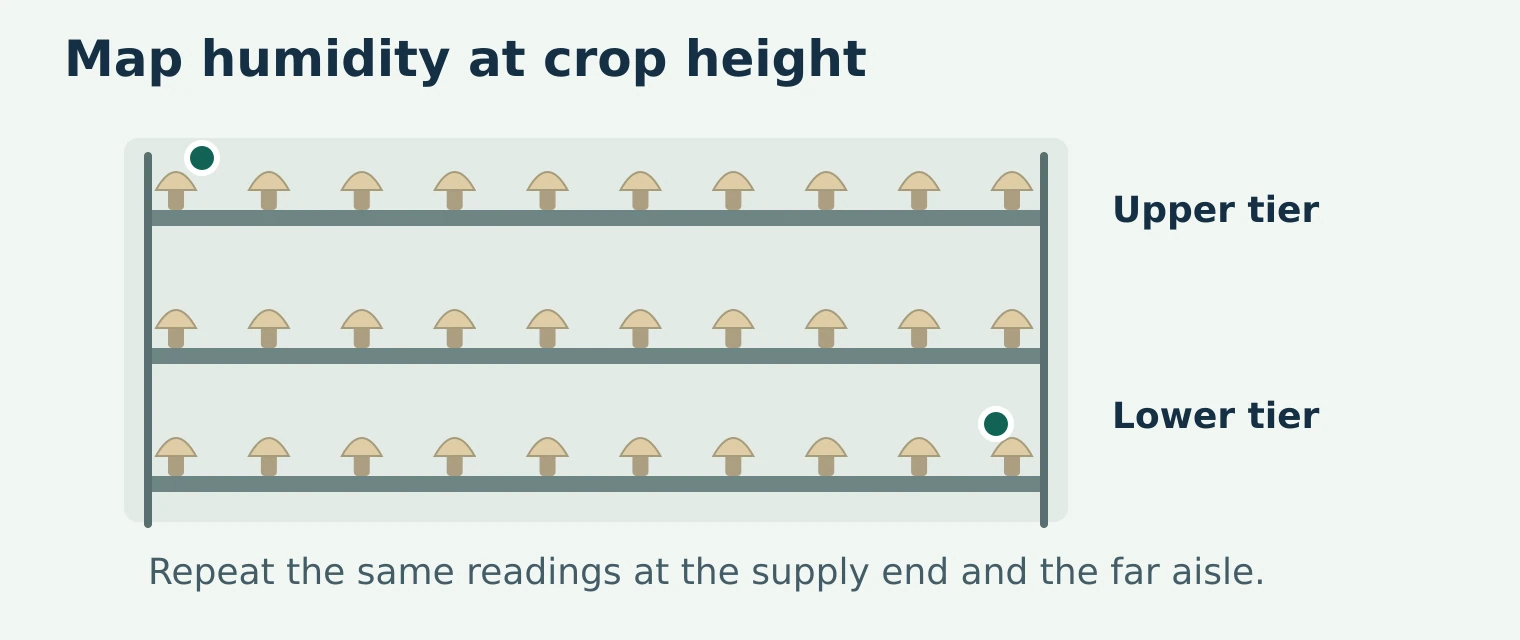
Mark a small set of repeatable locations on a room sketch. Include the supply end, far aisle, upper and lower tiers, and a point near the return. Keep a reference probe clear of direct discharge and wet surfaces. Record the mounting height, time interval and instrument identification. Synchronize the logger and controller clocks. Otherwise a short dip caused by a door opening can appear to precede the event.
A peer-reviewed Penn State study of Agaricus production rooms found that changing air distribution changed the temperature and humidity pattern across trays. The study supports checking several locations. Its results do not establish a universal crop setting or a yield gain from changing the duct layout.
For each point, note the lowest and highest RH, time outside the farm’s agreed band and the recovery time after a normal ventilation change. If the supply end recovers but the far aisle stays low, inspect distribution and obstructions. If the whole room dips together every time the outdoor-air rate rises, compare humidifier output with the incoming-air load. Use the fruiting-room sizing guide for that calculation.
Why fresh air changes the humidity load
In mushroom cultivation, fresh air exchange removes carbon dioxide and can also carry moisture out of the growing room. When outdoor air is drier than room air, more fresh air means more water must evaporate to hold the same humidity. Recirculating air across the racks redistributes moisture. Only the outdoor-air portion belongs in the ventilation moisture-load calculation.
If low humidity appears across every tier as the exhaust fan ramps up, compare the outdoor air and the humidifier output. If only one row of mushrooms dries out, look for a supply jet or a blocked aisle. Increasing humidity across the room can leave water droplets elsewhere while that row continues to dry.
Maintenance checks for the installed humidifier
Separate the humidifier, treatment equipment, sensors and room sanitation when assigning work. Each has its own service instructions and owner. The person who checks a filter differential may be different from the person who calibrates the reference instrument. Put the equipment identifier, check, acceptable condition and escalation contact in the shift log.
- During operation: record supply pressure under load, observed output, sensor readings, alarms and the first location where wetting or deposits appear. Note which other rooms were operating.
- At the planned service interval: inspect filters and treatment performance against the manufacturer’s instructions. Check for leaks, secure tubing and accessible isolation points. Record the actual readings and service date.
- Between crops: follow the farm’s approved cleaning and sanitation program. Verify the condition and placement of the RH sensor, then compare with a suitable reference. Repeat a rack-level check after a fan change, room expansion or nozzle relocation.
What to record for the next shift
A useful handover is short enough to use. Include the room and crop stage, target range, water sample location, affected racks and the time of the first symptom. Attach one trend covering the event and one photograph of the location. Record which intervention was tried and how the room responded under similar operating conditions. A log that says “raised humidity” leaves the next person guessing. “Far aisle recovered after airflow was restored; supply-end readings held steady” gives them a specific mechanism to check again.
For a design or retrofit review, bring room dimensions, rack layout, supply and exhaust airflow, minimum incoming-air conditions and the target at crop height. Include available water treatment and compressed-air capacity. Request a Smart Fog grow-room review.
Review a problem grow room
Bring your crop stage, rack layout, target humidity, outdoor-air flow and water-treatment readings. Note where wetting first appeared and what the ventilation was doing.