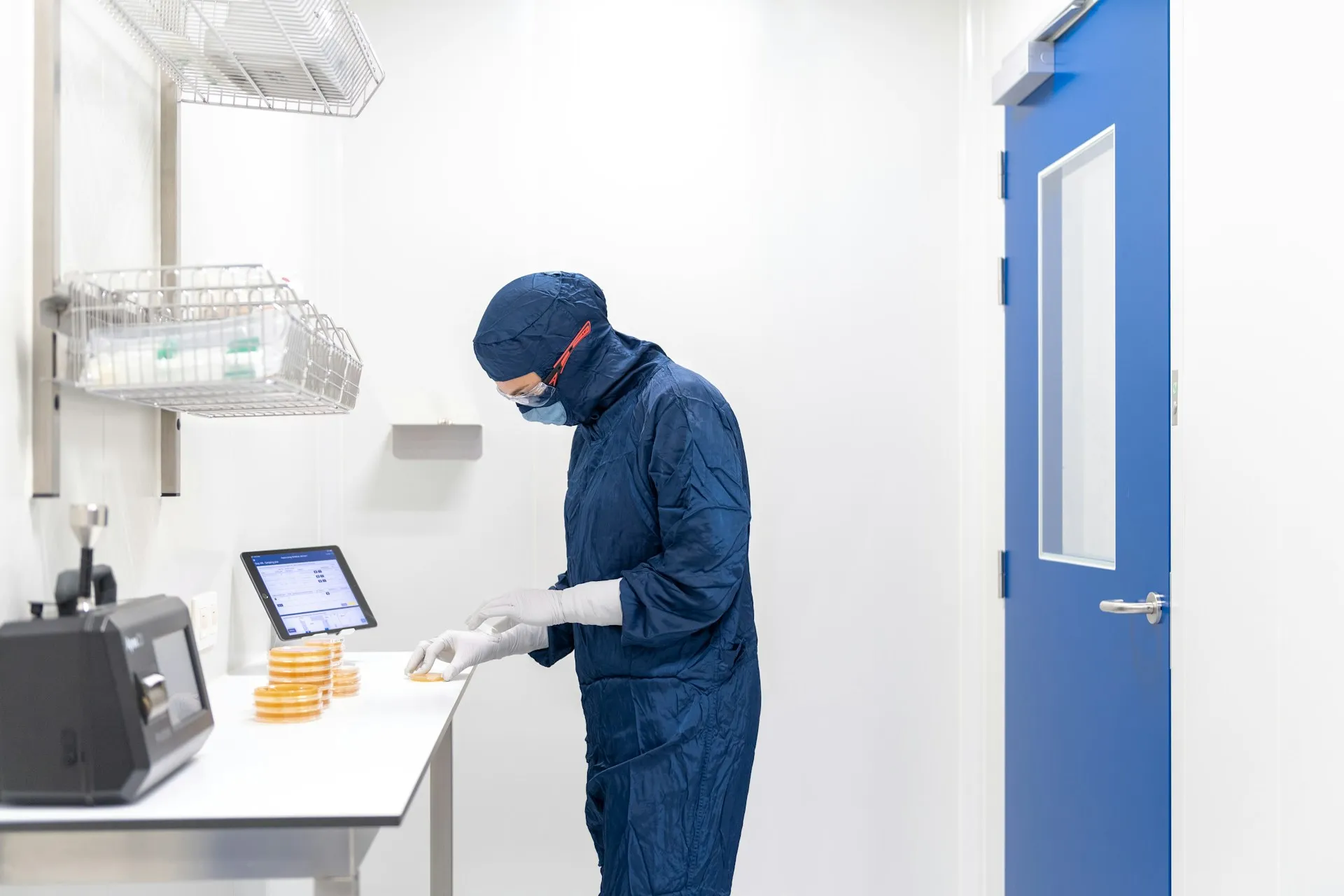


Commercial mold testing isn't a single test, it's a structured process combining air sampling, surface sampling, moisture assessment, and HVAC inspection, with results measured against action levels and followed by documented remediation and clearance. The stakes are higher than in a home: employer liability under federal workplace safety law, tenant health obligations, and building-scale HVAC systems all shape who conducts testing, how it's scoped, and what happens once results land. This article walks through the full process: which methods apply at which stage, what regulatory obligations commercial employers actually face, and how precision humidity control becomes the preventive measure once testing flags risk.
Key Takeaways
- Mold colonization in commercial buildings becomes viable when relative humidity (RH) is sustained above approximately 60%, making continuous humidity monitoring a measurable early-warning metric.
- Commercial mold testing and general indoor air quality (IAQ) testing are distinct scopes with different methods, diagnostic goals, and triggers for use.
- Air sampling methods are not interchangeable; spore trap sampling captures total airborne counts, PCR-based analysis identifies species by DNA, and viable sampling distinguishes live from dead mold spores.
- OSHA has no specific mold standard, but employers can be cited under the General Duty Clause (29 U.S.C. § 654(a)(1)) if mold constitutes a recognized workplace hazard.
- Post-remediation clearance testing is a required step under the IICRC S520 framework, not an optional verification, and must be conducted before affected areas return to full occupancy.
- Maintaining relative humidity levels below 60% RH through precision humidity control is the most operationally reliable strategy for preventing mold recurrence after remediation.
IAQ Testing vs. Mold Testing: Why the Distinction Matters in Commercial Facilities
These are two distinct assessments with different scopes, diagnostic goals, and methods. Conflating them leads facilities to either over-test or fail to identify the specific problem driving occupant complaints. Indoor air quality testing is a broad-scope assessment. It measures multiple contaminant categories including volatile organic compounds (VOCs), carbon dioxide (CO2), particulates, temperature, and relative humidity. It is the appropriate tool when the concern is general occupant health complaints or sick building syndrome patterns rather than a specific contamination source. Mold testing is a targeted assessment focused on airborne mold spores, surface colonization, and moisture conditions. It is used when visible mold, musty odor, water intrusion, or occupant health complaints concentrated in specific building zones suggest a biological contamination source. In practice, a commercial facility investigation often begins with general IAQ screening and escalates to mold-specific testing when results or site observations point to mold as the likely cause.
When to Request IAQ Testing
General indoor air quality testing is appropriate when the source of occupant complaints is unknown. Common triggers include new or escalating occupant health complaints without a clear origin, post-renovation air quality verification, HVAC system changes that may have altered airflow or filtration, and routine compliance documentation for building certification programs. This is the correct first step when the facility manager cannot yet identify whether the problem is biological, chemical, or ventilation-related.
When to Request Mold-Specific Testing
Mold-specific testing is warranted when the evidence points toward a biological contamination source. Specific triggers include persistent musty odor without a visible source, visible mold or water staining on surfaces, occupant complaints concentrated in specific building zones, post-flood or post-leak remediation verification, and HVAC system contamination concerns. A certified industrial hygienist can advise on whether mold testing is warranted after an initial site visit, before any sampling begins.
Warning Signs That a Commercial Facility May Have a Mold Problem
Facility managers conducting routine walk-throughs can identify mold risk indicators before air sampling is initiated. Recognizing these categories early reduces the cost and scope of investigation. Olfactory indicators:
- Persistent musty or earthy odor that does not resolve with increased ventilation, particularly when concentrated in specific rooms or HVAC return air zones
- Odor intensity that increases after HVAC cycles or during high-humidity periods
Visual indicators:
- Visible discoloration or surface growth on walls, ceilings, ductwork, or insulation
- Water staining that suggests past or ongoing moisture intrusion
- Building envelope moisture such as condensation on interior window surfaces or exterior wall assemblies
Occupant health patterns:
- Clustering of respiratory complaints, headache, or fatigue symptoms among occupants in specific building zones
- Symptoms that improve consistently when occupants leave the building, a documented pattern associated with sick building syndrome
Building condition indicators:
- History of flooding, plumbing failures, or roof leaks
- HVAC system contamination history or deferred maintenance on air handling units
- Older building age combined with evidence of inadequate vapor barrier installation
Using Relative Humidity Monitoring as an Early Warning Tool
Sustained relative humidity above approximately 60% RH creates the moisture conditions that support mold growth on building materials and HVAC components. Installing continuous RH monitoring at key points, including HVAC supply and return air locations and moisture-prone zones such as exterior wall adjacencies and basement-level spaces, provides measurable early warning before mold becomes visible or symptomatic. The 60% RH threshold is the broadly recognized facility management benchmark for mold risk. For more background on interpreting humidity readings in a facility context, see our article on what relative humidity levels mean for facility management.
Mold Testing Methods Used in Commercial Buildings
Commercial mold inspection involves four distinct testing methods, each serving a different diagnostic purpose. Understanding the differences allows facility managers to evaluate consultant proposals and ensure the scope of testing matches the actual concern.
Air Sampling
Air sampling captures what is present in the breathable air at the time of collection. The three primary approaches differ in what they detect and when each is appropriate. Spore trap sampling collects airborne particles on a sticky medium for microscopic analysis. It produces total spore counts by type and is the most common method for initial commercial mold inspection. A baseline outdoor air comparison must be collected simultaneously, because indoor counts cannot be interpreted in isolation. Indoor counts significantly exceeding outdoor baseline counts, or indoor detection of species absent outdoors, indicate a problem requiring further action. PCR-based analysis (including the Environmental Relative Moldiness Index, or ERMI) identifies mold species by DNA. It is appropriate when species identification matters for remediation decisions or liability documentation, particularly when mycotoxin-producing species such as Stachybotrys are suspected. Viable vs. non-viable sampling distinguishes live mold capable of continued growth from dead spores. Viable sampling is used when assessing active contamination; non-viable identifies both live and dead spores and is standard for post-remediation verification. All samples should be analyzed by a laboratory accredited under the AIHA Environmental Microbiology Proficiency Analytical Testing (EMPAT) program for defensible results.
Surface Sampling
Surface sampling identifies mold colonization at a specific location and is used when air sampling alone does not confirm the contamination source.
- Tape lift sampling is used for suspected surface growth on smooth, accessible materials such as drywall, ceiling tile, or ductwork surfaces.
- Swab sampling is used for irregular, porous, or recessed surfaces where tape lift contact is insufficient.
- Bulk sampling involves removing a physical sample of building material, most commonly for assessment prior to demolition or remediation scoping, when the extent of colonization within a wall assembly or substrate is unknown.
HVAC Duct Inspection and Sampling
HVAC systems are the primary distribution mechanism for mold spores in commercial buildings. A contaminated air handling unit or duct network will redistribute spores throughout the facility regardless of what surface remediation is performed. Duct sampling is conducted at supply and return registers using swab or tape lift methods, and at air handling unit components including coils, drain pans, and insulation surfaces. A positive duct result materially expands the remediation scope and cost. HVAC system contamination requires duct cleaning, component replacement, and verification sampling before the system returns to service. Facility managers should request HVAC sampling as part of any commercial mold assessment where the contamination source has not been definitively identified.
Moisture Assessment
Moisture assessment identifies the source condition that enabled mold growth. Without addressing the moisture source, remediation will fail. Tools used include thermal imaging to detect temperature differentials indicating moisture behind building surfaces, pin and pinless moisture meters for quantifying moisture content in building materials, and relative humidity measurement at supply and return air points. A moisture intrusion assessment is a diagnostic foundation, not a standalone mold test, but it is a required component of any complete commercial investigation.
Who Should Conduct Commercial Mold Testing
Commercial mold testing requires a qualified environmental professional. Credential categories are not equivalent, and the credential level should match the facility's liability exposure. Primary credential categories:
- Certified Industrial Hygienist (CIH), issued by the American Board of Industrial Hygiene (ABIH): the highest-tier credential for occupational environmental assessment and the most relevant for commercial employer settings with documented occupant health complaints or anticipated insurance involvement.
- Council-certified Indoor Environmental Consultant (CIEC), issued by the American Council for Accredited Certification (ACAC): specific to indoor environmental assessment and appropriate for facilities without anticipated litigation.
- State-licensed mold assessors: some states require separate licensure for mold inspection and remediation professionals; facility managers should confirm applicable state requirements before hiring.
For commercial facilities with documented occupant health complaints or anticipated insurance or legal involvement, a CIH-level assessment produces the most defensible documentation. Accredited laboratory analysis is required: samples must be analyzed by an AIHA EMPAT-accredited laboratory for results to carry evidentiary weight. One structural requirement applies regardless of credential level: the firm conducting the mold assessment must be independent from the remediation contractor. Combining these roles creates a conflict of interest that can complicate insurance claims and litigation outcomes.
What to Ask Before Hiring a Mold Assessor
Before engaging a mold assessor for a commercial facility, request clear answers to the following:
- What credentials do you hold, and what body issued them?
- Will samples be analyzed by an AIHA EMPAT-accredited laboratory?
- Do you provide a written assessment report with action levels and a remediation scope recommendation?
- Are you independent from any remediation contractor?
- Have you worked in commercial facilities of similar size and occupancy type?
OSHA, EPA, and the Regulatory Framework for Commercial Mold
OSHA has no specific mold standard, but that doesn't mean mold is unregulated. Under the OSHA General Duty Clause, 29 U.S.C. § 654(a)(1), employers must provide a workplace free from recognized hazards likely to cause death or serious harm, and OSHA has cited employers under this clause for mold-related IAQ failures, documented through NIOSH Health Hazard Evaluation reports. Discovering mold and taking no corrective action isn't protected just because no specific mold standard exists. The EPA publishes guidance for commercial and institutional buildings that doesn't carry regulatory force but is commonly used as a reference point in litigation and insurance disputes. OSHA covers the employer-employee relationship; EPA's guidance covers the physical facility, and both can apply in a mold dispute. Some states also have mold-specific regulations or disclosure requirements for commercial properties, worth confirming with legal counsel before remediation planning begins. One caution: ASTM E2418, a guide once used for evaluating readily observable mold in commercial buildings, was withdrawn in 2015. If a consultant or insurer references it, confirm with legal counsel what standard applies in its place today.
Liability Exposure for Commercial Landlords and Property Managers
Commercial landlords face additional exposure when mold is discovered in tenant-occupied spaces. Lease obligations, tenant health claims, and insurance coverage disputes all turn on whether the landlord responded appropriately and documented that response. Courts and insurance carriers generally evaluate landlord response against a reasonableness standard: was the problem identified promptly, was qualified testing conducted, and was remediation completed with documented clearance? Maintaining a documented testing and remediation record, including post-remediation clearance results, is the most effective way to limit liability exposure.
How to Interpret Mold Test Results and What to Do Next
Mold air sampling results are interpreted by comparing indoor spore counts to outdoor baseline samples taken simultaneously. There is no single federally established action level for commercial buildings, but the general principle used by industrial hygienists is that indoor spore counts significantly exceeding outdoor baseline counts, or indoor detection of species absent outdoors, warrant further investigation and likely remediation. The species present matters. Some species, such as Stachybotrys, are associated with higher mycotoxin production and may warrant more aggressive remediation scoping even at lower count levels. A written assessment report from a qualified assessor should include spore count data with outdoor comparison, species identification where applicable, moisture source findings, a remediation scope recommendation, and an explicit requirement for post-remediation clearance testing. A preventive remediation plan developed from this report gives the facility manager a documented basis for action. Without clearance testing confirming that conditions have returned to baseline, the remediation cannot be considered complete.
Post-Remediation Clearance Testing
The IICRC S520 Standard for Professional Mold Remediation defines the post-remediation verification protocol used by the industry. Clearance testing is conducted after remediation is complete by the assessor, not the remediator, maintaining the independence required for defensible documentation. A passing clearance result confirms that indoor spore counts have returned to outdoor baseline levels or below, that no elevated species remain, and that moisture conditions no longer support active growth. Affected areas should not return to full occupancy until clearance testing confirms these conditions. Some insurance carriers and large commercial tenants require documented clearance results as a condition of reoccupancy.
How Precision Humidity Control Prevents Mold Recurrence in Commercial Facilities
Mold requires sustained moisture conditions above approximately 60% RH to colonize building materials, HVAC components, and stored goods. Once a facility completes testing and remediation, the most effective long-term prevention strategy is maintaining relative humidity levels below that threshold with consistency and precision. The mechanism is direct: remove the moisture condition, and colonization cannot be sustained. The challenge in commercial facilities is that conventional humidification systems that overshoot target humidity or produce surface wetting can create the very conditions that enable mold recurrence. A system that maintains humidity precisely, without introducing surface moisture, eliminates this risk. For facility managers evaluating humidity control systems for commercial facilities after a mold finding, the relevant performance criteria are precision at the target RH level, non-wetting delivery, and consistent zone-level control across a large building footprint.
Non-Wetting Humidification and Why It Matters for Mold Risk
Conventional spray-based and poorly designed misting systems can create localized surface wetting, condensation on ductwork, and high-humidity zones adjacent to nozzles. These conditions actively promote mold growth rather than prevent it. Self-evaporating droplet technology, where each droplet is sized to evaporate before contacting any surface, delivers humidity to the target RH range without wetting surfaces, ductwork, or building materials under proper system design. This eliminates the moisture introduction risk that undermines less precise systems. Note that non-wetting applies to surfaces under proper system design; direct exposure to the fog stream will wet surfaces. Smart Fog systems use compressed air and water through a proprietary nozzle to produce an equal-sized droplet grid. Each droplet carries a slight charge that prevents re-aggregation, enabling full evaporation before surface contact. For facilities evaluating HVAC humidification systems for post-remediation installation, this operating principle is directly relevant to mold prevention outcomes. A broader overview of available technologies is available through the commercial humidification systems overview.
Maintaining the 60% RH Threshold Across Commercial Building Zones
Commercial facilities present the challenge of humidity variability across zones. HVAC supply and return air locations, exterior wall adjacencies, and high-occupancy areas can each create localized humidity spikes that exceed the 60% RH mold threshold even when building-average humidity appears controlled. Smart Fog systems maintain humidity up to the target level with plus or minus 1-2% precision, enabling consistent facility-wide control without manual intervention. For facility managers who want to understand how different system configurations address zone-level humidity variation, how humidity control works and which system to choose provides a detailed technical comparison.
Final Thoughts
Commercial mold testing is a multi-step process requiring the right methods in the right sequence: general IAQ screening when the source is unknown, targeted mold testing when evidence points to biological contamination, qualified assessors independent from remediation contractors, and post-remediation clearance testing before reoccupancy. The regulatory landscape does not protect employers or landlords who discover mold and take no action. The 60% RH threshold is measurable, actionable, and the most direct preventive lever available to a facility manager once testing and remediation are complete. Facilities that complete remediation without addressing the humidity conditions that enabled mold growth will face recurrence. Precision humidity control that maintains RH below the mold-enabling threshold, without introducing surface moisture, is the operational conclusion that a complete mold management program requires. To discuss maintaining precise humidity levels in a commercial facility as a mold prevention strategy, contact Smart Fog engineers for a system assessment tailored to the facility's zone layout and humidity control requirements. Consult a Humidity Expert
Frequently Asked Questions
How often should commercial buildings test for mold in indoor air?
Commercial buildings do not have a federally mandated testing frequency for mold. Most industrial hygienists recommend indoor air quality testing on an annual basis as part of a routine IAQ program, with additional mold-specific testing triggered by specific events: visible mold or water intrusion, occupant health complaints concentrated in specific zones, post-remediation verification, or any HVAC system contamination finding. Facilities in high-humidity climates or with aging building envelopes may benefit from more frequent moisture monitoring between formal testing cycles.
What are the signs that a commercial facility may have a mold air quality problem?
The primary indicators are a persistent musty or earthy odor that does not resolve with ventilation, visible discoloration or surface growth on walls, ceilings, or ductwork, and occupant health complaints such as respiratory symptoms or fatigue that improve when employees leave the building. Building condition factors including past flooding, plumbing failures, or HVAC system contamination history also elevate risk. Sustained relative humidity above 60% RH, measured at HVAC supply and return air points, is a measurable early-warning indicator that warrants investigation before symptoms develop.
What is the difference between air sampling and surface sampling for mold in a commercial building?
Air sampling captures the concentration and types of mold spores present in breathable air at the time of collection. It is used to assess exposure levels and identify whether elevated spore counts exist relative to an outdoor baseline. Surface sampling identifies mold colonization at a specific location on a building material or surface, using tape lift, swab, or bulk methods depending on the substrate. The two methods serve different diagnostic purposes: air sampling assesses what occupants are breathing, while surface sampling confirms whether a specific surface is a contamination source and helps scope remediation boundaries.
How much does professional indoor air quality mold testing cost for a commercial building?
Professional mold testing costs in commercial buildings vary based on building size, number of sample locations, laboratory analysis requirements, and assessor credential level. A basic commercial assessment including air and surface sampling with laboratory analysis typically ranges from several hundred to several thousand dollars. Facilities with documented occupant health complaints or anticipated insurance involvement should engage a certified industrial hygienist, whose assessment will carry greater evidentiary weight and may cost more than a general inspector, but reduces liability exposure significantly.
What mold spore count levels are considered unsafe in a commercial facility?
There is no single federally established unsafe spore count level for commercial buildings. Results are interpreted relative to a baseline outdoor air comparison collected simultaneously. As a general principle applied by industrial hygienists, indoor spore counts that significantly exceed outdoor baseline counts, or indoor detection of species absent from the outdoor sample, indicate a problem warranting further investigation and likely remediation. The species present also matters: mycotoxin-producing species such as Stachybotrys may warrant more aggressive action at lower count levels than common environmental molds.
Does OSHA require commercial employers to test for mold?
OSHA has no specific standard mandating mold testing. However, under the General Duty Clause (29 U.S.C. § 654(a)(1)), employers are legally required to address recognized workplace hazards. OSHA has cited employers for mold-related indoor air quality failures under this clause. Discovering mold and taking no corrective action does not protect an employer simply because no specific mold testing mandate exists. Facilities with documented occupant health complaints attributable to mold should consult a certified industrial hygienist and initiate testing and remediation as part of a defensible response.
What is post-remediation clearance testing and is it required after commercial mold remediation?
Post-remediation clearance testing is a verification step conducted after mold remediation is complete. It confirms that indoor spore counts have returned to outdoor baseline levels or below, that no elevated species remain, and that moisture conditions no longer support active growth. The IICRC S520 Standard for Professional Mold Remediation defines the verification protocol used by accredited assessors. Clearance testing must be conducted by the assessor, not the remediator, to maintain independence. Affected areas should not return to full occupancy until clearance results confirm adequate remediation. Some insurance carriers and large commercial tenants require documented clearance results before reoccupancy.
At what relative humidity level does mold begin to grow in commercial buildings?
Mold colonization in commercial buildings becomes viable when relative humidity is sustained above approximately 60% RH on building materials and surfaces. This threshold is the broadly recognized facility management benchmark for mold risk. Keeping RH consistently below 60% through precision humidity control is the most operationally reliable strategy for preventing mold growth on building materials, HVAC components, and stored goods. Monitoring RH continuously at HVAC supply and return air points and in moisture-prone zones gives facility managers a measurable early-warning indicator before visible mold or occupant symptoms develop.