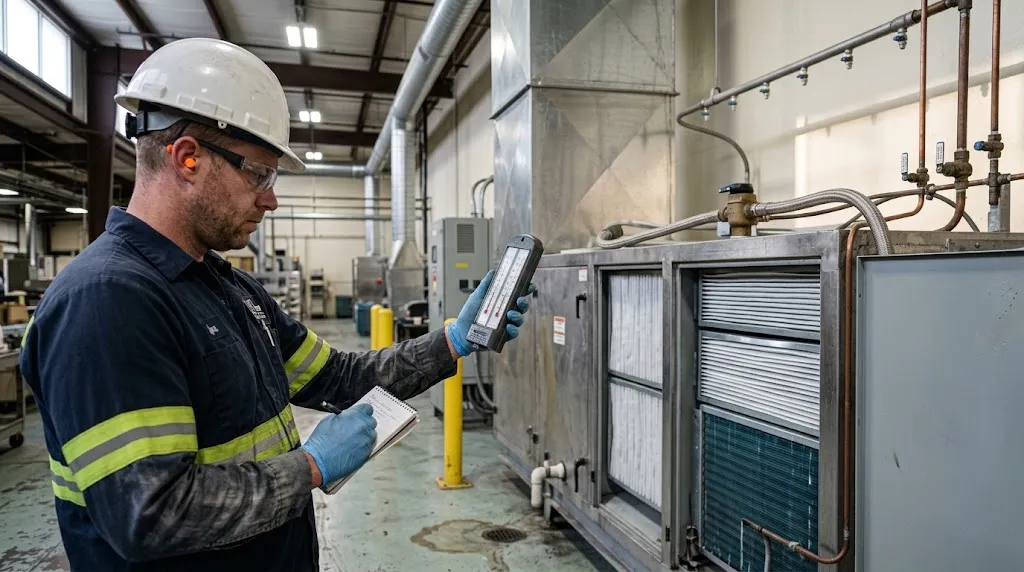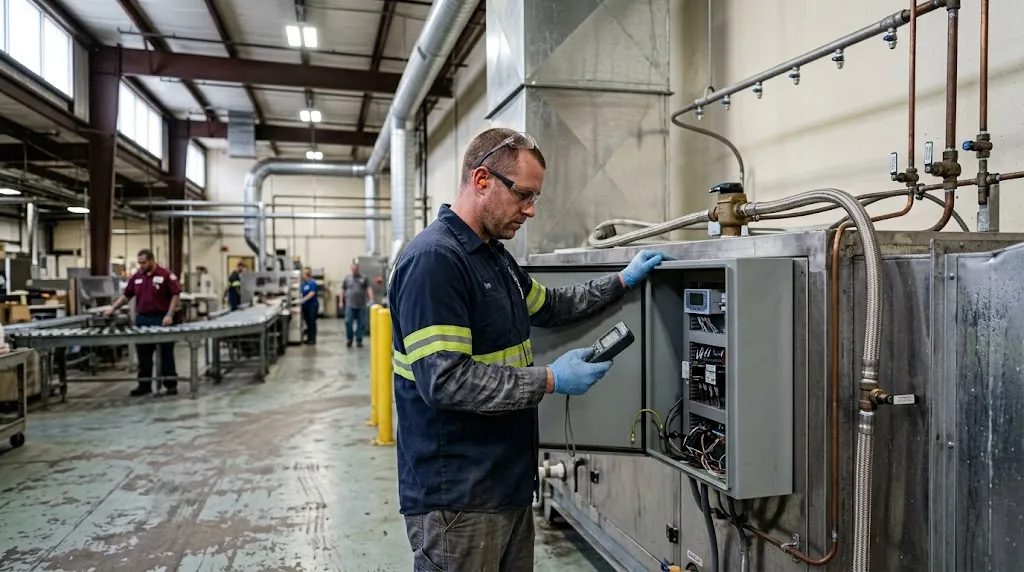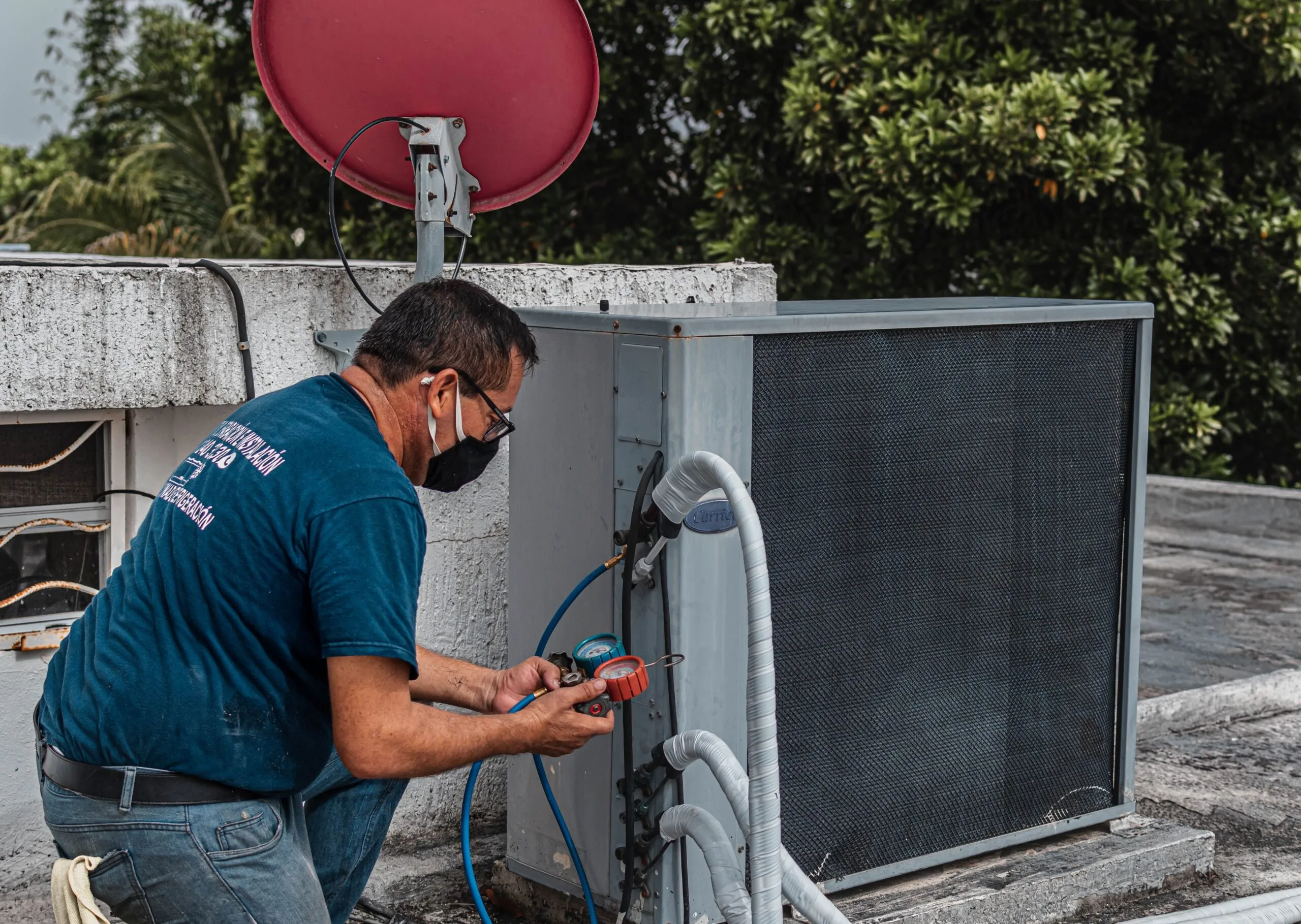


Condensation on cold surfaces is prevented by keeping the surface temperature above the dew point of the surrounding air, or by reducing the moisture content of the air enough that its dew point drops below the surface temperature. Both levers are available; choosing between them depends on the surface type, the facility context, and whether the cold condition is intentional or incidental.
This article covers the physics of surface condensation, the dew point threshold as a practical design tool, and a surface-by-surface breakdown of prevention methods applicable to pipes, windows, AC vents, and cold industrial equipment.
Key Takeaways
- Condensation forms on any surface whose temperature falls at or below the dew point of the surrounding air, regardless of surface material or the reason the surface is cold.
- At 70°F and 60% relative humidity (RH), the dew point is approximately 55°F, meaning any surface at or below that temperature will collect moisture.
- Insulation prevents condensation on cold pipes and ducts by raising the outer surface temperature above the dew point, but only vapour-impermeable insulation blocks moisture migration to the cold surface beneath.
- Thermal bridging through structural elements such as steel lintels and concrete columns creates localised cold spots that fall below the dew point independently of HVAC performance.
- In most commercial spaces, keeping indoor RH at or below 50 to 55% is sufficient to avoid condensation, since surface temperatures rarely drop below the low 50s°F under normal operation.
- Precision humidity control holds the dew point margin continuously, protecting all cold surfaces simultaneously rather than addressing individual condensation points one at a time.
Why Condensation Forms on Cold Surfaces
Condensation occurs when water vapor in the air contacts a surface whose temperature is at or below the dew point. The dew point is the temperature to which air must be cooled, at constant pressure and constant water vapour content, for saturation to occur and liquid water to appear on a surface. For any given combination of indoor temperature and RH, there is a corresponding dew point, and any surface below that threshold will collect condensation.
As a concrete reference: at 70°F and 60% RH, the dew point is approximately 55°F. Any surface at or below 55°F in those conditions will sweat. ASHRAE Standard 160, which governs moisture control criteria for building envelope performance, provides the dew point and moisture thresholds that engineers use to assess condensation risk in building assemblies.
The practical implication is that condensation is not simply caused by “too much humidity” in isolation. It is caused by the margin between surface temperature and dew point collapsing to zero. This distinction justifies surface-specific interventions. Lowering the RH throughout a space is one valid tool, but raising the surface temperature is equally valid, and in many industrial contexts it is the only practical option.
The Dew Point as a Prevention Threshold
Facility managers and building professionals can use the dew point as a direct design parameter. Calculate it from ambient dry-bulb temperature and RH using standard psychrometric relationships or the dew point calculator, then compare it against the measured surface temperature of the cold element in question.
The goal is to maintain a positive margin between the two. For a deeper treatment of how dew point and humidity relate as separate but connected variables, that relationship is covered in the linked resource.
The Role of Relative Humidity in Setting the Dew Point
Relative humidity and dry-bulb temperature together determine the dew point of the air. As indoor RH rises, the dew point rises, narrowing the margin to any cold surface in the space. Understanding relative humidity as a variable that directly controls dew point elevation is central to selecting the right intervention.
Managing indoor humidity levels is one of the two levers available; the other is raising the surface temperature. Both work, and the facility context determines which is more practical.
Surface-Specific Causes of Condensation
Condensation on different cold surface types has distinct causes and requires distinct fixes. A single-point intervention applied to the wrong surface type will not resolve the problem. The sections below cover four surface categories, identifying the cause of coldness, the indoor conditions that elevate risk, and the failure mode that results if condensation is not controlled.
Cold Pipes, Tanks, and Chilled Lines
Chilled water pipes, refrigerant lines, and cold storage tanks have surface temperatures that are deliberately maintained below ambient. This makes them inherently condensation-prone in any humid environment, regardless of indoor conditions.
The failure mode is corrosion beneath insulation and mold and mildew on pipe exteriors, both of which cause structural damage to pipe supports and equipment. Because the cold condition is intentional, humidity reduction alone is insufficient; insulation is the primary tool.
AC Vents and Supply Ductwork
AC supply vents become cold because conditioned air passing through them cools the metal or plastic surface. Condensation appears when room air carrying high moisture in the air contacts the cold vent face. Contributing factors include elevated indoor humidity levels, restricted airflow that reduces supply air volume and increases vent dwell time, and poorly insulated ductwork that allows cold to conduct outward along the duct wall. The result is dripping vents, ceiling staining, and mold and mildew growth around supply registers.
Windows, Glazing, and Window Frames
Condensation on windows is driven by the thermal performance of the glazing assembly. Single-pane glass conducts cold inward most readily, while double-glazed windows with low-emissivity coatings maintain a warmer inner surface.
Window frames, particularly aluminium, act as thermal bridges at the perimeter if they are not thermally broken, creating cold edge zones where condensation appears even when the glazing itself remains above the dew point.
Metal Roofs, Structural Elements, and Thermal Bridges
Thermal bridging creates localised cold spots that are independent of HVAC performance or any deliberate surface cooling. Steel lintels, concrete beams, and uninsulated structural steel conduct cold inward through walls, producing surface temperatures significantly lower than surrounding areas and triggering condensation at predictable locations. ISO 10211:2017, Thermal bridges in building construction is the standard calculation framework for identifying heat flows and surface temperature drops at thermal bridges. These cold spots require targeted insulation or surface treatment, not whole-room humidity reduction alone.
How to Prevent Condensation on Cold Surfaces: Methods by Type
The six prevention methods below move from the most targeted surface-level interventions to the most systemic. Each method is defined by its mechanism, its applicable surface types, and any implementation caveats that determine whether it will succeed or fail.
- Insulation wrapping to raise surface temperature. Applicable to pipes, tanks, and ducts, insulation raises the outer surface temperature above the dew point by resisting heat transfer between the cold surface and warm ambient air. The critical caveat is vapour permeability, covered in the H3 below. Closed-cell elastomeric foam insulation is the standard specification for cold pipe applications.
- Vapour barriers. A vapour barrier applied over insulation or at building envelope junctions blocks moisture migration into wall assemblies and insulation layers. Without a vapour barrier, water vapor diffuses inward through permeable insulation and condenses at the cold surface beneath, causing hidden corrosion and insulation degradation.
- Surface heating. Trace heating tape and electric panel heaters raise surface temperature directly above the dew point. This method applies to pipes, tanks, and condensation-prone structural elements where insulation alone is impractical or insufficient, such as outdoor pipe runs or exposed steel frames.
- Improved or upgraded glazing. Replacing single-pane glass with double-glazed windows fitted with low-emissivity coatings raises the inner surface temperature. Thermally broken frames eliminate the conductive edge path that causes perimeter condensation even when the glazing centre remains dry.
- Anti-condensation paint or coatings. Anti-condensation paint absorbs surface moisture and releases it slowly, reducing visible condensation at the surface. This is a symptom management tool, not a root cause fix. It does not alter the dew point margin; it buffers the visible effect of the margin collapsing. It is appropriate as a supplementary measure on structural surfaces where root cause intervention is not cost-effective.
- Mechanical ventilation and humidity control. Reducing indoor RH lowers the dew point of the air and widens the margin to every cold surface in the space simultaneously. ASHRAE Standard 62.2 specifies minimum ventilation rates for residential applications; ASHRAE 55 governs acceptable thermal environmental conditions for commercial and occupied industrial spaces.
An extractor fan used in high-moisture zones such as kitchens or process areas can reduce localised humidity, but a mechanical ventilation with heat recovery (MVHR) system provides continuous dilution across the whole space. For industrial environments, a dehumidifier can actively remove moisture in the air to lower RH, though in contexts where specific humidity levels must be maintained within a defined range, precision humidity control systems provide more reliable management than passive ventilation alone.
Choosing the Right Insulation: Why Vapour Permeability Matters
Not all insulation materials perform equally on cold surfaces. Vapour-permeable insulation allows water vapour to diffuse inward toward the cold surface, where it reaches the dew point and condenses inside the insulation layer. That trapped moisture degrades the insulation thermally and can cause corrosion on the pipe or surface beneath, accelerating structural damage from the inside without visible external signs.
Vapour-impermeable closed-cell foam, such as closed-cell polyisocyanurate or elastomeric foam, blocks vapour migration and keeps the cold surface dry. NAIMA (North American Insulation Manufacturers Association) guidance addresses vapour permeability as a primary selection criterion for cold-surface insulation.
Mechanical Ventilation and Humidity Control as Systemic Prevention
Surface-level interventions address individual condensation points but do not reduce the overall moisture load in the space. MVHR continuously dilutes indoor air by exchanging it with drier outdoor air, reducing RH and lowering the dew point throughout the facility or building.
For more detail on how to approach facility-wide moisture management, the guide on controlling humidity covers the full range of available methods. Maintaining indoor RH in the 40 to 60% range for typical commercial environments provides a reliable margin between the dew point and most surface temperatures encountered in normal building operation. Industrial facilities may also use process exhaust, supply air management, or precision humidity control systems to achieve equivalent or tighter moisture reduction where surface temperature conditions demand it.
What Humidity Level Prevents Condensation?
There is no universal answer because the safe RH threshold depends on the temperature of the coldest surface in the space. For typical commercial and industrial environments where surface temperatures rarely fall below 50 to 55°F under normal operating conditions, maintaining indoor RH at or below 50 to 55% provides a reliable condensation margin. For cold storage environments, data center hot aisle and cold aisle configurations, or any space with deliberately chilled surfaces, the required RH limit is lower and must be calculated from the actual surface temperature using the dew point approach described earlier.
ASHRAE Standard 55 defines acceptable RH ranges for occupied spaces in commercial buildings. ASHRAE Standard 160 provides moisture control thresholds for building envelope assemblies. Both standards are relevant when setting humidity targets for condensation prevention, as the target range is surface-temperature-dependent, not fixed.
How to Calculate the Safe RH Limit for Your Facility
A practical three-step framework applies in most facility contexts:
- Measure the coldest surface: use a non-contact infrared thermometer to find the temperature of the coldest surface in the space.
- Find the corresponding RH threshold: use a psychrometric chart or dew point calculator to determine what RH level at current indoor temperature corresponds to that surface temperature as the dew point.
- Set the target with a safety margin: set the RH control target at least 5 percentage points below that level to maintain a reliable buffer.
Reassess when outdoor conditions change seasonally, when cold equipment operating setpoints change, or when facility occupancy or process loads shift materially.
How Precision Humidity Control Prevents Condensation in Industrial Facilities
Controlling the moisture content of the air with plus or minus 1 to 2% RH precision gives facility managers a reliable tool for holding indoor RH below the condensation threshold for specific cold surfaces. The precision matters because a system that drifts above the target triggers moisture events; one that drifts below it may cause static discharge or product damage in environments where a minimum humidity level is also required. Precision control holds the dew point margin continuously, not just when conditions are ideal. In cold storage facilities, data centers, and pharmaceutical cold rooms, that stability is operationally significant.
In industrial contexts, a dehumidifier can lower ambient RH, but it does not hold a specific target with the same precision that a closed-loop humidity control system provides. The HVAC humidification systems approach integrates humidity control into the air handling infrastructure, providing facility-wide stability rather than point-source moisture management.
Controlling Humidity Without Adding Wetting Risk
Some humidification technologies introduce condensation risk of their own. Steam systems can produce localised high-humidity zones near diffusers. High-pressure misting systems can deposit droplets on cold surfaces near nozzles, adding moisture at the very points where condensation is already a risk.
A system that produces self-evaporating droplets from an equal-sized droplet grid addresses this problem at the mechanism level. The droplets evaporate before reaching any surface, meaning the humidification system itself does not contribute to surface wetting or localised condensation events.
This is the operating principle behind Smart Fog’s industrial systems. Surfaces remain dry under proper system design, making precision humidity control viable in environments where cold surfaces must stay dry, including cold storage humidification and data center humidification.
Note: Direct exposure to the fog stream, such as placing a hand into it, will wet the surface; the non-wetting characteristic applies to surfaces under proper system design.
Maintaining the Dew Point Margin Continuously
Condensation risk is not static. It changes with outdoor conditions, occupancy levels, equipment load, and seasonal variation. A system that holds RH within a narrow band provides a consistent dew point margin regardless of external variation. Smart Fog systems are designed to maintain humidity up to 99% RH with plus or minus 1 to 2% precision in continuous 24/7 industrial operation.
Key performance characteristics relevant to condensation control:
- Precision: Plus or minus 1 to 2% RH precision, allowing facility managers to set a target below the condensation threshold and hold it without manual adjustment.
- Non-wetting operation: Self-evaporating droplets evaporate before reaching surfaces, so the humidification system does not add to surface moisture load.
- Continuous operation: Designed for 24/7 industrial use, maintaining the dew point margin through occupancy shifts, seasonal changes, and equipment load variation.
- No moving parts: No moving parts in the humidification process, reducing maintenance intervals and reliability risk in environments where system downtime affects condensation control.
Final Thoughts
Condensation on cold surfaces is a physics problem with an engineering solution. The controlling variable is always the margin between surface temperature and the dew point of the surrounding air. Surface-level interventions, insulation, vapour barriers, surface heating, and upgraded glazing, address individual condensation points by raising the surface temperature side of that margin. Systemic humidity control addresses the dew point side, protecting all cold surfaces simultaneously.
For industrial facilities where cold surfaces are intentional and continuous, such as chilled water lines in data centers, cold storage equipment, and pharmaceutical process rooms, surface-level fixes alone are insufficient. Holding indoor RH within a defined, stable range using a precision system provides the systemic foundation that surface interventions build on. The two approaches are complementary, not competing.
Facilities managing condensation risk around cold equipment and cold surfaces can speak with a Smart Fog engineer to review humidity control specifications for cold storage environments, data centers, and manufacturing facilities where condensation tolerance is low and precision matters.
FAQ
What causes condensation on cold surfaces?
Condensation forms when a surface temperature drops to or below the dew point of the surrounding air. The dew point is determined by indoor temperature and relative humidity combined. When warm, moisture-laden air contacts a cold surface, the air at that surface cools to its dew point and water vapour converts to liquid. The root cause is always a negative margin between surface temperature and dew point, not simply high humidity in isolation.
How do I stop condensation on cold water pipes?
Condensation on cold water pipes is stopped by wrapping the pipe with vapour-impermeable insulation. The insulation raises the outer surface temperature above the dew point of the surrounding air, preventing moisture in the air from reaching the cold pipe surface. Use closed-cell elastomeric foam or equivalent vapour-impermeable material; vapour-permeable insulation allows moisture to migrate inward and condense at the pipe itself, causing hidden corrosion.
Does insulation prevent condensation on pipes and ducts?
Insulation prevents condensation on cold pipes and ducts only if it is vapour-impermeable. The insulation works by raising the outer surface temperature above the dew point, but vapour-permeable materials allow water vapour to diffuse through to the cold inner surface where it condenses inside the insulation layer. Closed-cell foam insulation blocks this moisture migration path and is the correct specification for cold-surface applications.
What indoor humidity level prevents condensation on cold surfaces?
There is no universal target because the safe relative humidity level depends on the temperature of the coldest surface in the space. In most commercial and industrial buildings where surfaces rarely fall below 50 to 55°F, maintaining indoor RH at or below 50 to 55% provides a reliable condensation margin. For cold storage rooms, data centers, or spaces with deliberately chilled equipment, the required RH limit is lower and must be calculated from the actual surface temperature using a dew point calculation.
What is thermal bridging and why does it cause condensation?
Thermal bridging occurs when a highly conductive structural element, such as a steel lintel, concrete column, or uninsulated metal frame, conducts cold inward through a wall or building assembly, creating a localised surface temperature significantly lower than surrounding surfaces. That cold spot can fall below the dew point of indoor air even when the surrounding wall does not, triggering condensation at a predictable location. ISO 10211 provides the calculation framework for identifying thermal bridge-induced surface temperature drops.
Is condensation on walls a sign of poor ventilation or high humidity?
Condensation on walls is typically caused by both factors together. High indoor humidity levels raise the dew point of the air, and poor ventilation or air circulation allows moisture to accumulate near cold surfaces rather than being diluted by drier supply air. In buildings with thermal bridges, condensation can appear on walls even at moderate humidity levels. An extractor fan in high-moisture zones reduces localised humidity, while mechanical ventilation with heat recovery addresses the whole-building moisture load.
What is the difference between a vapour barrier and pipe insulation for condensation control?
Pipe insulation raises the outer surface temperature of a cold pipe above the dew point, preventing condensation from forming on the insulation exterior. A vapour barrier is a separate component, applied over or within the insulation assembly, that blocks water vapour from migrating through permeable insulation toward the cold pipe beneath. Both are often required together: insulation for thermal resistance and a vapour barrier for vapour permeability control. Omitting the vapour barrier from a cold-pipe insulation assembly can result in internal condensation and corrosion that is invisible from the outside.
How do I calculate the dew point to prevent condensation in my facility?
Measure the temperature of the coldest surface in the space using a non-contact infrared thermometer. Then use a psychrometric chart or online dew point calculator to determine what relative humidity at the current indoor temperature would set the dew point equal to that surface temperature. From there, back off the RH setpoint by at least 5 percentage points to keep a working safety margin. Reassess the calculation seasonally and whenever cold equipment setpoints or occupancy patterns change.