

 Made in USA

Commercial greenhouse humidity control requires coordinated mechanical systems, not isolated interventions. The humidity load from crop evapotranspiration in large structures exceeds what any single method can manage reliably. That load also shifts across the day, across seasons, and across crop growth stages.
This article covers four coordinated systems. They are ventilation and heating, along with dehumidification and precision humidification. It also explains vapour pressure deficit (VPD) as the operative climate metric.
The closing sections cover automation and sensor integration, plus the failure modes of reactive management. This guide serves facility managers who are evaluating whether their current setup can sustain year-round production targets.
Key Takeaways
- Commercial greenhouses generate continuous humidity load from crop evapotranspiration. In a large production facility, that can release hundreds of gallons of water vapor per day. Reactive humidity management is therefore insufficient for stable climate control.
- Vapour pressure deficit (VPD), not raw relative humidity (RH), is the operative metric in commercial controlled environment agriculture. It accounts for the interaction between temperature and humidity that governs actual plant transpiration rates.
- Botrytis cinerea becomes active above approximately 85% RH. It can establish in localized microclimates even when the ambient hygrometer reads lower. Surface condensation on glazing and structural frames is therefore a separate risk that air humidity monitoring alone does not capture.
- Industrial ventilation systems control humidity through calculated air exchange rates, not manual venting. Exhaust fans and ridge vents are sized against the facility's total volume and crop transpiration load.
- Precision fogging systems serve a dual function in commercial greenhouses. They add humidity during low-RH periods to maintain VPD targets. Adiabatic evaporative cooling during high-temperature periods comes as a second benefit, without wetting plant surfaces or structural components under proper system design. Direct exposure to the fog stream will still wet a surface.
- Integrated climate control systems connect humidity sensors, temperature sensors, and actuators across ventilation, heating, dehumidification, and humidification. They automate the humidity response rather than relying on operator intervention. Year-round production needs bidirectional control, meaning both humidity addition and removal.
Why Humidity Is Harder to Control at Commercial Scale
Methods that work in a single-bay greenhouse fail at production scale. A multi-acre facility has entirely different air volumes, surface-area-to-volume ratios, and heat loss profiles. Those factors affect how quickly humidity builds and how hard it is to exhaust.
The humidity load also changes across the day and across seasons. That creates dynamic management demands that no single method meets.
Evapotranspiration as the Primary Humidity Load
The dominant humidity source in a commercial greenhouse is not irrigation or leaks. It is the crop canopy. Through evapotranspiration, plants continuously release moisture into the surrounding air as part of normal biological function.
A dense commercial crop covering a large growing area transpires significant water volume every day. That moisture accumulates faster than passive air exchange can exhaust it. Managing it takes active mechanical systems, not reactive interventions.
Seasonal Variation and Dynamic Load Shifting
The humidity management problem in a commercial greenhouse is not static. In summer, high ambient humidity combined with continuous crop transpiration creates excess moisture and heat stress. In winter, cold infiltration air enters dry. Heating the structure then reduces relative humidity sharply, sometimes below the range required for healthy transpiration.
Year-round commercial production therefore requires bidirectional humidity control. The facility needs the capacity to remove excess moisture and to add it when conditions fall short of target.
Vapour Pressure Deficit: The Metric Commercial Growers Actually Use
Relative humidity tells you what percentage of the air's moisture-holding capacity is currently occupied. It does not tell you how much moisture the air can still absorb. Nor does it show how strongly that air is pulling moisture from your plants.
VPD solves that problem. It is the difference between the moisture content the air currently holds and the maximum it could hold at the current temperature. It is the actual driver of plant transpiration.
Low VPD reduces transpiration and nutrient uptake. Excessively high VPD causes plant stress and accelerated water loss. Commercial controlled environment agriculture (CEA) operations therefore target specific VPD ranges rather than fixed RH percentages.
A single RH reading can give different VPD values at different temperatures. For most greenhouse crops, 0.8 to 1.2 kPa is a commonly cited VPD range during active growth. The right target still varies by species and growth stage. Our guide on VPD chart for cannabis and controlled environment crops covers crop-specific reference data.
How VPD Interacts With Heating and Ventilation Decisions
This interaction is where humidity management decisions often go wrong. Heating the greenhouse to reduce RH increases the air's moisture-holding capacity. VPD rises at the same time.
If that VPD increase is not compensated by adding humidity, the climate can overshoot the target range. Crops are then placed under transpiration stress.
Heating alone is therefore an incomplete humidity management strategy. Commercial facilities need integrated humidification and dehumidification operating in coordination, not separate reactive systems.
Method 1: Ventilation Systems for Humidity Removal
Ventilation removes humidity by exhausting moist interior air and replacing it with drier exterior air. In commercial facilities, this process must be engineered, not managed manually. The system is sized against facility volume, crop transpiration rate, and the air exchange rate needed to prevent moisture accumulation.
Ventilation has clear limits. It depends on the weather and introduces uncontrolled external air. Outside air may itself carry high humidity in summer. Ventilation also cannot raise humidity during dry periods.
Air circulation within the structure is a separate function from exhaust ventilation. Horizontal airflow fans move air through the canopy without exhausting it. That reduces humidity stratification near the crop surface.
Natural Ventilation Design for Large Greenhouses
Natural ventilation uses ridge vents and sidewall openings to drive passive air exchange through the stack effect. Warm, moist air rises and exits through the ridge. Cooler exterior air enters through sidewall openings. Vent sizing is calculated against facility volume and crop load.
In tall greenhouse structures, the stack effect can provide meaningful passive exchange rates. Natural ventilation alone is still typically insufficient for large commercial facilities.It depends on external wind and temperature. Control is also too unreliable to hold VPD targets during humid summers.
Mechanical Ventilation and Exhaust Fan Sizing
Commercial mechanical ventilation systems use exhaust fans sized to deliver a calculated number of air changes per hour relative to facility volume. Fan placement affects stratification in tall structures. Poorly placed exhaust points leave humid air trapped in the canopy zone.
Mechanical ventilation is the primary humidity reduction tool in commercial greenhouses. It integrates with automated climate controllers, and sensor inputs rather than operator scheduling trigger fan operation.
One tradeoff matters. Ventilation can over-exhaust during cold or dry conditions. That drives temperature and humidity below VPD targets and undoes the work of the heating and humidification systems.
Method 2: Heating to Manage Relative Humidity
Heating reduces relative humidity not by removing moisture from the air but by increasing the air's capacity to hold it. When air temperature rises, the same absolute moisture content represents a lower percentage of saturation. Commercial greenhouses therefore use heating as a first-line humidity reduction strategy during cold, humid periods.
Perimeter and overhead heating systems warm the greenhouse structure and raise air temperature across the space. Hot water pipe systems and forced-air unit heaters are both used in commercial facilities. Their distribution profiles differ. That affects humidity stratification.
The limitation is that heating raises VPD at the same time. Without compensatory humidification, heating can push the climate outside the optimal growth range even while it lowers RH readings.
Condensation on Structural Surfaces as a Separate Risk
Ambient RH can read within an acceptable range while condensation forms on cold glazing, metal frame members, and drip irrigation lines. On these cold surfaces, local RH effectively reaches 100%.
Condensation zones are primary infection sites for Botrytis cinerea and other fungal pathogens. They provide the sustained surface moisture that spore germination requires.
Managing structural condensation takes two simultaneous actions. Adequate heating raises surface temperatures above the dew point. Controlled ventilation reduces the dew point of interior air.
Neither action alone eliminates the risk. Monitoring ambient air humidity without accounting for surface temperature is an incomplete approach to plant disease prevention.
Method 3: Dehumidification Equipment for High-Humidity Conditions
Commercial greenhouse dehumidifiers are sized for large air volumes. They operate on different principles than residential units and are often integrated with air handling units.
Refrigerant-based units cool incoming air below the dew point. Moisture condenses and drains out before the air returns to the space. Desiccant dehumidifiers absorb moisture chemically. They are used where low temperatures make refrigerant systems ineffective, typically in cooler climates or during winter operation.
Capacity sizing must account for total facility volume, crop transpiration rate, and infiltration humidity load. A dehumidifier specified only against room volume will be undersized for commercial production conditions.
When Humidity Is Too Low: The Case for Humidification in Commercial Greenhouses
Several conditions call for adding humidity instead of removing it. They include winter heating and low-humidity climates, as well as post-ventilation dryness and high-VPD periods during peak production.
In well-sealed modern greenhouses with active heating, RH can drop to levels that impair transpiration. This is a predictable operational condition for any commercial facility running year-round production, not an edge case.
Standalone dehumidification cannot address it. Our greenhouse humidification systems page covers the humidity-addition side of a coordinated year-round system.
Disease Risk at the Humidity Thresholds That Matter
Several major greenhouse pathogens have humidity thresholds that define the operational risk window. Each one responds to a different mix of humidity and surface moisture. The three below show where that risk begins:
- Botrytis cinerea: It becomes active at approximately 85% RH. Disease pressure is aggressive in condensation zones, where local humidity is effectively 100%.
- Powdery mildew: It operates across a broader humidity range but thrives at 50 to 70% RH with high temperature fluctuation.
- Pythium: This water mold propagates through oversaturated growing media and standing surface moisture rather than air humidity alone.
Wide humidity swings raise the probability of crossing one of these thresholds. That can establish a disease cycle that reduces yield and may require intervention. For operations covered by our indoor growing and cultivation humidification page, stable humidity within target range is typically less costly than managing recurring disease pressure.
Method 4: Fogging and Precision Humidification Systems
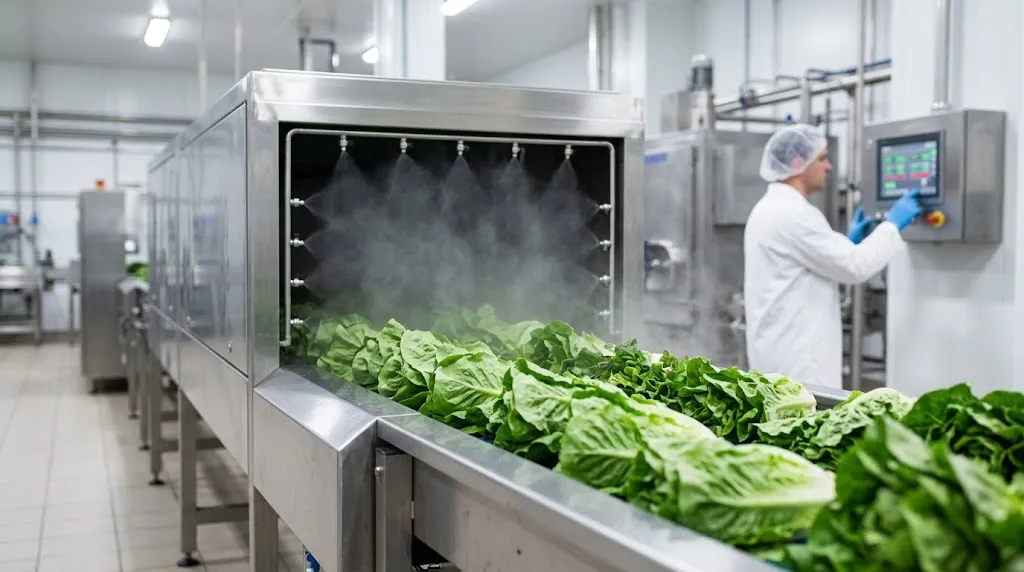
Industrial fogging systems add moisture to a greenhouse by producing very fine, self-evaporating droplets. Four points define how the technology behaves and where it fits.
- Droplet behavior: The droplets disperse into the air before reaching any surface. Non-wetting applies to surfaces under proper system design and nozzle placement. Direct exposure to the fog stream will still wet a surface.
- Why wetting matters: Surface wetting promotes the fungal conditions that humidity management is meant to prevent. Keeping plant surfaces, structural components, and equipment dry is therefore a core design goal.
- Cooling effect: Commercial fogging differs from basic misting in droplet behavior and energy effect. A self-evaporating droplet absorbs heat from the surrounding air as it evaporates, a process called adiabatic cooling. The same system therefore reduces sensible temperature without adding refrigeration load.
- Summer value: This dual function helps when heat stress and low humidity occur together. Our guide on evaporative cooling and how it works explains the adiabatic mechanism in full.
Nozzle placement, coverage area calculations, and integration with climate control determine regulated output. Fogging systems are not a substitute for dehumidification. Their job is the humidity addition side. The wider system must also include ventilation and humidity removal capability.
Evaporative Cooling as a Secondary Function of Fogging Systems
Adiabatic cooling works because evaporation requires energy. When a self-evaporating droplet turns from liquid to vapor, it draws that energy from the surrounding air as heat. That lowers ambient temperature.
No mechanical refrigeration is added and no electrical cooling load increases. In a commercial greenhouse where summer temperatures drive heat stress and high VPD together, a precision fogging system addresses both parameters with one installation. The cooling effect follows from the physics, not from a separate system function.
Fogging vs. Other Humidification Technologies for Greenhouse Use
The choice of humidification technology affects heat load, water quality requirements, and operational complexity. Three options matter for commercial greenhouse use:
- Adiabatic fogging: It adds humidity with a simultaneous cooling effect and needs no heat input. It operates with 100% water efficiency when droplets fully evaporate. That suits summer greenhouse conditions.
- Steam humidification: It adds both humidity and heat to the space. The added heat load is manageable in winter. In summer, it compounds heat stress and increases the HVAC burden.
- Ultrasonic systems: They produce fine droplets through high-frequency vibration but carry dissolved minerals from untreated water into the air. Mineral deposits accumulate on plant surfaces, equipment, and sensors unless the water supply is treated to a high purity standard.
Each option trades off heat, water quality, and complexity differently, so the right choice depends on your climate and water supply. Our guide on humidification technology types compared covers the full technology trade-off analysis.
Automation and Sensor Integration for Commercial Humidity Control
Commercial greenhouse humidity control at scale requires automation. The load changes continuously with crop growth stage, weather, and time of day. Heating and ventilation activity changes it as well.
Manual intervention cannot reliably maintain VPD targets within the narrow range required for consistent commercial production. A facility running year-round needs a climate control architecture that responds to sensor inputs continuously, not on an operator schedule.
An integrated system has three core components. They work together to turn sensor readings into equipment responses.
- Humidity sensors: Capacitive or resistive sensors sit at canopy height and at multiple structural points.
- Temperature sensors: These sensors supply the readings needed for VPD calculation.
- Climate controller: It integrates all sensor inputs and triggers responses across ventilation, heating, dehumidification, and humidification.
The controller compares real-time readings against target VPD setpoints. It activates the right equipment to bring conditions within range. Our humidity control systems page covers architectures that operate without continuous operator decision-making.
One interaction is worth planning for: CO2 enrichment. Operators using CO2 supplementation must balance ventilation frequency carefully. Exhausting CO2-enriched air to reduce humidity has a direct cost.
Climate controllers that target VPD setpoints directly help minimize unnecessary ventilation cycles. They preserve enrichment investments. Data logging from the controller also supports crop management records and compliance documentation.
A wet and dry bulb thermometer provides a useful manual cross-check for sensor calibration during commissioning. Continuous automated sensing is still required for production operation.
Humidity Sensor Placement in Large Greenhouse Structures
A single humidity sensor is insufficient for a large greenhouse. Stratification, proximity to drip irrigation lines, and distance from exhaust fans create humidity gradients across the structure. A single central reading may therefore show conditions within target while canopy-level zones are out of range.
Place sensors at canopy height and distribute them across the length and width of the structure. Keep them away from direct fogging nozzles and vent openings. Periodic calibration is also required because moisture and agrochemical residues affect accuracy over time.
Climate Controllers and Setpoint-Based Humidity Management
Commercial climate controllers use sensor inputs to trigger actuators across all four humidity management systems without operator decisions at each step. A controller configured for VPD setpoint management calculates current VPD from temperature and humidity readings. It then activates the appropriate response automatically.
When humidity is high, exhaust fans and heating activate. When humidity falls below target, the humidification system engages. VPD setpoint management accounts for temperature simultaneously.
It therefore prevents the overcorrection cycles that occur when temperature and humidity are managed separately. That is a meaningful operational advance over RH-only control.
Smart Fog Precision Humidification for Commercial Greenhouse Operations
Smart Fog uses compressed air and water mixed through a proprietary nozzle to produce an equal-sized droplet grid. Each droplet carries a slight charge that prevents re-aggregation. The droplets self-evaporate before reaching any surface.
Humidity is added to the greenhouse environment without wetting plants or structural frames, as well as irrigation lines and growing media. Under proper system design, surfaces remain dry. Direct exposure to the fog stream will result in contact wetting.
This matters in a greenhouse because surface wetting promotes the fungal conditions that humidity management is designed to prevent. Botrytis and powdery mildew are the examples. Insufficient humidity, in turn, impairs transpiration and raises VPD beyond target range. Our greenhouse humidification page covers how this applies to commercial operations.
Smart Fog systems maintain humidity up to 99% RH with plus or minus 1 to 2% precision. That enables VPD setpoint management rather than wide-band humidity cycling. The adiabatic evaporation process also delivers evaporative cooling. That reduces both humidity deficit and heat load in summer.
The systems work across summer heat-stress conditions and winter low-humidity periods. They integrate with commercial climate controllers for setpoint-based automated operation.
Humidity addition is their only function. Removal still comes from ventilation and dehumidification. Our Smart Fog technology overview explains how the technology works in detail.
Non-Wetting Operation in Plant-Dense Environments
Surface wetting in a commercial greenhouse carries three specific risks. Each one affects either the crop or the structure. Together they show why the non-wetting design matters:
- Fungal disease: Moisture on leaf and stem surfaces propagates fungal disease.
- Media saturation: Saturated growing media promotes Pythium and root disease.
- Corrosion: Moisture corrodes metal structural members and equipment fittings.
Smart Fog's self-evaporating droplets address these risks at the mechanical level. The droplets evaporate into the air before settling on any surface under proper system design. This is a function of droplet physics, not a coating, filter, or chemical treatment.
You can therefore raise humidity in a plant-dense environment without creating the surface moisture conditions that drive plant disease. Direct exposure to the fog stream will still wet a surface.
Set-and-Forget Continuous Operation for Year-Round Production
Year-round commercial greenhouse production needs a humidification system that runs without constant intervention. Smart Fog systems are designed for 24/7 continuous industrial operation. The humidification process has no moving parts.
Four operational specifications reduce the burden on large greenhouse operators. Each one supports unattended operation.
- Maintenance interval: Intervals extend up to every two years. That removes the nozzle-cleaning cycles that reduce uptime in conventional misting systems.
- Installation: No certified technician is required.
- Automation: The system integrates with commercial climate controllers for setpoint-based unattended operation.
- Water efficiency: 100% of water input evaporates into the air.
Our cannabis facility humidification systems page covers high-value crops where consistent VPD management directly affects yield quality. Every greenhouse has its own volume, crop mix, and climate profile. Those factors decide the right system design.
Final Thoughts
Commercial greenhouse humidity control at production scale requires four coordinated systems, not isolated interventions. Ventilation removes excess moisture. Heating modifies RH by raising air capacity.
Dehumidification provides direct moisture removal. Precision fogging adds humidity and cooling when conditions fall short of VPD targets. None of these systems works reliably in isolation for year-round production.
Automation is what separates industrial-grade climate management from reactive facility operation. A climate controller that manages VPD setpoints across all four systems keeps temperature and humidity within the range that supports consistent production. It holds that range through every season, weather change, and crop growth stage.
Humidity targets also shift as the crop develops. Our resource, the grow room humidity stage-by-stage guide, goes deeper on humidity management in controlled environment growing contexts.
Setpoints and automation only work if the equipment behind them fits the space. To find out what a precision fogging installation requires for your facility size and crop type, contact Smart Fog engineers for a specification review of your greenhouse humidification system.
FAQ
What is the ideal humidity level for a commercial greenhouse?
The ideal humidity for a commercial greenhouse depends on the crop, but most production crops are commonly kept between 60 and 80% RH. Commercial operations target a vapour pressure deficit of 0.8 to 1.2 kPa instead of a fixed RH. VPD accounts for the temperature-humidity interaction that governs plant transpiration. The specific crop and growth stage determine the precise setpoint.
How do I lower humidity in a large greenhouse without over-ventilating?
In a large greenhouse, heating and mechanical ventilation work better together than ventilation alone. Warming the air raises its moisture-holding capacity, which lowers RH without exhausting any air. Exhaust fans then clear a calculated volume of moist air based on your air exchange targets. A climate controller keeps the fans from overworking by switching them on only when heating can't meet the VPD setpoint.
What is vapour pressure deficit and why does it matter more than RH in a greenhouse?
Vapour pressure deficit (VPD) is the difference between the moisture the air currently holds and the maximum it could hold at the current temperature. It matters more than RH because VPD, not RH, drives plant transpiration. The same RH value produces different VPD at different temperatures. Low VPD reduces nutrient uptake. High VPD causes water stress. Commercial operations therefore target specific ranges, typically 0.8 to 1.2 kPa for active growth.
What causes high humidity in a commercial greenhouse at night?
High humidity at night in a commercial greenhouse comes mainly from falling temperature, not new moisture. Moisture released by the crop during the day stays in the air. As the air cools, its moisture-holding capacity drops and RH rises, often approaching 85% RH. Reduced overnight heating can compound the problem. Overnight minimum temperature setpoints keep air above the level where condensation forms on structural surfaces. Timed ventilation then exhausts accumulated moisture.
Can too much humidity kill greenhouse crops, and at what threshold does disease risk become critical?
Sustained high humidity rarely kills crops directly, but it creates the pathogen conditions that damage them. Botrytis cinerea becomes active at approximately 85% RH. It causes rapid foliar disease in humid, low-airflow conditions. Powdery mildew thrives at 50 to 70% RH with high temperature fluctuation. Pythium propagates through oversaturated growing media and excess surface moisture. A commercial greenhouse running above 85% RH without active dehumidification and air circulation faces disease pressure that can affect yield.
Do commercial greenhouses need both a dehumidifier and a humidification system?
Yes, most commercial greenhouses need both a dehumidifier and a humidification system for year-round production. In summer and wet seasons, crop transpiration and humid outside air push moisture above pathogen thresholds. In winter, heating and cold infiltration air drive RH too low. A facility without humidification will struggle to hold VPD targets in dry periods. One without dehumidification will struggle to limit disease pressure in humid periods. A climate controller coordinates both systems.
How does a fogging system help control humidity in a greenhouse without wetting plants?
A precision fogging system controls greenhouse humidity without wetting plants by producing self-evaporating droplets that disperse into the air before reaching any plant surface under proper system design. The droplets absorb heat from the surrounding air and evaporate fully. Moisture enters the air instead of settling on leaves, stems, or growing media. Conventional misting differs because larger droplets settle on surfaces and create the conditions that promote fungal disease. Direct exposure to the fog stream will still wet a surface, so non-wetting performance depends on proper system design and nozzle placement.
How do automated climate controllers manage humidity in large commercial greenhouse facilities?
Automated climate controllers manage greenhouse humidity by calculating real-time VPD from temperature and humidity sensors and activating the matching system when VPD leaves its setpoint range. The four systems are ventilation, heating, dehumidification, and humidification. Modern controllers can target VPD directly instead of fixed RH thresholds, which avoids the overcorrection cycles that occur when temperature and humidity are managed separately. Sensors at canopy height across multiple points keep those readings representative of the whole structure.