

 Made in USA

Industrial fogging sanitizes fresh produce by distributing a food-safe agent across produce surfaces through self-evaporating droplets, while simultaneously maintaining the relative humidity (RH) required to slow moisture loss and extend shelf life. Most post-harvest operations treat sanitization and humidity management as separate steps, each requiring its own equipment and scheduling. Tunnel-format fogging collapses both into a single continuous pass.
This article covers the sanitization mechanism, food-safe agent classes and their regulatory status, how the dual function works in practice, and what your operation must verify before selecting a system for compliance purposes.
Key Takeaways
- Industrial fogging distributes a sanitizing agent through an equal-sized droplet grid that reaches irregular produce surfaces, including leaf crevices and stem cavities, that spray-wash contact cannot consistently cover.
- The same fogging pass that delivers agent contact can maintain ambient RH in the 90 to 95% range required by most fresh produce categories to suppress transpiration-driven moisture loss.
- Food-safe fogging agents include substances with Generally Recognized As Safe (GRAS) status and EPA-registered disinfectants approved for food-contact surface use. Compliant selection requires matching agent concentration and contact time to FSMA Produce Safety Rule documentation requirements under 21 CFR Part 112.
- Complete droplet evaporation before surface settling is the design criterion that separates non-wetting fogging systems from conventional spray-wash or wet misting approaches.
- Tunnel fogging must be integrated into a facility's Sanitation Standard Operating Procedures (SSOP) and Hazard Analysis and Critical Control Points (HACCP) plan with documented critical limits for agent concentration, contact time, and equipment calibration.
- A correctly designed fogging machine operating in a tunnel format eliminates the capital cost and scheduling complexity of running sanitization and cold storage humidity control as sequential separate systems.
How Fogging Works as a Sanitization Method for Fresh Produce
Fogging reduces microbial load on produce surfaces by delivering a diluted food-safe sanitizing agent as a fine mist dispersed uniformly through the processing zone. The mechanism follows a defined sequence. First, the fogging machine atomizes the agent into a uniform droplet cloud. Second, droplets disperse through the tunnel or treatment zone, contacting produce surfaces during their airborne phase. Third, the agent remains on the surface for a dwell time validated to achieve the target microbial reduction for the pathogen of concern. Fourth, droplets evaporate, leaving no pooled liquid residue on the produce.
Fogging functions as a complementary sanitization step within SSOP and HACCP frameworks. It is not a replacement for primary cleaning. Facilities must document fogging as one defined process step within a broader food safety plan.
Surface Coverage and Droplet Behavior
Self-evaporating droplets reach produce surface geometries that spray-wash contact cannot consistently address. Leaf crevices, stem cavities, and surface irregularities create recessed areas where a directed spray loses contact pressure and coverage uniformity. Because fogging distributes agent as an airborne cloud rather than a directed stream, droplets reach these surfaces during suspension.
Uniform droplet sizing across the grid ensures predictable agent concentration at the point of surface contact, rather than the uneven distribution that results when droplets vary in size and settle at different rates.
Dwell Time and Microbial Contact Requirements
Dwell time is the duration the agent remains in contact with the produce surface. Effective contact disrupts microbial cell structures, but the required time varies by agent type and concentration. A quaternary ammonium compound at a given concentration has a different validated contact time than chlorine dioxide or an organic acid formulation.
Your food safety plan must document the validated dwell time for each agent and concentration used, aligned with the manufacturer's label claims and FSMA documentation requirements.
Food-Safe Fogging Agents and Their Regulatory Status
Selecting a fogging agent for produce applications is a regulatory decision as much as a performance decision. The agent must carry an approval basis that makes it legally defensible under FSMA's Produce Safety Rule under 21 CFR Part 112 for use in produce contact or food-contact surface applications. Three principal agent categories apply to industrial produce fogging.
GRAS Substances in Produce Fogging
GRAS substances are materials the FDA has determined to be safe under their intended conditions of use. In produce fogging, relevant GRAS agents include organic acids such as lactic acid and citric acid, which are used as antimicrobials at defined concentrations. Hydrogen peroxide at low concentrations also carries GRAS status for certain food applications.
These agents generally do not require a post-application potable water rinse at approved concentrations, but label compliance and concentration limits must be verified for your specific produce type and application format. Your written food safety plan must document the concentration range and application method used.
EPA-Registered and Secondary Direct Additive Status Agents
EPA-registered disinfectants approved for food-contact surface use without a potable water rinse include certain quaternary ammonium compounds and chlorine dioxide formulations at defined concentrations. These carry EPA registration for food-contact surface sanitizer use under specific label conditions.
Some agents also carry FDA 21 CFR 178.1010 secondary direct food additive status, which governs sanitizers that may have incidental food contact. If a post-application rinse is required by the agent's label, that step must be built into the process design and documented in your SSOP. Using an agent outside its registered concentration range or contact time parameters creates a compliance gap under FSMA regardless of the agent's general approval status.
Ozone applied as an antimicrobial gas or in aqueous form carries a GRAS determination from FDA for use on food. Its short half-life means residue risk is low, but application concentration and contact time must still be validated and documented.
The Dual Function: Sanitization and Humidity Preservation in One Pass
Conventional post-harvest operations address sanitization and cold storage humidity management as separate process steps. Sanitization runs on the processing line. Humidity control runs in cold storage, managed by a separate system. Each step requires its own equipment, scheduling, and operational oversight. Tunnel-format fogging changes this model.
When self-evaporating droplets carry a food-safe sanitizing agent through a tunnel environment, they contact produce surfaces during their airborne phase and deliver agent contact. Because those droplets fully evaporate before settling, they do not deposit pooled liquid on the produce surface. That complete evaporation simultaneously drives ambient RH upward inside the tunnel.
The result is that produce exiting the tunnel has received surface agent contact and has been held in a high-RH environment that reduces transpiration-driven moisture loss during that processing period.
Why Moisture Loss Matters in Post-Harvest Produce Handling
Fresh produce loses marketable quality rapidly when held below its target RH. Transpiration-driven weight loss, surface wilting, and texture degradation begin at weight losses as low as 1 to 3%, depending on produce category.
For context on should vegetables be stored in high or low humidity, most fresh produce categories require 90 to 95% RH in storage to maintain turgor and minimize weight loss. Humidity maintenance is not optional. It directly determines how much of your product reaches commerce in a sellable condition.
How Complete Droplet Evaporation Enables Both Outcomes
The physics that make dual-function fogging possible depend on complete droplet evaporation before surface contact as pooled liquid. Droplets must disperse and evaporate into the air column during their airborne phase, raising ambient RH as they do. This is fundamentally different from spray-wash or wet fogging approaches, where surface liquid deposition is the intended mechanism.
A non-wetting fogging system raises RH and delivers agent contact without leaving residual moisture on produce surfaces. Residual surface moisture would promote microbial regrowth, accelerate decay in delicate produce types, and undermine the sanitization outcome the fogging step was designed to achieve.
Tunnel-Format Industrial Fogging: Process Design Considerations
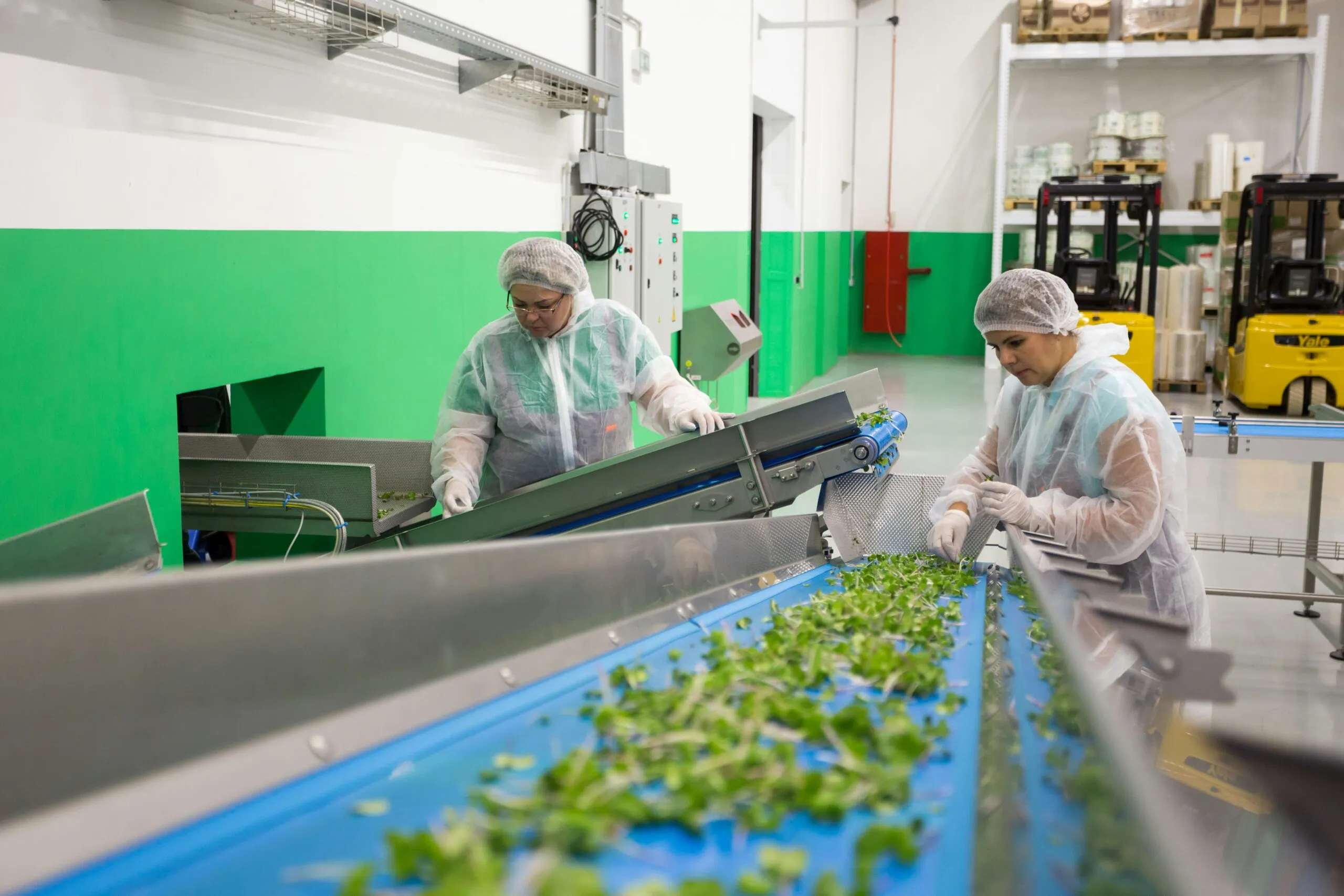
In tunnel-format fogging, produce travels on a conveyor through a fogging zone where nozzle arrays distribute sanitizing fog uniformly across the product stream. Dwell time is controlled by conveyor speed and tunnel length.
Both variables must be validated to achieve the target surface contact time for the selected agent at the throughput volume your line requires. For food processing humidification applications running in the 90 to 95% RH range, system components must be rated for continuous operation at sustained high humidity.
Key design variables include:
- Nozzle placement: Array configuration determines fog uniformity across the product cross-section at each point in the tunnel.
- Fog density: Agent dosing per unit volume of tunnel air controls surface concentration and contact time.
- Airflow management: Airflow direction and velocity affect droplet suspension time and distribution uniformity.
- Conveyor speed: Line speed sets the dwell time available for agent contact at a given tunnel length.
- Water quality: Mineral content in supply water affects nozzle scaling rates and long-term fog consistency.
SSOP and HACCP Integration for Tunnel Fogging
Tunnel fogging must appear in your facility's written SSOP as a defined process step with documented critical limits. Those limits include agent type, concentration range, contact time, nozzle configuration, and conveyor speed. FSMA's Produce Safety Rule requires produce operations to document and follow written procedures for any sanitizer applied to produce or food-contact surfaces. A fogging step without documented critical limits is not a compliant step, regardless of the agent's approval status.
Equipment and Maintenance Considerations for Continuous Operation
A fogging machine running continuously in a food processing environment faces two primary maintenance drivers: mineral scaling on nozzles from water mineral content, and wear from sustained high-humidity operating conditions. Water quality management, including filtration appropriate to your supply water hardness, directly affects how frequently nozzles require service.
Nozzle designs with no moving parts in the humidification mechanism reduce maintenance burden in high-uptime lines, where scheduled downtime for nozzle service creates throughput risk.
Smart Fog Tunnel Humidification for Food Processing and Cold Storage
Producing an equal-sized droplet grid through a proprietary compressed-air-and-water nozzle is the design property that enables non-wetting dual-function fogging. Each droplet is slightly charged to prevent re-aggregation after leaving the nozzle. The droplets self-evaporate before reaching any surface under proper system design.
This self-evaporation is precisely what raises ambient RH while delivering agent contact during the droplet's airborne phase. It is the technical property the dual-function application requires.
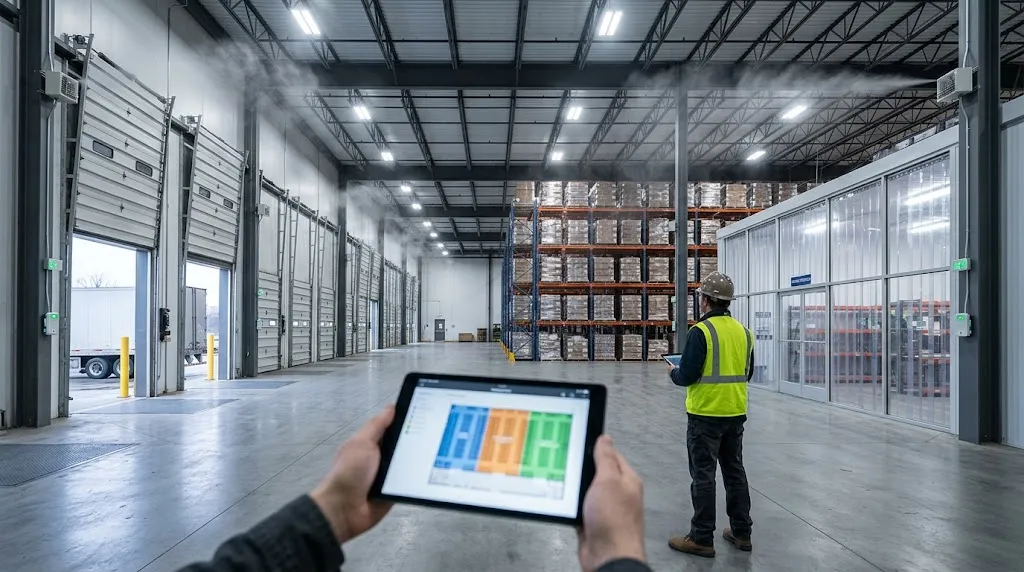
For cold storage humidification and post-harvest produce applications, Smart Fog systems maintain RH up to 99% with plus or minus 1 to 2% precision. Operating in the 90 to 95% RH range for fresh produce, this precision level prevents both under-humidification, which accelerates moisture loss, and over-humidification, which risks condensation on produce surfaces and compromises sanitization outcomes. Note: non-wetting applies to surfaces under proper system design. Direct exposure to the fog stream will wet the surface it contacts.
Precision RH Control in Cold Storage and Processing Tunnels
Consistent RH at the 90 to 95% range reduces produce weight loss, preserves turgor, and extends the marketable shelf life window without introducing surface moisture that would damage product integrity. Smart Fog's precision RH control in cold storage humidity control environments is maintained continuously. The system operates with no moving parts in the humidification process, and maintenance intervals extend up to every two years. For high-uptime food processing lines, that maintenance profile reduces the scheduling risk and downtime cost associated with frequent nozzle service.
Key performance points for produce storage and processing applications:
- RH precision: Plus or minus 1 to 2% at set points up to 99% RH.
- Non-wetting: Droplets self-evaporate before surface contact under proper system design.
- Maintenance: No moving parts in humidification; service intervals up to every two years.
- Continuous operation: Designed for 24/7 industrial uptime without constant nozzle cleaning.
System Design and Installation for Food Processing Environments
Rather than supplying a component kit, Smart Fog designs and delivers a complete engineered system. Nozzle configuration, system layout, and operating parameters are all specified to your facility, produce type, and throughput requirements before installation. No certified technician is required for installation. Systems are made in the USA. For food safety and processing humidification applications requiring both sanitization support and precision humidity control, the Smart Fog technology overview describes the core nozzle mechanism and system design approach. For produce facilities using ripening cycles, ripening room humidity systems covers how Smart Fog's precision RH control applies to that specific post-harvest stage.
Final Thoughts
Tunnel-format fogging addresses two post-harvest priorities in a single continuous process: delivering a food-safe sanitizing agent to produce surfaces and maintaining the ambient RH conditions that preserve produce quality. No separate humidity management system, no additional scheduling complexity.
The regulatory framework governing agent selection under FSMA's Produce Safety Rule is specific, and your food safety plan must document agent type, concentration, contact time, and equipment parameters before a fogging step is compliant. System design, not just agent selection, determines whether a fogging installation achieves both outcomes reliably at production scale.
To discuss humidification and fogging system design for your food processing or cold storage facility, contact Smart Fog engineers.
FAQ
What is the difference between fogging and spray washing for fresh produce sanitization?
Fogging distributes a sanitizing agent as an airborne droplet cloud that contacts produce surfaces during the droplet's suspended phase, reaching leaf crevices, stem cavities, and surface irregularities that a directed spray cannot consistently cover. Spray washing applies agent through directed water contact intended to physically remove contamination from surfaces. Fogging is classified as a complementary sanitization step within SSOP and HACCP frameworks, not a replacement for primary cleaning. It can simultaneously raise ambient relative humidity in the treatment zone without depositing pooled liquid on produce surfaces.
Which food-safe agents are approved for use in produce fogging systems under FSMA requirements?
FSMA's Produce Safety Rule under 21 CFR Part 112 governs sanitizer use in produce contact applications and requires written documentation of agent selection and use parameters. Approved agent categories include GRAS substances such as organic acids and low-concentration hydrogen peroxide, plus EPA-registered sanitizers approved for food-contact surface use without a post-application rinse. Ozone is also approved, carrying FDA GRAS status for use on food. Your food safety plan must document the specific agent, concentration range, and contact time used for each application.
How does industrial fogging maintain produce freshness and extend shelf life during post-harvest processing?
Most fresh produce categories require 90 to 95% relative humidity in storage to suppress transpiration-driven moisture loss and maintain turgor. When a fogging system produces self-evaporating droplets that fully evaporate before settling on surfaces, that evaporation raises ambient RH in the treatment zone. This reduces the humidity deficit that drives weight loss and surface wilting in fresh produce. A non-wetting fogging system achieves this without depositing residual surface moisture that could promote microbial regrowth or damage delicate produce types.
Can a single fogging system both sanitize produce and maintain cold storage humidity levels?
Yes, under proper system design. When a fogging system produces self-evaporating droplets carrying a food-safe sanitizing agent, the droplets contact produce surfaces during their airborne phase, delivering agent contact. Because the droplets fully evaporate before settling, no pooled liquid is deposited on surfaces, and that evaporation simultaneously raises ambient relative humidity in the tunnel or storage environment. This dual function requires a system designed specifically for complete droplet evaporation, not a conventional spray-based or wet fogging system.
What is the required contact time for fogging agents to be effective on produce surfaces?
Required contact time varies by agent type, concentration, and the target organism. There is no universal contact time that applies across all fogging agent categories. That's why EPA registration conditions for antimicrobial pesticides and the manufacturer's own label claims are what your food safety plan must reference, not a generic industry figure. In tunnel-format fogging, dwell time is controlled by conveyor speed and tunnel length, both of which must be validated to achieve the target surface contact time for the selected agent at your line's throughput volume.
How does tunnel fogging integrate into a HACCP food safety plan?
Tunnel fogging must be incorporated into your facility's written SSOP as a defined process step, with agent type, concentration range, contact time, nozzle configuration, and conveyor speed all documented as critical limits. Within a HACCP plan, fogging functions as a control measure at a defined point in the post-harvest process, with monitoring requirements, corrective action protocols, and verification procedures documented for each critical limit. FSMA's Produce Safety Rule requires that any sanitizer applied to produce or food-contact surfaces be covered by written procedures your facility follows.
Does fogging leave chemical residue on produce surfaces, and is a water rinse required after treatment?
Whether a post-application water rinse is required depends on the specific agent used and its EPA registration or GRAS status conditions. Some agents, such as certain quaternary ammonium compounds, require a potable water rinse before produce enters commerce when used above defined concentrations. Others, including ozone and some organic acid formulations at approved concentrations, do not require a rinse. Your agent selection and rinse protocol must align with the agent's label claims and your written food safety plan documentation. Never assume rinse requirements based on agent category alone; verify against the specific product's registration and concentration parameters.
What maintenance is required for an industrial fogging machine used in continuous food processing operations?
The primary maintenance drivers for a fogging machine in continuous food processing operation are mineral scaling on nozzle components from supply water mineral content, and wear from sustained high-humidity operating conditions. Water quality management, including appropriate filtration for your supply water hardness, directly affects nozzle service frequency. Fogging machine designs with no moving parts in the humidification mechanism reduce maintenance burden in high-uptime processing environments. For properly designed industrial foggers, maintenance intervals can extend significantly compared to conventional spray or misting systems, reducing the scheduled downtime risk that frequent nozzle service creates on continuous production lines.