

 Made in USA

Dry air degrades food product quality and creates regulatory compliance exposure in processing environments. At low relative humidity (RH), exposed product loses moisture and its surfaces degrade. Packaging lines and powder handling systems are disrupted as well.
This article covers four dry-air failure modes. Product shrinkage and surface degradation come first, followed by static-driven packaging failures and powder handling problems. It also covers the regulatory framework that governs humidity control in food facilities.
Key Takeaways
The points below summarize the failure modes, the regulatory framework, and the solution profile this article covers. Each point is expanded in the sections that follow.
- When RH drops below approximately 50%, exposed food products begin losing moisture through evaporation. That loss produces measurable weight loss that directly reduces sellable yield.
- Dry air causes surface cracking in baked goods, hard cheeses, and cured meats. The exterior dries faster than the interior equilibrates. Resulting moisture gradients fracture the surface structure.
- RH below 35% generates electrostatic charge buildup on flexible packaging films and powder handling equipment. The result is film misfeeds, inaccurate weight dosing, and ingredient clumping.
- FDA regulations under 21 CFR Part 117 require food facilities to implement environmental controls sufficient to prevent conditions that could adulterate or degrade food. Humidity management falls within those controls.
- Smart Fog food-safe humidification systems maintain RH up to 99% with plus or minus 1 to 2% precision. Self-evaporating droplets humidify the air without depositing moisture on food products, equipment, or surfaces under proper system design.
- These systems have no moving parts in the humidification process, support maintenance intervals up to every two years, and require no certified technician for installation.
Why Relative Humidity Matters Specifically in Food Processing Environments
Food products are hygroscopic systems in equilibrium with their environment. When ambient RH drops, the vapor pressure gradient between a product's surface and the surrounding air pulls moisture out of the product. In low-humidity environments, that loss can become measurable within hours.
Food processing facilities are especially vulnerable because they typically run high air change rates to manage odor, temperature, and contamination risk. Those air changes continuously replace humid air with drier conditioned supply air. In food processing humidification applications, this creates a chronic low-humidity condition even in well-maintained facilities.
Food facilities face two humidity-related concerns: quality loss from low RH and microbial or condensation risk from excess RH. This article focuses on the dry-air side of that equation. For the fundamentals of how RH behaves in a specific facility, see our guide to relative humidity.
ASHRAE design guidance covers air change rates and supply air dew point for food processing environments. Dry air is therefore an engineering problem with engineering solutions.
What Relative Humidity Thresholds Are Relevant for Food Processing
Two RH thresholds mark the onset of dry-air risk in food facilities. They are summarized below.
- Below approximately 50% RH: Exposed food products begin losing moisture at a rate that becomes measurable across a production run.
- Below 35% RH: Flexible packaging films, conveyor belts, and powder handling ducting accumulate electrostatic charge. The moisture layer that normally dissipates charge is absent.
Acceptable RH ranges vary by product type and process stage. The practical engineering goal is a stable target range rather than a single setpoint.
Why HVAC Systems Alone Cannot Maintain Stable Humidity in Food Facilities
Standard heating, ventilation, and air conditioning (HVAC) design prioritizes temperature and air quality. It does not inherently maintain precise RH. Refrigerated processing areas are especially vulnerable, since cold supply air carries less absolute moisture.
The RH of delivered air in a refrigerated zone is frequently lower than the facility setpoint requires. This establishes the need for dedicated humidity control systems, not just general climate control. For a closer look, see humidity control systems explained, which covers how purpose-built humidification differs from HVAC-integrated approaches.
Product Weight Loss and Shrinkage: The Direct Cost of Dry Air
Evaporative shrinkage is a direct revenue loss, not an inherent product characteristic. When ambient RH falls below a product's equilibrium moisture level, the product loses moisture to the air. For fresh meat and poultry, this is measured as trim loss or shrinkage, expressed as a percentage of original weight.
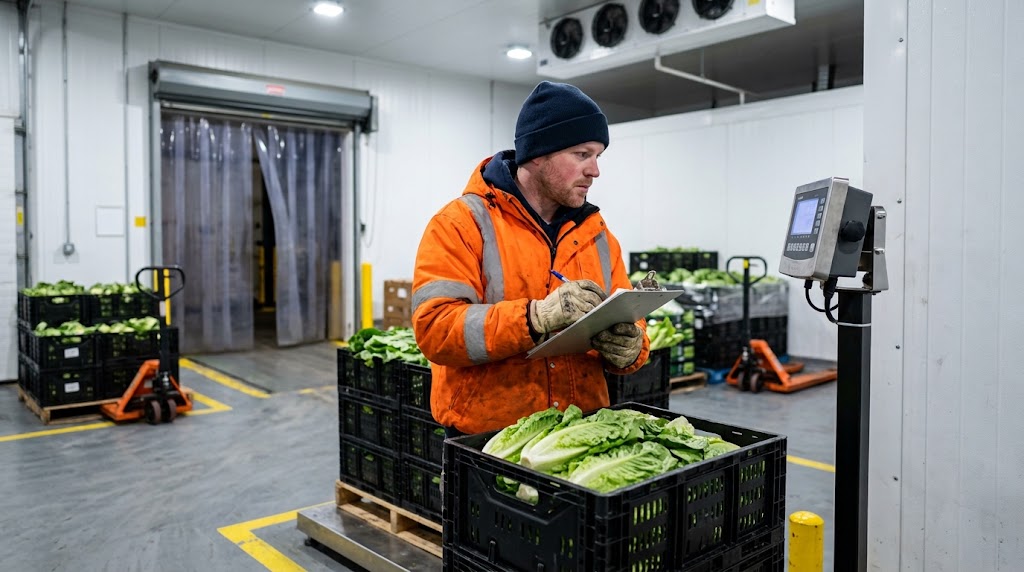
In bakery goods, moisture loss changes texture and perceived freshness before the product reaches packaging. Fresh produce held in refrigerated processing areas shows wilting, surface desiccation, and reduced pack weight.
The financial consequence is straightforward. Product sold by weight that loses even one to two percent of its mass before packaging represents a quantified yield loss across every production run. This loss is preventable with active humidity control.
The USDA Food Safety and Inspection Service (FSIS) acknowledges moisture loss in meat and poultry processing. Its final rule on retained water notes that air chilling causes carcass weight loss from evaporation in livestock slaughtering establishments. Maintaining appropriate environmental conditions is part of preventing unnecessary product degradation.
Which Food Categories Are Most Susceptible to Shrinkage in Dry Conditions
Several product categories carry elevated shrinkage risk in low-humidity environments. Each one loses moisture through a different mechanism, as the list below shows.
- Fresh meat and poultry: These carry the highest moisture content and begin measurable shrinkage at RH below approximately 60%. Weight loss in exposed cuts accumulates quickly on high-throughput lines.
- Fresh bakery goods: Surface drying changes both perceived freshness and pack weight before retail. This happens even when product is not yet past its shelf date.
- Hard cheeses and cured meats: Surface drying disrupts controlled aging processes. Premature moisture loss interferes with rind development in cheese and affects casing integrity in cured meats.
- Fresh produce in refrigerated processing: Cold air compounds the drying effect. Low RH in refrigerated holding areas accelerates surface desiccation beyond what temperature alone would cause. For produce-specific RH requirements, see whether vegetables should be stored in high or low humidity.
How to Quantify Shrinkage Loss Across a Production Run
Yield analysis is the practical tool for surfacing the financial scale of evaporative loss. The steps below turn weight data into a documented loss figure.
- Weigh at three stages: Record product weight immediately after processing, after holding, and at the point of packaging.
- Compare across RH levels: Line up those figures across production runs conducted at different RH levels.
- Calculate the difference: The difference between runs is a documented, attributable yield loss figure.
That figure establishes the business case for cold storage humidification and humidity control investment without relying on projected ROI figures.
Surface Cracking and Texture Degradation in Dry Processing Environments
Surface cracking and texture degradation are mechanistically distinct failure modes. Both are downstream of inadequate humidity control, not inherent product instability. Neither should be conflated with microbial spoilage, which is a high-humidity failure mode.
Surface Cracking in Baked Goods, Cheeses, and Cured Meats
Surface cracking results from differential moisture gradients. When ambient RH drops, the exterior of a product dries faster than the interior can equilibrate. Eventually the surface contracts and fractures.
The same root cause plays out differently in each product category. Three categories are most affected, as the list below shows.
- Artisan bread crusts: Cracking can render the product unsellable.
- Hard cheeses: Surface cracking breaks the protective rind and exposes the interior to contamination risk. It also disrupts the controlled rind development that defines the product grade.
- Cured meats: Cracking in casings compromises both appearance and the structural barrier that protects against spoilage.
All three share the same root cause. The rate of surface moisture loss exceeds the rate at which internal moisture redistributes.
Texture Loss in Hygroscopic Ingredients and Finished Products
Texture degradation operates through a different pathway. In low-RH environments, the moisture content of hygroscopic products equilibrates downward. The effect shows up in two forms, as the list below shows.
- Brittle finished products: Crackers, snack foods, and dried ingredients become brittle. They break more easily during handling, packaging, and transit. Higher packaging waste and breakage rates are measurable operational costs.
- Caking powders: Hygroscopic powder ingredients cake and clump as they absorb and release moisture unevenly when a facility cycles between dry and humid conditions. That behavior affects dosing accuracy and processing consistency.
Electrostatic Discharge in Dry Air: Packaging Line Failures and Powder Handling Risk
Static electricity buildup is the most technically disruptive dry-air failure mode on modern packaging and powder handling lines. When RH drops below approximately 35% to 40%, non-conductive surfaces lose the thin moisture layer that normally allows charge to dissipate. Charge then accumulates on packaging films, conveyor belts, and powder ducting.
In food processing, static generates two distinct operational problems. These are packaging line disruption and powder handling system failures. Understanding how to prevent static electricity with humidification applies directly to food packaging environments, where the physics are identical.
How Static Charge Disrupts Flexible Packaging Lines
Static charge on flexible film causes predictable line failures. The main failure points are listed below.
- Film mistracking: Mistracking on form-fill-seal machinery leads to misfolds and seal misalignment.
- Film adhesion to guides: Film sticks to machine guides and resists separation at unwind stations.
- Particulate attraction: Charged film surfaces attract airborne particulates, including product dust and debris. These particles can contaminate sealing areas before the seal closes.
- Label application failures: Charged film disrupts label adhesion and positioning accuracy.
Seal contamination of this kind can result in batch rejection and rework costs that far exceed the cost of prevention. Our page on electrostatic discharge control in food packaging covers the control approach in more detail. For a comparison of mitigation approaches, see ESD control methods.
Powder Bridging, Clumping, and Dosing Inaccuracy in Dry Conditions
Powder handling systems are highly sensitive to electrostatic conditions. Charge accumulating on powder particles in pneumatic conveying systems makes particles adhere to each other and to equipment surfaces. The operational consequences are listed below.
- Bridging: Bridging at hopper outlets and transition points interrupts flow.
- Clumping: Caking and clumping against sifter screens reduces throughput and requires manual intervention.
- Dosing inaccuracy: Weight-based and volumetric dosing accuracy suffers when powder flow becomes irregular.
Milk powder, flour, and starches are among the most affected ingredients. Spice blends and powdered flavor systems face the same risk. The result is meaningful yield loss and product quality inconsistency.
Powder handling research supports this mechanism. AIChE conference work notes that charging propensity is typically managed by controlling relative humidity, earthing, or ionizing equipment. A study published in EPJ Web of Conferences finds that relative air humidity and electrostatic charge strongly influence powder flow.
FSMA, FDA GMP, and Humidity Control Compliance in Food Processing
Humidity control in food processing facilities is a risk-based compliance obligation, not merely a quality preference. The FDA's Current Good Manufacturing Practice (GMP) regulations under 21 CFR Part 117 were established under the Food Safety Modernization Act (FSMA). They require food facilities to implement environmental controls sufficient to prevent contamination and adulteration.
The regulation does not prescribe a universal RH setpoint for all facility types. It requires that temperature and humidity be controlled wherever such control is necessary to prevent product degradation or adulteration. Food safety regulations place the burden on the facility to determine where humidity is a relevant hazard and to implement proportionate controls.
USDA FSIS sanitation regulations for federally inspected meat and poultry establishments add a parallel expectation. 9 CFR Part 416 requires ventilation adequate to control odors, vapors, and condensation to the extent necessary to prevent adulteration of product. Those establishments should document how humidity is managed within these environmental controls.
Facilities that fail to document adequate environmental controls risk audit findings and corrective action requirements. Active, documented humidity control puts a facility in a stronger compliance posture than reliance on passive environmental conditions.
What 21 CFR Part 117 Requires Regarding Environmental Controls
The FSMA framework is risk-based. Facilities must identify whether humidity is a relevant hazard for their specific process and implement controls proportionate to that risk. They should consult regulatory counsel and the provisions applicable to their product category to determine what documentation standards apply.
For facilities processing exposed product in dry or refrigerated environments, humidity qualifies as a relevant physical and chemical hazard. Physical degradation pathways include shrinkage and surface cracking. Electrostatic particulate attraction adds a contamination pathway for open product streams.
HACCP Plans and Humidity as an Environmental Hazard
A thorough Hazard Analysis and Critical Control Points (HACCP) review should evaluate whether ambient RH at any stage could cause product contamination or degradation. Dry air is a physical hazard through shrinkage and cracking. It is also a contributing factor to electrostatic particulate attraction, which can introduce airborne debris into open product streams.
HACCP compliance documentation should include the facility's humidity monitoring methodology and defined corrective action thresholds. Documenting the RH range, the control system maintaining it, and the response protocol for deviations demonstrates that the hazard has been identified and controlled.
Documentation and Monitoring Requirements for Compliance
Demonstrating compliance requires four documentation elements. They are listed below.
- Monitoring: Temperature and humidity are monitored continuously or frequently at critical process stages.
- Setpoints: Target setpoints are documented for each stage.
- Corrective actions: Corrective action protocols define the response when RH deviates from the target range.
- Calibration: Calibration records cover every monitoring sensor.
An active humidification system with closed-loop control provides the continuous, logged control record that supports an audit response. Uncontrolled ambient conditions, by definition, cannot produce that record. Closed-loop humidity control systems generate the continuous data that compliance documentation requires.
How Smart Fog Food-Safe Humidification Systems Solve Dry-Air Problems in Food Processing
Smart Fog systems mix compressed air and water through a proprietary nozzle to produce an equal-sized droplet grid. Each droplet carries a slight charge that prevents re-aggregation. The droplets self-evaporate before reaching any surface.
That adds moisture to the air without depositing water on food products and equipment, or on walls and floors. Non-wetting performance applies to surfaces under proper system design. Surfaces placed directly in the path of the fog stream will experience wetting.
A system that raises RH but deposits water on food products, equipment, or floors introduces microbial risk and potential contamination. That trades one compliance problem for another. Humidifying a food processing environment without creating surface moisture is therefore the core engineering challenge.
Non-Wetting Precision Humidity for Food-Safe Environments
Self-evaporating droplets address the surface-moisture problem at the mechanism level. Each droplet evaporates before reaching any surface, adding moisture to the air without wetting food products or equipment under proper system design. This non-wetting characteristic is the material difference for food safety and processing humidification applications.
Traditional spray-based systems risk surface wetting. Steam introduces thermal energy that can affect temperature-sensitive products and environments. Surfaces in the direct path of the fog stream remain an exception, since non-wetting performance depends on proper system design, not on every installation configuration.
Four points summarize how the system meets food processing requirements. They are listed below.
- Precision: The system maintains RH up to 99% with plus or minus 1 to 2% precision, which provides the stable target range that compliance documentation requires.
- Non-wetting droplets: Self-evaporating droplets humidify air without depositing moisture on exposed product, equipment surfaces, or flooring under proper system design.
- Scope of function: The system controls humidity, not microbial load.
- Closed-loop control: Precision closed-loop control generates the continuous humidity log that HACCP and GMP audit responses require.
Continuous Operation, Low Maintenance, and Compliance-Ready Performance
Food processing facilities run continuously. Humidification equipment must match that operational profile. Each attribute below ties to a specific operational concern.
- Set-and-forget operation: The systems are designed for 24/7 operation, which suits continuous food processing schedules.
- Two-year maintenance intervals: Maintenance intervals extend up to every two years. That limits maintenance-related downtime and the gaps it can create in monitoring records.
- No moving parts: The humidification process has no moving parts, which reduces mechanical failure risk.
- No certified installer: No certified technician is required for installation, which reduces capital deployment cost and scheduling friction.
- Made in the USA: Components are made in the USA.
- Complete engineered system: Each installation is delivered as a complete engineered system, not a component kit. Facilities that need a single accountable supplier for their environmental control documentation benefit from that arrangement. A unified system design with a single point of responsibility supports the audit trail that food safety regulations require.
Final Thoughts
Dry air in food processing environments is a quantifiable operational problem. It reduces yield through evaporative shrinkage and degrades product texture and surface integrity. Static electricity buildup further disrupts packaging and powder handling lines.
Regulatory compliance exposure under FSMA and GMP requirements completes the picture. Each of these consequences has a mechanism, a measurable threshold, and an engineering solution. Active humidity control that maintains stable RH within a documented target range addresses all four failure modes simultaneously.
For a food facility, the right system humidifies without wetting surfaces under proper system design. It also runs without constant maintenance and provides the continuous control record that compliance documentation demands.
If dry air is affecting your yield or your audit readiness, contact Smart Fog engineers to talk through a system design for your facility.
FAQ
What relative humidity level should a food processing facility maintain to prevent product shrinkage and weight loss?
Food processing facilities should generally maintain RH above 50% in areas where exposed food products are present. Below that threshold, the vapor pressure gradient between product surfaces and the surrounding air drives measurable evaporative moisture loss. Fresh meat and poultry are typically managed at 60% RH or higher. Other products require different setpoints based on their equilibrium moisture content. The facility's HACCP plan should document the target range and the corrective action thresholds for each critical process stage.
How does dry air cause surface cracking in baked goods and aged cheeses?
Dry air causes surface cracking in baked goods and aged cheeses through differential moisture gradients. As the exterior dries faster than the interior can equilibrate, the surface contracts and eventually fractures. In hard cheeses, this breaks the protective rind and creates a contamination pathway into the interior. The same mechanism can render baked goods unsellable before they reach packaging. Stable RH in the processing or aging environment prevents the gradient from developing.
What does 21 CFR Part 117 require regarding humidity control in food manufacturing environments?
Under 21 CFR Part 117, food facilities must implement environmental controls sufficient to prevent conditions that could adulterate or degrade food. The regulation does not specify a universal RH setpoint. Each facility must instead determine whether humidity is a hazard for its own process and control it in proportion to that risk. The determination is typically positive wherever product sits exposed in a dry or refrigerated area. Facilities should consult regulatory counsel for guidance specific to their product category and applicable standards.
Why does low humidity cause static electricity problems on food packaging lines?
Low humidity causes static problems on packaging lines by removing the thin surface moisture layer that lets charge dissipate. Flexible packaging films, conveyor surfaces, and product materials accumulate charge below approximately 35% to 40% RH. Charged film mistracks on form-fill-seal equipment and sticks to machine guides. Airborne particulates, including product dust, are also attracted to sealing surfaces. The result is seal contamination, label failures, and batch rejection. Maintaining humidity above the electrostatic threshold prevents charge from accumulating.
How does electrostatic charge buildup in dry air affect powder handling systems in food facilities?
Electrostatic charge buildup in dry air makes powder particles adhere to each other and to equipment surfaces in pneumatic conveying and sifting systems. Bridging at hopper outlets and transitions, caking against sifter screens, and inaccurate weight-based dosing follow. Facilities processing milk powder, flour, or spice blends are most affected. The consequence is yield loss, process interruption, and dosing inconsistency. Maintaining RH above the charge-generation threshold restores predictable powder flow.
What is the difference between a humidification system and a dehumidification system for food processing applications?
Humidification systems add moisture to the air to raise RH where dry air is causing quality or compliance problems. A dehumidification system removes moisture from the air to lower RH where excess humidity creates condensation, microbial growth, or product spoilage risk. These are opposing functions served by separate equipment categories. Smart Fog designs and manufactures humidification systems for food processing applications. Dehumidification is a distinct need addressed by different equipment types.
Can a humidification system be used in a food-safe environment without risking surface moisture or product contamination?
Yes, a humidification system can operate in a food-safe environment when it uses non-wetting technology. Smart Fog systems use self-evaporating droplets that evaporate before reaching any surface. The air therefore gains moisture without water depositing on food products, equipment, or floors under proper system design. Spray-based and traditional misting systems can instead deposit surface moisture and create microbial risk in food-safe environments. Direct contact is the exception to non-wetting performance, since anything positioned in the fog stream's path will get wet. Non-wetting behavior therefore assumes proper system design and correct installation.
How should a food facility document humidity control for HACCP compliance and FDA audit readiness?
A food facility should document humidity control with continuous or frequent RH monitoring records at critical process stages and defined setpoint ranges for each stage. Corrective action protocols for RH deviations and calibration records for all monitoring sensors complete the file. An active humidification system with closed-loop control generates a continuous log that supports an audit response directly. Uncontrolled ambient conditions cannot produce this record. The HACCP plan should identify RH as a monitored parameter at any stage where dry air creates a documented degradation or contamination risk.