

 Made in USA

Choosing the right humidification equipment for a large warehouse is secondary to choosing the right system architecture. Three factors define the right architecture before any equipment is specified: facility layout, duct coverage, and zone humidity targets. Even well-specified equipment will underperform inside the wrong architecture.
This article covers the in-duct versus direct-space trade-off, zoning strategy for mixed-use warehouse footprints, and moisture load sizing methodology. It is written for facilities engineers and operations managers who already understand heating, ventilation, and air conditioning (HVAC) fundamentals. Warehouse-specific humidification design may be new to them.
Key Takeaways
- In-duct humidification depends entirely on duct coverage and air handling unit (AHU) capacity. It fails in warehouses where the duct system does not reach dock areas, cold storage sections, or high-bay zones.
- Direct-space nozzle arrays install within the conditioned space itself, enabling independent zone coverage without relying on existing duct layout.
- Large warehouses typically contain at least three distinct humidity zones: dock and loading areas, climate-sensitive storage sections, and general floor space. Each requires a separate setpoint and separate coverage.
- Moisture load sizing for a warehouse is driven by infiltration from door cycling, building envelope leakage, and internal moisture sinks. Standard residential sizing tables do not account for these variables and will significantly undersize a warehouse system.
- Humidification systems that produce self-evaporating droplets can operate in open floor environments without wetting racking, stored products, or floor surfaces under proper system design.
- Sensor placement must account for stratification. A single ceiling-mounted sensor will not return accurate readings for dock zones, cold storage aisles, and general floor space simultaneously.
Why Large Warehouses Require a System Architecture Decision, Not Just Equipment
Large warehouse footprints introduce two variables that make equipment selection alone insufficient. First, zones across the same facility have different infiltration exposure and different relative humidity (RH) targets. Second, the existing HVAC duct layout rarely matches the zones that actually need humidity control.
A 200,000-square-foot distribution warehouse shows how these two variables play out. Dock doors on one wall create a zone with rapid humidity swings as doors cycle. A pharmaceutical storage section and general dry goods floor space complete the layout.
These three zones place very different demands on a humidification system. Pharmaceutical storage may require RH control within a narrow regulatory band. The general floor tolerates a wider range.
The architecture decision comes first. Equipment selection follows from it.
The Core Variables That Determine System Configuration
Three variables drive every warehouse humidification architecture decision. Each one becomes an input to the sections that follow.
- Duct layout and AHU capacity: The existing HVAC duct layout and air handling capacity come first.
- Humidity zones: The number and type of zones the facility requires come next.
- Moisture load: The total moisture load the system must deliver per hour completes the set.
In-Duct vs. Direct-Space Humidification: Which Architecture Fits Your Warehouse
The in-duct versus direct-space decision is the foundational architecture choice for any large warehouse. It determines where moisture enters the air stream, which infrastructure the system depends on, and which zones it can serve. Our overview of humidity control systems covers how each delivery method works in practice.
- Distribution method
- In-duct: Moisture is injected at the AHU and carried through the duct system to conditioned spaces.
- Direct-space: Nozzle arrays install within the conditioned space and distribute moisture at the zone level.
Dependency on existing HVAC
- In-duct: The system needs complete, balanced duct coverage of every zone requiring humidity control. Spare AHU capacity must also carry the added moisture load without condensation in the ductwork.
- Direct-space: The system operates independently of duct layout. It needs no spare AHU capacity.
Suitability for zoned control
- In-duct: Independent zoning is difficult in large facilities. Moisture delivered through shared ductwork affects all connected zones at once.
- Direct-space: Each nozzle array can serve a discrete zone with its own setpoint and independent control.
Surface wetting risk
- In-duct: Condensation can form inside ductwork if supply air temperature drops below the dew point of the delivered moisture.
- Direct-space: Self-evaporating systems eliminate surface wetting risk across the open floor under proper system design.
Scalability for large square footage
- In-duct: Duct run length and AHU capacity limit scale. Adding zones requires duct extension or AHU upgrades.
- Direct-space: Additional nozzle arrays extend coverage without duct modification.
When In-Duct Humidification Works in a Warehouse
In-duct delivery is appropriate when three conditions hold. Each one must apply to every zone the system serves.
- Duct coverage: The duct system must reach every zone that needs humidity control.
- AHU capacity: The AHU must have spare capacity to carry the added moisture load.
- Zone temperature: Every zone must operate above the dew point of the delivered moisture.
When all three conditions hold, in-duct delivery is a sound choice. Smaller, fully ducted warehouses often fit that profile, as do office areas and break rooms needing supplemental humidity within a larger facility. For facilities that fit, the Smart Fog TS100 in-duct humidifier is available.
When Direct-Space Systems Are Required
Direct-space deployment is the right call when duct delivery can't reach the problem. Four situations typically point that way.
- Incomplete duct coverage: Some zones that need humidity control sit outside the duct system.
- High-bay ceilings: Duct-delivered moisture stratifies before it reaches the occupied zone.
- Cold storage sections: Running ductwork into these areas is impractical.
- Different setpoints: Zones that hold different RH targets need independently controlled coverage.
Nozzle arrays sit at the zone level and run independently. That gives you true zonal control across a mixed-use footprint. For a closer comparison, read our guide on how humidity control systems work and which one you need.
Warehouse Zoning Strategy: How to Divide a Large Facility for Humidity Control
Most large warehouses contain at least three distinct zone types. Each has its own infiltration profile, RH target, and consequence if humidity control fails. Defining these zones before sizing any equipment prevents undersized coverage and setpoint conflicts.
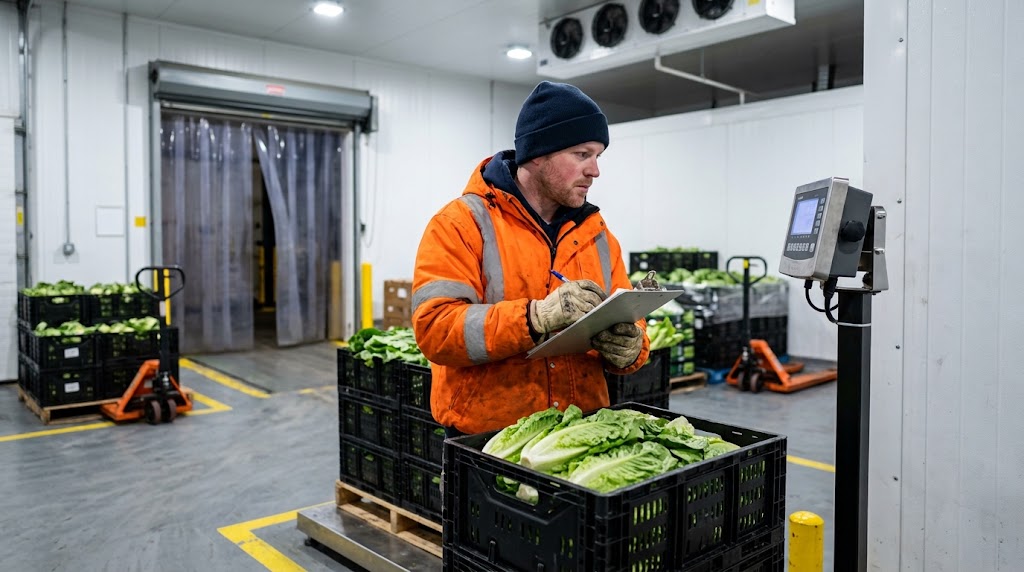
- Dock door and loading bay zones: Infiltration here is highest. Humidity swings rapidly as doors open and close, exchanging conditioned air with exterior air. These zones need localized humidification sized to offset infiltration, not a setpoint matched to the interior target.
- Climate-sensitive storage zones: Pharmaceutical, electronics, or food-grade sections carry the tightest RH tolerances and often regulatory requirements. These sections need the most precise control and the most rigorous sensor coverage. Facilities with cold storage or food processing areas can read more on cold storage humidification and food processing humidification.
- General floor and racking zones: RH control here prevents rack corrosion, static buildup on packaging materials, and mold growth on stored goods. These zones typically accept a wider tolerance band than climate-sensitive sections.
Each zone should have its own sensor, setpoint, and humidification coverage segment. Without independent coverage, a high-infiltration dock zone drags down overall system performance and pulls humidity away from adjacent zones.
Setting Setpoints Across Multiple Zones
Different zones within the same warehouse may require meaningfully different RH targets. Each zone needs its own setpoint. The humidification system must maintain each one independently.
- Pharmaceutical storage: Conditions follow each product's labeling and pharmacopeial requirements such as USP General Chapter <659> on packaging and storage.
- Cold storage sections: These sections need tighter control to prevent condensation near the dew point of cooled air.
- General floor space: Non-sensitive goods typically operate acceptably between 40 and 60% RH.
Estimating Moisture Load for a Large Warehouse: A Sizing Framework
Moisture load for a warehouse is not a single number. It is the sum of three distinct load sources, each driven by different building and operational variables. Identify each source, estimate its contribution in pounds or kilograms per hour, and sum them to get total system output capacity.
- Infiltration load: Door cycling frequency, the temperature and humidity differential between interior and exterior, and the building's air exchange rate drive this load. The ASHRAE Handbook of Fundamentals provides the basis for calculating infiltration-driven moisture load in buildings with frequent door openings.
- Building envelope leakage: Vapor migrates through concrete slabs, wall assemblies, and roof penetrations. In some climates, vapor drive through an uninsulated concrete slab represents a larger moisture load than door infiltration.
- Internal moisture sinks: Product off-gassing, personnel, and any processes that consume or generate moisture all contribute to the total load.
This is a pre-specification framework for scoping purposes. Precise sizing requires an engineering assessment of your specific facility.
Why Warehouse Sizing Differs From HVAC Rule-of-Thumb Calculations
Standard HVAC sizing rules are built on residential and light commercial assumptions. They miss three conditions that drive large warehouse moisture loads.
- Dock door cycling: Frequent openings create infiltration rates that these rules do not account for.
- High-bay stratification: Tall building volumes stratify air in ways that residential assumptions do not capture.
- Concrete tilt-up envelope: This construction is common in industrial warehouses and has its own envelope characteristics.
A facilities engineer who applies a residential pints-per-day-per-square-foot table to a 200,000-square-foot distribution center will significantly undersize the system. The system then cannot hold setpoints when dock doors cycle or exterior conditions push infiltration higher.
How Smart Fog's Humidification Systems Are Configured for Large Warehouse Environments
Direct-space humidification in an open warehouse environment works only if the system does not wet racking, stored products, or floor surfaces. This is the operational constraint that determines whether a direct-space system is viable or not. Smart Fog's industrial humidifier systems address this constraint through a specific mechanism.
Smart Fog mixes compressed air and water through a proprietary nozzle to create an equal-sized droplet grid. Each droplet carries a slight charge, which keeps the droplets from merging into larger ones. They evaporate before reaching any surface.
That's what lets direct-space systems work on open warehouse floors. Racking, stored products, and floors stay dry under proper system design. Direct exposure to the fog stream will still wet a surface.
Direct-Space Deployment Without Duct Dependency
Placed inside the conditioned space, Smart Fog nozzle arrays give each zone its own coverage regardless of duct layout. Multiple arrays can serve separate zones at independent setpoints. Together, these capabilities deliver the zonal architecture described earlier in this article.
This design suits facilities with incomplete duct coverage or cold storage sections where duct integration is impractical. It also suits high-bay zones where duct-delivered moisture would stratify before reaching the occupied level. Our commercial and industrial humidifiers page lists the configurations available.
Precision, Scalability, and Low Maintenance in a Large Facility
Five specifications matter most for a large, multi-zone warehouse. Each one ties back to the architecture and sizing decisions covered above.
- Precision: Systems maintain up to 99% RH with plus or minus 1 to 2% precision across independently controlled zones.
- Scalability: Additional nozzle arrays extend coverage across large footprints without duct modification or AHU upgrades.
- Maintenance interval: The humidification process has no moving parts, so maintenance intervals extend up to every two years. This reduces the logistical burden of servicing ceiling-mounted equipment in a large facility.
- Water efficiency: Every droplet evaporates into the air, which makes the system 100% water efficient. The humidified space needs no drainage.
- System delivery: Smart Fog designs and delivers the complete engineered system. The zoning and load sizing work covered in this article is part of the design process Smart Fog conducts for each facility.
Every warehouse combines its own mix of zones, duct coverage, and moisture load. Those inputs decide which configuration fits.
Final Thoughts
Large warehouse humidity control is an architecture problem before it is an equipment problem. Three inputs determine what kind of system your facility needs: the in-duct versus direct-space decision, the zoning framework, and the moisture load estimate. Working through them before engaging a vendor grounds your specification in actual facility conditions rather than a product category assumption.
For a wider view of the options, read our guide on how to control humidity. To turn those inputs into a specification for your facility, contact Smart Fog engineers and review your zones and moisture load together.
FAQ
What is the difference between in-duct and direct-space humidification for a warehouse?
In-duct humidification distributes moisture through a warehouse's duct system, whereas direct-space humidification places nozzle arrays inside the conditioned space itself. With in-duct humidification, moisture is injected at the AHU and carried to each zone through existing ductwork. Direct-space humidification delivers moisture at the zone level without depending on duct coverage. In-duct delivery works when a warehouse has complete, balanced duct coverage and an AHU with spare capacity. Direct-space delivery suits warehouses with incomplete duct coverage, high-bay zones, or cold storage sections. Multiple zones with independent setpoints also call for direct-space delivery.
How do I calculate the moisture load for a large warehouse?
A large warehouse's moisture load equals the sum of three sources: infiltration, building envelope leakage, and internal moisture sinks. Door cycling and air exchange create the infiltration load. Vapor moving through concrete slabs and wall assemblies creates envelope leakage. Personnel and product off-gassing contribute the internal moisture sinks. Each source is estimated in pounds per hour or kilograms per hour. Adding the three figures gives the total system output capacity required. This framework is a scoping estimate only. An engineering assessment turns it into a firm system size.
What is the ideal humidity level for warehouse storage?
Most general warehouse goods sit comfortably between 40 and 60% RH, though the ideal level depends on what the facility stores. Pharmaceutical products follow the storage conditions on their labeling and applicable regulatory guidance. Cold storage sections need tighter control so cooled air does not condense. Electronics and food-grade sections may carry additional RH constraints from product or regulatory requirements. Setting the target per zone works better than setting one target for the whole facility.
How do I zone humidity control in a large warehouse with multiple storage areas?
Divide the warehouse into at least three zone types: dock areas, climate-sensitive storage, and general floor and racking zones. Each zone gets its own sensor, setpoint, and humidification coverage segment. A dock zone with high infiltration and no independent coverage drags humidity away from adjacent zones. Neighboring zones then struggle to hold their setpoints.
Is 70% relative humidity too high for a warehouse?
Yes, 70% relative humidity is too high for most warehouses because it sits well above the typical 40 to 60% RH target. At that level, mold can grow on stored goods and metal racking can corrode. Condensation can also form on cool surfaces. Climate-sensitive sections may require tighter upper limits. Warehouses with cooled zones face added condensation risk near dew point thresholds when humidity reaches 70% or above.
How can I reduce humidity quickly in a large warehouse?
Reducing humidity quickly in a large warehouse requires dehumidification, air conditioning, or ventilation. Dehumidifiers remove moisture directly from the air. Closing dock doors also limits the exterior moisture that infiltration brings in. Smart Fog systems are humidification-only and cannot lower humidity. Zoned control still matters here because each zone can hold its own setpoint when humidity varies across the floor.
What type of humidification system works best in a warehouse with dock doors?
Direct-space humidification with nozzle arrays placed in the dock zone and controlled independently works best for warehouses with dock doors. Dock door zones need localized humidification sized to offset infiltration, not a setpoint matched to interior targets. In-duct systems typically cannot provide that localized, independent control. Duct-delivered moisture serves all connected zones at once instead of concentrating on the high-infiltration dock area.
How many humidity sensors does a large warehouse need, and where should they be placed?
A large warehouse needs at least one humidity sensor per zone, not one sensor for the whole building. Sensors belong at breathing height near dock doors, within each climate-sensitive storage section, and at product level in general floor zones. A single ceiling-mounted sensor cannot accurately represent dock zones, cold storage aisles, and general floor space at once. Temperature stratification and different infiltration rates across zones cause those differences. Distributed sensor coverage is essential for accurate zonal setpoints across a large footprint.