

 Made in USA

Industrial humidifiers extend produce shelf life in cold storage by replenishing the moisture that refrigerated air continuously strips from produce cells. Without active humidity control, refrigeration creates a dry environment that accelerates weight loss, texture degradation, and spoilage even at correct temperatures.
This article covers the biology of humidity-driven produce degradation, relative humidity (RH) targets by commodity, and a framework for calculating the revenue value of weight retention. It also covers how precision humidification systems apply these principles at distribution scale.
Key Takeaways
- Refrigerated air at typical cold storage temperatures (34 to 40°F) holds less moisture than ambient air, creating a continuous vapor pressure gradient that pulls moisture out of stored produce through transpiration.
- USDA Agricultural Handbook 66 specifies RH targets by commodity: leafy greens require 95 to 100% RH, root vegetables 90 to 98% RH, and citrus fruit 85 to 90% RH.
- Produce weight loss in cold storage typically ranges from 1 to 10% of fresh weight, depending on commodity, storage duration, and ambient RH level.
- A 2 to 5% weight retention improvement applied to daily throughput volume produces a recoverable revenue figure that can be calculated against humidification system costs to establish a payback period.
- Precision humidification systems using self-evaporating droplets can maintain RH approaching saturation without wetting produce surfaces or packaging, under proper system design.
- Over-humidification is a real operational risk. Exceeding commodity-appropriate RH ceilings can promote mold growth, making plus or minus 1 to 2% precision a functional requirement.
Why Cold Storage Air Dries Out Produce
Cold air holds less moisture than warm air. When refrigerated air circulates around produce with higher internal moisture content, a vapor pressure gradient forms and pulls moisture from produce cells into the surrounding atmosphere. This process is called transpiration, and it continues as long as the gradient exists.
Transpiration drives visible, commercial consequences: weight loss, wilting, texture degradation, color change, and accelerated spoilage. Refrigeration slows biological metabolism but does not address the vapor pressure gradient. Cold storage humidification addresses this gap directly by replenishing atmospheric moisture at the rate it is lost.
Transpiration and Cell Turgidity Loss
Water inside produce cells creates internal pressure called turgidity, which maintains the texture and structural integrity operators associate with Grade 1 marketability. When moisture exits through the vapor pressure gradient, turgidity falls. The result is the wilting and shriveling that signals reduced quality and lost revenue.
This process is continuous. Even brief periods of inadequate humidity during receiving or staging accumulate into measurable moisture loss before the product reaches long-term storage.
The Role of Refrigeration in Accelerating Dryness
Refrigeration systems remove heat from storage environments, but cooling coils also condense moisture from the air, effectively acting as dehumidifiers. The result is a cold but dry environment that holds temperature targets while continuing to pull moisture from stored product.
Temperature control and humidity control must be managed as separate variables. One does not substitute for the other.
Optimal Relative Humidity Targets by Produce Category
Different commodities require different humidity levels, and deviation in either direction carries measurable consequences. The USDA Agricultural Handbook 66 recommended storage conditions for horticultural crops is the industry reference standard for commercial produce storage RH targets. The ability to meet these targets consistently requires precision humidity control, not approximate zone management.
For questions about whether specific vegetables belong in high or low humidity storage, the vegetables storage humidity guide covers commodity-level detail.
High-Humidity Commodities (95 to 100% RH)
- Leafy greens (lettuce, spinach, kale): Require 95 to 100% RH. High surface-area-to-volume ratios make these commodities vulnerable to rapid moisture loss. Wilting can begin within hours at RH below 90%.
- Fresh herbs: Require 95 to 100% RH. Surface area exposure is extreme, and marketability degrades faster than most other commodity categories.
- Broccoli: Requires 95 to 100% RH. Texture and color loss are early-stage indicators of inadequate humidity.
Moderate-Humidity Commodities (85 to 95% RH)
- Root vegetables (carrots, beets, parsnips): Target 90 to 98% RH. These commodities tolerate brief RH variation but sustain cumulative shrinkage over longer storage periods below target.
- Stone fruits (peaches, cherries, plums): Target 90 to 95% RH. Weight loss is gradual but compounds over typical distribution timelines.
- Apples: Target 90 to 95% RH. Extended cold storage makes consistent humidity level maintenance critical for marketable yield.
Lower-Humidity Commodities (80 to 90% RH)
- Citrus fruits: Target 85 to 90% RH. Excess moisture on citrus skin promotes surface mold, making the upper RH boundary as important as the lower.
- Onions and garlic: Target 65 to 70% RH. These commodities require significantly lower humidity than most produce and are damaged by excess moisture.
- Winter squash: Target 50 to 70% RH. Storing mixed commodities in shared cold rooms requires zoning by humidity requirement or setting humidity to the most sensitive product stored.
RH targets can vary by variety and storage duration. Systems capable of plus or minus 1 to 2% accuracy provide meaningful operational value over systems with wider variance.
Calculating the Revenue Impact of Weight Retention
Produce sold by weight means every pound of moisture lost between receiving and sale is revenue that cannot be recovered. Inadequate humidity control in cold storage typically produces 2 to 5% weight loss, and even at the lower end of that range, the aggregate impact across high-volume operations is substantial.
Consider a facility handling 10,000 pounds of leafy greens daily with a shrinkage rate of 3%. That facility loses 300 pounds of marketable weight per day. At a conservative wholesale value of approximately $0.80 to $1.20 per pound for mixed greens, that represents $240 to $360 of daily revenue loss. Annualized, that figure can be compared against the capital cost of a cold storage humidifier to establish a payback period. Higher-value produce, such as stone fruit or fresh herbs, produces proportionally larger recoverable figures at the same retention percentage.
This framework scales with your throughput and commodity mix. Apply your own daily volume and wholesale price data to produce a facility-specific estimate.
Shrinkage Rate Variables by Storage Condition
Actual weight loss in any cold storage environment depends on four variables: RH level relative to commodity target, storage duration, airflow velocity, and commodity surface-area-to-volume ratio. Higher airflow accelerates surface evaporation.
Facilities with intermittent humidification or wide RH variance typically see shrinkage at the higher end of documented ranges. Partial moisture replacement during active cycles allows a repeated vapor pressure differential to re-form during off-cycles, compounding cumulative loss.
Beyond Weight: Spoilage and Grade Downgrade Losses
Weight loss is measurable and linear, but spoilage and grade downgrade losses compound the financial case. Produce that drops below Grade 1 thresholds due to wilting, discoloration, or surface damage must be sold at a discount, composted, or disposed of entirely.
These losses are harder to track precisely, but operators who implement humidity control consistently report grade downgrade reduction as a secondary financial benefit alongside weight retention.
How Industrial Humidifiers Maintain Precise RH in Cold Storage Environments
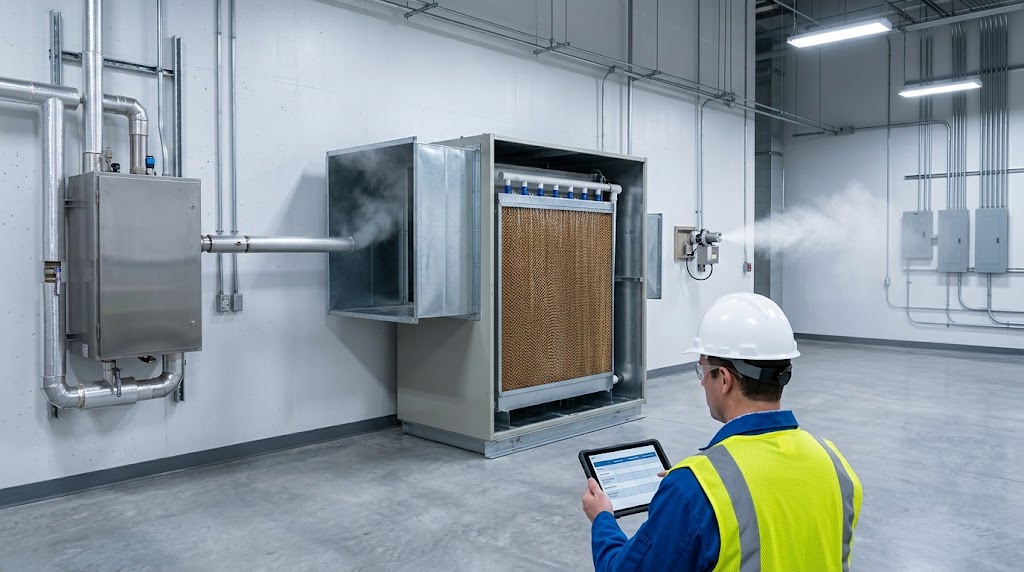
Industrial cold storage humidifiers introduce controlled moisture into the storage atmosphere at a rate sufficient to offset the continuous loss caused by refrigeration and air circulation. Systems humidify either the incoming air stream (in-duct or pre-cooling) or the storage space directly. Cold storage environments present a specific challenge: low temperatures reduce evaporation rates, so droplet delivery systems must produce self-evaporating droplets that fully evaporate before reaching produce, structural surfaces, or refrigeration equipment.
Key specification factors your facility must account for include: target RH range for stored commodities, storage room volume and air exchange rate, refrigeration system moisture removal rate, and required precision tolerance. For a broader overview of system selection, the industrial humidifiers complete buyer's guide covers evaluation criteria across facility types.
Effective food processing humidification and cold storage humidification share a common requirement: consistent, controlled moisture delivery without introducing free water into the environment.
Humidity Sensors and Control Systems
Effective cold storage humidification requires closed-loop control. Sensors continuously measure RH at representative points in the storage environment, and the humidifier modulates output to maintain the set-point range. Sensor placement matters because temperature and airflow variations within a cold room create RH gradients.
Systems with multiple sensor inputs provide more accurate environment-wide control than single-point sensing. Plus or minus 1 to 2% RH precision is achievable with properly specified industrial control system configurations and is operationally significant for commodities with narrow optimal storage RH windows.
Avoiding Over-Humidification and Surface Wetting
Over-humidification is a real operational risk that operators must account for in system design. RH maintained above commodity-appropriate ceilings can promote mold proliferation on produce surfaces and condensation on walls, floors, refrigeration coils, and packaging.
Humidifier systems that release droplets too large to self-evaporate before reaching surfaces introduce free water directly into the storage environment. Effective cold storage humidification requires precision control and a delivery mechanism that adds moisture to the air without depositing it on surfaces.
How Smart Fog Precision Humidification Applies to Cold Storage and Fog Tunnel Applications
Producing an equal-sized droplet grid in which every droplet is slightly charged to prevent re-aggregation solves the surface wetting problem that defines the over-humidification risk described above. Each droplet self-evaporates before reaching any surface, making it possible to maintain RH approaching saturation without wetting produce, packaging, refrigeration coils, or structural surfaces under proper system design. This is the operating principle behind Smart Fog's humidity control systems for cold storage applications.
Smart Fog systems are designed to maintain RH with plus or minus 1 to 2% precision, which is operationally relevant for mixed-commodity cold storage where different produce categories require different humidity targets.
Self-Evaporating Droplet Delivery for Produce-Safe Humidification
Every droplet in the Smart Fog equal-sized droplet grid self-evaporates before reaching a surface. This means the system adds moisture to the air without depositing free water on produce skin, packaging, or structural surfaces under proper system design.
Note: "non-wetting" applies to surfaces under proper system design. Direct exposure to the fog stream, such as a worker placing a hand directly into it, will cause wetting.
Key operational characteristics:
- Water efficiency: 100% of water evaporates into the air. No water is lost to floor pooling, drain disposal, or surface runoff, which simplifies compliance with food safety humidification and facility hygiene requirements.
- Maintenance intervals: Designed to extend up to every two years, with no moving parts in the humidification process.
- Continuous operation: Engineered for 24/7 set-and-forget operation without constant monitoring.
Fog Tunnel Integration for Distribution-Scale Cold Storage
A fog tunnel is a precision humidification zone, typically positioned at the receiving or pre-storage staging point in a distribution facility, through which produce passes on conveyors or pallets. It rapidly restores surface and near-surface moisture to produce that has experienced transit-related desiccation.
Produce entering long-term storage with higher initial moisture content loses less marketable weight over the same storage duration. This connects directly to the weight retention ROI framework: a fog tunnel reduces the cumulative moisture deficit that drives downstream shrinkage. Smart Fog fog tunnel systems are engineered as complete solutions for specific facility dimensions, throughput volume, and commodity mix, not component kits. For produce facilities managing ripening alongside cold storage, ripening room humidity systems can be integrated within the same humidification design.
Final Thoughts
Cold storage humidity directly determines how much weight your produce loses and how quickly it spoils. Temperature control alone does not address the vapor pressure gradient that drives moisture loss. Precision humidification does.
The ROI case is concrete. Weight retention improvements of 2 to 5% applied to daily throughput volume produce recoverable revenue figures that can be calculated against capital and operating costs. The biological mechanism is well-documented: transpiration continues as long as the vapor pressure differential exists, and only active humidity control closes that gap.
Contact Smart Fog to discuss cold storage humidification and request a system assessment for your facility's commodity mix, throughput volume, and cold storage configuration.
FAQ
What is the optimal relative humidity for storing leafy greens in cold storage?
Leafy greens require 95 to 100% RH in cold storage, according to USDA Agricultural Handbook 66. At RH below 90%, wilting can begin within hours due to the high surface-area-to-volume ratio of these commodities. Maintaining humidity at the upper end of this range requires a precision humidification system capable of plus or minus 1 to 2% accuracy.
How much weight can produce lose in cold storage due to low humidity?
Produce weight loss in cold storage typically ranges from 1 to 10% of fresh weight, depending on commodity type, storage duration, ambient RH, and airflow velocity. Even at the lower end of that range, a facility handling 10,000 pounds of leafy greens daily at 3% shrinkage loses 300 pounds of marketable weight per day. Proper humidity control reduces this loss directly.
What humidity level should a cold storage room maintain for mixed produce?
There is no single universal RH target for mixed produce storage. USDA Agricultural Handbook 66 specifies commodity-specific ranges: leafy greens require 95 to 100% RH, root vegetables 90 to 98% RH, and citrus 85 to 90% RH. When those commodities share a room, the practical options are splitting the space into humidity zones or defaulting the whole room to whichever product is most sensitive.
How do industrial humidifiers work in refrigerated cold storage environments?
In a refrigerated room, humidifiers are constantly fighting the moisture that refrigeration and air circulation strip out, and closed-loop control systems handle that by measuring RH continuously and adjusting output to hold the set point. Droplet size matters more here than in ambient environments: the cold slows evaporation, so a system that doesn't use self-evaporating droplets risks wetting produce directly.
What is the difference between humidification and refrigeration in cold storage?
Refrigeration controls temperature and slows biological metabolism, but cooling coils also condense and remove moisture from the air, effectively dehumidifying the storage environment. Humidification replenishes that lost moisture to maintain the RH levels produce requires for freshness and marketable weight retention. The two systems must be managed as separate variables, and one does not substitute for the other.
Can industrial humidifiers cause surface wetting or mold on stored produce?
Improperly specified humidification systems can cause surface wetting if droplets are too large to self-evaporate before reaching produce. Surface wetting can promote mold and accelerate spoilage. Over-humidification, meaning RH maintained above commodity-appropriate ceilings, carries the same risk. Systems that produce self-evaporating droplets and maintain plus or minus 1 to 2% RH precision address both risks under proper system design.
How long can vegetables be stored in cold storage with proper humidity control?
Storage duration at acceptable quality levels varies significantly by commodity. Leafy greens stored at 32 to 36°F and 95 to 100% RH typically last 1 to 3 weeks, while root vegetables at target humidity can hold quality for several months. Precise humidity control extends the upper end of these ranges by reducing the cumulative moisture loss that drives texture degradation, spoilage, and grade downgrade.
How do I calculate the ROI of installing a humidification system in a cold storage facility?
The calculation framework is: daily throughput volume (pounds) multiplied by shrinkage rate (percentage) multiplied by wholesale value per pound equals daily recoverable revenue. Apply your facility's throughput, commodity mix, and current shrinkage rate to estimate daily and annual revenue loss attributable to humidity-driven weight loss. Compare that figure against the capital and operating cost of a humidification system to establish a payback period. Higher-value produce categories produce proportionally larger recoverable figures at the same retention improvement percentage.