- Humid air contains more water vapor per cubic meter than dry air, reducing atmospheric density and creating pressure differences that drive weather circulation patterns.
- Heat index increases exponentially with humidity because water vapor prevents sweat evaporation, making 90 degrees F at 70% relative humidity feel like 105 degrees F heat index.
- Water vapor condenses into clouds when humid air cools to its dew point temperature, initiating precipitation through droplet nucleation and collision processes.
- Atmospheric humidity creates convection currents because moist air rises faster than dry air due to lower molecular density.
- Barometric pressure drops as atmospheric humidity increases because water vapor molecules weigh approximately 62% less than the nitrogen and oxygen they displace.
- Regional humidity patterns vary from 10-20% in desert climates to 80-90% in tropical coastal areas, directly affecting local weather system intensity and frequency.
How Water Vapor Changes Atmospheric Conditions
Water vapor fundamentally alters atmospheric physics through molecular displacement and density reduction. Each water molecule (H2O) has a molecular weight of 18 atomic mass units, while nitrogen (N2) weighs 28 and oxygen (O2) weighs 32. When water vapor enters the atmosphere, it displaces these heavier molecules, creating air masses with lower overall density. This density difference drives atmospheric circulation patterns. Humid air masses rise more readily than dry air because they weigh less per unit volume. The rising motion creates low-pressure areas at the surface, drawing in surrounding air and establishing circulation patterns that become the foundation of weather systems. Latent heat transfer amplifies these effects. When water evaporates, it absorbs approximately 2,260 kilojoules per kilogram of energy from the surrounding environment. This energy travels with the water vapor until condensation occurs, at which point the stored energy releases into the atmosphere. This energy transfer mechanism powers storm development and intensifies weather patterns far beyond what temperature differences alone could generate.Water Vapor Density and Air Pressure
Atmospheric pressure decreases measurably as humidity increases because water vapor molecules are significantly lighter than the gases they replace. At sea level, completely dry air exerts 1,013.25 millibars of pressure, while air saturated with water vapor at the same temperature exerts approximately 6-8 millibars less pressure. This pressure reduction creates horizontal pressure gradients that drive wind patterns. Air flows from high-pressure dry regions toward low-pressure humid areas, establishing the circulation patterns that move weather systems across geographic regions. The greater the humidity difference between adjacent air masses, the stronger the pressure gradient and resulting wind speeds.Convection and Air Movement Patterns
Humid air rises through the atmosphere faster and more consistently than dry air due to its reduced density. This buoyancy effect creates thermal columns and convection cells that transport moisture vertically through atmospheric layers. As humid air rises, it expands and cools, eventually reaching its saturation point where condensation begins. These convection patterns establish feedback loops. Rising humid air creates surface low pressure that draws in more moist air from surrounding areas. The continuous supply of water vapor sustains convection activity, leading to organized weather systems. Without adequate humidity, convection remains weak and weather systems lose their driving energy source.Heat Index: How Humidity Makes Hot Weather Feel Hotter
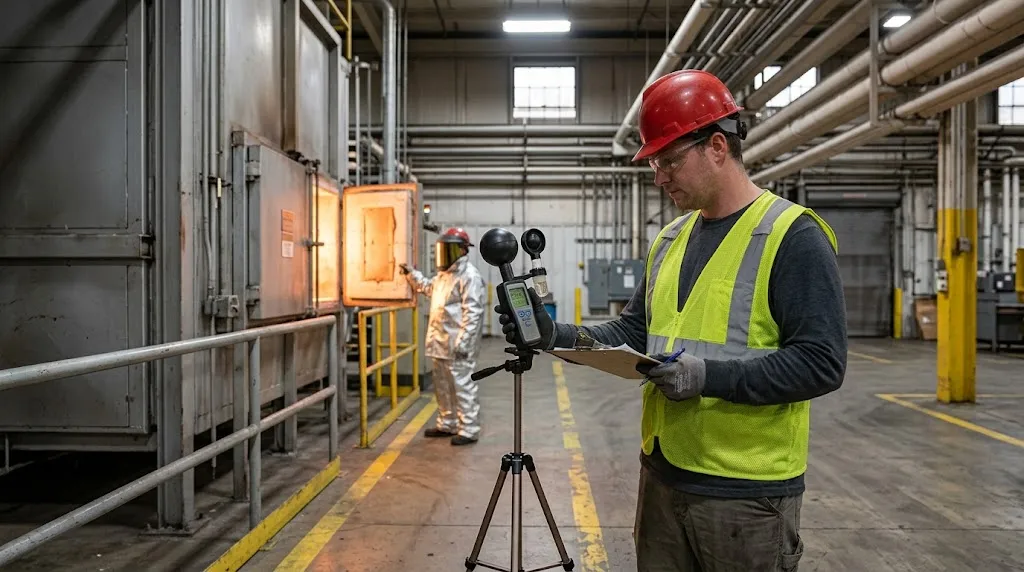
Heat index quantifies the combined effect of air temperature and relative humidity on human thermal perception. The human body regulates temperature through perspiration evaporation, which removes approximately 2,430 kilojoules of heat energy per liter of sweat evaporated. High humidity reduces evaporation rates, preventing effective body cooling and creating the sensation of higher temperatures. The relationship between humidity and perceived temperature follows an exponential curve rather than a linear progression. At 90 degrees F air temperature, increasing relative humidity from 40% to 70% raises the heat index from 91 degrees F to 105 degrees F. This 30-percentage-point humidity increase creates a 14-degree perceived temperature rise, demonstrating how humidity amplifies thermal stress far beyond its proportional increase. Heat index calculations become critical for safety assessment at elevated temperature-humidity combinations. The National Weather Service issues heat advisories when heat index values reach 105-109 degrees F and excessive heat warnings above 110 degrees F. These thresholds reflect the point where physiological cooling mechanisms become insufficient to maintain normal body temperature.The Science Behind Perceived Temperature
Human thermoregulation depends on heat transfer through four mechanisms: conduction, convection, radiation, and evaporation. At temperatures above approximately 70 degrees F, evaporation becomes the dominant cooling pathway. Sweat glands produce moisture that must evaporate from skin surfaces to remove heat energy from the body. Evaporation rates are determined by the water vapor pressure gradient between skin surface and ambient air. When atmospheric humidity increases, this gradient decreases, slowing evaporation and reducing cooling effectiveness. At 90% relative humidity, evaporation virtually ceases regardless of sweat production rate, forcing the body to rely on less efficient cooling mechanisms. The exponential heat index relationship occurs because small humidity increases create proportionally larger reductions in cooling capacity. Moving from 50% to 60% relative humidity reduces evaporation potential more significantly than moving from 20% to 30%, explaining why humid heat creates disproportionate thermal stress compared to dry heat at equivalent temperatures.Heat Index Calculations and Thresholds
Heat index values are calculated using the Rothfusz equation, which incorporates both dry-bulb temperature and relative humidity to determine apparent temperature. The equation produces these representative combinations:- 80 degrees F air temperature: 30% RH feels like 79 degrees F, 60% RH feels like 82 degrees F, 90% RH feels like 86 degrees F according to heat index calculations.
- 90 degrees F air temperature with varying humidity levels: 30% RH creates a heat index of 91 degrees F, 60% RH feels like 100 degrees F, 90% RH feels like 122 degrees F.
- 100 degrees F air temperature: 30% RH feels like 104 degrees F, 60% RH feels like 132 degrees F, with 90% RH exceeding safe heat index calculation ranges.