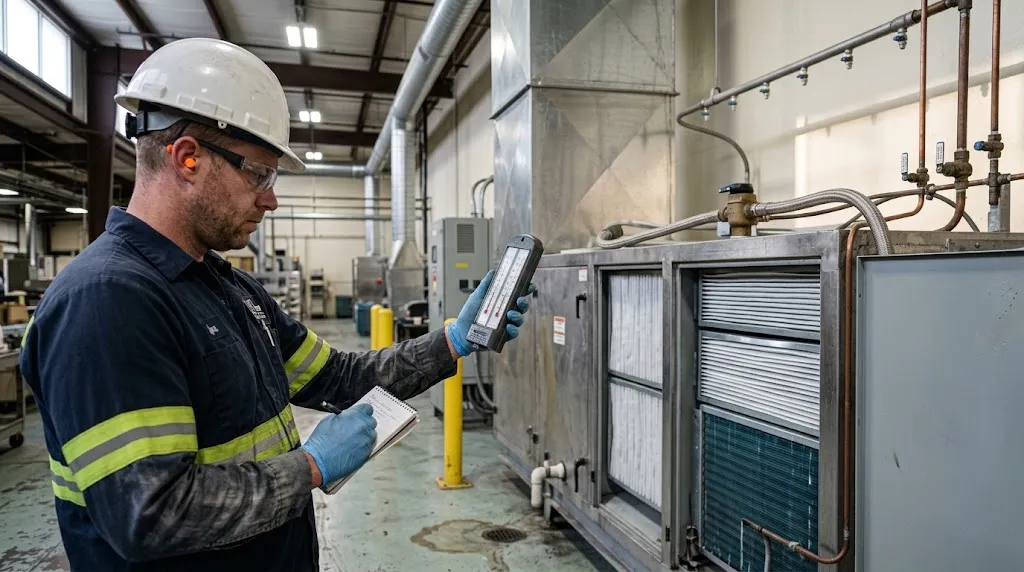
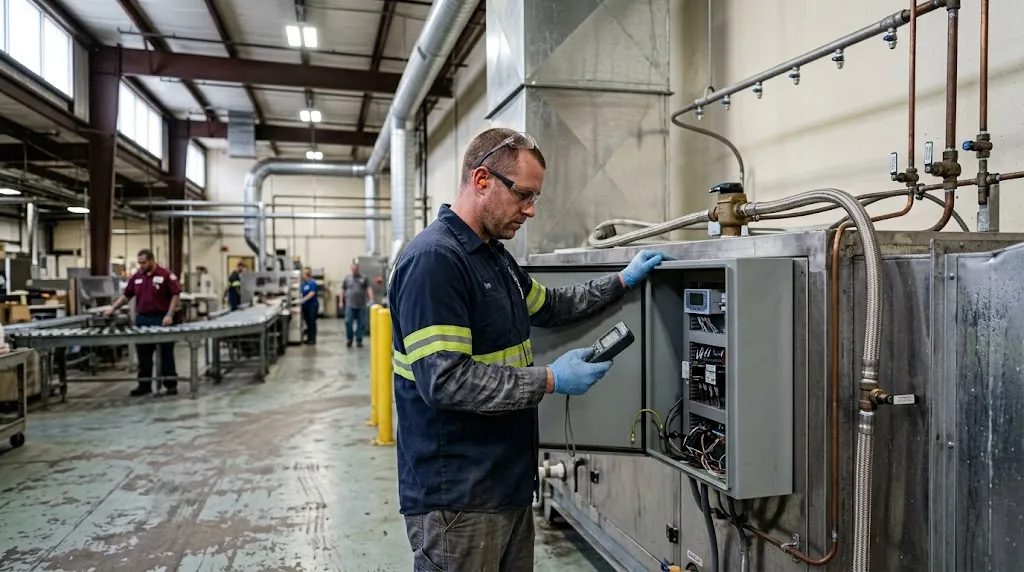
ASHRAE TC9.9 (“Thermal Guidelines for Data Processing Environments”) defines a recommended dew point range of approximately 42°F (5.5°C) as the lower limit and 59°F (15°C) as the upper limit for data center environments. Those two numbers represent more than setpoint targets. They mark the boundaries between a controlled environment and two distinct failure modes: electrostatic discharge (ESD) below the floor, and condensation above the ceiling.
This article explains the ASHRAE TC9.9 class envelopes in dew point terms, clarifies the difference between allowable and recommended ranges, and connects each threshold to the equipment failure mechanism it governs. Facility teams can check a current reading against these thresholds directly with the dew point calculator.
Key Takeaways
- ASHRAE TC9.9 defines a recommended dew point range of approximately 42°F (5.5°C) at the lower limit and 59°F (15°C) at the upper limit, with allowable envelopes that extend beyond those boundaries under defined conditions.
- Below the lower dew point threshold, reduced air moisture allows electrostatic charge to accumulate on server components and technicians, increasing the risk of ESD events that can cause latent damage without triggering alarms.
- Above the upper dew point threshold, water vapor condenses on server surfaces, cold aisle infrastructure, and exposed circuit board traces, accelerating electrochemical corrosion and creating short-circuit risk on energized boards.
- ASHRAE TC9.9 defines equipment classes A1 through A4 for air-cooled equipment, each with progressively broader humidity tolerances. When multiple classes share a data hall, the entire room must be managed to the most restrictive class present.
- Relative humidity (RH) varies with temperature without any change in absolute moisture content, making dew point the more operationally stable metric for humidity management across the thermal gradients typical in active data halls.
- Data centers operating air-side economizers face a specific condensation risk during the transition from mechanical cooling to economizer mode, when incoming outdoor air at elevated dew points contacts cold-side infrastructure.
Why Dew Point Is the Correct Metric for Data Center Humidity Management
Relative humidity describes how much moisture the air holds relative to its maximum capacity at a given temperature, according to the National Weather Service humidity resource. That temperature-dependence is a meaningful limitation in data center environments, where significant thermal gradients exist between cold aisles, hot aisles, and server inlet planes. A single RH reading from one sensor location may accurately reflect conditions at that sensor while masking a condensation or ESD risk forming elsewhere in the same room.
Dew point, by contrast, measures the temperature at which the air’s moisture content would begin to condense, regardless of the ambient air temperature at the measurement point. It is a property of the air’s absolute moisture content, not of the local temperature, which makes it stable across sensor locations and more reliable as a threshold metric. ASHRAE TC9.9 guidance on dew point as the preferred data center humidity metric and Energy Star’s data center efficiency guidance both recommend measuring humidity with dew point rather than RH for this reason.
The practical comparison between the two metrics across four operational dimensions:
- Measurement stability across temperature gradients: Dew point remains constant as air moves through thermal zones; RH rises as air cools and falls as air warms, producing variable readings from the same air mass.
- Usefulness as a condensation risk indicator: Dew point directly identifies the surface temperature at which condensation will form; RH requires temperature correction before it can serve the same function.
- Usefulness as an ESD risk indicator: Dew point maps directly to absolute moisture content, which governs air conductivity and charge dissipation; RH does not.
- Calibration sensitivity: Dew point sensors maintain accuracy across a wider temperature range; RH sensors require recalibration when ambient temperature drifts outside their calibration range.
For a detailed treatment of the relationship between these two metrics, see our comparison of dew point vs. humidity.
How Temperature Gradients in Data Halls Affect RH Readings
A cold aisle maintained at 65°F and a hot aisle at 95°F will produce very different RH readings from the same volume of air, because RH is temperature-dependent. A sensor placed in the hot aisle may display an RH reading that appears safe, while conditions at the cold server inlet are approaching the dew point of that same air mass. Facility-wide RH monitoring is structurally insufficient for condensation risk detection when large temperature differentials are present.
Dew Point as a Surface Condensation Indicator
Condensation forms when a surface temperature falls at or below the dew point of the surrounding air. In actively cooled data halls, server inlet temperatures can reach levels where this threshold is crossed if the ambient dew point is not maintained below those surface temperatures. This is the physical mechanism that makes the ASHRAE TC9.9 upper dew point limit operationally significant, and it is discussed in detail in the failure modes section below.
ASHRAE TC9.9 Dew Point and Humidity Ranges Explained
ASHRAE TC9.9 establishes both a recommended operating envelope and a broader allowable envelope for data center environments. The recommended dew point lower limit is approximately 42°F (5.5°C). The recommended upper limit is approximately 59°F (15°C). These recommended limits represent the conditions under which equipment OEMs expect their hardware to operate reliably and, in most cases, the conditions under which warranty terms apply.
The allowable envelope extends beyond those boundaries under defined operating conditions. In relative humidity terms, the recommended range corresponds generally to approximately 40 to 60% RH at typical data center operating temperatures, though those RH equivalents are temperature-dependent and should not be used as primary setpoints. Dew point is the operationally correct primary metric.
Recommended vs. Allowable Envelopes: What the Distinction Means Operationally
Operating within the allowable-but-not-recommended envelope may void equipment warranties from major server OEMs, even when the facility remains within ASHRAE’s stated outer limits. OEM hardware warranty documentation commonly specifies ASHRAE class compliance as a condition, meaning a facility operating at the outer edges of the allowable range carries warranty exposure that the recommended envelope does not.
This distinction is a risk management consideration, not merely a standards footnote, and it affects how facilities should interpret the margin between recommended and allowable thresholds during setpoint planning.
How Altitude Affects Data Center Dew Point Setpoints
ASHRAE TC9.9 specifies that data centers above approximately 950 meters (3,117 feet) face altitude-adjusted humidity considerations:
- Lower pressure at altitude: at higher elevations, atmospheric pressure is lower than at sea level.
- The effect on moisture content: [this is the part worth re-checking, see note above before publishing].
- Practical implication: facilities at altitude should account for this when establishing their humidity setpoints, since sea-level recommended limits may not translate directly.
ASHRAE Equipment Classes and Their Humidity Envelopes
ASHRAE TC9.9 does not apply a single humidity envelope to all data center equipment. It defines distinct equipment classes, each with progressively broader environmental tolerances. The class composition of a data hall, not just the hall’s average conditions, determines the compliance constraint for the entire space.
For air-cooled equipment, the four classes are A1 through A4. A1 represents enterprise-grade servers designed for tightly controlled environments, with the most restrictive allowable humidity range. A2 and A3 represent progressively broader tolerances, covering equipment designed for less precisely controlled conditions. A4 has the broadest tolerance, covering ruggedized and telecom-grade equipment built for harsh or variable environments.
For exact dew point and RH figures for each class, consult the published ASHRAE TC9.9 document directly. The principle holds across all editions: each successive class permits wider humidity excursions, and mixing classes in a single hall constrains the room to the most restrictive class present.
- A1 (enterprise servers, tightly controlled environments): Narrowest allowable humidity envelope; requires stable dew point management within the recommended range.
- A2 (general commercial servers): Broader tolerance than A1; allowable envelope extends modestly beyond A1 limits in both directions.
- A3 (servers for variable environments): Wider still; designed for environments where precision air conditioning may be less consistent.
- A4 (ruggedized and telecom-grade equipment): Broadest tolerance; intended for harsh or outdoor-adjacent conditions.
ASHRAE TC9.9 also defines W1 through W5 classes for water and liquid-cooled equipment. These are covered briefly below.
Why Mixed-Class Data Halls Require the Most Restrictive Setpoint
A data center manager who deploys a batch of A1-class servers into a hall previously running A3-class equipment must re-evaluate the room’s humidity setpoints to the A1 envelope. The reverse applies equally: relaxing setpoints to accommodate A3 or A4 equipment may place A1 hardware outside its ASHRAE class conditions.
This is a planning consideration for refresh cycles and hardware procurement. Every hardware generation change that introduces equipment of a different ASHRAE class requires a setpoint review for the affected data hall.
Liquid-Cooled Environments and the W-Class Designations
W1 through W5 classes cover water and liquid-cooled equipment. In liquid-cooled environments, chilled water manifolds and server cold plates can operate at surface temperatures well below the room’s ambient dew point if the system is not properly designed.
This creates a more acute condensation risk profile than air-cooled racks, because the cold surfaces are in direct contact with components and circuit pathways. The failure mode is the same as for air-cooled equipment, but the surface area and contact proximity make moisture damage more immediate.
The Two Failure Modes: ESD Below the Dew Point Floor, Condensation Above the Ceiling
The ASHRAE TC9.9 dew point limits are not arbitrary. Each boundary exists because crossing it in either direction produces a specific physical failure mechanism with documented consequences for IT equipment. Understanding those mechanisms is necessary for prioritizing the humidity control response at each boundary.
ESD Risk at Low Dew Point: How Dry Air Enables Static Accumulation
Air at low dew point contains less moisture, which reduces the conductivity of both the air and the surfaces within the space. When surface conductivity falls, electrostatic charge accumulates on server components, technicians, and equipment carts rather than dissipating harmlessly. ASHRAE TC9.9’s lower recommended limit of approximately 42°F (5.5°C) exists specifically to maintain enough ambient moisture to allow charge to dissipate before it accumulates to damaging levels.
When accumulated charge discharges across a component junction, the result is either immediate hard failure or latent ESD damage. Latent damage is the more operationally dangerous outcome. A component sustains internal junction degradation but continues functioning, with the damage only becoming apparent during a failure event weeks or months later.
That delayed failure mode does not trigger immediate alarms and is frequently misattributed to other causes during failure analysis. For a full treatment of the mechanism, see how static electricity damages server hardware and how humidity control prevents ESD in server rooms.
Condensation Risk at High Dew Point: When Server Surfaces Become Condensation Points
Condensation forms when the ambient dew point exceeds the surface temperature of cold-side components: server inlets, cold water manifolds, cold aisle infrastructure, and exposed PCB traces near air intake points. ASHRAE TC9.9’s upper recommended limit of approximately 59°F (15°C) represents the dew point above which the risk of surface condensation in actively cooled data halls becomes significant.
Once condensation forms on energized circuit board traces or connector contacts, electrochemical corrosion begins. Corrosion on electrical contacts is a slow-developing failure mode that may not be detectable until substantial infrastructure damage has accumulated, compounding the risk relative to immediately visible failures.
Humidity Management During Air-Side Economizer Operation
Air-side economizers reduce data center cooling energy by drawing in outdoor air when ambient conditions are favorable. The condensation risk that this mode introduces is among the least-covered topics in data center humidity management, despite being a well-documented design consideration in ASHRAE evaporative cooling and economizer guidance for data centers.
When a data center transitions from mechanical cooling to economizer mode, outdoor air at variable dew points enters the conditioned space. If incoming air carries a dew point higher than the surface temperature of cold-side infrastructure, condensation forms on contact with those surfaces. This risk is highest during shoulder-season conditions, when outdoor temperatures are moderate enough to permit economizer operation but regional weather patterns produce elevated outdoor dew points. Environmental monitoring must be configured to detect this scenario before it reaches cold surfaces, not after.
A1-class equipment has less tolerance for brief excursions above the upper dew point limit than A3 or A4 equipment. A data hall running A1-class servers faces a narrower operating window during economizer transitions and requires more responsive humidity control system integration to stay within the recommended envelope.
Monitoring Dew Point at the Economizer Intake, Not Just the Room
A room-level dew point sensor will lag the actual condensation risk by the time it takes for incoming air to mix with conditioned air. For economizer transitions, the critical measurement point is at or near the air-side intake. If the incoming air’s dew point exceeds the surface temperature of cold-side infrastructure, the transition to economizer mode should be delayed or the humidification setpoint adjusted to condition incoming air before it contacts cold surfaces. Placing humidity sensors only at room level is an environmental monitoring gap with direct condensation consequences.
Humidity Control System Requirements for Mixed-Mode Cooling
Humidity control in an economizer-equipped data center requires the system to respond quickly to incoming air dew point changes, integrate with cooling mode switchover logic, and maintain setpoints referenced to the coldest surface temperatures in the room. A system calibrated to average air temperature rather than the coldest surface will underestimate condensation risk during transitions. This is a system design requirement, not simply a monitoring configuration question.
How Precision Humidification Maintains ASHRAE-Compliant Dew Point in Data Centers
Maintaining a stable dew point within the ASHRAE TC9.9 recommended envelope requires a humidification system that can hold tight setpoints without introducing surface moisture. In a data center, those two requirements are in direct tension: the system must add enough moisture to stay above the ESD risk threshold while staying well below the dew point of the coldest server surfaces in the room.
An equal-sized droplet grid designed to self-evaporate before reaching any surface resolves that tension directly. Because every droplet is sized and charged to evaporate into the air column before surface contact, the system raises ambient dew point without depositing moisture on server racks, cold aisle panels, or energized circuit pathways. This is the operating principle behind Smart Fog’s data center humidification systems, and it addresses the condensation failure mode at the mechanism level rather than relying on airflow management alone.
For a broader comparison of humidity control in data centers and the factors that differentiate system performance, that resource covers selection criteria in detail.
Non-Wetting Operation in Precision-Critical Environments
Smart Fog’s self-evaporating droplet grid is designed so that droplets evaporate before reaching any surface under proper system design. This makes the system compatible with energized server equipment, open rack configurations, and cold aisle environments where any surface moisture would immediately create condensation or corrosion risk. The non-wetting characteristic applies under proper system design; direct exposure to the fog stream will result in wetting.
Key performance characteristics relevant to ASHRAE compliance:
- Humidity precision: Systems maintain up to 99% RH with plus or minus 1 to 2% precision, holding dew point within the recommended envelope without overshooting into the condensation risk zone.
- Surface compatibility: Self-evaporating droplets are designed to reach the target RH without depositing moisture on racks, ducts, or IT equipment surfaces under proper system design.
- No moving parts: No mechanical components in the humidification process eliminates failure points that would produce unmonitored humidity excursions.
For a comparison of ESD control methods compared and how humidity-based control positions against other approaches, that article covers the full range of available methods.
Continuous Operation and Dew Point Stability in 24/7 Facilities
Data centers operate continuously and cannot tolerate humidity excursions that occur during system maintenance windows. Smart Fog’s no-moving-parts design supports maintenance intervals of up to two years, meaning the system does not require scheduled shutdowns that would interrupt humidity control. A humidification system that is offline for maintenance during a shoulder-season economizer transition creates exactly the kind of unmonitored dew point excursion described in the economizer section above.
Continuous availability of the humidification system is a direct operational requirement for facilities running mixed-mode cooling. Facilities evaluating ideal humidity levels for data centers alongside system selection criteria will find that setpoint capability and system uptime are equally important inputs to that decision.
Final Thoughts
ASHRAE TC9.9 provides a precise, enforceable framework for data center humidity management, but the operational value of that framework depends on how facilities interpret and apply it. Treating the recommended dew point range as a simple RH setpoint ignores the temperature-dependence of RH across data hall thermal gradients, the class-specific compliance obligations that mixed equipment deployments create, and the distinct failure mechanisms that operate at each boundary.
The 42°F (5.5°C) lower limit is an ESD threshold. The 59°F (15°C) upper limit is a condensation threshold. Each failure mode operates through a different physical mechanism, produces a different pattern of equipment damage, and requires a different operational response. Understanding both, and selecting ESD control systems and humidification systems capable of holding setpoints within the recommended envelope, is the engineering-grade approach that ASHRAE’s standards are designed to support.
To discuss ASHRAE-compliant dew point control for your data center facility, contact Smart Fog engineers for a system assessment.
FAQ
What is the ASHRAE TC9.9 recommended dew point range for data centers?
Data centers should target a dew point envelope bounded by roughly 42°F (5.5°C) on the low end and 59°F (15°C) on the high end, per ASHRAE TC9.9. These recommended limits sit within a broader allowable envelope that extends beyond those values under defined conditions. Operating within the recommended range is the threshold at which most server OEMs expect warranty terms to apply, making it the operationally relevant target for facility setpoint planning.
What happens to server equipment when data center dew point falls below the ASHRAE lower limit?
When dew point falls below approximately 42°F (5.5°C), air moisture content drops low enough to reduce the conductivity of both the air and surrounding surfaces. Electrostatic charge accumulates on server components, technicians, and equipment carts rather than dissipating. When that charge discharges across a component junction, the result can be immediate hard failure or latent ESD damage, where internal junction degradation is present but the component continues functioning until it fails weeks or months later, often without triggering immediate alarms.
How is dew point different from relative humidity, and which should a data center monitor?
Relative humidity measures moisture content as a percentage of the air’s maximum capacity at a given temperature, meaning the RH value changes when temperature changes even if the actual moisture content does not. Dew point measures the temperature at which condensation would form from the air’s current moisture content, a value that stays constant regardless of ambient temperature. Data centers should use dew point as the primary setpoint metric because it remains stable across the thermal gradients typical in active data halls, where RH sensors in different thermal zones will report very different values from the same air mass.
What ASHRAE equipment classes apply to data center humidity management, and how do they differ?
ASHRAE TC9.9 defines air-cooled equipment classes A1 through A4, with each successive class permitting progressively wider humidity tolerances. On the tight end of the spectrum, A1 enterprise servers hold the narrowest humidity tolerance of the four classes; on the broad end, A4 ruggedized and telecom-grade hardware can handle the widest swings. When multiple classes share a data hall, the most restrictive class present sets the humidity compliance boundary for the entire space. Exact dew point and RH figures differ by class and edition, so check the current published ASHRAE TC9.9 document rather than relying on generalized figures.
How does condensation form on server hardware, and what does it damage?
Condensation forms when the ambient dew point exceeds the surface temperature of a component or infrastructure element. In data centers, vulnerable surfaces include server inlet filters, cold aisle panels, chilled water manifolds, and exposed PCB traces near air intake points. That moisture on energized circuit traces or connector contacts is what triggers electrochemical corrosion. Corrosion on electrical contacts develops gradually and may not be detectable until significant infrastructure damage has accumulated, making it a slow-developing but serious failure mode.
What is the upper dew point limit for data centers, and why does exceeding it create risk?
The ASHRAE TC9.9 recommended upper dew point limit is approximately 59°F (15°C). Above this threshold, the dew point of the ambient air exceeds the surface temperature of cold-side infrastructure in actively cooled data halls, causing condensation to form on server inlets, cold water manifolds, and circuit board traces. That condensation accelerates electrochemical corrosion on metal contacts and creates short-circuit risk on energized boards.
How should humidity be managed during air-side economizer operation to prevent condensation?
Humidity management during economizer operation requires dew point monitoring at the air-side intake, not only at room level. When the incoming outdoor air’s dew point runs higher than the cold-side surface temperatures it will contact, the safer response is to hold off on the economizer switch, or to precondition that incoming air, rather than let it reach those surfaces unmodified. The humidity control system must be capable of integrating with cooling mode switchover logic and responding quickly to incoming air dew point changes, not just steady-state room conditions.
Does altitude affect the dew point setpoints a data center should maintain?
Yes. ASHRAE TC9.9 specifies altitude-adjusted humidity thresholds for facilities above approximately 950 meters (3,117 feet). Atmospheric pressure drops with elevation, so a given dew point reading at altitude represents less actual water vapor per unit volume than the same reading at sea level. Running a high-altitude facility at the standard 42°F (5.5°C) sea-level floor therefore leaves less real moisture in the air than that number suggests, narrowing the ESD safety margin relative to a sea-level facility reading the same value. Facilities at altitude should adjust their humidity setpoints accordingly and consult ASHRAE TC9.9 for altitude-specific guidance.