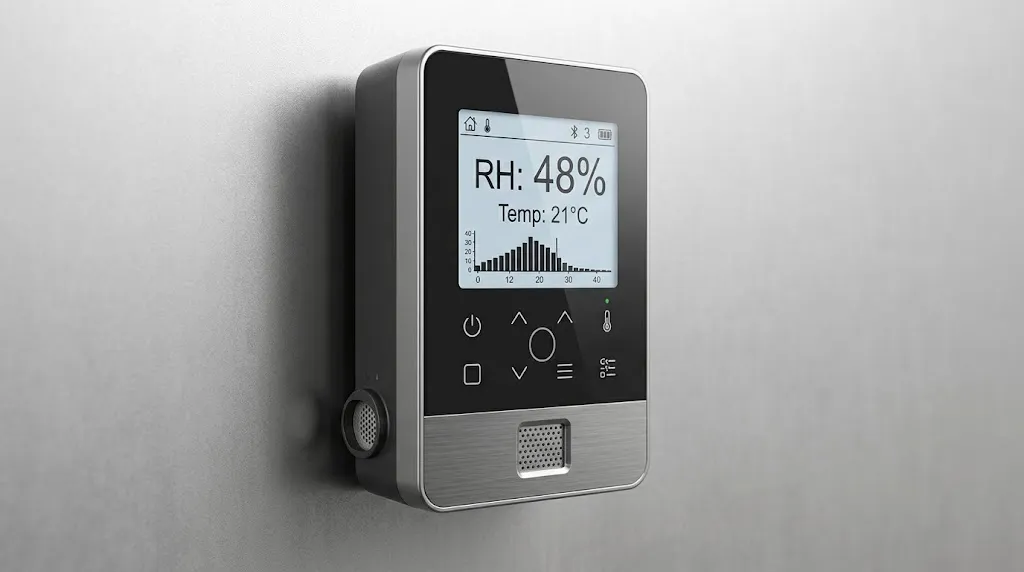
A humidity reading can look completely stable while actual moisture conditions inside a sealed environment shift dramatically. This happens because relative humidity (RH) changes with temperature even when no water vapor has moved into or out of a space. In drying and sealed storage applications, that behavior makes %RH an unreliable process control metric, and grams per cubic meter (g/m³) the correct one.
This article covers the full drying-to-seal workflow: why %RH misleads at the critical moments when temperature changes, how to define and verify an absolute humidity target before sealing, how desiccant selection connects to that target, and what failure modes result from getting the sealed condition wrong. Our free absolute humidity calculator can also help you better understand the requirements for your environment.
Key Takeaways
- Relative humidity is a temperature-dependent ratio. Sealing a container at 40% RH at 25°C and cooling it to 15°C will drive internal %RH to approximately 72%, with no new moisture entering the space.
- Absolute humidity, expressed in g/m³, does not change with temperature in a sealed space. It measures actual water vapor mass per unit volume, making it the correct metric for drying endpoints and sealed storage verification.
- Drying is complete only when enclosed materials reach equilibrium moisture content (EMC) with the surrounding air. Sealing before that point traps an ongoing internal moisture source.
- Desiccant selection must match the absolute humidity target. Silica gel equilibrates at a relatively high residual moisture level and cannot achieve the dew points required for battery dry rooms or Class 1 moisture-sensitive electronics.
- Industrial standards governing electronics packaging under IPC/JEDEC J-STD-033, pharmaceutical GMP guidelines, and military specifications such as MIL-D-3464 all use g/m³ or dew point as the governing humidity metric because %RH's temperature dependence disqualifies it for sealed-environment control.
- Temperature cycling after sealing redistributes moisture inside a closed enclosure. Even correctly sealed packages can develop internal condensation if surface temperatures drop to or below the internal dew point during transit or storage.
Why %RH Fails as a Process Metric When Temperature Changes
Percent relative humidity measures the ratio of actual water vapor pressure to the maximum water vapor pressure possible at a given temperature. That ratio is useful for comfort and biological applications, where the goal is understanding how air feels to occupants or affects living systems. For sealed storage and drying process control, it is the wrong tool.
The problem is specific: %RH shifts whenever temperature changes, even in a perfectly sealed space where no moisture has moved. For a deeper comparison of the two metrics, see absolute humidity vs relative humidity.
The Saturation Vapor Pressure Relationship
Air's capacity to hold water vapor increases with temperature. At higher temperatures, the saturation vapor pressure is higher, so the same absolute mass of water vapor represents a smaller fraction of the total capacity, and %RH is lower. Cool that same air down, and the capacity shrinks.
The same mass of water vapor now represents a larger fraction, so %RH rises. Psychrometric charts visualize this relationship across temperature and humidity combinations and are the standard engineering tool for tracking it.
What This Means for a Sealed Container in Transit
Consider a sealed electronics shipment verified at 25°C and 40% RH before dispatch. At 25°C, 40% RH corresponds to approximately 9.2 g/m³. When that container arrives at a cooler warehouse at 15°C, the internal %RH rises to approximately 72%, because the air's capacity to hold moisture has decreased at the lower temperature. The absolute moisture content is unchanged at 9.2 g/m³, but the %RH reading has climbed by more than 30 percentage points. That gap widens further the colder the warehouse gets; this shipment's dew point sits close to 9-10°C, so a warehouse colder than that, not just a cooler one, would start condensing moisture on internal surfaces rather than merely reading a higher %RH. If a quality engineer measures only %RH on arrival and flags the shipment, the reading is technically correct but operationally misleading. The moisture content is identical to what was verified at dispatch. This is the physical mechanism behind condensation damage in sealed electronics shipments and moisture ingress failures in pharmaceutical packaging during cold-chain distribution.
Defining the Correct Drying Endpoint Before Sealing
The most common mistake in drying-before-packaging workflows is treating a %RH reading in the drying environment as confirmation that the product is ready to seal. It is not. The ambient air in the drying chamber may have reached a target humidity level, but the material inside may still be releasing moisture into that air. For how humidity is measured correctly in these environments, see how humidity is measured.
Equilibrium Moisture Content and Why Premature Sealing Is a Hidden Risk
Equilibrium moisture content is the moisture level a material reaches when it stops exchanging water vapor with its surrounding air. At that point, net moisture transfer between the material and the ambient air is zero. Before that point, the material is still releasing moisture, and sealing it creates a closed system where that off-gassing continues with no escape path. The result is that internal absolute humidity rises after sealing, regardless of what conditions were verified beforehand.
The correct drying endpoint is confirmation that both the material and the ambient air have reached the same absolute humidity level. A %RH reading alone does not confirm this because it does not distinguish between a stable equilibrated state and an ongoing drying process that has simply slowed. The verification steps are:
- Confirm the ambient air in the drying environment has reached the target absolute humidity in g/m³.
- Confirm the material has been exposed at that condition long enough for equilibration to occur.
- Verify that successive g/m³ readings over time show no upward drift caused by continued material off-gassing.
- Seal immediately after confirmation, before re-absorption from ambient air begins.
Application-Specific Drying Targets in g/m³
The required absolute humidity target before sealing varies by application and is defined by relevant standards.
- Electronics component packaging: JEDEC/IPC J-STD-020 moisture sensitivity classification assigns Moisture Sensitivity Level (MSL) ratings that correspond to defined floor life limits. MSL 1 components tolerate indefinite exposure at 30°C and 85% RH, while MSL 5a components require dry-pack storage and baking before assembly if floor life is exceeded. IPC/JEDEC J-STD-033 governs dry-pack conditions, requiring desiccated storage at dew points consistent with very low absolute humidity levels.
- Pharmaceutical tablet packaging: International Council for Harmonisation (ICH) Q1B moisture sensitivity studies define stability thresholds based on the active ingredient's response to moisture. Packaging line ambient humidity must be held to a defined absolute level that reflects the formulation's critical moisture content, not a generic %RH target.
- Battery and cell manufacturing dry rooms: Lithium-ion cell manufacturing requires ambient dew points below -40°C, which corresponds to an extremely low absolute humidity. Even trace moisture degrades electrolyte chemistry and reduces cell cycle life.
- Vacuum-sealed food packaging: Water activity targets, which correspond directly to absolute humidity levels in the headspace gas, govern food preservation and shelf life extension. The FDA guidance on water activity in food establishes that products with water activity at or below 0.85 are not subject to the same pathogen growth risk as higher-moisture products.
Choosing the Right Desiccant Based on Your Absolute Humidity Target
Desiccant selection is not interchangeable across applications. The desiccant type must match the absolute humidity target the sealed space must maintain. Using the wrong desiccant means the target g/m³ level will not be held over the storage period, even if initial sealing conditions were correctly verified. Humidity meters and monitors are essential tools for confirming baseline conditions before desiccant quantities are finalized.
Silica Gel vs. Molecular Sieve: The Critical Distinction
The fundamental difference between silica gel and molecular sieve is the difference between equilibration and exclusion.
Silica gel adsorbs moisture through surface equilibration. It will stabilize internal humidity at a level determined by how much moisture the enclosed material and air volume contain. It cannot guarantee a dew point floor below its own equilibration point, which is typically in the range of -20°C to -30°C under favorable conditions. For general low-humidity storage, this is often sufficient. For Class 1 MSL electronics or lithium battery manufacturing, it is not.
Molecular sieve desiccants, specifically 3-angstrom and 4-angstrom variants, adsorb water molecules by physical exclusion based on pore size. They can reach dew points below -40°C because they trap water molecules structurally rather than relying on surface equilibration dynamics. This is not a marginal performance difference. It determines whether a sealed package meets the conditions required by J-STD-033 for MSL-rated components or only achieves general reduced-humidity storage.
Matching Desiccant Quantity to Absolute Humidity Load
Desiccant quantity must be calculated from the total absolute moisture load inside the sealed space, not estimated from volume alone. That load has two components: the moisture contained in the enclosed air volume at the time of sealing, calculated as g/m³ multiplied by the air volume, plus the moisture that enclosed materials will continue to off-gas before reaching EMC.
Undersizing the desiccant relative to this combined load means the target will not be maintained. MIL-D-3464 governs desiccant selection and quantity requirements for US military sealed packaging applications, and J-STD-033 provides the equivalent guidance for electronics dry-pack.
The four desiccant types and their key distinctions across the decision criteria:
Achievable dew point floor:
- Silica gel: Typically -20°C to -30°C under favorable conditions; insufficient for battery dry rooms or Class 1 MSL electronics.
- Molecular sieve (3Å / 4Å): Below -40°C; suitable for the most demanding sealed storage applications.
- Activated alumina: Intermediate performance between silica gel and molecular sieve; used in pharmaceutical and general industrial applications.
- Calcium chloride: High moisture absorption capacity but can liquefy; unsuitable for rigid sealed packaging where liquid water would cause secondary damage.
Equilibrium behavior:
- Silica gel: Equilibrates with the enclosed environment; cannot drive humidity below its own equilibrium point.
- Molecular sieve: Drives to a defined floor by molecular exclusion, not surface equilibration.
- Activated alumina: Equilibrates, similar in mechanism to silica gel but with lower residual moisture.
- Calcium chloride: Absorbs moisture continuously until it liquefies; no stable equilibrium in humid conditions.
Primary application contexts:
- Silica gel: General packaging, electronics at MSL 2 and above, pharmaceutical blister stock.
- Molecular sieve: Battery manufacturing, MSL 1 electronics, military component storage under MIL-D-3464.
- Activated alumina: Pharmaceutical packaging, instrument cases, general industrial sealed storage.
- Calcium chloride: Shipping containers and transport applications where liquid accumulation can be managed separately.
Temperature Cycling After Sealing: What Happens to Moisture Inside a Closed Enclosure
Verifying the correct absolute humidity at sealing does not guarantee a moisture-safe outcome if the sealed enclosure is later exposed to lower temperatures. The internal absolute humidity remains constant after sealing, but the risk profile changes as temperature drops toward the dew point.
Dew Point as the Sealed Storage Safety Threshold
The dew point is the temperature at which internal surfaces of a sealed enclosure will begin to accumulate condensation. It is the correct specification for sealed storage safety, not %RH. For a full explanation of how these metrics relate, see dew point and humidity differences.
Consider a sealed enclosure verified at 20°C and approximately 30% RH before dispatch, with an internal dew point of roughly 2°C. That enclosure can be stored or shipped in any environment where internal surface temperatures stay above 2°C without condensation risk. If it enters a freight hold at -5°C, every internal surface that cools to the dew point will accumulate condensation, including connector pins, board traces, and metal housings. This moisture migration pattern is responsible for corrosion failures that ISO 9223 categorizes as corrosivity class C3 and above, where even modest condensation events cause measurable metal loss in copper and zinc alloys over time.
Nitrogen Purging as an Alternative to Desiccant-Based Moisture Control
Nitrogen purging displaces humid ambient air with dry inert gas before sealing. This achieves a defined and verifiable dew point without relying on desiccant to absorb residual moisture over the storage period. The internal dew point is set at the time of purging, and the sealed environment does not contain a residual moisture reservoir that desiccant must progressively capture.
This approach is used in electronics dry-room storage facilities where airtight containers must maintain extremely low dew points over extended periods. Vapor barriers in the container wall or packaging material extend the protection window by slowing entry of external moisture if seals are imperfect.
They do not, however, eliminate the internal dew point risk from moisture that was already present at sealing. A vapor barrier is a rate-limiting protection measure, not a substitute for correct initial sealing conditions.
Humidity Control in Pre-Sealing Environments: How Precision Matters
The drying-before-sealing workflow is only as reliable as the stability of the ambient environment where drying occurs. If ambient humidity fluctuates during the drying period, the material's moisture content at sealing will vary with it, and sealed-product shelf life and reliability will vary accordingly.
Maintaining a Defined Absolute Humidity Target in Controlled Manufacturing Environments
A facility environment that fluctuates between 35% RH and 55% RH at a constant 20°C is delivering ambient air with an absolute moisture content varying between approximately 5.8 g/m³ and 9.6 g/m³. That 3.8 g/m³ variation directly affects the EMC of materials being prepared for sealing. A component equilibrated at the high end of that range will carry measurably more moisture into its sealed package than one equilibrated at the low end. Neither the quality manager nor the packaging process can compensate for that variability after the seal is applied.
Precision humidity control systems that hold ambient conditions within a tight absolute humidity band are the engineering requirement that makes the drying-to-seal workflow repeatable. For electronics manufacturing humidification environments and pharmaceutical manufacturing humidification packaging areas, ambient humidity stability is a process quality variable, not simply a comfort specification.
Smart Fog systems maintain ambient humidity to within plus or minus 1 to 2 percent RH continuously, using closed-loop control. In absolute terms at 20°C, that precision corresponds to a g/m³ variation of less than 0.35 g/m³, giving pre-sealing staging environments a stable, verifiable moisture baseline.
Non-Wetting Precision Humidification for Moisture-Sensitive Facilities
Facilities preparing components or products for sealed storage cannot use humidification systems that risk wetting surfaces, packaging materials, or in-process components. Precision humidity control in these environments must add moisture to the air without depositing moisture on surfaces. Smart Fog systems produce an equal-sized droplet grid from compressed air and water through a proprietary nozzle.
The droplets are self-evaporating and reach vapor phase before contacting surfaces under proper system design. This means humidity is raised in the ambient air without wetting the components, racks, or packaging materials present in the space. Note the required caveat: direct exposure to the fog stream itself will wet a surface.
For staging environments and cleanroom humidifiers anteroom applications where %RH must be maintained at a defined level and surface moisture is not acceptable, this operating characteristic is a material requirement, not a convenience feature.
Key performance characteristics relevant to pre-sealing environments:
- Precision: Maintains humidity within plus or minus 1 to 2% RH continuously, translating to a tight g/m³ band at any given staging temperature.
- Non-wetting: Self-evaporating droplets disperse into ambient air without contacting surfaces under proper system design.
- Continuous operation: Engineered for 24/7 set-and-forget operation with no process interruption.
- Maintenance interval: No constant nozzle cleaning required; maintenance intervals extend to every two years.
- No moving parts: The humidification process contains no moving parts, reducing mechanical failure risk in controlled environments.
Final Thoughts
In drying and sealed storage applications, g/m³ is the correct process control metric because it measures what is actually in the air: water vapor mass per unit volume. Relative humidity tells you how close that air is to saturation at its current temperature, which is valuable for occupant comfort but unreliable as a drying endpoint or sealed storage specification whenever temperature changes are involved.
The drying-to-seal workflow has a precise logic: confirm the ambient environment has reached the target absolute humidity, verify the material has equilibrated to that level, select a desiccant matched to the required dew point floor, and seal before re-absorption begins. Every step after that depends on how well the sealed dew point holds against the temperature range the enclosure will encounter in storage or transit.
If your facility requires a defined absolute humidity environment for drying or pre-sealing operations, contact Smart Fog engineers to specify a precision humidity control system matched to your process targets.
FAQ
What is the difference between absolute humidity and relative humidity in drying applications, and which should I use to set a drying endpoint?
Absolute humidity measures the actual mass of water vapor in a volume of air, expressed in grams per cubic meter (g/m³), and does not change when temperature changes. Relative humidity measures the ratio of actual water vapor pressure to the maximum possible at a given temperature, so it rises or falls whenever temperature shifts even if no moisture has moved. For drying endpoints, you should use absolute humidity. A %RH reading at the end of a thermal drying cycle will rise as the drying environment cools, making the material appear wetter than it is. A g/m³ reading remains stable and tells you what moisture is actually present in the air at the moment you are evaluating the drying endpoint.
How do I calculate the target absolute humidity level my drying environment must reach before I can seal a moisture-sensitive product or component?
Your target absolute humidity is determined by the moisture sensitivity specification of the material you are sealing, not by a general rule. For electronics, IPC/JEDEC J-STD-033 defines dry-pack conditions that correspond to specific dew point floors depending on the MSL rating. For pharmaceutical products, ICH stability guidelines specify the moisture thresholds relevant to your formulation. For food products, water activity targets define the headspace moisture level required. Convert those dew point or water activity values to g/m³ using psychrometric relationships or a psychrometric chart, and set your drying environment to hold that absolute humidity level steadily before and during the equilibration period.
What absolute humidity or dew point level is required for long-term sealed storage of moisture-sensitive electronics under IPC/JEDEC J-STD-033?
IPC/JEDEC J-STD-033 defines dry-pack storage requirements based on Moisture Sensitivity Level (MSL) ratings. MSL 1 components do not require dry-pack storage because they can tolerate unlimited exposure at standard conditions. Components at MSL 2 through MSL 5a require sealed dry-pack storage with desiccant sized to maintain conditions equivalent to a dew point well below the ambient level, typically targeting less than 10% RH inside the sealed bag over the defined storage period. Battery manufacturing and the most demanding sealed electronic storage applications require ambient dew points below -40°C, which silica gel alone cannot achieve. Molecular sieve desiccants are required for those floor-level specifications.
Why does relative humidity inside a sealed container rise after the container is moved to a cooler location, even though no moisture has entered?
The absolute moisture content inside a sealed, airtight container does not change when the container moves to a cooler environment. What changes is the air's capacity to hold that moisture. This reduced capacity means condensation becomes a practical risk at surface temperatures that would have been entirely safe at the original sealing temperature. That fraction is what %RH measures. So %RH rises as temperature drops, even in a perfectly sealed space with no moisture ingress. This is why dew point, not %RH, is the correct specification for sealed storage safety: the dew point tells you the temperature at which condensation will form on internal surfaces, which is the failure mode that matters.
What is the difference between silica gel and molecular sieve desiccant, and when does the application require molecular sieve instead of silica gel?
Silica gel adsorbs moisture through surface equilibration. It will reduce humidity inside a sealed space but cannot drive conditions below its own equilibration point, which is typically equivalent to a dew point in the range of -20°C to -30°C under favorable conditions. Molecular sieve desiccants adsorb by physical pore exclusion and can reach dew points below -40°C. Your application requires molecular sieve when the sealed environment must meet Class 1 MSL conditions under J-STD-033, when you are sealing lithium battery cells or electrolyte-containing components, or when MIL-D-3464 governs your packaging specification. For general pharmaceutical blister packaging or MSL 2 and above electronics storage, silica gel is often sufficient, provided desiccant quantity is correctly sized to the total moisture load.
How does equilibrium moisture content determine whether a product is ready to be sealed, and how long does equilibration typically take in an industrial drying environment?
Equilibrium moisture content is the moisture level a material reaches when it stops exchanging water vapor with the surrounding air. When a material reaches EMC at the target ambient absolute humidity, net moisture transfer has stopped, and the air inside the sealed package will not gain additional moisture from the material after sealing. Sealing before EMC is reached traps a continuing moisture source inside the package. Equilibration time depends on material type, geometry, surface area, and the drying environment's humidity stability. Dense or thick materials equilibrate more slowly than porous or thin ones. In controlled industrial drying environments, equilibration can range from hours for thin packaging films to days for dense molded components. Monitoring successive absolute humidity readings in the drying chamber for drift is the practical way to confirm equilibration has occurred.
What is a vapor barrier's role in sealed storage, and does it eliminate the risk of internal condensation from moisture that was present at the time of sealing?
A vapor barrier slows the rate at which external moisture penetrates a sealed enclosure through the container walls or packaging material. It extends the effective protection window by limiting moisture ingress over time, which is valuable for long-duration storage or transit in humid environments. It does not eliminate the risk of internal condensation from moisture that was already present when the package was sealed. If the internal dew point at sealing was too high, any internal surface that cools to or below that dew point will accumulate condensation regardless of how effective the vapor barrier is. The vapor barrier and the initial sealing condition are complementary controls. Neither substitutes for the other.
How should a facility's ambient humidity be specified and controlled to ensure products sealed in that environment meet moisture-content requirements throughout their shelf life?
Your facility's ambient humidity specification for a pre-sealing environment should be expressed as an absolute humidity target in g/m³, derived from the moisture sensitivity specification of the product being sealed. Specifying only a %RH range is insufficient because the g/m³ content of the air varies with temperature even within that %RH band. The control system must hold the ambient condition tightly enough that materials equilibrating in that environment reach a consistent, repeatable moisture content before sealing. ASHRAE standards provide guidance on environmental control precision for controlled manufacturing environments. A humidity control system that maintains plus or minus 1 to 2% RH continuously is the appropriate specification for electronics, pharmaceutical, and defense pre-sealing staging areas, because that precision translates directly to a narrow and reproducible g/m³ range at the point of seal.