 Made in USA


Industries / Healthcare
Hospital humidifiers for healthcare facilities
Hospital humidifiers help facilities teams maintain the relative humidity required for medical equipment, supplies and occupied spaces. Start with each room’s limits, then check which humidification method the serving air handler is allowed to use.

Which humidity range governs this room?
Start with the approved room data sheet. Identify the clinical use, the adopted ventilation standard and the devices or supplies stored or used there. The design team needs the intersection of those requirements before it can agree on an operating band.
When the equipment limit is tighter
Operating and procedure rooms
Verify the room classification, the applicable edition of the ventilation standard and sterile supply and medical equipment instructions for use. Record whether an alarm is based on room relative humidity or a duct high limit.
Sterile storage and processing
Obtain the department’s environmental requirements, package storage instructions and pressure relationships. Conditions for one part of the department may differ from those for another.
Patient rooms and campus support areas
Trace the air handler serving each proposed zone. An office with an independent HVAC system and an office on a shared clinical supply can lead to different equipment decisions.
Which hospital humidifiers are eligible?
For a U.S. healthcare project, identify the ventilation standard and addenda adopted for the project, the air-handling system served and the facility’s infection-prevention requirements. ASHRAE’s interpretation IC 170-2013-12 explicitly excludes compressed-air nozzle humidifiers under the high-pressure water-atomizing provision it interprets. The TS100 and ES100 use compressed air. An in-duct location, small droplets or purified water does not establish eligibility for that provision.
Where that restriction applies, specify a permitted humidification system. For a separately served support or process area, Smart Fog can review the application with the engineer of record. Confirm the applicable design basis with the facility and authority having jurisdiction before requesting a model submittal.
ASHRAE interpretation IC 170-2013-12 (PDF) · CDC environmental infection-control recommendations
Equipment information for eligible support areas
Use these Smart Fog specifications after the project team establishes that compressed-air atomization is permitted for the served area. They support facility HVAC selection. Patient breathing circuits and respiratory therapy require different equipment.
Direct-space humidification
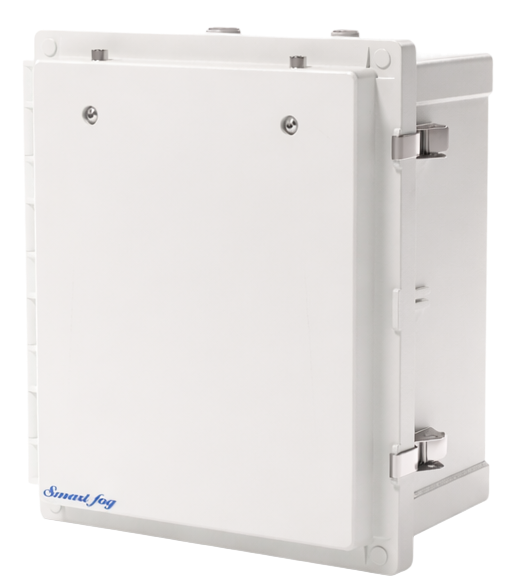
An independently controlled support or process room may be a candidate for direct-space humidity control. Check operating airflow, nearby surfaces, placement and access for service.
View ES100 specificationsIn-duct humidification
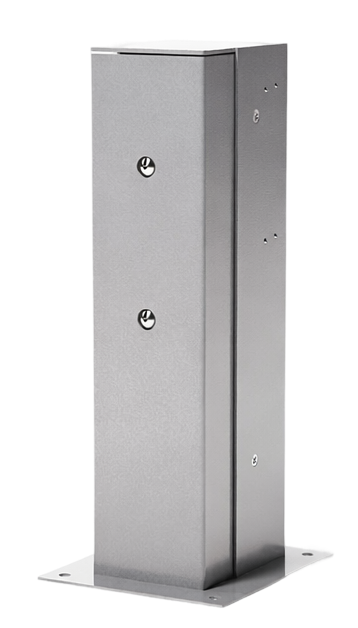
For an eligible, separately identified air handler, review minimum supply airflow, available evaporation distance, downstream filters and duct takeoffs. Confirm the allowed method first.
View TS100 specifications| Model | Moisture output | Compressed air |
|---|---|---|
| ES100-1 / TS100-1 | 6 L/h | 70 L/min |
| ES100-2 / TS100-2 | 12 L/h | 140 L/min |
Published air supply pressure is 100–120 psi for ES100 and 100 psi for TS100. Confirm utilities, capacity and installation conditions against the project submittal.
What the facilities team should be able to verify
Room sensing and alarms
Trend relative humidity and temperature in a representative location alongside the air-handler operating mode. Agree alarm limits, delay, notification and the response owner with the hospital. A duct high-limit sensor serves a separate protective function.
Water management and shutdown
Document the water-treatment and maintenance plan for the selected technology. Specify sampling, access and shutdown behavior. CDC recommends steam humidifiers when feasible and advises avoiding cool-mist humidifiers in healthcare air handling.
Commissioning and records
Test the airflow interlock, sensor comparison and loss-of-signal response. Demonstrate the result at minimum airflow and in winter operation. Record the conditions, acceptance limits and the person responsible for checking ongoing performance.
Compare utility costs at the system boundary
A hospital comparing steam humidification with another permitted method should use the same delivered moisture load, winter hours and utility rates. Include steam distribution losses where relevant. For adiabatic equipment, account for compressor electricity, water treatment and any preheat or reheat required to maintain supply-air temperature. Add consumables, sampling and service labor. A nozzle power figure alone cannot establish annual savings.
Humidity control in healthcare facilities
A humidity alarm in one operating room can come from a change in room temperature, a control problem or dry air at the air handler. The following checks help hospital facilities staff decide who should investigate and what to record.
When several rooms report low humidity
Compare the humidity sensors with a reference instrument and examine the air-handler trend. Check outdoor airflow, steam availability or the enable signal for the approved humidification system. If only one room reports low humidity, compare its temperature, airflow and sensor location with an adjacent room on the same supply.
When a room exceeds its upper humidity limit
Look for cooling-valve or dehumidification problems, a leaking steam valve, or an unplanned change in airflow. Inspect cold surfaces for condensation. Prolonged dampness can support microbial growth on materials. Follow the hospital’s infection control and water-management procedures for any wet material.
When equipment arrives with different limits
Before using new medical equipment or moving sterile supplies, compare the instructions with the room’s current humidity levels. The facilities team and clinical owner should agree on the response to an excursion. Keep the approved instructions with the alarm record so the next shift can act on the same information.
For healthcare facilities planning a retrofit, document which areas share the humidification system, how the building automation system records humidity conditions and how staff will maintain service during a changeover. These details affect patient comfort, access and operating costs. They also give the engineer a basis for comparing steam systems with another permitted technology.
Hospital humidifiers questions
What humidity should an operating room maintain?
Use the adopted requirements and the hospital’s approved room data. CMS notes that some ventilation standards permit a lower limit of 20% RH, while sterile supplies and medical equipment can have a higher minimum. CMS also describes a typical upper limit of 60%. Verify the applicable range and document temperature, humidity and airflow. CMS hospital survey guidance (PDF).
Can hospital humidity control establish infection prevention?
A room RH trend can document environmental conditions. It cannot demonstrate an infection-rate reduction. Filtration, ventilation, water management and infection-prevention practices remain separate parts of the facility program.
What should we include for hospital humidifier sizing?
Send the room list, approved RH and temperature band, air-handler schedule, outdoor-air flow, entering moisture condition and the permitted humidification method. Identify shared clinical supply and any equipment storage limits.
Is this a medical humidifier for a patient?
This page covers humidity control in hospital buildings. A bedside humidifier, a CPAP humidifier and a ventilator humidifier serve different purposes. For facility projects, the engineering review starts with the HVAC system and room schedule.
How do steam humidifiers and adiabatic humidification differ in healthcare facilities?
Steam systems heat water to generate vapor for the HVAC airstream. Adiabatic humidification uses heat from the air to evaporate water. The method changes the energy consumption, water treatment and maintenance obligations of the humidification system. For hospital environments, evaluate the permitted technology and infection control requirements first. Then compare installed and operating costs at equal delivered capacity.
How should intensive care units and operating rooms be grouped for humidity control?
List each room and the air handler that serves it. Verify the environmental limits for the clinical activity and the medical equipment in each room. Where humidity conditions differ, have the engineer review zoning and controls. Precise humidity control at a single sensor cannot demonstrate stable humidity throughout a shared system. For intensive care units, coordinate facility humidity control with the department’s approved requirements.
Review your hospital HVAC project
Identify the rooms, the air handler that serves them, the design standard and any equipment-specific RH limits. If you are early in design, a list of spaces is enough to start.