 Made in USA


Industries / Controlled environments
Cleanroom humidification
Cleanroom humidification holds the relative humidity required by the process while protecting exposed product and cold surfaces. Specify the allowed band at the work location, then verify moisture control alongside particle monitoring and room pressure.

Will the coldest surface stay dry?
Room relative humidity alone cannot answer that question. Compare local dew point with the coldest product, tool or fixture surface under its actual operating conditions. Then check that water droplets have adequate time and distance to evaporate.
Two surfaces in the same cleanroom
Semiconductor and electronics
Identify the exposed process and the materials that accumulate static charge. Verify local RH with the ESD program’s grounding, handling and ionization controls.
Pharmaceutical and medical-device production
Start with the approved process specification and qualification plan. Record operating and at-rest conditions, cleaning cycles and the product-contact or packaging surfaces that need protection.
Precision assembly and metrology
Map the tool or sample location alongside cold fixtures and local heat sources. Check temperature stability and sensor uncertainty before specifying a tighter humidity band.
Specify humidity control and particle cleanliness separately
ISO 14644-1 classifies cleanrooms by airborne particle concentration. The ISO class does not establish a universal relative humidity target. In a cleanroom manufacturing environment, the product, process, equipment instructions and the facility’s quality requirements establish the humidity control specification. Identify the relevant ISO class and monitoring plan separately from the temperature and humidity operating band.
For a room specification, name the location, occupancy state, allowable excursion and recovery time. If a process requires consistent room humidity at an exposed assembly station, demonstrate that point under actual gowning, exhaust and material-transfer conditions. A return-air average may hide a supply jet, cold panel or local heat source. Where a tighter humidity tolerance is requested, separate sensor accuracy from system variation and mapping uncertainty.
A humidifier adds water vapor as droplets evaporate. Feedwater with dissolved minerals can leave residue after evaporation. Establish the incoming water specification, treatment stages, sample location, service intervals and the method for checking the finished surface. A surface inspection and an airborne particle count answer different qualification questions.
ISO 14644-1: air cleanliness classification · ISO 14644-2: particle monitoring
Select the delivery location before choosing capacity
Cleanroom humidification systems must fit the pressure cascade, filtration layout and maintenance strategy. Review changes with the cleanroom owner or validation team before selecting either installation.
Direct-space humidification
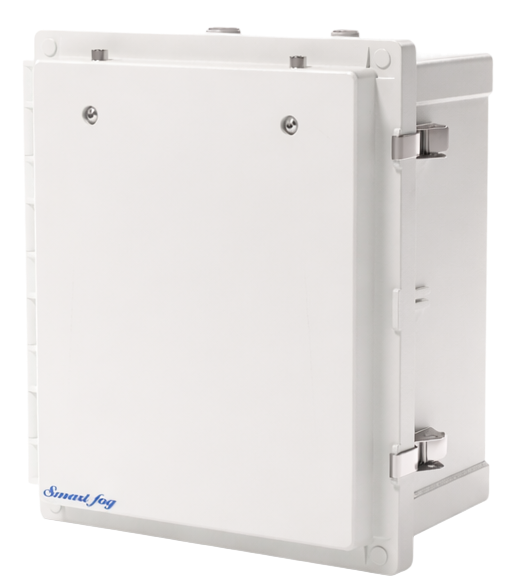
For a permitted local zone, review the position of exposed product, the discharge path and cleaning access. Confirm that a direct-space installation is acceptable under the room’s contamination-control and change-control procedures.
View ES100 specificationsIn-duct humidification
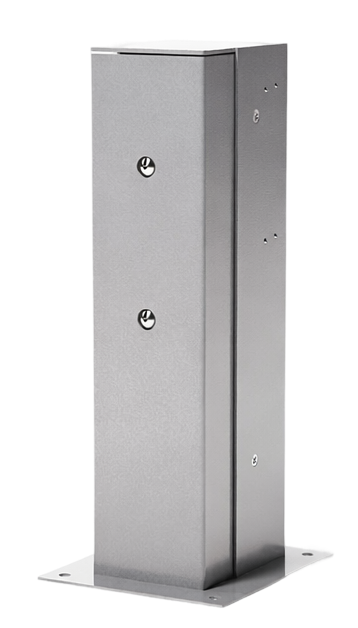
For a central air handler, identify airflow extremes, terminal filters, downstream takeoffs and the available absorption distance. Review monitoring and isolation access from the service side where practical.
View TS100 specifications| Model | Moisture output | Compressed air |
|---|---|---|
| ES100-1 / TS100-1 | 6 L/h | 70 L/min |
| ES100-2 / TS100-2 | 12 L/h | 140 L/min |
Published air supply pressure is 100–120 psi for ES100 and 100 psi for TS100. Confirm utilities, capacity and installation conditions against the project submittal.
What to verify during qualification
Temperature, RH and dew point
Map representative process locations and the coldest surfaces with calibrated instruments. Include the measurement uncertainty when the dew-point margin is small. Compare both normal operation and recovery after an approved transition.
Water quality and surface checks
Compare feedwater and treated water with the approved specification. Investigate white residue, visible droplets and condensation separately. Record the duty cycle and airflow at the time of any observation.
Particle monitoring and pressure
Verify airborne particle cleanliness using the approved monitoring method. Trend pressure relationships separately. Record operating state, filter configuration and any change to the validated air-handling sequence.
Choose controls for both dry and humid conditions
Low humidity can change the behavior of moisture-sensitive materials. High humidity can limit evaporation or reduce the margin to a cold surface. An adiabatic humidifier addresses a moisture deficit; excess moisture requires a separate dehumidification strategy. Review the expected operating envelope, pressure relationships, process exhaust and planned maintenance access before setting a control sequence. Compare water treatment, compressed air and conditioning energy against the facility’s baseline.
Troubleshooting cleanroom humidity control
Many cleanroom manufacturing processes involve materials that exchange moisture with the air or hold an electrostatic charge. The right humidity level depends on the process, air temperature and coldest exposed surface. Include representative process locations in the monitoring plan so excursions can be related to production quality.
Low humidity and static at a workstation
At low relative humidity, static charge can persist on insulating surfaces. Review the ESD control program, grounding, material handling and ionization where required. Compare work-zone air humidity with the return sensor. A workstation heated by nearby equipment can show lower relative humidity even with the same moisture content.
High relative humidity near a cold fixture
Check the fixture temperature against the local dew point before changing the cleanroom setpoint. Condensation can form on the fixture while room-average relative humidity remains within the process band. Inspect cold piping and transfer points as well. Reliable temperature management is part of precise humidity control when the allowed surface margin is small.
Humidity levels rise after a process change
Compare outdoor air, exhaust and material moisture loads before changing the humidity control system. Excess moisture may require cooling and dehumidification. For a very low humidity process, desiccant dehumidifiers may be appropriate: the desiccant takes up water vapor and a regeneration air stream removes it. Include regeneration energy and the temperature of the returning air in the design review.
When specifying tighter humidity control, list the required accuracy of the relative humidity sensors, allowable spatial variation, time in band and recovery after an approved disturbance. Test humidity control systems at the process locations under agreed operating conditions. This gives the cleanroom owner evidence of consistent humidity levels while preserving separate records for particle cleanliness, pressure and temperature.
Cleanroom humidification questions
Does an ISO class specify the required cleanroom humidity?
ISO 14644-1 defines air cleanliness by particle concentration. Select the required humidity level from the process, material and equipment requirements. Verify accurate humidity control and particle cleanliness with their respective methods.
Can cleanroom humidity control prevent all static discharge?
Humidity can help control static on some materials. Sensitive electronics still require a qualified ESD program. Agree on the process and workstation tests before using a change in relative humidity to address a defect.
How do I investigate residue on a cleanroom surface?
Record its location and when it appears. Wetting along a discharge path, a film on a cold surface and a deposit left after drying suggest different checks. Inspect clearance, compare local dew point and measure treated-water quality.
What should I send for cleanroom humidifier sizing?
Send the process RH and temperature band, room or duct layout, makeup and exhaust airflow, coldest surface temperature and relevant qualification limits. Include the water-treatment and access constraints that an installation must meet.
Which humidity control systems can maintain air humidity in a cleanroom?
Isothermal humidification uses steam. Electrode steam humidifiers pass current through water, while resistive steam humidifiers use heating elements. Adiabatic humidifiers evaporate water into the air and cool the airstream. Ultrasonic humidifiers use high-frequency vibration to make fine droplets. For a cleanroom environment, compare feedwater purity, service access, heat load and conditions downstream. Set water quality and inspection requirements to limit residues, scale and microbial growth.
Does ISO classification establish an appropriate humidity level?
ISO 14644-1 classifies particle cleanliness. A class designation alone gives no relative humidity target. The cleanroom owner sets the required humidity control for the process, equipment and materials. Two rooms with the same cleanliness class may need different relative humidity bands, operating temperatures and recovery times. Document the target for each operating state and measurement location.
Who should set the specification for a very low humidity process?
Start with the manufacturer of the moisture-sensitive material and the process owner. A battery dry room, for example, may specify dew point because very low relative humidity readings are strongly affected by sensor accuracy and air temperature. Size dehumidification for product, people, infiltration and door openings. A humidifier is relevant only in operating modes that actually require moisture addition.
Review your cleanroom process conditions
Describe the exposed product, target RH band, air handler and qualification requirements. A simple room or duct layout helps identify the next engineering check.