- An in-duct humidifier distributes humidity through existing ductwork to every supply register in the facility, eliminating the zone-by-zone inconsistency that portable units create.
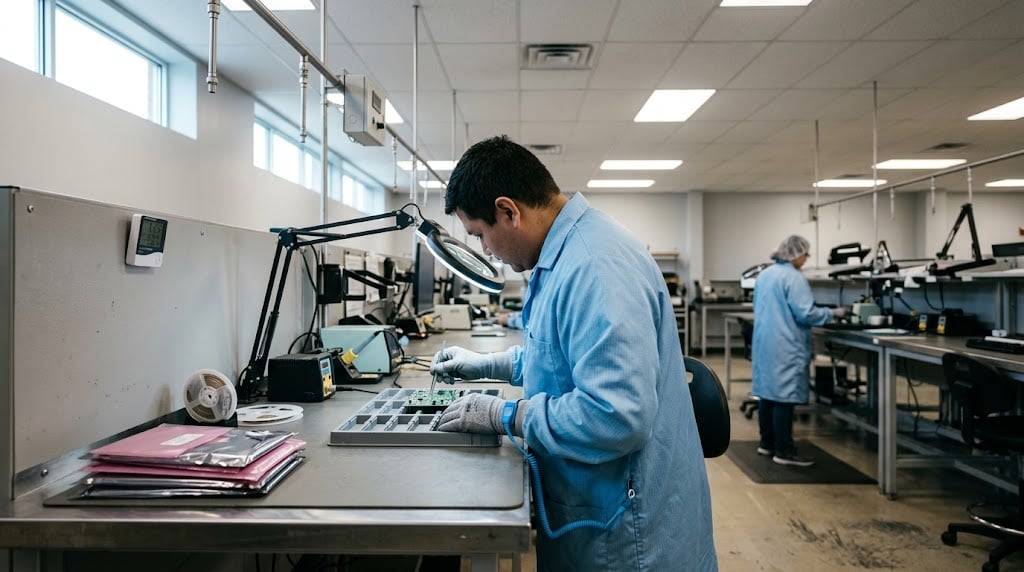
- Relative humidity matters because relative humidity (RH) below 40% accelerates electrostatic discharge (ESD) accumulation on equipment surfaces, floors, and personnel, creating measurable operational risk in electronics, printing, and pharmaceutical environments.
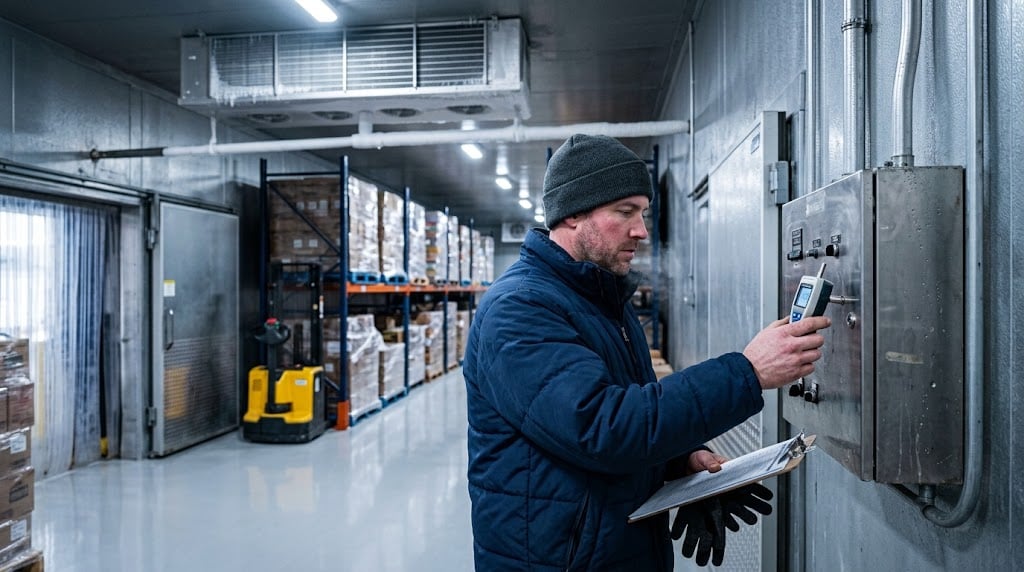
- A humidistat monitors ambient RH and signals the system to run or stop automatically, making manual adjustment across a facility unnecessary.
- Condensation inside air ducts is a risk associated with liquid water contacting duct surfaces, not with systems that evaporate moisture into water vapor before it reaches any surface.
- Industrial-grade in-duct systems with no moving parts in the humidification process are designed for maintenance intervals extending up to every two years.
- EPA indoor air guidelines recommend maintaining indoor relative humidity between 30% and 60% RH to limit biological contaminant growth and occupant discomfort.
What Is an In-Duct Humidifier and How Does It Work?
An in-duct humidifier is mounted either at the supply plenum, where conditioned air exits the air handler, or at a point within the duct run itself. In both positions, the system introduces moisture into moving air before that air distributes through the building's register vents. Because every zone served by the forced air system receives the same humidified airstream, whole-facility coverage is a function of ductwork design, not device count. Industrial and commercial in-duct systems are built for continuous year-round operation. They are not seasonal add-ons. The core components of a properly configured in-duct system include a moisture delivery assembly connected to a water supply, a control interface, and a humidistat sensor placed in the return air stream or occupied space.How Moisture Enters the Airstream
Moisture enters the airstream when the system introduces either steam, evaporated water, or self-evaporating droplets into the moving air inside the duct. The airstream carries that moisture outward to every supply register vent throughout the building. In systems that produce self-evaporating droplets, the droplets complete their evaporation into water vapor before contacting duct surfaces. That evaporation process is what prevents condensation and surface wetting inside the ductwork, which is the primary concern facility managers raise about duct-mounted humidification.What a Humidistat Does and Why It Matters
The humidistat is the control mechanism that keeps an in-duct system operating within a defined RH range. It measures relative humidity in the space, compares the reading against the target setpoint, and signals the humidifier to run or stop accordingly. Without a humidistat, an in-duct system cannot maintain consistent humidity levels and risks over-humidification, which is the condition most associated with condensation inside ducts and mold growth. Industrial-grade systems pair the humidistat with precise moisture output control to hold RH within tight tolerances across the full operating range.Three Core Benefits of an In-Duct Humidifier
The case for in-duct humidification is grounded in three operational outcomes that a room-by-room approach cannot replicate at commercial or industrial scale. Each benefit follows directly from the system's architecture: moisture introduced into the airstream distributes everywhere the air goes.1. Consistent Humidity Levels Across Every Zone
A portable humidifier can only humidify the room it occupies. In a multi-room or multi-zone facility, that creates humidity gradients, where some areas stay within the target range while others remain dry. An in-duct system eliminates that problem by distributing moisture through the ductwork to every register vent in the building simultaneously. For facilities with large floor areas, multiple production zones, or environmentally sensitive spaces, humidity uniformity is not a comfort preference. It is an operational requirement. Materials, equipment, and processes respond to actual local RH conditions, not to the average across the building. Maintaining consistent humidity levels throughout the HVAC system's footprint removes the variability that undermines environmental control.2. Continuous Static Electricity Control
As RH drops below 40%, air loses its ability to dissipate surface charge. Static electricity accumulates on floors, equipment surfaces, and personnel, creating ESD risk that can damage components, disrupt processes, and trigger safety events. This effect is most acute during heating season, when cold outdoor air drawn into a building loses RH rapidly as it warms indoors. An in-duct system operating continuously above the 40% RH threshold provides passive, equipment-free static control across the entire facility. No additional ESD mitigation hardware is needed in zones served by the humidified airstream. This benefit is directly relevant to electronics handling, printing operations, and pharmaceutical environments, where electrostatic discharge control is a documented operational requirement.3. Protecting Equipment, Materials, and Building Occupants
Sustained dry air degrades hygroscopic materials. Paper warps and becomes dimensionally unstable. Wood composites shrink and develop cracks. Textiles lose flexibility. Precision instruments and sensitive machinery are exposed to the ESD conditions described above, increasing wear and failure rates over time. Building occupants in low-humidity environments experience dry air discomfort, including irritated mucous membranes and increased sensitivity to airborne particulates. These effects are not acute health risks, but they are measurable and reduce comfort in occupied spaces. An in-duct system addresses all three effects simultaneously by maintaining consistent relative humidity throughout the facility, requiring no room-by-room intervention.In-Duct Humidifiers vs. Portable Units: Why Duct Placement Wins at Scale
For medium-to-large commercial or industrial facilities, the choice between an in-duct system and portable units is rarely a close comparison. The architectural difference between the two approaches creates performance gaps that widen as facility size and humidity precision requirements increase. The relevant comparison dimensions are coverage, maintenance burden, operational control, and moisture delivery risk. Coverage and consistency:- In-duct system: Distributes humidified air through existing ductwork to every supply register in the building, providing whole-facility humidity coverage from a single installation point.
- Portable humidifier: Covers the room where the unit is placed. In multi-zone facilities, achieving consistent coverage requires multiple units operating independently with no coordinated control.
- In-duct system: Industrial-grade systems designed for continuous operation can extend maintenance intervals significantly, with some engineered for service every two years. Check out our article on humidifier maintenance expectations for a detailed breakdown by system type.
- Portable humidifier: Requires frequent tank refilling, filter or wick changes, and periodic tank cleaning to prevent mineral buildup and biofilm accumulation.
- In-duct system: A humidistat monitors ambient RH and controls moisture output automatically, maintaining the target setpoint without manual adjustment.
- Portable humidifier: Output settings are adjusted manually. Without automatic RH feedback, maintaining a consistent setpoint across a facility is not practical.
- In-duct system: Systems that produce self-evaporating droplets introduce moisture as water vapor into the moving airstream, preventing surface wetting inside the ductwork and at supply registers.
- Portable humidifier: Ultrasonic and cool-mist units can deposit mineral residue and surface moisture near the unit, particularly when placed close to equipment or materials.
When a Portable Humidifier Is Appropriate
Portable humidifiers serve a defined role: single-room applications, temporary or seasonal use, and spaces without access to a forced air system. For these scenarios, a standalone unit is the practical choice. However, for whole-facility or multi-zone applications, portable units are not a substitute for an in-duct system. The coverage, control, and consistency gaps are not closed by adding more units.Installation and Maintenance: What to Expect from an In-Duct System
The installation process for an in-duct humidifier involves four primary connections: the moisture delivery assembly to the supply plenum or duct run, the system to the building's forced air system airflow, the humidistat sensor to the return air stream or occupied space, and the unit to a water supply line. Unlike steam-based systems, which require high-voltage electrical connections and generate heat as a byproduct, in-duct systems that rely on compressed air or evaporative principles typically do not require a certified technician for installation. Maintenance expectations vary significantly by technology type and system design. An evaporative humidifier with a wick or media pad requires regular media replacement, typically on a seasonal schedule. Industrial-grade systems with no moving parts in the humidification process and precision droplet delivery are engineered for extended maintenance intervals, with some reaching up to two years between service events. The steps involved in a standard in-duct installation follow a defined sequence:- Confirm duct geometry and airflow volume to determine mounting position and moisture output requirements
- Mount the humidification assembly at the supply plenum or selected duct location
- Connect the unit to the building water supply line
- Install the humidistat sensor in the return air path or representative occupied zone
- Commission the control interface and verify RH setpoint response across operating conditions
Common Questions About Duct Humidifier Safety
Facility managers considering an in-duct system almost always ask the same thing first.- Do in-duct humidifiers cause mold in air ducts?
- Can over-humidification cause the same problem even with a good system?
- Is there any situation where the fog itself will wet a surface?
Smart Fog TS100: Industrial In-Duct Humidification Without Surface Wetting
Compressed air and water, mixed through a proprietary nozzle, produce an equal-sized droplet grid where each droplet carries a slight electrical charge that prevents re-aggregation. The droplets self-evaporate before reaching any duct surface, equipment surface, or product in the airstream. This is the mechanism that makes duct-mounted humidification viable without condensation risk, and it is the operating principle behind the Smart Fog TS100 in-duct humidifier.How the TS100 Delivers Humidity Without Wetting Ductwork
The equal-sized droplet grid produced by the TS100 is specifically engineered to complete evaporation before contacting duct surfaces, nozzles, equipment racks, or products in the airstream. Because every droplet is the same size, the evaporation profile is predictable and consistent under proper system design. This is what distinguishes the TS100 from standard duct-mounted systems, where droplet size variation can result in larger particles that do not evaporate in time and deposit surface moisture inside the duct. Note that direct exposure to the fog stream will cause wetting, consistent with the behavior of any pressurized water-air system.Precision, Reliability, and Low Maintenance for Continuous Facility Operation
The TS100 is designed for 24/7 continuous operation without manual intervention. Key operational specifications include:- Humidity precision: Maintains RH up to 99% at plus or minus 1 to 2 percent, suitable for pharmaceutical, electronics, and printing environments with tight humidity tolerances.
- Water efficiency: Every droplet evaporates into the air. No water is wasted and no drainage is required.
- Maintenance interval: No moving parts in the humidification process. Maintenance intervals extend to every two years under standard operating conditions.
- Installation: No certified technician required. The system is a complete engineered solution, not a component kit requiring field assembly.