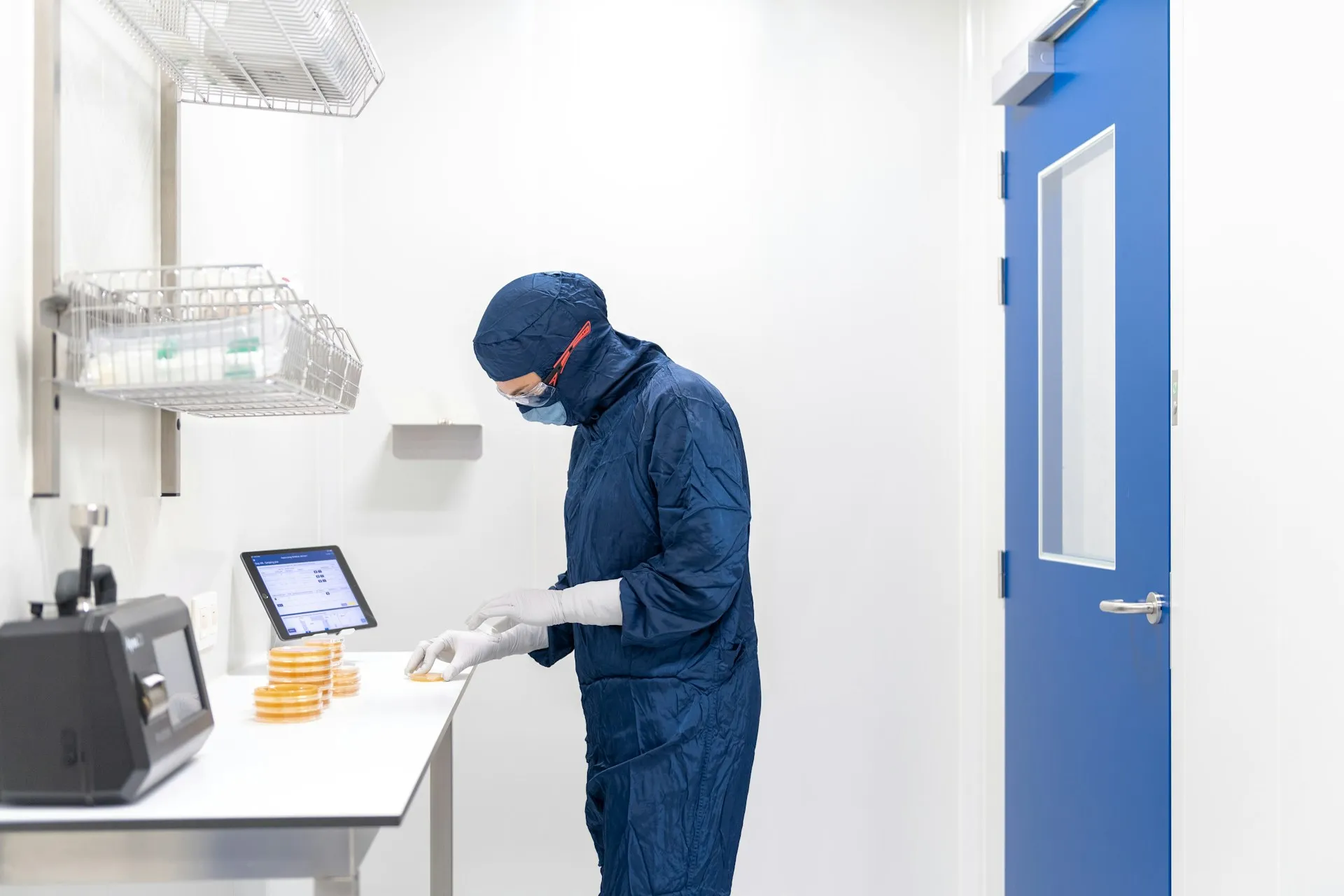


Humidity in cleanrooms governs particle behavior, electrostatic discharge (ESD) risk, and microbial growth, which is why relative humidity (RH) is a controlled parameter under ISO 14644 and GMP frameworks rather than a comfort variable. This guide covers the three humidity-dependent risk mechanisms, the ISO and GMP standards that define acceptable RH ranges, and what precision humidity control requires in practice for regulated manufacturing environments.
Key Takeaways
- ISO 14644-1 classifies cleanrooms by airborne particulate concentration, not by humidity or temperature. Acceptable RH ranges are determined by product sensitivity, process risk, and the applicable regulatory framework.
- Below approximately 30% RH, the moisture film that dissipates surface charge becomes insufficient. Triboelectric charging increases, attracting airborne particles to surfaces and creating ESD events that damage components without visible evidence of failure.
- Above approximately 60% RH, surface moisture conditions support microbial proliferation on cleanroom walls, floors, gowning areas, and process equipment. EU GMP Annex 1 (2022) addresses this directly within its Contamination Control Strategy requirements.
- Condensation occurs when humid air contacts surfaces below the local dew point temperature. This can happen at moderate overall RH when supply air temperature differentials are present, making it a system design issue as much as a set-point issue.
- In pharmaceutical cleanrooms, humidity control systems must be validated through Installation Qualification (IQ), Operational Qualification (OQ), and Performance Qualification (PQ) protocols per FDA 21 CFR Part 211.68 and EU GMP Annex 1.
- RH is temperature-dependent. In semiconductor fabrication and precision optics environments, dew point is often the more appropriate engineering specification because it remains stable as room temperature fluctuates.
What ISO 14644 and GMP Standards Actually Say About Cleanroom Humidity
A persistent misreading of cleanroom standards is that ISO 14644 prescribes specific humidity ranges by class. It does not. Understanding where the actual compliance obligation lives is the first requirement for any facility engineer or pharmaceutical QA lead preparing for regulatory review.
ISO 14644: Classification vs. Environmental Specification
ISO 14644-1 establishes particle count thresholds for ISO Classes 1 through 9. It does not set humidity or temperature limits. RH specifications are an overlay applied by industry type, product sensitivity, or the regulatory body governing the manufacturing process. A facility operating at ISO Class 5 for pharmaceutical fill-finish has different humidity obligations than one operating at ISO Class 5 for semiconductor lithography, despite identical particle classification.
EU GMP Annex 1 and FDA 21 CFR Part 211: Where the Humidity Obligation Lives
For pharmaceutical, biotech, and medical device manufacturers, GMP frameworks are where humidity compliance becomes enforceable. EU GMP Annex 1 (2022 revision) requires a written Contamination Control Strategy (CCS) that includes environmental monitoring, and humidity is a monitored critical process parameter within that strategy. Pharmaceutical manufacturing cleanrooms operating under GMP grading (Grade A through Grade D, corresponding broadly to ISO 5 through ISO 8) typically target 30 to 65% RH, but the specific set point must be justified by the CCS, not assumed from a general range. For broader context on how these frameworks interact, see our guide on GMP humidity requirements.
Three Humidity-Dependent Risk Mechanisms in Cleanrooms
Contamination control failures in cleanrooms are rarely attributed to a single cause, but three humidity-dependent mechanisms account for a disproportionate share of environmental excursions and compliance findings. Each operates through a distinct physical or biological pathway, and each becomes significant at a specific RH threshold.
Low Humidity and Electrostatic Discharge: Particle Attraction and Component Damage
As RH drops below approximately 30%, the thin moisture film that normally provides a conductive pathway for surface charge dissipation becomes insufficient. This is not a static buildup problem in the colloquial sense. It is a triboelectric charging and charge dissipation failure: charges accumulate on surfaces, gowning, and process equipment, generating electrostatic fields that actively attract airborne particles to product surfaces. This increases contamination counts independently of heating, ventilation, and air conditioning (HVAC) filtration performance. In electronics and semiconductor environments, charge accumulation also produces ESD events that damage components below the threshold of visible evidence but above JEDEC moisture sensitivity level thresholds. ANSI/ESD S20.20 is the ESD control program standard for cleanroom environments, and it identifies humidity control as a primary environmental mitigation measure. For a detailed analysis of how static charge behaves in controlled environments, see our article on static electricity problems in cleanroom environments.
High Humidity and Microbial Growth: Why RH Above 60% Changes the Contamination Profile
Relative humidity above approximately 60% provides the surface moisture conditions that support microbial proliferation on cleanroom walls, floors, gowning areas, and process surfaces. The humidification system itself does not cause microbial contamination. Uncontrolled high humidity creates the surface conditions that environmental monitoring programs must detect and that contamination control strategies must prevent. EU GMP Annex 1 (2022) explicitly includes humidity as a variable within the CCS framework, with the expectation that environmental monitoring data supports humidity set-point validation. Facilities that treat their RH upper limit as a rough target rather than a validated parameter carry measurable microbial risk that a regulatory inspector will identify.
Condensation: How Humidity and Temperature Interact at Cleanroom Surfaces
Condensation is not simply a consequence of high overall RH. It occurs when humid air contacts a surface whose temperature falls below the local dew point, regardless of what the room-level RH reads. In cleanrooms with chilled supply air, cold process equipment, or low-temperature storage adjacency, condensation can form at moderate RH levels if surface temperatures are sufficiently low. The contamination consequences are direct: condensation introduces surface moisture that can absorb moisture from packaging, promote corrosion of process equipment, and disrupt laminar airflow patterns. Controlling condensation requires accounting for supply air temperature differentials in system design, not only selecting an appropriate RH set point. For more on how cleanroom humidity control addresses these interacting parameters, check out our linked resource.
Humidity Requirements by Cleanroom Type and Industry
No single RH range applies across all cleanroom types. The appropriate humidity level depends on the process, the product sensitivity, and the governing regulatory framework. The ranges below identify the primary risk each is designed to mitigate, because the number alone is insufficient guidance without the mechanism.
- Pharmaceutical manufacturing (GMP Grade A/B, ISO 5 equivalent): 30 to 45% RH. Primary risk is microbial proliferation and particulate attraction. EU GMP Annex 1 (2022) requires validated set points documented within the CCS. See pharmaceutical manufacturing humidification for system design considerations.
- Pharmaceutical manufacturing (GMP Grade C/D, ISO 7 to 8 equivalent): 30 to 65% RH depending on process, per temperature and humidity requirements for pharmaceutical environments. Primary risk shifts toward material degradation and packaging integrity. Set points must be justified by product sensitivity data.
- Semiconductor fabrication (ISO 3 to 5): 35 to 50% RH, with dew point often the controlling specification rather than RH. Primary risk is triboelectric charging below 30% RH and photoresist degradation from moisture variation. SEMI S2 environmental health and safety guidelines reference both RH and dew point for semiconductor equipment environments.
- Medical device manufacturing (ISO 7 to 8): 45 to 65% RH. Primary risk is ESD damage to sensitive components and material moisture absorption affecting product dimensional stability.
- General industrial cleanrooms (ISO 7 to 9): 40 to 60% RH. Primary risk is particulate attraction from low-humidity static and surface moisture from high-humidity condensation.
When Dew Point Matters More Than Relative Humidity
RH is temperature-dependent: the same absolute moisture content produces a different RH reading as room temperature changes. In facilities where process temperatures vary or where sub-ambient surfaces exist, dew point is the physically stable control parameter. SEMI S2 references dew point alongside RH for semiconductor equipment environments specifically because surface temperature variability makes RH an unreliable single specification. Engineers designing high-precision environments should confirm with their HVAC engineer whether dew point should be the primary specification. For a technical explanation of this distinction, see our dew point vs humidity comparison.
Humidity Validation in Regulated Cleanrooms: IQ, OQ, and PQ Requirements
Having a humidity control system installed is not the same as having a validated humidity control system. Inspectors under FDA 21 CFR Part 211 and EU GMP Annex 1 (2022) expect documented evidence that the system performs to specification under defined operating conditions. The three qualification stages each carry specific requirements for humidity control. Installation Qualification (IQ) confirms that the humidification system is installed according to design specifications. This includes sensor placement records, calibration documentation, and verification that the system matches the engineering design package. Operational Qualification (OQ) demonstrates that the system achieves and maintains the specified RH range under simulated or actual operating conditions across the facility. OQ testing must capture performance at the boundaries of the designed operating envelope, not only at nominal conditions. Performance Qualification (PQ) provides documented evidence that the system maintains compliant conditions during actual production, including worst-case load conditions such as maximum occupancy or peak equipment heat load. The 2022 revision of EU GMP Annex 1 introduced the CCS requirement, which explicitly encompasses environmental parameters including humidity. Humidity monitoring data must be part of the ongoing environmental monitoring program, not a one-time commissioning check. Systems must perform predictably over time, not only at the moment of qualification.
What Inspectors Look for in Humidity Control Documentation
Key documentation artifacts that satisfy an FDA or EU GMP audit include:
- Calibrated sensor placement records: with justification for sensor location relative to critical zones.
- Alarm set-point justification: tied to the validated RH range.
- Out-of-specification response procedures: with defined investigation and corrective action steps.
- Trend data: demonstrating that the system maintains the validated range under production conditions.
Sensor calibration intervals are a common inspection finding. A sensor that has drifted introduces compliance risk even when the humidification system itself is performing correctly, calibration records must be current and traceable.
How Smart Fog Precision Humidification Supports Cleanroom Compliance
Precision humidity control in a regulated cleanroom requires a system that maintains its set point continuously, does not introduce surface moisture as a secondary contamination risk, and performs predictably enough to support OQ and PQ documentation. The operating mechanism determines whether those requirements can be met.
Non-Wetting Operation in Controlled Environments
Compressed air and water are mixed through a proprietary nozzle to produce an equal-sized droplet grid. Each droplet carries a slight charge that prevents re-aggregation, and the droplets self-evaporate before reaching any surface. The result is humidity introduced into the cleanroom environment without wetting surfaces, product, racks, or equipment under proper system design. In controlled environments where surface moisture from water contact constitutes a contamination or compliance failure, this is a design-level safeguard rather than a feature to weigh against alternatives. The caveat that applies to all non-wetting claims: direct exposure to the fog stream will wet the exposed surface. Proper nozzle placement and system design are required to maintain non-wetting performance. Facilities evaluating cleanroom humidifiers for regulated environments should confirm that system design accounts for nozzle placement relative to product and process surfaces. See also our resource on cleanroom humidification for application-specific configuration detail.
Precision and Stability for Validated Environments
Maintaining humidity up to 99% RH with plus or minus 1 to 2% precision and minimal fluctuation provides the stability that OQ and PQ documentation demands. A validated cleanroom cannot rely on a humidification system whose output varies enough to trigger out-of-specification readings during production. The Smart Fog technology overview covers the operating principles in detail, including the no-moving-parts design that supports 24/7 continuous operation with maintenance intervals extending up to every two years. For environments where ESD risk is the primary humidity-dependent concern, our guides on ESD control systems and preventing static electricity in electronics manufacturing provide complementary guidance on integrated control programs. Key operational characteristics relevant to regulated cleanroom facilities:
- Humidity precision: plus or minus 1 to 2% RH, supporting validated environmental control
- Operating range: up to 99% RH with minimal fluctuation
- Water efficiency: 100% of water evaporates into the air, with no surface accumulation under proper system design
- Maintenance interval: designed for intervals extending up to every two years
- Operation mode: 24/7 continuous industrial operation with no moving parts in the humidification process
Final Thoughts
Humidity in cleanrooms operates through specific physical and biological mechanisms that directly affect contamination control performance, regulatory compliance status, and product integrity. The three mechanisms, triboelectric charging and charge dissipation failure below 30% RH, microbial proliferation above 60% RH, and condensation driven by surface temperature differentials, each require different engineering responses. ISO 14644 does not prescribe a universal RH range, and treating GMP humidity requirements as a target rather than a validated parameter creates measurable audit exposure. Facilities operating under ISO 14644 or GMP requirements and evaluating humidification options should specify systems against the precision and validation demands that regulated cleanrooms impose. A system installed but not validated to IQ/OQ/PQ standards does not satisfy regulatory expectation. If your facility operates under ISO 14644 or GMP requirements and needs a humidification system designed for validated environmental control, contact Smart Fog engineers to discuss your cleanroom's specific humidity specification. Consult a Humidity Expert
FAQ
What is the ideal humidity level for a cleanroom?
There is no single ideal humidity level that applies to all cleanrooms. Acceptable RH ranges depend on the product being manufactured, the process risk, and the regulatory framework governing the facility. Pharmaceutical manufacturing cleanrooms operating under EU GMP grading typically target 30 to 65% RH depending on grade and process. Semiconductor fabrication environments often specify 35 to 50% RH, with dew point sometimes the controlling parameter. The appropriate set point must be justified by process data and, in regulated industries, validated through a formal qualification program.
What do ISO 14644 and GMP standards require for cleanroom humidity control?
ISO 14644-1 classifies cleanrooms by airborne particulate concentration and does not specify humidity or temperature limits. Humidity requirements in ISO-classified cleanrooms are determined by product type, process sensitivity, and the regulatory framework applied. For pharmaceutical and biotech manufacturers, EU GMP Annex 1 (2022) and FDA 21 CFR Part 211 are where enforceable humidity obligations reside. Annex 1 requires a written Contamination Control Strategy that includes humidity as a monitored critical parameter, with set points that are validated rather than assumed.
What happens if cleanroom humidity is too low?
When RH drops below approximately 30%, the moisture film that dissipates surface charge becomes insufficient. This creates a triboelectric charging and charge dissipation failure: static charges accumulate on surfaces and personnel, attracting airborne particles to product surfaces and increasing contamination counts. In electronics and semiconductor cleanrooms, charge accumulation also produces ESD events that damage components below the threshold of visible evidence. Low humidity is therefore both a contamination control risk and a product quality risk in charge-sensitive manufacturing environments.
What happens if cleanroom humidity is too high?
Relative humidity above approximately 60% provides surface moisture conditions that support microbial proliferation on cleanroom walls, floors, gowning areas, and process surfaces. EU GMP Annex 1 (2022) addresses high humidity as a microbial risk factor within its Contamination Control Strategy requirements. High humidity can also increase condensation risk when humid air contacts surfaces below the local dew point temperature, introducing surface moisture that can promote corrosion of process equipment and disrupt laminar airflow patterns.
How does humidity affect static electricity in cleanroom environments?
Static electricity in cleanrooms is controlled in part through humidity because moisture on surfaces provides a conductive pathway for charge dissipation. As RH falls below approximately 30%, that pathway becomes insufficient, allowing triboelectric charges to accumulate. This generates electrostatic fields that attract particles and can discharge into sensitive electronic components. ANSI/ESD S20.20 identifies humidity control as a primary environmental mitigation measure within ESD control programs for cleanroom environments.
What is the difference between relative humidity and dew point in cleanroom specifications?
Relative humidity is a temperature-dependent measurement: the same absolute moisture content in the air produces a different RH reading as temperature changes. Dew point measures the temperature at which air becomes saturated regardless of the current room temperature, making it a physically stable parameter. In cleanroom environments where process temperatures vary or where sub-ambient surfaces exist, dew point is often the more appropriate engineering specification. SEMI S2 environmental health and safety guidelines for semiconductor equipment reference dew point alongside RH for this reason.
How must humidity control systems be validated in pharmaceutical cleanrooms?
In regulated pharmaceutical cleanrooms, humidity control systems must be validated through three sequential qualification stages. Installation Qualification (IQ) confirms the system is installed according to design specifications, including calibrated sensor placement. Operational Qualification (OQ) demonstrates the system achieves and maintains the specified RH range under operating conditions. Performance Qualification (PQ) provides documented evidence of compliant performance during actual production, including worst-case load conditions. EU GMP Annex 1 (2022) and FDA 21 CFR Part 211.68 both require this documented validation approach, and ongoing environmental monitoring must continue after initial qualification.
What type of humidification system is appropriate for a regulated cleanroom?
A humidification system for a regulated cleanroom must meet three engineering criteria: it must maintain the validated RH set point with sufficient precision to avoid out-of-specification excursions, it must not introduce surface moisture that creates additional contamination risk, and it must perform reliably enough over time to support OQ and PQ documentation. Systems that produce self-evaporating droplets and maintain plus or minus 1 to 2% RH precision address all three criteria. A dehumidifier may also be required depending on facility baseline conditions. Any system installed in a regulated cleanroom must be qualified through a formal IQ/OQ/PQ program regardless of technology type.