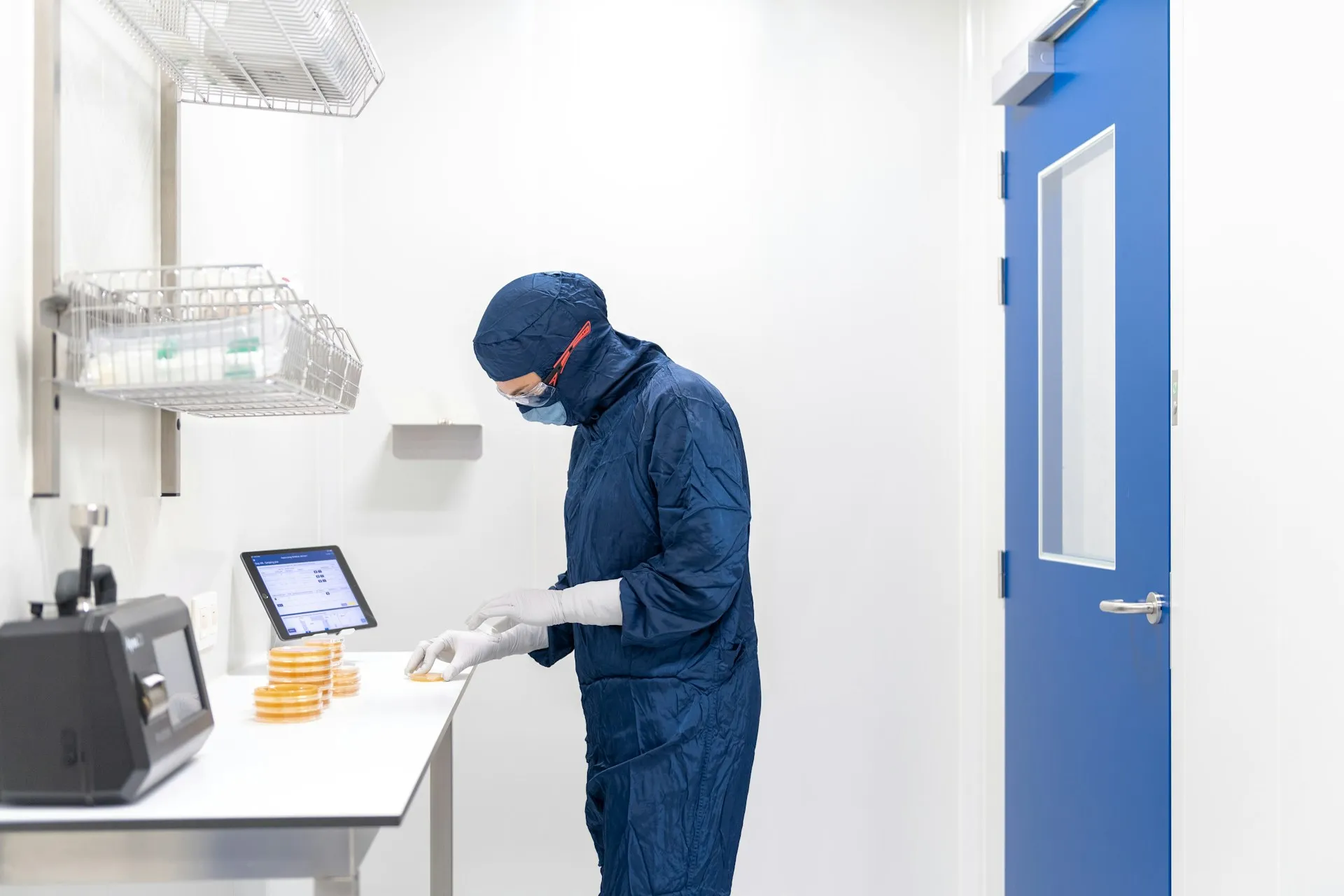


Operating rooms in acute care hospitals must maintain relative humidity between 20% and 60%, per ASHRAE Standard 170 and the FGI Guidelines, which underpin CMS Conditions of Participation. That range isn't universal: ambulatory surgery centers accredited by ACHC require 30% to 60%, and device IFUs can impose an even higher floor. A facility at 22% RH may satisfy federal code while still facing an accreditation finding under its own body's standard. This article covers which standard governs which facility type, how to resolve conflicts between authorities and device IFUs, the fire and electrostatic safety case for a 30% practical floor in anesthetizing locations, and what monitoring practices satisfy Joint Commission, ACHC, and CMS survey requirements.
Key Takeaways
- ASHRAE Standard 170 and the FGI Guidelines for hospitals set the accepted OR RH range at 20 to 60% for acute care hospitals operating under CMS Conditions of Participation (42 CFR §482.41).
- ASCs accredited by ACHC must maintain OR humidity between 30% and 60% RH; dropping below 30% requires documented CMS waiver approval and adherence to manufacturer IFU specifications for all installed surgical equipment.
- When a medical device IFU specifies an RH minimum above the adopted facility code floor, such as 35% for an electrosurgical unit, the IFU requirement governs that device's safe operating environment and creates a conflict the facility must resolve through documented risk assessment.
- NFPA 99 Chapter 15 addresses ignition source controls in anesthetizing locations; sub-30% RH increases electrostatic discharge (ESD) risk by reducing charge dissipation rates on non-conductive surfaces, elevating fire risk in environments where electrosurgical units and surgical lasers operate.
- ACHC Standard 15.01.02 requires daily logging of temperature, humidity, and airflow in every OR in use, with excursion responses documented; facilities that cannot produce these records are exposed to survey findings even if RH was within range.
- A facility's operating RH target should be set at the highest lower bound across all applicable authorities, not the lowest permitted by any single code, with that target documented in the facility's infection control risk assessment or environment of care management plan.
The Accepted Relative Humidity Range for Operating Rooms
For acute care hospitals, ASHRAE Standard 170 is the governing document for OR heating, ventilation, and air conditioning (HVAC) environmental requirements. This standard specifies the required RH range for operating rooms at 20 to 60%. It is not a guideline in the advisory sense; it is the technical standard adopted by reference into the regulatory framework that governs licensed hospitals.
ASHRAE Standard 170 and the FGI Guidelines
ASHRAE Standard 170 establishes minimum ventilation requirements for healthcare facilities, including airflow rates, temperature ranges, and RH limits for specific room types. The FGI publishes two separate sets of guidelines: the Guidelines for Design and Construction of Hospitals, and the Guidelines for Design and Construction of Outpatient Facilities. Both adopt ASHRAE 170 by reference, but they apply to different facility types. The hospital guidelines govern acute care ORs. The outpatient guidelines govern ASC and outpatient surgical facility environments. This distinction matters because ASC compliance officers sometimes reference the hospital guidelines when their applicable document is the outpatient version, or vice versa. CMS adopts the FGI Hospital Guidelines as the compliance benchmark for acute care hospitals under the 42 CFR §482.41. The regulatory chain runs from ASHRAE Standard 170 through the FGI Guidelines to CMS enforcement. For a licensed acute care hospital, the 20 to 60% RH range carries federal regulatory weight.
Why the Lower Bound Changed from 30% to 20%
The shift from a 30% minimum to a 20% minimum occurred in the 2008 revision cycle of the ASHRAE and FGI standards. The change reflected evidence that 20% RH does not create a materially different patient safety outcome than 30% RH in acute care OR settings when other infection control measures are in place. It also addressed the operational reality that maintaining 30% RH in low-dewpoint climates imposes a significant humidification load, particularly during winter months, increasing energy cost without proportional patient safety benefit. The practical consequence for facilities is that those operating under older state-adopted code editions may still face a 30% lower bound if their jurisdiction has not adopted the revised FGI edition. State code adoption lags the publication cycle, sometimes by several years. Facilities should confirm which FGI edition their state has formally adopted before assuming the 20% floor applies to their specific regulatory context.
Ambulatory Surgery Centers: Different Standards, Different Lower Bound
The 20 to 60% and 30 to 60% RH ranges are not contradictory. They apply to different facility types under different regulatory frameworks, and conflating them is a compliance error with real survey consequences. ASCs operate under a distinct regulatory structure from acute care hospitals. ACHC Standard 15.01.02 requires ASC ORs to comply with ASHRAE requirements as applied to outpatient settings. In that context, the applicable lower bound is 30% RH, not 20%. The outpatient FGI Guidelines, which the accreditation framework references, reflect a more conservative threshold for facilities that typically lack the redundant HVAC infrastructure of large hospital campuses and where the patient population may include higher proportions of elective procedure patients with different risk profiles.
ACHC Standard 15.01.02 and Accreditation Implications
ACHC Standard 15.01.02 explicitly requires ASC ORs to maintain temperature, humidity, and airflow within ASHRAE-specified parameters for outpatient surgical environments, with OR humidity maintained at 30 to 60% RH. Reducing humidity below 30% requires adherence to manufacturer specifications and documented CMS waiver protocols under ACHC Standard 15.01.02. The accreditation finding risk is not theoretical:
- An ASC operating below 30% RH without a documented CMS waiver is out of compliance with its accreditation standard, regardless of what the acute care ASHRAE 170 table permits.
- A surveyor reviewing OR environmental logs who finds readings below 30% with no documented waiver approval and no corrective action record has grounds for a deficiency citation.
- A deficiency citation generates a corrective action plan obligation, adding administrative burden beyond the initial finding.
The Joint Commission also accredits ASCs and applies environment of care standards to outpatient surgical settings. Facilities accredited by The Joint Commission should confirm the applicable environmental parameter table in the current standards manual for ambulatory care, as the specific RH reference may differ from the ACHC citation.
When Your Facility Sits Between Standards
Some facilities are licensed as hospitals but accredited under ASC-specific standards, or perform both inpatient and outpatient procedures in a mixed-use OR suite. In these cases, the applicable standard is determined by the facility's accreditation body and the specific space's designated use classification, not simply by the facility's licensure category. A hospital-licensed outpatient surgical suite may still be subject to the 30% lower bound if it is classified and surveyed as an outpatient procedure room under the applicable accreditation framework. Facilities in ambiguous licensing and accreditation positions should document their compliance position formally, naming the specific standard they apply, the regulatory basis for that choice, and the accreditation body that will survey the space. That documentation belongs in the facility's environment of care management plan and should be reviewed at each accreditation cycle. An ASC that must operate below 30% RH for operational reasons, whether due to geographic climate conditions or building system limitations, must obtain CMS waiver approval before doing so. The waiver process is addressed in the following section.
Resolving Conflicts: When Standards, IFUs, and Codes Disagree
A facility's OR humidity compliance posture is rarely determined by a single standard. Most facilities are simultaneously subject to their state-adopted FGI edition, their accreditation body's environmental parameter requirements, and the manufacturer IFU specifications for every medical device in the OR. When these authorities specify different RH requirements, the facility must establish a documented decision hierarchy. No currently ranking compliance resource explains how to do this, and the absence of that guidance creates real operational liability. The scenario is common: ASHRAE 170 and CMS allow a 20% minimum; the state-adopted FGI edition may require 30%; an electrosurgical unit IFU may specify 35% as the minimum safe operating environment; and the accreditation body may apply yet a different benchmark. The facility is subject to all four simultaneously. Operating at 22% RH satisfies the federal code floor but violates the device IFU and potentially the accreditation standard. The conflict must be identified, analyzed, and resolved through documented policy before a surveyor or a patient safety event forces the issue. The decision hierarchy for establishing an OR operating RH target should follow this sequence:
- Identify which edition of the FGI Guidelines the facility's state has formally adopted. This determines the base code floor for the physical environment. State adoption status is available through the facility's state health department or the FGI's published adoption tracker.
- Confirm the accreditation body and the applicable standard for the specific space. For acute care hospital ORs, this is typically Joint Commission EC.02.06.05 and the FGI Hospital Guidelines. For ASC ORs, this is typically ACHC Standard 15.01.02 or The Joint Commission ambulatory care standards.
- Audit installed equipment IFUs for any RH minimum above the adopted code floor. Biomedical engineering teams should maintain a current IFU registry for every device in active use. Any device with an RH minimum above the code floor creates a conflict requiring resolution.
- Set the operating RH target at the highest lower bound across all applicable authorities, not the lowest. If the code allows 20%, the accreditation standard requires 30%, and a device IFU requires 35%, the operating target is 35% or above.
- Document the basis for the operating range in the facility's infection control risk assessment (ICRA) or environmental control policy, with specific citation to each governing authority reviewed and the rationale for the selected target.
The governing references for this analysis are the CMS State Operations Manual (Appendix A, A-0700 series tags) and the facility's adopted FGI Guidelines edition. Both are required reading for any compliance officer establishing or auditing OR environmental parameter policy.
Device IFUs as a Humidity Authority
Medical device IFUs carry regulatory weight under FDA requirements for device use conditions. A facility that operates a device outside its IFU-specified environmental parameters, including RH, is using that device in a condition not cleared or approved by FDA. This is not a minor compliance footnote. It creates a risk management exposure that intersects both accreditation liability and potential product liability considerations if a device malfunction or adverse event occurs in an out-of-IFU environment. The AHRMM advisory on this topic has called on hospitals to audit their installed equipment against current code and against each device's IFU, precisely because the 2008 reduction in the ASHRAE minimum from 30% to 20% created a class of devices whose IFUs were written under the older standard. Those devices have not been re-tested or re-cleared for environments below 30% RH. A facility operating them at 22% RH may have no documented basis for concluding that the device functions within its intended safety parameters at that level.
Documenting Your Compliance Position
The documentation a facility should maintain to demonstrate compliance with OR humidity requirements covers three areas:
- Regulatory standards reviewed: a record identifying the specific FGI edition the state has adopted, the accreditation body standard, and each device IFU with an RH specification.
- Conflict identification and resolution: documentation of any conflict identified between authorities and the resolution rationale. If a device IFU requires 35% and the operating target has been set at 35%, that alignment must be explicit.
- Environmental control policy: an ICRA addendum that establishes the facility's OR RH operating target and monitoring protocol.
The ICRA and the environment of care management plan are the standard vehicles for this documentation in Joint Commission-accredited facilities. For ACHC-accredited ASCs, the quality management program and facility safety policies serve the same function. Surveyors reviewing OR environmental compliance expect to find not just monitoring logs but the policy basis that establishes what the facility is targeting and why.
The Fire and Electrostatic Risk of Sub-30% Humidity in Anesthetizing Locations
The rationale for maintaining OR humidity above 30% extends beyond infection control. In anesthetizing locations, low RH creates conditions that elevate electrostatic discharge risk in environments where ignition sources are routinely present. This is a fire safety issue with specific code coverage, and it is absent from all currently ranking competitor content on OR humidity compliance. When RH drops below 30%, the surface resistivity of non-conductive materials, including surgical drapes, gowns, and equipment housings, increases significantly. Charge dissipation slows because the thin conductive moisture film that normally allows surface charges to leak away is absent. Electrostatic charge accumulates on personnel and materials, and the potential for a spark discharge event rises. In an OR where electrosurgical units and surgical lasers are in active use, a discharge event can serve as an ignition source, particularly in the presence of oxygen-enriched atmospheres created by anesthesia delivery systems.
NFPA 99 and Humidity Requirements in Anesthetizing Locations
NFPA 99: Health Care Facilities Code, Chapter 15 addresses requirements for anesthetizing locations, which NFPA 99 defines as any area of a healthcare facility intended for the administration of any flammable or nonflammable inhalation anesthetic agent in the course of examination or treatment. Chapter 15 requires facilities to implement controls for ignition sources in these locations. Humidity management is one component of that obligation. The standard's provisions reflect the established relationship between low RH and elevated ESD risk in environments where flammable anesthetic agents, oxygen-enriched atmospheres, and electrical ignition sources coexist. Facilities should not interpret NFPA 99 as independently setting a specific RH minimum for ORs. The humidity-related provisions in Chapter 15 are part of a broader fire safety framework that requires systematic control of ignition sources. Humidity control is one element of that framework, not a standalone requirement with a specific numeric floor stated in the standard itself. But the fire safety rationale for maintaining RH at or above 30% in anesthetizing locations is grounded in this code coverage and should be cited in the facility's ICRA when the operating target is established.
Electrosurgical Units and Surgical Lasers: Elevated ESD Risk at Low RH
Electrosurgical units and surgical lasers represent the highest ESD-related fire risk in the OR environment. Both generate electrical energy in proximity to drapes, gases, and tissue. At RH levels below 30%, the accumulation of static charge on surgical drapes and personnel clothing creates conditions where a discharge event, though brief, can initiate ignition in an oxygen-enriched field. For facilities that routinely use electrosurgical units or surgical lasers, treating 30% as a practical lower floor is defensible as a fire safety engineering control, even when the adopted code permits 20%:
- Document the position in the facility's fire risk assessment and reference it in the ICRA.
- Recognize the independence of this rationale: the fire safety argument operates separately from infection control rationale and speaks directly to the facility safety officer audience responsible for NFPA 99 compliance.
- Treat humidity as one control, not the whole program: humidity control alone doesn't eliminate OR fire risk. Facilities must implement the full suite of ignition source controls required by NFPA 99 Chapter 15, including equipment safety protocols, drape placement practices, and anesthesia delivery controls.
Humidity Monitoring and Documentation for OR Compliance
OR humidity monitoring is not discretionary, and the documentation obligation goes beyond simply recording that readings fell within the acceptable range. A facility that maintains correct RH levels but cannot produce logs with documented excursion responses, responsible party sign-offs, and root cause entries is exposed to accreditation findings as surely as one that failed to maintain the range at all. Surveyors evaluate the monitoring program as an integrated system, not just the numbers it produces. ACHC Standard 15.01.02 requires daily logging of temperature, humidity, and airflow for every OR in active use. The Joint Commission's environment of care standard EC.02.06.05 establishes broader facility environmental monitoring obligations applicable to acute care hospital ORs. Both frameworks operate on the same underlying principle: environmental parameter compliance must be demonstrated through a documented, consistent monitoring record, not through assertion. A compliant OR humidity monitoring program must address four operational dimensions: Monitoring frequency and sensor placement:
- Daily logging is the minimum frequency required under ACHC Standard 15.01.02; continuous automated logging is increasingly the expected standard in Joint Commission-accredited acute care settings.
- Sensors must reflect room-level conditions. Readings taken from supply air ducts upstream of the OR do not satisfy the requirement because they do not capture actual room RH, which can diverge from supply air conditions due to room load, door cycling, and adjacent space pressures.
- Each OR must be monitored independently. A single corridor sensor or building management system reading does not constitute per-room compliance documentation.
Excursion thresholds and response requirements:
- Any reading outside the facility's adopted acceptable range constitutes a humidity excursion requiring documented response.
- Excursion response documentation must include the time and duration of the excursion, the probable cause, the corrective action taken, the time RH returned to the acceptable range, and the signature of the responsible party.
- A pattern of repeated excursions without corrective action escalation is a more serious survey finding than a single isolated event with complete documentation.
Survey evidence expectations:
- Accreditation surveyors reviewing OR environmental compliance will request the monitoring log lookback period specified by the relevant body. Logs must be organized, complete, and retrievable for that period.
- Incomplete logs, gaps in daily entries, or excursion entries without response documentation are common sources of deficiency citations in environment of care survey findings.
- Facilities should treat their monitoring logs as legal records, not operational worksheets, and apply the same completeness and retention standards accordingly.
Interim life safety measures during renovation:
- When active renovation disrupts OR HVAC systems, both Joint Commission EC.02.06.05 and the FGI Guidelines impose interim life safety measure (ILSM) obligations.
- ILSMs during renovation phases typically require increased monitoring frequency in affected ORs, documentation of temporary humidity control measures, and a designated responsible party for environmental parameter oversight during the construction period.
Understanding the environmental risks in healthcare facilities that arise during renovation and HVAC disruption is a prerequisite for designing an adequate ILSM monitoring protocol.
What Constitutes a Humidity Excursion and How to Respond
A humidity excursion is any monitoring reading outside the facility's adopted acceptable RH range for the space being monitored. The threshold depends on which standard the facility operates under, not the broadest permissible range in any available code:
- Acute care hospital OR (20 to 60% target): a reading of 19% or 61% is an excursion.
- ASC OR (30 to 60% target): a reading of 28% is an excursion, even though a hospital OR at the same level would not be.
The minimum documentation required for each excursion includes:
- Time and date of the reading
- Duration before RH returned to range
- Probable cause identified
- Corrective action taken
- Time of range restoration
- Signature of the responsible party
Single excursions with complete documentation rarely generate major survey findings. A series of excursions, particularly in the same OR over a short period, with incomplete documentation or no evidence of corrective action, signals a systemic HVAC or monitoring failure that surveyors are obligated to flag as a pattern deficiency. Facilities should review their excursion log monthly for recurrence patterns, not only at the point of each event.
Humidity Monitoring During Construction and Renovation
Active renovation adjacent to operating ORs creates humidity instability that normal monitoring intervals may not catch quickly enough. Duct modifications, temporary HVAC bypasses, pressure differential disruptions, and altered door traffic patterns through temporary barriers all affect room-level RH in ways supply air readings won't capture, one of the highest-risk periods for OR humidity compliance. ILSM obligations during renovation require three things:
- Increased monitoring frequency in affected ORs, typically moving from daily to multiple-times-daily or continuous logging for ORs adjacent to active construction.
- Temporary humidity control measures where the permanent system is compromised, documented formally as part of the ILSM record.
- A named responsible party for environmental parameter oversight, who maintains the excursion response record throughout construction.
Facilities should treat the construction phase as a period of elevated compliance intensity, not relaxed standards. Surveyors conducting post-construction inspections review ILSM records for continuity of environmental monitoring throughout the disruption period.
Automated Monitoring vs. Manual Logging
Manual daily logging satisfies the ACHC minimum frequency requirement but creates compliance gaps that automated systems resolve structurally. A manual log captures a point-in-time reading, typically once per nursing shift or once per day. A humidity excursion that begins and resolves between logging intervals is invisible to the record unless a staff member happens to observe an environmental alert. In a survey context, an undocumented excursion is indistinguishable from one that never occurred, which is the desired outcome, but the facility cannot demonstrate that the excursion response process functioned as designed. Automated continuous monitoring systems log RH at intervals of minutes or seconds, generate time-stamped alerts when readings cross excursion thresholds, and create an audit trail that surveyors can review with timestamp precision. The comparison across key compliance dimensions is direct:
- Excursion detection speed: Automated systems detect and alert within minutes of threshold crossing. Manual logging detects only at the next scheduled logging interval, which may be hours later.
- Documentation completeness: Automated systems generate continuous records with no entry gaps. Manual logs are subject to missed entries, illegible handwriting, and retrospective completion.
- Survey evidence quality: Automated logs provide timestamp-level evidence of excursion onset, duration, and resolution. Manual logs provide a daily data point with no visibility into between-entry conditions.
- Staffing burden: Automated monitoring reduces the daily environmental documentation workload on OR nursing and facility management staff, reassigning that time to excursion response rather than routine data entry.
Facilities evaluating monitoring system upgrades should confirm that automated systems produce reports in a format directly usable for accreditation survey presentation, and that the system's alert configuration matches the facility's adopted RH range, not a default factory setting.
Precision Humidification for Operating Room Compliance
Maintaining stable RH within a narrow compliant band continuously, without surface wetting that could compromise sterile fields, HVAC duct integrity, or installed surgical equipment, is the core engineering challenge in OR humidification. Achieving an average humidity reading within the acceptable range is insufficient. A system that cycles between 18% and 65% RH produces excursion records, and excursion records produce accreditation findings. The operational requirement is continuous stability within the adopted range, delivered without wetting surfaces or requiring manual intervention during active surgical procedures. Healthcare facility humidification in OR environments demands a delivery mechanism that separates moisture introduction from surface contact. Smart Fog systems use compressed air and water mixed through a proprietary nozzle to produce an equal-sized droplet grid, where each droplet carries a slight charge that prevents re-aggregation. The droplets are sized and conditioned to complete evaporation before reaching any surface, delivering humidity as fully evaporated vapor. This is the physical mechanism that makes the system appropriate for environments where wetting of sterile drapes, instrument trays, or supply air ductwork creates direct contamination exposure. The recommended humidity levels for hospitals framework, and the compliance obligations it carries, requires a humidification system capable of maintaining setpoint with enough precision that the facility's monitoring logs remain clean through accreditation survey periods. Smart Fog systems maintain RH within plus or minus 1 to 2% of setpoint across the full 20 to 60% operating band, which means a facility operating with a 30% target stays well within the compliant range without manual adjustment or intervention between monitoring cycles. For more information on hospital and clinic humidifiers designed for clinical environments, the Smart Fog healthcare product range addresses OR-grade precision requirements. The set-and-forget operational profile is directly relevant to OR environments. Facilities cannot station staff at a humidification control panel during active surgical procedures. A system that requires manual adjustment to maintain setpoint, or that produces RH swings large enough to trigger excursion thresholds, creates both a monitoring burden and a compliance exposure that a precision system eliminates structurally. Reviewing our article on hospital humidity control for patient safety and infection prevention provides additional context on how stable RH contributes to the broader clinical environment management framework.
Non-Wetting Delivery in Sterile Environments
The equal-sized droplet grid produced by Smart Fog's nozzle technology completes evaporation before any droplet reaches a surface, under proper system design. In an OR environment, this means the humidification process does not wet surgical drapes, instrument trays, anesthesia equipment surfaces, or HVAC duct interiors. The physical mechanism, self-evaporating droplets that transition to vapor before surface contact, is what distinguishes this delivery approach from spray-based or steam-based systems where condensation on cold surfaces or wetting of equipment is a known failure mode. One caveat applies: "non-wetting" describes the behavior under proper system design for room surfaces and equipment. Direct exposure to the fog stream at the point of discharge, such as placing a hand directly in front of an active nozzle, will wet the surface in contact. This is a function of proximity to the discharge point, not a characteristic of the room environment the system creates. System design and nozzle placement are the engineering controls that determine where the fog stream completes evaporation relative to OR surfaces and personnel. Facilities should evaluate humidity control systems design options with OR-specific placement requirements in view. Smart Fog does not make sterilization or pathogen elimination claims for its humidification systems. The non-wetting mechanism addresses surface wetting and contamination exposure from moisture, not microbial contamination from other sources.
Maintaining Stable RH Within the Compliant Range
A humidification system's contribution to OR accreditation compliance is measured not by its peak humidity output but by its ability to maintain setpoint continuously within the adopted compliant band. Smart Fog systems are engineered to hold RH within plus or minus 1 to 2% of setpoint with minimal fluctuation. At a 30% target, this means the system operates in the 28 to 32% band. At a 25% target in an acute care OR, it operates in the 23 to 27% band. In both cases, the monitoring log remains clean, excursion thresholds are not crossed, and the corrective action log stays empty. This precision directly reduces the documentation burden associated with OR humidity compliance:
- Fewer excursions mean fewer corrective action entries in the monitoring log.
- A clean monitoring log reduces the risk of pattern deficiency findings during accreditation surveys.
- Continuous stable delivery eliminates the need for manual RH adjustment between monitoring intervals.
- The 100% water efficiency design means every droplet contributes to the target RH, without pooling, condensation, or wasted water that could affect duct hygiene or floor surfaces.
Our breakdown of cleanroom humidity control standards and risks provides a relevant parallel: environments where tight RH tolerances and surface contamination control are both mandatory requirements demand the same engineering discipline that OR humidification requires. Smart Fog's industrial systems are designed for 24/7 continuous operation with maintenance intervals extending up to two years, making them appropriate for facilities where humidification reliability is a compliance-critical function, not a comfort amenity.
Final Thoughts
OR humidity compliance is a multi-authority problem. ASHRAE 170 sets 20 to 60% RH for acute care hospitals, ACHC 15.01.02 sets 30 to 60% for ASC ORs, device IFUs may require a higher floor than either, and NFPA 99 Chapter 15 adds a fire safety rationale for staying at 30% or above in anesthetizing locations. Each authority is correct within its context, and a facility subject to all four must build a documented decision hierarchy rather than default to the most permissive number. The monitoring obligation follows the same logic: daily logging is the floor, not the standard of practice, and automated continuous monitoring with time-stamped alerts produces a cleaner audit trail than manual logs. The humidification system a facility installs decides whether those logs stay clean or accumulate excursions, since a system that can't hold setpoint continuously creates an ongoing compliance liability, not just an occasional one. Facilities that need to maintain stable RH within a narrow compliant range continuously, without surface wetting and without manual monitoring intervention during active procedures, should speak with a Smart Fog engineer to discuss system design for their specific facility configuration and adopted regulatory standard. Consult a Humidity Expert
FAQ
What is the required relative humidity range for hospital operating rooms under ASHRAE Standard 170?
ASHRAE Standard 170 sets the required RH range for acute care hospital operating rooms at 20% to 60%. This range is adopted by reference into the FGI Hospital Guidelines, which CMS uses as the compliance benchmark under Conditions of Participation (42 CFR §482.41). For a licensed acute care hospital, this range carries federal regulatory weight, not just advisory status.
Why do some sources cite 30% and others cite 20% as the minimum humidity level for operating rooms?
The discrepancy reflects different regulatory authorities governing different facility types, not conflicting standards. ASHRAE 170 and the FGI Hospital Guidelines set a 20% floor for acute care hospitals, following a 2008 revision that lowered the minimum from an earlier 30% threshold. ACHC Standard 15.01.02, which governs ambulatory surgery centers, still requires a 30% floor. Both figures are correct within their own regulatory context; the error is applying one facility type's standard to the other.
What humidity range is required in ambulatory surgery center operating rooms?
Ambulatory surgery centers accredited by ACHC must maintain OR humidity between 30% and 60% RH under ACHC Standard 15.01.02. Dropping below 30% requires a documented CMS waiver and adherence to manufacturer IFU specifications for all installed surgical equipment. This is a stricter floor than the 20% minimum that applies to acute care hospitals under ASHRAE 170.
What happens if OR humidity falls outside the acceptable range during a procedure?
A reading outside the facility's adopted range constitutes a documented excursion requiring a specific response: the time and duration of the excursion, the probable cause, the corrective action taken, the time RH returned to range, and sign-off from the responsible party. A single, well-documented excursion rarely generates a major survey finding. A pattern of repeated excursions, or excursions without complete documentation, signals a systemic HVAC or monitoring failure that surveyors are obligated to flag as a pattern deficiency.
How often must operating room humidity be monitored and documented for accreditation compliance?
ACHC Standard 15.01.02 requires daily logging of temperature, humidity, and airflow for every OR in active use, at minimum. The Joint Commission's EC.02.06.05 imposes broader environmental monitoring obligations for acute care hospital ORs, and continuous automated monitoring is increasingly the expected standard rather than daily manual logging. Sensors must reflect actual room-level conditions, not supply air readings, and each OR should be monitored independently rather than relying on a single corridor sensor.
Does low humidity in an operating room increase the risk of fire from electrosurgical equipment?
Yes. Below 30% RH, the surface resistivity of non-conductive materials like surgical drapes and gowns increases, slowing charge dissipation and allowing electrostatic charge to accumulate on personnel and materials. In an OR where electrosurgical units or surgical lasers are active, a discharge event can serve as an ignition source, particularly in oxygen-enriched atmospheres. NFPA 99 Chapter 15 addresses ignition source controls in anesthetizing locations, and many facilities treat 30% as a practical fire-safety floor even where adopted code permits 20%.
What does a CMS waiver for operating below 30% RH in an ASC involve?
An ASC that needs to operate below the 30% ACHC-required floor must obtain documented CMS waiver approval before doing so, along with confirmation that all installed surgical equipment continues to function within its manufacturer IFU-specified environmental parameters. Operating below 30% without a documented waiver in place exposes the facility to a deficiency citation during survey, even if the acute care ASHRAE 170 table would otherwise permit that reading.
How does OR humidity compliance change during facility renovation or HVAC disruption?
Active renovation adjacent to operating ORs triggers Interim Life Safety Measures (ILSM) obligations, since duct modifications, temporary HVAC bypasses, and pressure differential disruptions can destabilize room-level RH in ways supply air readings won't capture. ILSM requirements typically mean increasing monitoring frequency from daily to multiple-times-daily or continuous logging for affected ORs, implementing temporary humidity control measures where the permanent system is compromised, and naming a responsible party to maintain the excursion record throughout construction. Facilities should treat the renovation period as one of elevated compliance intensity, not relaxed expectations.