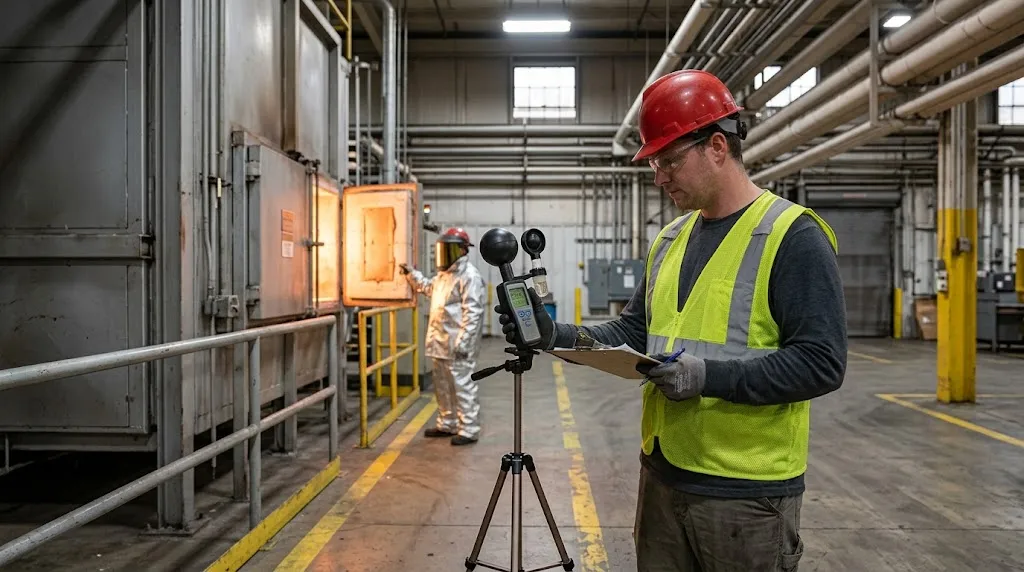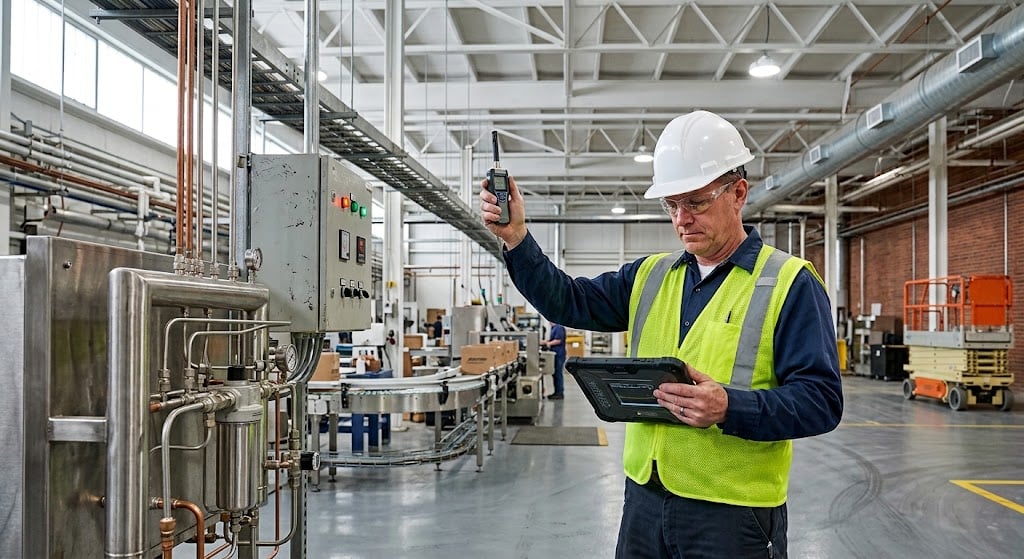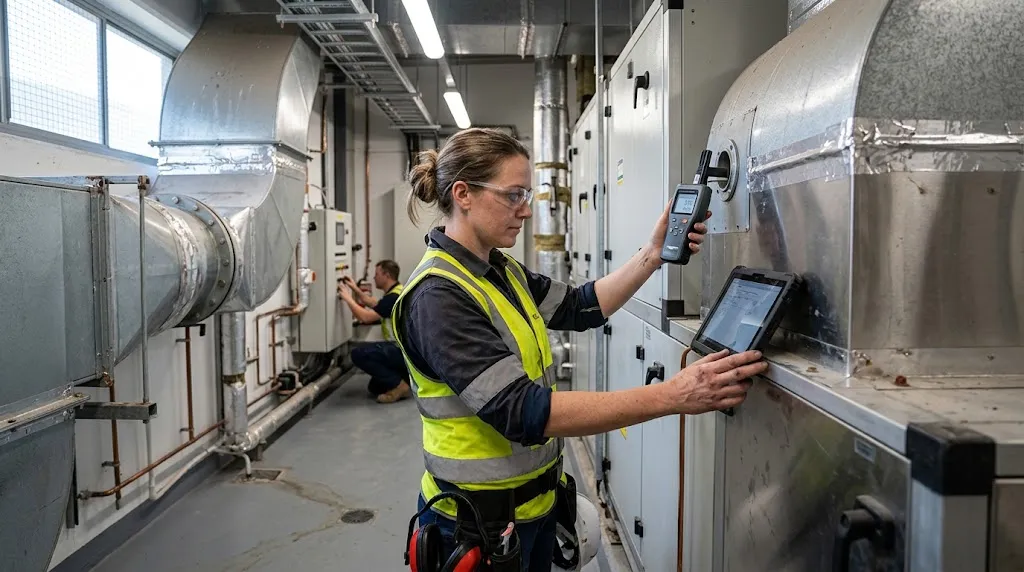


- Stagnant water in a dehumidifier's water collection tank, combined with neglected filter maintenance, can support bacterial contamination and disperse airborne contaminants when the unit operates.
- The Occupational Safety and Health Administration (OSHA) and the Environmental Protection Agency (EPA) both identify excessively dry and excessively moist indoor air as contributors to indoor air quality complaints in commercial and industrial settings.
- Relative humidity (RH) levels below 30% RH in occupied industrial facilities are associated with increased respiratory issues, dry skin and irritation, and elevated electrostatic discharge (ESD) events.
- ESD generated by low-humidity air can damage electronics, PCBs, and sensitive components during assembly or storage, making moisture control a production quality issue.
- Industrial humidifiers that produce self-evaporating droplets add moisture without wetting surfaces or equipment, eliminating the condensation risk associated with poorly designed humidification.
- Systems with no standing water in the delivery path and maintenance intervals extending to every two years reduce the opportunity for the bacterial contamination that concerns EHS officers.
Can Industrial Dehumidifiers Make You Sick? What the Evidence Shows
An industrial dehumidifier does not inherently make people sick. The risk is a function of equipment management, not equipment type, and that distinction matters when evaluating any humidity control system for a facility. Specific maintenance failures, however, do create conditions that affect indoor air quality. The three most common failure points are a neglected water collection tank, failed filter maintenance, and over-drying of the air. Each creates a different pathway to occupant health effects. Understanding the mechanism behind each one allows facility managers and EHS officers to separate genuine equipment risk from operational failure.When Dehumidifier Maintenance Fails, Air Quality Suffers
Stagnant water collecting in a dehumidifier's water collection tank creates the conditions for bacterial contamination. Warm ambient temperatures accelerate microbial growth. When a unit runs with a saturated or neglected filter, it can disperse those contaminants as airborne particles through the facility air stream. This is a maintenance failure, not an inherent product defect, but the health consequences for occupants are the same either way. A consistent dehumidifier maintenance schedule prevents this chain of events:- Empty and clean the water collection tank regularly, following the manufacturer's interval recommendation.
- Inspect and replace filters on schedule. A visibly soiled filter is already past the point of safe operation.
- Check for mold and mildew growth on internal surfaces during each service interval.
- Verify that drainage lines are clear and not backing up into the unit.
- Confirm that the unit is not operating in a space with inadequate proper ventilation, which concentrates any contaminants it might release.
Over-Drying: The Less Obvious Risk
When dehumidification removes too much moisture from the air, the resulting excessive dryness creates its own occupational health concerns. The general industry recommendation for occupied industrial spaces is 30% to 60% RH. Below 30% RH, facilities typically see increased complaints of dry skin and irritation, sore throats, and respiratory issues among workers. Dust mites and allergens in the air also behave differently in very dry conditions, with particulate staying airborne longer rather than settling. An HVAC system that is over-dehumidifying, particularly during dry winter months, can push indoor RH well below this threshold without operators realizing it. Regular monitoring of relative humidity levels is the practical control measure. Understanding relative humidity and how it is measured is the starting point for managing this risk.Humidity Problems in Production Facilities: What Low RH Actually Costs
Low relative humidity is a production variable, not only a comfort variable. Facilities that track defect rates, material waste, and unplanned downtime without monitoring RH are missing a parameter that affects all three. The consequences of low humidity fall across four operational domains: static electricity and ESD events, material integrity, worker health as it affects attendance and output, and surface quality in finishing operations.Static Electricity and ESD in Dry Production Environments
Low humidity reduces the conductivity of ambient air, allowing static charge to accumulate on surfaces, equipment, and personnel. In electronics assembly and PCB manufacturing, an ESD event measured in hundreds of volts can permanently damage components that appear visually undamaged. Preventing static electricity in electronics manufacturing requires maintaining RH at levels that prevent charge accumulation, typically above 40% RH in sensitive assembly areas. Pharmaceutical powder handling presents a related risk. Dry air causes fine powders to develop electrostatic charge, affecting blend uniformity, yield, and transfer efficiency. ESD control systems in these environments rely on humidity as a primary suppression mechanism, not a secondary one.Material Integrity: Wood, Paper, and Moisture-Sensitive Substrates
Wood, paper, and hygroscopic materials expand and contract with changes in ambient RH. In printing environments, substrate curl and misregistration are direct consequences of uncontrolled humidity. A sheet that absorbs moisture unevenly across its surface will not feed, register, or finish within tolerance. Our guide on printing facility humidity control addresses this through stable RH maintenance across the production floor, preventing the dimensional variation that causes press rejects. Wood flooring, millwork, and joinery in manufacturing and hospitality facilities face similar dimensional instability when RH fluctuates. Gaps, cupping, and cracking are the physical result of a facility that cycles between low and normal humidity without control.Worker Health and Absenteeism as a Production Variable
Chronic low humidity in production facilities is associated with increased worker complaints about dry skin and irritation, sore throats, and respiratory issues. Whether dry air causes sore throat is a concern among the workforce, the operational consequence is the same: increased absenteeism during dry winter months affects output. This is a production variable that facility and EHS managers can directly influence through moisture control. The causal relationship should not be overstated beyond what Bradford Hill criteria support. Low humidity contributes to the conditions associated with these complaints; it is not the sole cause. But facilities with documented RH below 30% RH during winter operation have measurable grounds to investigate humidity as a contributing factor before attributing health complaints to other sources.Are Humidifiers Bad for Electronics? What Facility Managers Need to Know
The honest answer is that the wrong humidification system, or a correctly specified system installed incorrectly, can introduce condensation risk to sensitive electronics. A precision system engineered for non-wetting operation does not. The distinction lies in the mechanism by which moisture enters the air.The Condensation Risk: When Humidifiers and Electronics Don't Mix
Steam-based or spray-based humidification systems release moisture in forms that can reach surfaces before fully evaporating. In a data center or electronics assembly environment, that surface moisture on server racks, PCBs, or sensitive hardware creates immediate risk of short circuits and latent corrosion. This is the real risk behind the question "are humidifiers bad for electronics," and it's a real one with the wrong system design or an oversaturated environment. Data center humidification systems must be specified to prevent this failure mode, not simply to add humidity. ASHRAE A1 thermal envelope guidance recommends 40% to 60% RH for data center environments, a range that:- Prevents ESD events from excessive dryness
- Prevents condensation risk from excessive moisture
Precision Non-Wetting Systems: How the Risk Is Engineered Out
Precision adiabatic humidification systems that produce self-evaporating droplets eliminate the condensation pathway by design. Each droplet is sized and charged to evaporate before contacting any surface, so no liquid phase reaches equipment, racks, or components under proper system design. This is why electronics manufacturing humidification in sensitive environments specifies this technology class over steam or conventional spray systems. One caveat applies to any non-wetting claim: direct exposure to the fog stream, such as placing a hand directly into the output, will wet the surface. Non-wetting behavior applies to surfaces in the operating environment under correct system design and nozzle placement. System design is not a secondary consideration; it determines whether the non-wetting specification holds in practice.The Specific Problems Industrial Humidifiers Are Designed to Solve
Once the failure modes of poorly managed humidity are understood, the engineering response becomes clear. Industrial humidifier systems address three core problem domains when properly specified and maintained:- Static electricity and ESD control. Maintaining RH above 40% reduces charge accumulation on surfaces and personnel. Moist air provides a conductive pathway that dissipates charge before it builds to damaging levels, making humidity a primary ESD control measure in electronics assembly and pharmaceutical powder handling.
- Material stability. Precise moisture control prevents the dimensional change in wood, paper, and hygroscopic substrates that disrupts manufacturing tolerances and print registration. Humidity control systems maintain the stable RH band that keeps materials within specification throughout production.
- Occupant health and indoor air quality. Maintaining RH above 30% reduces the conditions associated with respiratory issues, dry skin and irritation, and elevated dust and allergen concentration, since dust mites, airborne allergens, and particulate behavior are all influenced by RH. A facility managing humidity within the 30% to 60% band addresses occupant health concerns as a side effect of proper production environment control.
Humidity and Filter Maintenance: What Keeps a System Clean
The health concern that opened this article is a maintenance concern. A humidifier that is neglected becomes a source of airborne contaminants rather than a solution to dry air. The practical controls are straightforward:- Inspect filters on a documented schedule and replace them before visible fouling, not after.
- Confirm that no standing water accumulates in the delivery path between service intervals.
- Check for mold and mildew growth at every service point, particularly in warm ambient conditions.
- Verify that the humidifier is integrated with adequate proper ventilation so contaminants cannot concentrate.
- Record service dates and filter replacement in a facility maintenance log to create an auditable dehumidifier maintenance schedule.
How Smart Fog Precision Humidification Addresses These Problems
An equal-sized droplet grid that self-evaporates before reaching any surface eliminates the condensation pathway that makes conventional humidification a risk for electronics and health-sensitive environments. Each droplet produced by Smart Fog's proprietary nozzle carries a slight charge that prevents re-aggregation, ensuring the droplet grid disperses into vapor rather than combining into larger droplets that could settle on surfaces. This is the operating principle behind Smart Fog technology overview.Self-Evaporating Droplets: No Condensation, No Wetting Risk
The self-evaporating droplet mechanism directly addresses the condensation risk that makes standard humidification inappropriate for data centers, electronics manufacturing, and pharmaceutical environments. Because no droplet reaches a surface before evaporating, the condensation pathway is closed by design rather than managed through operational precaution. Key performance characteristics of this approach:- Maintains RH up to 99% with plus or minus 1% to 2% precision, supporting both ESD suppression and material stability requirements.
- Operates without wetting racks, equipment, substrates, or products under proper system design.
- Delivers 100% water efficiency as every droplet evaporates into the air, with no standing water in the delivery path.