Relative humidity (RH) requirements differ substantially by industry, and the common 40 to 60% benchmark applied to occupied commercial spaces fails most industrial and regulated applications. Pharmaceutical cleanrooms, electronics dry rooms, cold storage environments, and hospital operating suites each operate under distinct regulatory frameworks with RH targets that fall well outside any general HVAC guideline.
This article covers specific RH ranges for pharmaceuticals, data center humidification systems, healthcare, electronics manufacturing, lithium-ion battery production, printing, food processing, cold storage, aerospace, and defense, with governing standards and consequences of non-compliance noted for each sector.
Key Takeaways
- Pharmaceutical GMP frameworks including GMP humidity requirements under FDA 21 CFR Part 211 and EU GMP Annex 1 specify RH ranges by process area, and humidity excursions require formal deviation documentation and may trigger batch rejection.
- ASHRAE Standard 170, outlined in ASHRAE’s health care facilities resources, requires general patient care areas to maintain 30 to 60% RH and operating rooms to maintain 20 to 60% RH, with low humidity linked to increased airborne pathogen survival and high humidity associated with mold and mildew growth in facility structures.
- ANSI/ESD S20.20 and IEC 61340-5-1 establish a minimum 30 to 40% RH floor for electronics and semiconductor manufacturing, making humidity control a statutory electrostatic discharge (ESD) compliance requirement.
- Lithium-ion battery cell assembly dry rooms require dew point conditions of minus 40°C or lower, making battery manufacturing one of the most demanding humidity control applications in industrial production.
- Cold storage RH targets vary by product category: fresh produce requires 85 to 95% RH, dairy and meat environments target 75 to 85% RH, and freezer rooms must remain below 70% RH to suppress frost accumulation.
- Humidity fluctuations, even brief ones within an otherwise compliant range, can trigger ESD events, initiate condensation on cold surfaces, and cause moisture uptake in hygroscopic materials, making stability as critical as range coverage.
Why One Humidity Range Cannot Cover Every Industry
The 40 to 60% RH range frequently cited in general HVAC guidance originates from ASHRAE Standard 62.1, which governs ventilation and indoor air quality in occupied spaces. That standard was designed to support occupant comfort and acceptable indoor air quality, not to serve as a universal industrial specification. Applying it to a regulated manufacturing or storage environment misrepresents the standard’s intent and leaves real compliance risk unaddressed.
Pharmaceutical GMP production floors, electronics ESD-sensitive assembly areas, cold storage facilities, and hospital operating suites each operate under their own named regulatory frameworks. Those frameworks specify RH targets based on process chemistry, product stability, equipment sensitivity, or patient safety, not occupant comfort. The ranges these frameworks require often fall well outside the 40 to 60% band, and operating within the HVAC comfort range while outside the process range creates compliance exposure that a comfort-based standard was never designed to prevent.
The sections below present RH requirements sector by sector, with the governing standard, the required range, and the operational or regulatory consequence of operating outside it.
What Governs Humidity Requirements in Regulated Industries
Regulated sectors including pharmaceuticals, healthcare, food processing, and electronics manufacturing operate under named regulatory frameworks issued by several standards bodies:
- U.S. Food and Drug Administration (FDA): governs pharmaceutical and food processing environments.
- ASHRAE: sets environmental design standards referenced across most regulated and commercial facility types.
- International Organization for Standardization (ISO): governs cleanroom and manufacturing environmental classifications.
- American National Standards Institute (ANSI): coordinates U.S. standards adoption across multiple sectors.
- International Electrotechnical Commission (IEC): governs electronics manufacturing and ESD-related environmental requirements.
These aren’t general building codes. Each framework specifies environmental conditions as a function of product quality, equipment performance, or patient safety outcomes. Where those frameworks apply, general HVAC system design targets are a baseline floor, not a substitute for process-specific requirements. Understanding what is relative humidity as a measurable property, and how it interacts with temperature and dew point, is foundational to applying any of these frameworks correctly.
Relative Humidity Requirements by Industry: Reference Guide
The specifications below represent the primary governing standards for each sector. Temperature and humidity are often specified together in these frameworks, and the RH ranges cited here assume temperature control is maintained within the same standard’s requirements. A calibrated hygrometer or building management system with continuous RH logging is standard practice in regulated environments. Use the relative humidity calculator to check a facility’s current reading against the sector-specific ranges below.
Pharmaceutical Manufacturing
Pharmaceutical manufacturing humidification operates under GMP frameworks that specify environmental conditions by area classification. Requirements vary by process type, and no single RH value applies across all zones.
- Required RH range: Production floors typically 45 to 55% RH; API storage areas 35 to 65% RH depending on product sensitivity; sterile fill-finish areas commonly 30 to 50% RH per facility-specific validation protocols.
- Governing standard: FDA 21 CFR Part 211, Subpart D (equipment) and Subpart E (production controls); EU GMP Annex 1 for sterile manufacturing environments.
- Consequence of non-compliance: Humidity excursions above validated limits cause tablet moisture absorption, coating adhesion failure, and capsule softening. Excursions in sterile fill areas can compromise cleanroom classification and require deviation documentation, batch investigation, and potential product rejection under GMP frameworks.
Data Centers and Server Rooms
Server hardware generates heat that interacts directly with ambient humidity levels, creating both condensation and ESD risk depending on which direction RH drifts. More detail on managing these thresholds is available in the Smart Fog guide to ideal humidity levels for data centers.
- Required RH range: ASHRAE A1 equipment class allows 20 to 80% RH with a recommended operating range of 40 to 60% RH. Operation below 30% RH creates ESD risk. Operation above 70% RH risks condensation on active server hardware.
- Governing standard: ASHRAE Thermal Guidelines for Data Processing Environments (A1 class); ASHRAE Standard 90.4 for data center energy performance.
- Consequence of non-compliance: ESD at sub-30% RH can destroy memory modules and processor components with no visible damage at the time of occurrence. Condensation above 70% RH causes corrosion on PCB traces, connector pins, and storage media. Data center cooling strategies that prioritise thermal management without accounting for RH create humidity conditions that fall outside the safe operating envelope.
Healthcare and Hospital Environments
Healthcare humidity requirements are set by ASHRAE Standard 170, which governs ventilation in health care facilities and specifies RH by room type. Recommended humidity levels for hospitals vary by care environment and carry both patient safety and infection control implications. Facilities managing these requirements will benefit from reviewing healthcare facility humidification and hospital and clinic humidifiers options suited to clinical environments.
- Required RH range: General patient care areas 30 to 60% RH; operating rooms 20 to 60% RH; intensive care units 30 to 60% RH; sterile processing departments 30 to 60% RH.
- Governing standard: ASHRAE Standard 170 (Ventilation of Health Care Facilities); The Joint Commission Environment of Care standards.
- Consequence of non-compliance: Low humidity increases the survival and airborne transmission of respiratory pathogens and causes patient mucosal dryness that increases infection susceptibility. High humidity supports mold and mildew growth in wall cavities and ceiling spaces, triggering occupational health and safety citations and The Joint Commission findings during accreditation surveys.
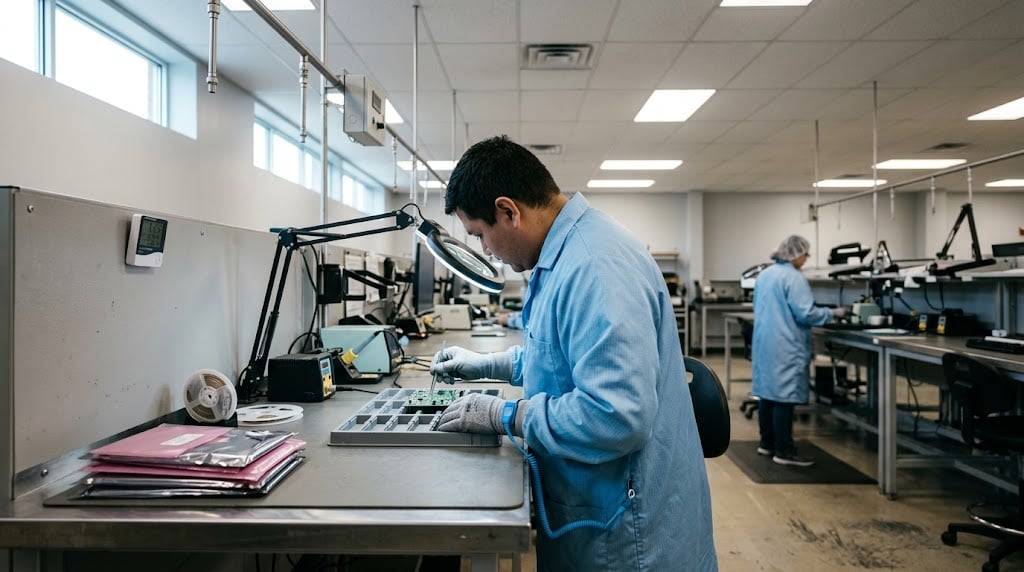
Electronics and Semiconductor Manufacturing
ESD is the primary humidity-related failure mode in electronics manufacturing. Humidity acts as a conductive layer that dissipates static charge buildup, and below the threshold set by governing standards, that protection disappears. Detailed information is available on our guides covering how to prevent static electricity in electronics manufacturing and humidity requirements for PCB manufacturing.
- Required RH range: Minimum 30 to 40% RH per ANSI/ESD S20.20 and IEC 61340-5-1; many semiconductor fabs target 45 to 55% RH for process stability.
- Governing standard: ANSI/ESD S20.20 (Protection of Electrical and Electronic Parts, Assemblies and Equipment); IEC 61340-5-1.
- Consequence of non-compliance: ESD events at low RH can destroy MOSFET gate oxides and PCB traces with no visible damage at the time of exposure. Latent ESD damage passes functional testing at the factory but fails in field deployment, creating warranty exposure and traceability problems. Electronics manufacturing humidification and ESD control systems address both the static electricity suppression and process stability requirements of these environments.
Lithium-Ion Battery Manufacturing (Dry Rooms)
Battery cell assembly represents the most demanding humidity control application in industrial manufacturing. The electrolyte compounds used in lithium-ion cells react with atmospheric moisture during assembly, and no general industrial RH range applies here.
- Required humidity condition: Dew point of minus 40°C or lower, sustained throughout the cell assembly environment. Some OEM specifications require dew points of minus 50°C or below for certain cathode and anode chemistries.
- Governing standard: IEC 62485 (Safety requirements for secondary batteries and battery installations); OEM process specifications, which govern dry room classification requirements.
- Consequence of non-compliance: Moisture contamination during cell assembly causes electrolyte decomposition, lithium plating on anode surfaces, and capacity loss. In severe cases, moisture-contaminated cells present thermal runaway risk during charging. This is a failure mode with direct safety implications, not only a yield or quality issue.
Printing and Publishing Facilities
Wood and paper products are hygroscopic. They absorb and release moisture in response to ambient humidity levels, and those dimensional changes are the primary cause of print defects. Printing facility humidity control is designed for the precise, stable RH management that offset and digital print environments require.
- Required RH range: 45 to 55% RH for offset and digital printing environments; paper conditioning areas typically held to 50% RH plus or minus 3%.
- Governing standard: ISO 187 (Paper, board, and pulps: standard atmosphere for conditioning and testing); facility specifications derived from press manufacturer requirements.
- Consequence of non-compliance: Low humidity causes paper curl, static electricity buildup on sheet surfaces, and misregistration in multi-pass colour printing. High humidity causes ink drying delays, paper cockling, and blanket adhesion problems in offset applications. Either condition produces scrap and press downtime.
Food Processing and Cold Storage
RH requirements in food environments vary significantly by storage temperature, product category, and processing stage. A single facility may require very different humidity levels in adjacent spaces. Food safety humidification and cold storage humidification address these segmented requirements.
- Fresh produce storage: 85 to 95% RH to prevent dehydration, weight loss, and premature senescence.
- Dairy and meat storage: 75 to 85% RH to balance surface drying with mold and mildew growth suppression.
- Dry goods and grain storage: 50 to 60% RH to prevent moisture absorption and mycotoxin development.
- Food processing production rooms: 40 to 60% RH per facility hygiene plans and equipment manufacturer requirements.
- Freezer rooms: Below 70% RH to suppress frost accumulation on evaporator coils and product surfaces.
- Governing standard: FDA Food Safety Modernization Act (FSMA) environmental controls (21 CFR Part 117); USDA Agricultural Marketing Service storage guidelines by commodity.
- Consequence of non-compliance: Produce weight loss from low-humidity storage directly reduces saleable yield. High humidity in dry goods storage initiates mold growth and mycotoxin contamination, which is a reportable food safety event under FSMA. Frost accumulation in freezer rooms increases defrost cycle frequency and energy load.
Aerospace and Defense Manufacturing
Aerospace production environments include multiple distinct process areas, each with different humidity sensitivity. Aerospace manufacturing humidification and defense and military facility humidification address the multi-zone requirements of these facilities.
- Composite lay-up and cure areas: 45 to 55% RH to maintain resin pot life and prevent surface moisture contamination that causes void formation in cured laminates.
- Paint and coating booths: 40 to 60% RH per coating manufacturer specifications; humidity excursions cause adhesion failure and surface blushing.
- Electronics integration and avionics assembly: 30 to 50% RH per MIL-STD-810 environmental control requirements for ESD-sensitive hardware.
- Long-term weapons and hardware storage: Below 50% RH per MIL-STD-2073 packaging and preservation specifications to suppress corrosion.
- Governing standard: MIL-STD-810 (Environmental Engineering Considerations and Laboratory Tests); MIL-STD-2073; ASHRAE Handbook guidance for aerospace facility design.
- Consequence of non-compliance: Excess moisture during composite lay-up causes delamination that may not be visible on surface inspection. Corrosion in stored hardware creates serviceability and airworthiness compliance failures. ESD damage during electronics integration produces latent faults in flight-critical systems.
Cleanrooms (General)
Cleanroom humidity requirements are set by the process classification and the sensitivity of the work performed, not by a universal number. Cleanroom humidity requirements by industry provides process-specific breakdowns. Both cleanroom humidifiers and cleanroom humidification system designs must account for gowning area transitions and pressurisation requirements.
- Required RH range: 30 to 60% RH per ISO 14644 classification-based requirements; specific process cleanrooms may operate at tighter tolerances within this band.
- Governing standard: ISO 14644-1 cleanroom classification (Classification of Air Cleanliness by Particle Concentration); process-specific supplements issued by equipment or product OEMs.
- Consequence of non-compliance: Low humidity in cleanroom environments increases particle aggregation and ESD events that compromise yield in semiconductor and medical device manufacturing. High humidity in cleanroom environments affects gowning material integrity and personnel comfort in ways that increase gowning protocol violations. Both conditions affect the controlled environment’s classification integrity.
What Happens When Relative Humidity Falls Outside the Required Range
The consequences of operating outside the specified RH band are not uniform across industries. Each sector has a distinct primary failure mode, and understanding which consequence applies to a given facility is necessary for framing the cost of inadequate humidity control to internal stakeholders.
Product quality and yield loss:
- Pharmaceutical tablets absorb ambient moisture above validated RH limits, causing weight gain, coating softening, and dissolution profile changes that trigger batch rejection.
- Fresh produce loses saleable weight at a measurable rate when held below target RH, reducing revenue per pallet without any other failure occurring.
- Print substrates in low-humidity conditions accumulate static electricity that causes sheet misfeeding and misregistration, producing scrap at the press rather than at inspection.
Regulatory compliance exposure:
- Pharmaceutical humidity excursions in GMP environments require formal deviation documentation, root cause investigation, and CAPA records. Repeated excursions affect product release decisions and can appear in FDA 483 inspection observations.
- FSMA environmental monitoring requirements for food processing facilities include temperature and humidity as parameters that must be documented, controlled, and trended.
Equipment and asset damage:
- ESD at low RH can cause latent semiconductor damage that passes functional testing at the factory but fails in field deployment, creating warranty and reliability liability.
- Condensation on server hardware above 70% RH causes corrosion on connector contacts and PCB surfaces that is not immediately apparent but accelerates over time.
Occupational health and safety:
- Operating rooms and clinical spaces held below 30% RH create mucosal dryness in patients and clinical staff, increasing susceptibility to airborne pathogens. ASHRAE Standard 170 establishes these limits in part for infection control.
- Facilities in which mold and mildew growth develops in response to sustained high humidity create occupational health and safety exposure under OSHA 1910 general industry standards.
Structural facility risk:
- High indoor RH in facilities located in cold climates can cause interstitial condensation in building envelopes when indoor dew point exceeds the temperature of exterior-facing surfaces, per ASHRAE Standard 160 moisture control criteria. This creates structural degradation that is not visible from the interior until significant damage has occurred.
The Compounding Risk of Humidity Fluctuation
Maintaining a point-in-time RH measurement within the specified range is insufficient for most regulated and process-critical applications. What governing standards and process validation frameworks require is sustained stability within the specified band across the full operational period.
Brief humidity fluctuations, even those that return quickly to the nominal target, create discrete risk windows. A 10-minute drop below 30% RH in an electronics assembly area is sufficient to initiate ESD events on exposed components. A transient rise above the validated RH ceiling in a pharmaceutical coating suite creates a documentation obligation under GMP, regardless of how quickly conditions recover. In cold storage environments, RH fluctuations cause condensation-evaporation cycles on product surfaces that accelerate microbial growth.
This means precision and stability are the operative system requirements, not merely range coverage. A humidity control system that achieves the target range on average while fluctuating significantly around it does not meet the functional requirement of most regulated environments. The measurement tool used to verify compliance, whether a calibrated hygrometer or a building management system with continuous data logging, must be capable of capturing transient excursions, not only steady-state averages.
Seasonal and Climate-Zone Adjustments to Indoor RH Targets
Achieving a given indoor RH target creates different condensation and structural risks depending on outdoor climate conditions and the thermal performance of the building envelope. A facility maintaining 50% RH in Houston, Texas in summer faces very different moisture management challenges than one maintaining the same target in Minneapolis, Minnesota in January. The nominal RH target is the same; the risk profile is not.
The physics governing this are straightforward and covered in the ASHRAE Handbook of Fundamentals psychrometrics chapters and ASHRAE Standard 160 for moisture control in buildings. The dew point of indoor air at a given RH rises with air temperature. If the indoor dew point exceeds the surface temperature of any building component, including exterior walls, windows, metal ductwork, or cold water pipes, condensation occurs on that surface. Facilities in cold climates that maintain high indoor RH in winter face condensation on cold exterior-facing surfaces. This leads to interstitial moisture accumulation, structural degradation, and potential mold growth inside wall cavities where it is not immediately detectable.
Facilities in hot, humid climates face the inverse problem. Outdoor air infiltrating through doors, loading docks, and building envelope gaps carries high absolute moisture content. Maintaining a lower indoor RH target in these conditions requires HVAC systems to manage both the internal moisture load and continuous infiltration from the exterior. The energy and system capacity implications of this are significant, and HVAC system design for such facilities must account for climate zone as a primary input, not an afterthought.
Why the Same RH Target Creates Different Risks by Location
Three climate scenarios illustrate how the same indoor humidity target produces different engineering requirements and risk exposures.
Arid or cold climate (Minneapolis, Minnesota in January): Outdoor absolute humidity is extremely low. Maintaining 45% RH indoors requires significant humidification load and creates a steep vapour pressure gradient toward exterior-facing surfaces. Interstitial condensation in walls and around window frames is the primary risk if the vapour barrier and insulation are not designed to handle the differential.
Temperate climate (Denver, Colorado in spring): Outdoor conditions vary. Humidification may be required in winter and may be unnecessary in shoulder seasons. System design must account for seasonal variation in load, and controls must modulate output in response to outdoor conditions as well as indoor targets.
Hot and humid climate (Houston, Texas in summer): Outdoor dew points regularly exceed 22°C, which means infiltrating air carries substantial moisture load. Maintaining 50% RH indoors at 22°C means holding indoor dew point at approximately 11°C. Any surface below that temperature, including supply air ducts delivering cooled air, becomes a condensation point. HVAC systems in this climate zone must be sized and controlled with this infiltration load as a primary design input.
How Smart Fog Meets Precision Humidity Requirements Across Industrial Sectors
Precision humidification that maintains stable RH within the tolerances required by pharmaceutical GMP frameworks, ASHRAE data center guidelines, and electronics ESD standards depends on how the system produces and distributes moisture, not only on the control algorithm that governs it. The foundational requirement is a humidification mechanism that adds moisture to air without depositing liquid on surfaces, equipment, or product. That requirement eliminates steam systems, which deliver heat alongside moisture, and traditional misting systems, which produce droplets that settle before evaporating.
Smart Fog’s proprietary nozzle mixes compressed air and water to produce an equal-sized droplet grid where each droplet carries a slight electrical charge that prevents re-aggregation. The droplets self-evaporate before reaching any surface, enabling non-wetting humidification under proper system design.
This mechanism supports humidity control systems that maintain RH up to 99% RH with plus or minus 1 to 2% precision across the full industrial range. The caveat applies: non-wetting describes the system’s behaviour under proper design; direct contact with the fog stream will wet a surface.
Precision and Stability Across the Full Industrial RH Range
The performance specifications that matter to procurement and engineering readers evaluating humidity control options are tolerance, stability, and maintenance demand. A system that achieves the target range on average while fluctuating by 10% around it does not meet the functional requirement of a pharmaceutical validation protocol or an electronics ESD compliance programme.
- Humidity precision: Maintains RH up to 99% RH with plus or minus 1 to 2% precision, sustained continuously.
- Stability: The equal-sized droplet grid and self-evaporation mechanism produce consistent output without the cycling and overshoot behaviour associated with on/off steam systems.
- Maintenance interval: No moving parts in the humidification process; maintenance intervals extend to every two years, reducing scheduled downtime in continuous production environments.
- Water efficiency: Every droplet evaporates into the air, achieving 100% water utilisation with no runoff, no drain requirement in standard installation, and no surface wetting under proper system design.
- Operational continuity: Designed for 24/7 set-and-forget operation in industrial environments without constant monitoring or adjustment.
Sector-Specific System Design, Not a Generic Output Target
Regulated industries require humidity control systems that can be documented, validated, and maintained against a defined specification. A component kit assembled in the field does not satisfy that requirement. Smart Fog designs and delivers the complete engineered system for the specific facility, accounting for the volume, process area layout, required RH range, and temperature and humidity interactions that determine system performance. This is particularly relevant in pharmaceutical manufacturing, aerospace, and electronics environments where the system configuration must be recorded as part of the facility’s environmental control documentation.
The Smart Fog technology overview covers the engineering principles behind the equal-sized droplet grid and the nozzle design that enables non-wetting performance.
Final Thoughts
Relative humidity requirements vary by industry for reasons grounded in process chemistry, equipment sensitivity, product stability, and regulatory mandate. No single RH target serves pharmaceutical cleanrooms, cold storage facilities, electronics assembly areas, and printing production rooms simultaneously. Each sector has a governing standard, a defined range, and a specific failure mode that results from operating outside it.
The information in this guide is a starting point for specification and compliance review. Facility teams can use the Smart Fog relative humidity calculator to check current readings against a sector’s target range directly. The downloadable Smart Fog RH Reference Guide provides the full sector-by-sector benchmark table formatted for use in specification documents, facility assessments, and compliance reviews.
For facilities at the stage of evaluating whether a current humidity control system meets the standard for their sector, contact Smart Fog engineers to request a sector-specific system assessment.
Frequently Asked Questions
What is the ideal relative humidity level for pharmaceutical manufacturing facilities?
Pharmaceutical manufacturing facilities do not operate under a single universal RH target. FDA 21 CFR Part 211 and EU GMP Annex 1 require that environmental conditions, including relative humidity, be controlled and documented by process area, with the specific range varying by whether the space is a production floor, API storage, or sterile fill-finish. Excursions beyond validated limits require formal deviation documentation and may trigger batch investigation or rejection.
How does relative humidity affect food storage and food processing quality?
Relative humidity affects food storage differently depending on the product category and storage temperature, with high-moisture produce, refrigerated proteins, and shelf-stable dry goods each sitting at a different point on the RH scale for different reasons (see the ranges above). Operating outside these ranges under FSMA 21 CFR Part 117 constitutes a documented environmental control failure that facilities must address in their food safety plans.
What humidity levels are required in hospital and healthcare environments under ASHRAE 170?
ASHRAE Standard 170, which governs ventilation in healthcare facilities, specifies relative humidity by room type rather than by a single building-wide target. General patient care areas and intensive care units must maintain 30 to 60% RH. Operating rooms require 20 to 60% RH. Sterile processing departments target 30 to 60% RH. Operating below the lower limit increases airborne pathogen survival and patient mucosal dryness. Operating above the upper limit creates conditions that support mold and mildew growth in building cavities, which is a Joint Commission Environment of Care compliance issue.
Why is humidity control important in data centers and server rooms?
Humidity control in data centers addresses two distinct failure risks associated with operating outside the acceptable range. Below 30% RH, static electricity accumulates on hardware and personnel in the absence of the conductive moisture layer that dissipates charge buildup, creating ESD risk to memory modules and processors. Above 70% RH, condensation forms on active server hardware, connector contacts, and PCB surfaces, causing corrosion that degrades performance over time. ASHRAE A1 equipment class guidelines establish a recommended operating range of 40 to 60% RH to maintain a safe margin from both thresholds.
What are the ASHRAE recommended humidity ranges for commercial and industrial buildings?
ASHRAE Standard 62.1 recommends 40 to 60% RH for occupied commercial spaces as a ventilation and indoor air quality guideline. This range was designed around occupant comfort and acceptable indoor air quality, not industrial process requirements. Industrial facilities operating under pharmaceutical GMP, aerospace MIL-STD, or food safety FSMA frameworks are governed by those sector-specific standards, which specify RH ranges based on process performance and product safety, not occupant comfort. For regulated environments, ASHRAE 62.1 should be understood as a general building baseline, not a process specification.
What humidity levels are required in electronics and semiconductor cleanrooms to prevent ESD?
Electronics and semiconductor manufacturing environments must maintain a minimum of 30 to 40% RH per ANSI/ESD S20.20 and IEC 61340-5-1 to suppress electrostatic discharge. Many semiconductor fabs target 45 to 55% RH for process stability margins above this floor. ESD events in low-humidity environments can destroy MOSFET gate oxides and PCB traces without producing visible damage at the time of exposure. The damage is latent and often appears as field failures after functional testing has cleared the component, creating reliability and warranty liability.
What dew point conditions are required in lithium-ion battery dry room manufacturing?
Lithium-ion battery cell assembly requires sustained dew point conditions of minus 40°C or lower throughout the production environment. Some OEM specifications require minus 50°C or below for specific electrode chemistries. These requirements are governed by IEC 62485 and OEM process specifications, not general HVAC standards. Moisture present during cell assembly reacts with electrolyte compounds, causing electrolyte decomposition, lithium plating, and reduced cycle life. In severe cases, moisture contamination in assembled cells presents thermal runaway risk during charging, making this a safety-critical environmental control requirement.
How do outdoor climate conditions affect indoor relative humidity targets for industrial facilities?
Outdoor climate conditions affect both the energy and condensation risk implications of maintaining a given indoor RH target. In cold climates, maintaining high indoor RH in winter creates a vapour pressure gradient toward exterior-facing surfaces. If the indoor dew point exceeds the temperature of those surfaces, interstitial condensation occurs in wall cavities and around penetrations, per ASHRAE Standard 160 moisture control criteria. In hot, humid climates, outdoor air infiltration carries high absolute moisture content that adds to the internal humidification load, making RH maintenance more energy-intensive. HVAC system design must account for climate zone as a primary design input, not solely the nominal indoor RH target.