

 Made in USA

Static electricity contaminates cleanrooms by creating charged surfaces that attract and retain airborne particles, including particles that HEPA filtration has already removed from the airstream. This article covers the electrostatic particle-attraction mechanism, why it operates independently of filtration quality, how it maps to ISO and GMP classification risk, and what the humidity-plus-ionization control framework does to stop it.
The problem is systematically underestimated because the conversation about static in cleanrooms defaults almost entirely to spark and fire hazard risk. The contamination vector, specifically how charged surfaces defeat expensive filtration infrastructure, receives far less attention in published guidance, auditor checklists, or facility engineering reviews.
Key Takeaways
- Charged surfaces attract airborne particles through electrostatic force, including particles already removed from the airstream by HEPA filtration, making filtration partially self-defeating in low-humidity, ungrounded environments.
- Surface potentials in the range of 100 to 1,000 volts are sufficient to attract particles in the size ranges governing ISO Class 5 through 8 compliance, and those potentials are routinely generated by personnel movement and polymer packaging in low-relative humidity (RH) conditions.
- Relative humidity maintained between 40% and 50% RH reduces triboelectric charge generation by increasing surface conductivity, allowing charge to dissipate before it accumulates to particle-attracting levels.
- In pharmaceutical GMP cleanrooms classified as Grade A or B under EU GMP Annex 1 (2022), RH above 50% can increase bioburden risk, meaning humidity-based static control must be implemented within a defined operating window.
- Ionization systems neutralize charge on isolated conductors and insulating materials that grounding and electrostatic discharge (ESD) flooring cannot reach, filling the gap that grounding-only programs routinely miss.
- Regulatory inspectors conducting FDA and EMA audits expect documented evidence of ESD control measures, including periodic ionizer verification logs and humidity monitoring records with defined alert and action limits.
What Static Electricity Actually Does in a Cleanroom
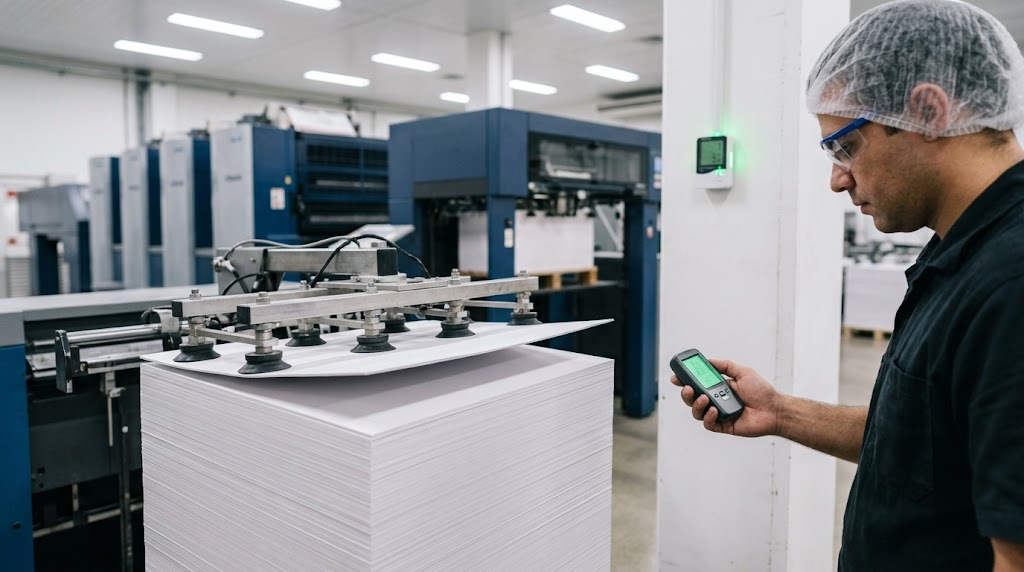
Triboelectric charging occurs when two materials contact and separate, transferring electrons and leaving surfaces with net charge. In a cleanroom, this happens continuously: gown friction against garments and gloves, personnel walking across flooring, and equipment surfaces contacting product all generate charge separation. The resulting surface potentials can reach hundreds to thousands of volts in low-RH conditions. Charged surfaces exert electrostatic attraction on airborne particles suspended in the cleanroom environment. This force acts on particles regardless of their source, including particles that the HEPA system has already captured and removed from the primary airstream, and that subsequently re-enter circulation through air turbulence or handling activity.
Why HEPA Filtration Alone Cannot Stop Electrostatically Attracted Particles
HEPA filtration controls airborne particle concentration but does not neutralize surface charge. A particle removed from the airstream by filtration can be re-suspended by airflow disturbance and subsequently attracted to a charged surface before it exits through the return air path. This is the mechanism by which static charge defeats the filtration investment: the cleanroom removes the particle, then electrostatic force redeposits it onto a critical product surface. Understanding this sequence is what allows a quality engineer to explain a compliance failure that cannot be traced to a filtration system fault.
The Voltage Thresholds That Matter for ISO Classification
ANSI/ESD S20.20 and IEC 61340-5-1 define charge decay time and voltage threshold requirements for controlled environments. Surface potentials in the range of 100 to 1,000 volts are sufficient to attract particles in the size ranges that determine compliance at ISO Class 5 through 8. Those potentials are routinely generated by personnel movement and equipment surfaces in low-humidity cleanrooms without active static control, making them a baseline operating condition rather than an edge case.
Where Static Charge Comes From in Cleanroom Environments
Identifying static generation sources accurately is the first step in designing a control program that addresses actual risk. Facilities that audit only equipment-based sources routinely underestimate personnel and packaging as contributors, which leaves the highest-frequency and highest-proximity sources uncontrolled. For a fuller treatment of static electricity problems in cleanroom environments, the source categories below each carry a distinct mechanism and affect different zones of the cleanroom.
Personnel Movement as the Highest-Frequency Static Source
Human activity is the highest-frequency static generation event in most cleanrooms. Gowning friction, walking, and repetitive handling motions generate charge continuously across a shift. Gowning protocols designed to control particulate shedding do not eliminate triboelectric charging; garment material selection affects both contamination performance and ESD performance, and the two are not always optimized together. Personnel represent a moving, constantly regenerating charge source that grounding alone cannot fully manage.
- Personnel gowning friction: Garment-to-garment and garment-to-glove contact generates charge during gowning and throughout shift activity.
- Walking on flooring: ESD flooring provides a ground path for footwear-to-floor contact, but standard cleanroom flooring does not; charge buildup depends on footwear compliance and flooring specification.
- Repetitive handling: Glove-to-surface contact during product handling generates charge at the point of highest contamination risk.
Packaging Materials and Product Containers
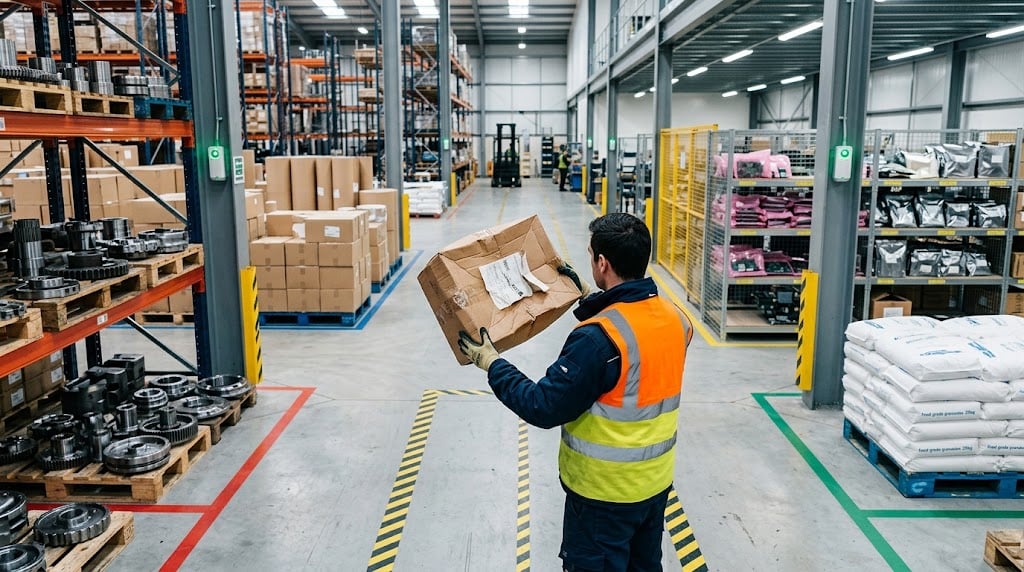
Cleanroom-rated polymer packaging is itself a strong charge generator, and it brings static directly to the product surface. Polypropylene, polyethylene, and similar polymers used in cleanroom-rated trays and containers sit high on the triboelectric series, meaning contact and separation events generate significant charge separation. Low relative humidity conditions below 35% to 40% RH reduce the surface conductivity that would otherwise allow that charge to dissipate passively, compounding the effect. This source category is systematically underweighted in ESD audits that focus on personnel paths and equipment grounding.
How Static Charge Defeats Your Filtration Investment
Facilities routinely invest in HEPA filtration at ISO Class 5 or 6 specification, validate the system correctly, and still encounter particle count excursions during audits or ongoing environmental monitoring. When static charge is not controlled, the filtration investment does not deliver its full specification. Charged surfaces continuously recontaminate what the filtration system removes, creating a cycle the HVAC system cannot resolve on its own. The specific failure modes that indicate electrostatic contamination as a root cause include:
- Particle count excursions during or immediately after personnel activity, not correlated with filtration system fault.
- Surface contamination on product-adjacent tooling and fixtures with no identifiable breach in gowning or handling protocol.
- Persistent non-conformances that cannot be attributed to filtration failure, personnel error, or process variation.
- Yield losses in semiconductor or pharmaceutical production that correlate with low-RH periods or seasonal humidity drops.
The ISO Classification Consequences
At ISO Class 5, the ISO 14644-1 particle count limit at 0.5 microns is 3,520 particles per cubic meter. Electrostatically attracted particles that deposit on surfaces and re-enter the airstream during handling or turbulence contribute directly to measured exceedances. For pharmaceutical readers, ISO Class 5 maps to GMP Grade A, where particle count limits carry direct regulatory consequences under EU GMP Annex 1 (2022) and FDA aseptic processing guidance.
Why the Problem Is Invisible Until It Fails
Electrostatic attraction is not visible during routine inspection. It does not trigger alarm systems and does not appear in HVAC monitoring logs. Facilities may operate with active static contamination for extended periods with no signal other than anomalous particle counts or yield data. This is precisely why it qualifies as the hidden risk: the mechanism is real, ongoing, and completely absent from the outputs that cleanroom operators monitor daily.
The Dual Solution Framework: Humidity Control and Ionization
Grounding and ESD flooring are necessary components of any static control program, but they address conductive surfaces and personnel ground paths only. They have no effect on insulating materials, isolated conductors, or airborne particles. The two control methods that fill those gaps are controlled relative humidity and active ionization. For a detailed comparison of ESD control methods compared, the distinction between preventive and corrective mechanisms matters for program design. Humidity control is preventive and ambient. Maintaining 40% to 50% RH increases surface conductivity across the entire environment, allowing charge to dissipate passively before it accumulates to particle-attracting thresholds. Ionization is corrective and targeted. Ionizers emit balanced positive and negative ions that neutralize existing charge on surfaces and in the air, addressing buildup that has already occurred. Together they address both the generation and accumulation phases of the contamination pathway.
Why Grounding Alone Is Insufficient
Grounding provides a discharge path for conductive surfaces and grounded personnel, but it has no effect on insulating materials such as polymer packaging, garments, and product surfaces, or on isolated conductors not connected to a ground path. These are precisely the materials and surfaces most likely to be at or near the product. ESD control programs that rely on flooring resistance and wrist strap compliance alone leave this category entirely uncontrolled, which is the mechanism gap that ionization fills.
Setting the Right Humidity Operating Window
The 40% to 50% RH range is the operating window where static suppression is effective without introducing bioburden risk in pharmaceutical cleanrooms. EU GMP Annex 1 (2022) Section 4 environmental monitoring requirements and FDA guidance on aseptic processing establish that RH above 50% in Grade A and B spaces can increase bioburden risk on surfaces. The upper boundary of the humidity operating window is therefore a compliance-derived constraint, not an informal preference. Raising RH without accounting for this boundary is not a safe default in GMP-regulated environments.
ESD Control Documentation: What Regulators Expect to See
Regulatory inspectors conducting FDA 483 reviews and EMA audits expect documented evidence of ESD control as part of the environmental control system, not simply physical installation of ESD materials. The audit expectation covers ongoing performance verification, not one-time qualification. For cleanroom humidity control programs in GMP-regulated facilities, the documentation categories auditors review include:
- Periodic ionizer performance verification logs, including offset voltage measurements and discharge time records.
- Personnel wrist strap and footwear tester records with documented frequency of verification.
- ESD flooring resistance test results, typically measured per ANSI/ESD S7.1 or equivalent.
- Humidity monitoring logs with defined alert and action limits and documented excursion responses.
- Periodic cleanroom ESD audit reports covering all static source categories and control method performance.
Ionizer Verification and Frequency Requirements
Ionizer verification records must include offset voltage measurement, discharge time to the specified target voltage, and zone coverage confirmation. Periodic verification is the regulatory expectation, not one-time installation testing. A system that passed commissioning but has not been verified since does not satisfy the environmental control documentation standard that FDA and EMA inspectors apply during review of aseptic processing environments.
Humidity as a Documented Environmental Control Parameter
In GMP-regulated cleanrooms, relative humidity is a monitored environmental parameter with defined alert and action limits. It is not an informal comfort setting. Humidity records are reviewed during inspections alongside particle count data as part of the batch manufacturing record environment. A facility that maintains humidity within the 40% to 50% static-suppression window but cannot produce monitoring records with defined limits and documented excursion responses is not audit-ready, regardless of physical system performance.
How Smart Fog Delivers Precision Humidity Control in Cleanroom Environments
Precision humidity in a cleanroom is only viable if the delivery mechanism does not introduce the contamination risks it is meant to prevent. Conventional misting and spray-based humidification deposit moisture on surfaces, equipment, and products, creating secondary contamination, corrosion, and bioburden risks that make them incompatible with ISO-classified and GMP-regulated environments. The delivery mechanism determines whether humidity control is actually usable in a controlled environment. Smart Fog systems for cleanroom humidification use compressed air and water mixed through a proprietary nozzle to produce an equal-sized droplet grid. Each droplet carries a slight charge that prevents re-aggregation, and the droplets self-evaporate before reaching any surface under proper system design. The humidity increase occurs in the air, not on equipment, racks, flooring, or product surfaces. For a full overview of cleanroom humidifiers designed for ISO-classified environments, system design and nozzle placement govern the non-wetting outcome.
Non-Wetting Delivery in Controlled Environments
The self-evaporating droplet design addresses the core objection to humidity-based static control in cleanrooms: the risk of surface wetting and its associated contamination and bioburden consequences. Because droplets self-evaporate before reaching surfaces under proper system design, the facility receives the conductivity benefit of elevated RH without surface deposition risk. The caveat is that direct exposure to the fog stream will wet a surface. Proper system design governs nozzle placement and coverage to ensure no critical surface falls within the direct fog stream. Smart Fog ESD control systems are engineered as complete, facility-specific solutions, not component kits.
Precision RH Maintenance Within the GMP Operating Window
Smart Fog systems achieve plus or minus 1% to 2% RH precision. For pharmaceutical manufacturing humidification programs where EU GMP Annex 1 and FDA guidance impose RH monitoring with defined alert and action limits, this precision level is operationally significant.
- A target RH of 45% with plus or minus 2% precision keeps the facility within the 40% to 50% static-suppression window without drifting above the bioburden-risk threshold.
- Systems operate continuously without constant operator intervention, supporting the set-and-forget reliability that GMP environmental monitoring programs require.
- Maintenance intervals extend up to every two years, with no moving parts in the humidification process, reducing the service burden in classified environments where access and downtime carry compliance implications.
For engineers also addressing static in electronics production, our guide on how to prevent static electricity in electronics manufacturing covers the humidity and ionization specification requirements for semiconductor and PCB environments.
Final Thoughts
Static electricity contaminates cleanrooms through a mechanism that operates independently of filtration quality. Charged surfaces attract and retain particles that HEPA systems already removed, creating a contamination pathway that is invisible in routine inspection and absent from standard HVAC monitoring outputs. The result is filtration underperformance in facilities that have no filtration system fault. The dual framework of humidity control and ionization addresses both the generation and accumulation phases of the problem. Grounding and flooring handle conductive paths; humidity raises surface conductivity across the environment; ionization neutralizes charge on insulators and isolated conductors. In GMP-regulated environments, all three require documented verification records, not just physical installation. Precision humidity delivery that raises RH into the 40% to 50% static-suppression window without wetting surfaces, equipment, or products is what makes humidity control viable in ISO-classified and pharmaceutical cleanrooms. To discuss humidity specifications and system design for a cleanroom or GMP facility, speak with a Smart Fog engineer. Consult a Humidity Expert
FAQ
How does static electricity cause contamination in a cleanroom if HEPA filters are working correctly?
HEPA filtration controls airborne particle concentration but does not neutralize surface charge. A particle removed from the airstream by filtration can be re-suspended by air turbulence and subsequently attracted to a charged surface before it exits through the return air path. This means a correctly specified and validated HEPA system can still fail to protect product surfaces if triboelectric charge is present on equipment, packaging, or personnel in the same space.
What relative humidity level is recommended to control static electricity in a pharmaceutical cleanroom?
The recommended operating window for static suppression in pharmaceutical cleanrooms is 40% to 50% RH. Below 40% RH, surface conductivity drops and charge accumulates more readily. Above 50% RH, EU GMP Annex 1 (2022) and FDA aseptic processing guidance indicate increased bioburden risk on surfaces in Grade A and B spaces. The 40% to 50% range is derived from the intersection of ESD control requirements and GMP environmental monitoring obligations.
What is the difference between grounding and ionization for cleanroom ESD control?
Grounding provides a discharge path for conductive surfaces and personnel who are connected to a ground path through ESD footwear or wrist straps. It has no effect on insulating materials such as polymer packaging, garments, or product surfaces, and no effect on isolated conductors. Ionization emits balanced positive and negative ions that neutralize charge on any surface, including insulators and airborne particles, making it the only method that addresses the charge sources grounding cannot reach.
What are the main sources of static charge buildup in a cleanroom environment?
The four primary sources are personnel movement, equipment surfaces, cleanroom-compatible packaging materials, and low relative humidity conditions. Personnel generate charge continuously through gowning friction, walking, and repetitive handling. Polymer packaging and product trays generate charge at the point of highest contamination risk because they contact the product directly. Low RH, typically below 35% to 40%, reduces the surface conductivity that would otherwise allow charge from all sources to dissipate passively.
Can humidity control alone eliminate static electricity contamination risk in a cleanroom?
No. Humidity control in the 40% to 50% RH range is a preventive measure that reduces charge generation across the environment by increasing surface conductivity. It does not neutralize charge that has already accumulated on isolated conductors or insulating materials. Ionization is required to address existing charge on surfaces that grounding and humidity cannot reach. A complete ESD control program combines grounding, humidity control, and ionization to address both charge generation and accumulation.
What documentation does the FDA expect for ESD control in a GMP-regulated cleanroom?
FDA inspectors reviewing aseptic processing environments under the Guidance for Industry on Sterile Drug Products Produced by Aseptic Processing expect documented evidence of ongoing ESD control performance, not one-time installation qualification. That documentation includes periodic ionizer verification logs with offset voltage and discharge time records, personnel wrist strap and footwear tester records with verification frequency, ESD flooring resistance test results, and humidity monitoring logs with defined alert and action limits and documented excursion responses.
What is the biggest source of contamination in a cleanroom?
Personnel are consistently identified as the primary contamination source in cleanrooms because human activity generates both particulate shedding and triboelectric charge continuously throughout a shift. Gowning controls particulate shedding to a degree, but garment friction also generates charge that attracts particles to product-adjacent surfaces. Packaging materials are a secondary but underweighted source because cleanroom-rated polymers such as polypropylene and polyethylene generate significant charge at the point of direct product contact.
What causes high levels of static electricity to build up in a controlled room environment?
The primary cause is low relative humidity. When RH drops below 35% to 40%, surface conductivity decreases and charge generated by triboelectric activity cannot dissipate passively. Personnel movement, equipment operation, and polymer packaging all generate charge regardless of humidity, but in low-RH conditions that charge accumulates rather than dissipating. The combination of frequent charge generation events and reduced surface conductivity is what produces the high surface potentials, in the range of hundreds to thousands of volts, that drive electrostatic contamination in cleanrooms.