

Introduction — The Invisible Threat Above Your Sterile Processes
When most pharmaceutical facilities think of microbial risk, they think of surfaces. QA teams swab stainless tables, test fill needles, and audit cleaning logs to ensure no residues or contamination points remain. Every day, operators sanitize lines, monitor for residues, and meticulously document compliance.
But despite these heroic efforts, the vast majority of microbial contamination issues start somewhere else:in your air.
Air is the primary carrier for bacteria, mold spores, and yeast cells. Tiny droplets or dried particles carry viable microorganisms that float easily on gentle currents. Unlike surfaces, you can’t simply wipe air down with disinfectant. And unlike floor drains, your air system is often treated as a “fixed” asset — assumed to be always within spec if your HVAC is running.
That assumption is dangerous. When humidity isn’t precisely controlled, your cleanroom environment does exactly two things that encourage contamination:
- It allows micro-condensation to form on colder process surfaces, creating moisture films where bacteria can thrive.
- It drops to low RH levels that keep microbe-laden particles floating for hours instead of settling out.
Both phenomena dramatically raise your microbial counts, compromise your sterility assurance levels, and trigger costly investigations, holds, or even batch destruction.

This is why the smartest pharma operations no longer rely on HVAC specs alone. They directly manage humidity inside their cleanrooms to cut these risks at the root — before bacteria or mold ever get the chance to settle, grow, or show up on your next QA plate.
How Condensation Creates Perfect Havens for Bacteria & Mold
Most contamination horror stories start small. A single microbe-laden droplet, drifting on a slow upward thermal plume, lands on a stainless pipe that happens to be a few degrees cooler than the ambient air. If the relative humidity in your room is even slightly elevated — say 60% instead of the target 50% — that droplet doesn’t evaporate. It sticks. Worse, if RH climbs toward dew point, moisture actually condenses directly from the air onto the metal surface.
This tiny film of water is invisible to operators. You can sanitize the pipe surface daily and still miss it. But for bacteria or mold spores, it’s the perfect incubator:
- Moisture allows biofilms to start — slimy layers of polysaccharides that protect bacteria from cleaning agents.
- Once established, these biofilms can seed ongoing contamination. Even aggressive clean-in-place cycles might fail to fully remove them, leading to recurring environmental hits.
Common condensation culprits:
- Jacketed tanks or lines carrying slightly chilled fluids.
- HVAC ducts or ceiling plenums with temperature gradients.
- Glass or metal sight gauges on fill equipment.
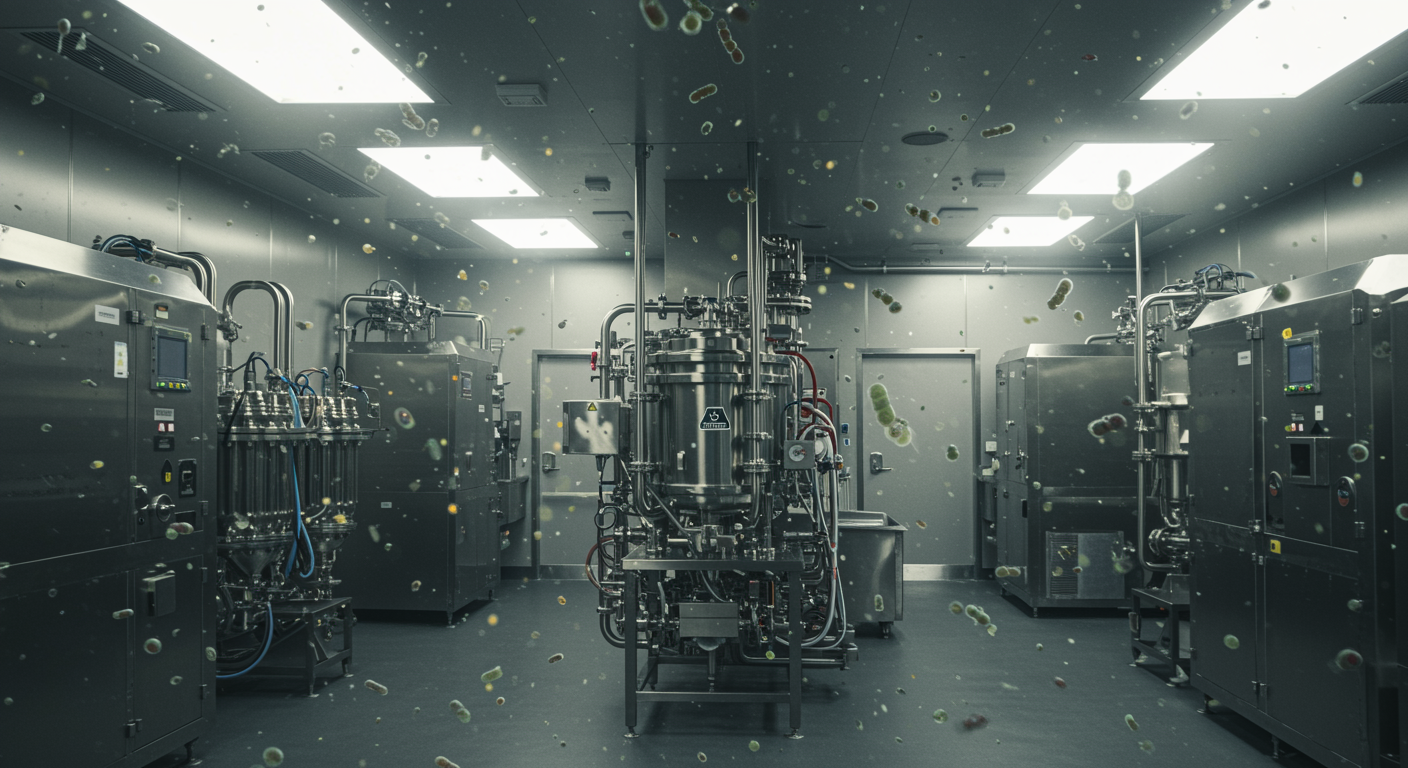
In one typical GMP investigation scenario, a facility noticed repeated high microbial counts on air plates near a lyophilization load port. After extensive environmental tracing, they found local RH drifted above 58% due to adjacent door openings. That let micro-condensation form on a cold flange. Bacteria established biofilms, periodically sloughing off into the air right above open vials.
The remediation? Not just re-sanitizing — they had to temporarily halt production, requalify the line, and install local humidity control to stabilize RH.
Takeaway:
If your environment isn’t held tightly around your dew point margins, even world-class sanitation can’t stop microbes from finding new footholds. The key isn’t more chemical wipes — it’s stopping condensation from ever happening.
Low RH Isn’t Safe Either — It Keeps Airborne Microbes Floating
Many facilities swing the other way, running lower humidity to avoid condensation risks. It’s common to see pharmaceutical suites intentionally kept around 35–40% RH. At first glance, this seems smart: no water films, no bacterial havens.
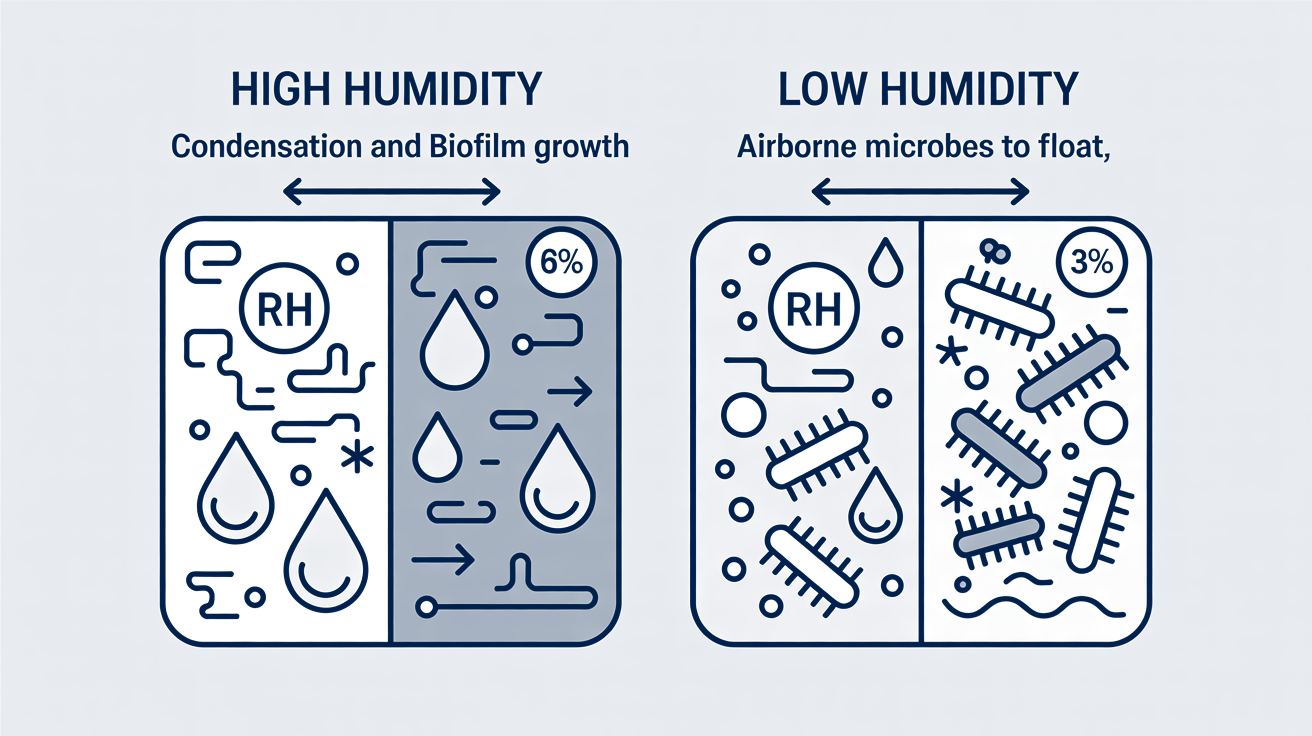
But the problem simply changes shape.
At low RH levels:
- Airborne particles, including microbe carriers, stay lighter and more buoyant.
- They resist settling due to reduced mass and lower cohesion from ambient moisture.
- Even gentle thermal plumes from equipment or human body heat keep them suspended for hours.
That means contamination sources travel farther. A spore that might normally settle harmlessly to the floor instead drifts over to a stopper hopper or fill nozzle, where it lands directly on your product path.
Worse, low RH is notorious for fueling static build-up. This means:
- Gowns, polymer tubing, PET trays, and even stainless fill machine components accumulate electrostatic charges.
- These charged surfaces actively pull airborne particles toward them.
- That includes the bacteria or mold spores you worked so hard to filter out with your HVAC.
This is why regulatory inspectors increasingly look not just at your differential pressures and particle counts, but your RH logs too. A record that shows frequent dips under 40% RH becomes a glaring question mark in your sterility assurance documentation.
Takeaway:
Stable humidity isn’t just about avoiding condensation. It’s about balancing air mass so microbial carriers settle out — instead of floating indefinitely and finding their way into your critical process zones.
Smart Fog: Stopping Microbial Risks by Controlling RH & Air Physics
Smart Fog solves these twin threats — condensation and airborne microbe suspension — by precisely managing humidity right inside your cleanroom environment. Unlike HVAC systems that try to brute-force humidity by overcooling or reheating, Smart Fog works at the process level.
Ultra-fine dry fog for exact RH
Smart Fog systems generate ultra-fine droplets (under 4.2 microns), which evaporate instantly in air. This means:
- No wetting of surfaces or equipment.
- Immediate adjustment to local RH, even if doors open or process heat loads change.
- Tight control — usually within ±2% of your target range.
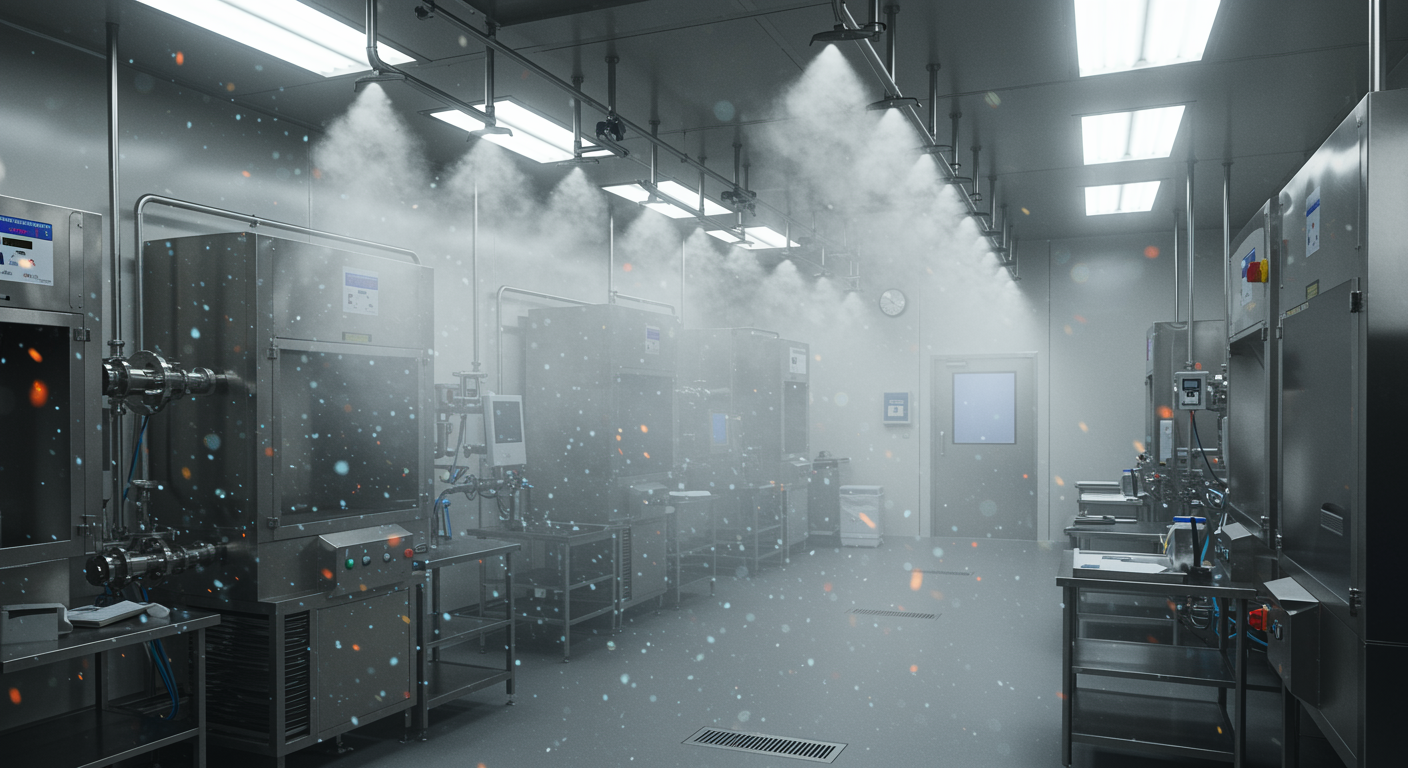
By maintaining stable RH, you:
- Stay well below condensation thresholds on even your coldest metal or glass process surfaces.
- Keep biofilm risks minimal, eliminating moisture microfilms that bacteria love.
Natural ionisation for added protection
But Smart Fog goes beyond humidity. As these micro-droplets shear through air, they generate natural negative ions via the Lenard Effect. These ions disperse through your cleanroom, doing critical double-duty:
- Neutralize static charges on gowns, packaging films, fill line plastics. That stops charged surfaces from pulling airborne microbe carriers out of the air.
- Cause small particles to clump together. These heavier agglomerates settle out faster, instead of floating for hours.
The result is an environment where bacteria and spores either fall harmlessly to the floor — where your routine cleaning removes them — or simply never land on your critical fill zones in the first place.
Zero ozone, zero chemical residue
Smart Fog’s approach is entirely physical — relying on water and natural ionisation. It’s UL 2998 certified for zero ozone, protecting your sensitive APIs, excipients, and regulatory compliance records. There are no byproducts that might compromise batch stability or require extra documentation.
This is why top pharmaceutical plants globally trust Smart Fog in everything from sterile fill suites to packaging prep areas. It proactively stops the physics that make microbial contamination possible, all while simplifying your QA records with stable RH trends and static control logs.
The ROI: Fewer Holds, Fewer Investigations, and Lower Energy Costs
When pharmaceutical plants invest in Smart Fog, they often start with quality in mind: protect sterile fills, reduce contamination hits, improve audit standing. But the financial paybacks are often even more compelling.
Reduced QA investigations and holds
Every sterility test failure triggers a cascade of cost:
- Immediate lot holds, tying up valuable inventory.
- Extended QA and root cause teams diving through environmental monitoring logs, equipment cleaning records, and operator workflows.
- Possible full lot destruction if contamination can’t be definitively ruled out.
These processes consume thousands of staff hours annually and can block millions in product from shipping. By proactively stabilizing humidity and preventing condensation or static-driven particle attraction, Smart Fog cuts these investigations at the source.
Lower energy bills and longer HVAC life
Because humidity is managed directly inside the process space, your HVAC no longer needs to overcool to drop out moisture and then reheat — a cycle that burns enormous energy.
Facilities typically see:
- 10–20% reductions in HVAC electrical loads.
- Smoother compressor operation, reducing short cycles that damage equipment.
- Longer intervals between major capital replacements (fans, chillers, compressors).
These savings alone often deliver ROI inside 12–18 months, before even accounting for reduced QA labor costs or batch hold risks.
FAQs: What Pharmaceutical Teams Ask About Humidity & Microbial Contro
Will Smart Fog make my fills or vials wet?
No. Droplets are under 4.2 microns and evaporate immediately. They stabilize humidity in the air itself, never wetting surfaces or packaging.
Is it validated for sterile environments?
Yes. Used globally in ISO Class 5–8 environments, with full certifications showing zero ozone and no chemical residues.
How does it impact HVAC?
It complements your existing systems, dramatically reducing the humidity load they need to manage. This means HVAC focuses on temperature and pressure, with less wear and lower energy use.
Can we log RH & ion data for audits?
Absolutely. Smart Fog integrates with your BMS, feeding continuous RH and static control trend data directly into your GMP logs. This simplifies audit prep and helps quickly satisfy regulatory questions.
Conclusion — Control Your Air, Protect Your Batches, Safeguard Your Brand
Your pharmaceutical facility runs on trust: trust from regulators that you meet every sterility standard, trust from buyers that your product will perform in patients without contamination concerns, and trust from your own board that quality never compromises brand reputation.
But without tight humidity control, you’re quietly gambling with every lot. Small RH drifts create micro-condensation that shelters bacteria. Low humidity lets spores float for hours, or static charges pull them right onto critical fills.
Smart Fog fixes this at the source:
- Holding RH within ±2% to eliminate moisture films on cold surfaces.
- Neutralizing static so your gowning and packaging don’t become contamination magnets.
- Causing airborne microbe carriers to clump and fall out of circulation — before they ever reach your stopper bowls or sterile seals.
- It’s how the world’s leading pharmaceutical brands protect every batch, every audit, and every patient.
[Book a Smart Fog assessment and see how precise humidity pays you back — in fewer holds, lower energy bills, and stronger compliance confidence.]