 Made in USA

- Dry fog dust suppression works by generating self-evaporating droplets sized to collide with and agglomerate respirable dust particles, causing them to settle out of the air column rather than remain breathable airborne particulate matter.
- OSHA's permissible exposure limit for respirable crystalline silica is 50 µg/m³ as an 8-hour time-weighted average under 29 CFR 1910.1053, establishing the regulatory floor that industrial dust control systems must meet and document.
- Dry fog dust suppression does not increase material moisture content under proper system design, which is a direct operational advantage in mining, aggregate, and grain handling where over-wetting creates downstream process problems.
- Smart Fog's proprietary nozzle produces an equal-sized droplet grid where each droplet carries a slight electrical charge, preventing re-aggregation and maintaining even droplet distribution through the air column.
- Dry fog systems produce no liquid runoff or secondary waste slurry, which simplifies waste handling compared to wet suppression or water cannon systems that require drainage management.
- Smart Fog dust suppression systems have no moving parts in the humidification process, with maintenance intervals designed to extend up to two years, reducing total ownership burden in continuous industrial operation.
How Dry Fog Dust Suppression Works
Effective dust suppression depends on matching the droplet to the particle. Droplets that are too large fall before intercepting fine respirable particles. The self-evaporating droplets produced by dry fog dust suppression systems are sized to remain suspended long enough to collide with the fine particle fractions that pose the greatest health and regulatory risk. On contact, the particle agglomerates onto the droplet, increasing its mass until gravity removes it from the breathing zone. This process has a useful side effect for waste handling:- Agglomerated particles settle to the ground or are removed through standard housekeeping
- Because droplets evaporate on contact with air rather than accumulating on surfaces, captured material does not become liquid waste or slurry
- This is an operationally important distinction for facilities comparing dust control system options, where secondary waste handling adds cost and compliance burden
Why Droplet Distribution Matters for Capture Efficiency
A system producing droplets of unequal size is less efficient because large droplets fall too quickly to intercept fine particles, while oversized droplets increase surface wetting risk. Uneven distribution concentrates moisture unevenly across the air volume, reducing collision probability at the points where dust generation is highest. An equal-sized droplet grid ensures consistent coverage through the full air column at the dust generation point, maximizing particle-droplet contact without accumulating moisture on any single surface.What Happens to Captured Particles
Once a droplet captures a particle, the agglomerated mass becomes heavy enough to drop out of the air column and settle. Settled material is removed through standard floor cleaning and routine housekeeping. The process generates no slurry and no contaminated liquid requiring drainage or treatment, which is a practical advantage over wet scrubbing systems that produce liquid waste streams requiring separate management.Regulatory Compliance Drivers: OSHA, EPA, and MSHA
Industrial dust suppression procurement is rarely discretionary. For EHS officers and operations managers, the regulatory framework establishes the minimum performance standard that any dust control system must meet, and compliance documentation is a procurement requirement, not an optional feature. Three regulatory frameworks govern most industrial dust suppression obligations:- OSHA: the respirable crystalline silica standard, 29 CFR 1910.1053, sets a permissible exposure limit of 50 µg/m³ as an 8-hour time-weighted average for general industry workers
- MSHA: enforces separate exposure limits for coal dust and metal/nonmetal operations under 30 CFR Parts 70 and 71, with action levels for respirable coal dust set at 1.5 mg/m³
- EPA: the National Ambient Air Quality Standards (NAAQS) under the Clean Air Act set PM2.5 limits at 12 µg/m³ annual mean and 35 µg/m³ over 24 hours, with PM10 capped at 150 µg/m³ over 24 hours
OSHA's Hierarchy of Controls and Engineering Solutions
OSHA's hierarchy of controls places engineering controls above administrative controls and personal protective equipment as the preferred method of hazard reduction. Engineering controls address the hazard at the source rather than relying on worker behavior or respiratory equipment. Dry fog dust suppression qualifies as an engineering control, which matters for recordkeeping, compliance documentation, and audit outcomes. A facility that documents engineering controls demonstrates regulatory good faith more effectively than one relying primarily on PPE.EPA Fugitive Dust Emissions and Ambient Air Quality Standards
Fugitive dust from industrial operations is a regulated emission source under Clean Air Act Title V and applicable state implementation plans. Dry fog dust suppression at transfer points, outdoor stockpiles, and bulk material handling enclosures can support environmental compliance by reducing particulate emissions at the generation point. For facilities in designated non-attainment areas, demonstrating control at generation points can be a condition of operating permits.Dry Fog vs. Wet Suppression, Chemical Fogging, and Dust Collectors
Procurement managers evaluating industrial dust suppression need honest trade-off data across the full range of available approaches. The comparison below covers four technology types across the dimensions that most directly affect total cost of ownership and operational burden. Water consumption:- Dry fog dust suppression: Droplets are sized to evaporate rather than accumulate, producing significant water consumption reduction compared to volume-based suppression methods.
- Wet suppression / water cannon: Delivers large volumes of water that run off and require drainage infrastructure and management.
- Chemical fogging: Adds chemical material and disposal cost on top of water consumption.
- Baghouse / dust collector: Uses no water, but consumes energy continuously and requires filter replacement.
- Dry fog dust suppression: Does not wet material surfaces under proper system design, leaving material moisture content unchanged. Note: direct exposure to the fog stream will wet the surface; this applies to any strong non-wetting claim.
- Wet suppression / water cannon: Wets both the dust and the material, increasing bulk material moisture content, which can create downstream process problems.
- Chemical fogging: Deposits chemical agents on surfaces and materials in addition to moisture.
- Baghouse / dust collector: Does not contact material surfaces.
- Dry fog dust suppression: Produces no liquid runoff or slurry; settled particles are removed by standard housekeeping.
- Wet suppression / water cannon: Produces contaminated water requiring collection, drainage, and disposal management.
- Chemical fogging: Produces chemically contaminated waste requiring regulated disposal.
- Baghouse / dust collector: Produces collected dry particulate requiring disposal per applicable waste regulations.
- Dry fog dust suppression: No moving parts in the humidification process; maintenance intervals designed to extend up to two years.
- Wet suppression / water cannon: Requires regular pump, nozzle, and drainage system maintenance.
- Chemical fogging: Requires chemical handling, nozzle maintenance, and chemical replenishment.
- Baghouse / dust collector: Requires frequent filter changes and fan and motor maintenance.
When Dry Fog Is the Right Choice
Dry fog dust suppression delivers the strongest technical fit in enclosed or semi-enclosed spaces with defined dust generation points: conveyor transfer points, crusher discharge, loading areas, and bulk handling enclosures. It is particularly appropriate where material over-wetting is operationally unacceptable, where liquid runoff would create additional regulatory or housekeeping burden, and where a low-maintenance engineering control is required for continuous operation. Facilities with outdoor open-air dispersal and no defined generation point will face greater system design complexity, which should be evaluated before specifying.Limitations to Evaluate Before Specifying
Very high air velocity environments reduce droplet residence time, which can lower dust suppression efficiency at the generation point. Extremely high ambient temperatures affect evaporation dynamics and should be accounted for in system design. Where a baghouse is already installed and correctly sized, dry fog at the generation point can complement rather than replace the collector by reducing the particulate load entering the collection system.Industrial Applications: Where Dry Fog Dust Suppression Is Used
Mining and aggregate operations
Dry fog suppression at the point of generation intercepts airborne particulate before it enters the breathing zone.- Transfer points, conveyor discharge, crusher rooms, and outdoor stockpiles are the primary generation points
- Subject to MSHA and OSHA silica permissible exposure limits as low as 50 µg/m³
- Over-wetting is a genuine process problem here: excess moisture affects material weight, handling, and downstream processing
- A system that suppresses without increasing material moisture content addresses both the regulatory and process constraints at once
Bulk material handling and warehousing
Dry fog systems positioned at transfer points intercept dust before it disperses into the building volume.- Loading docks, grain elevators, and conveyor belt dust control points are the main generation points
- Fugitive dust accumulates on surfaces and in building air volumes if uncontrolled
- OSHA General Industry standards apply here, not MSHA
- Reduces both occupational exposure and the surface contamination that requires housekeeping intervention
Electronics and semiconductor manufacturing
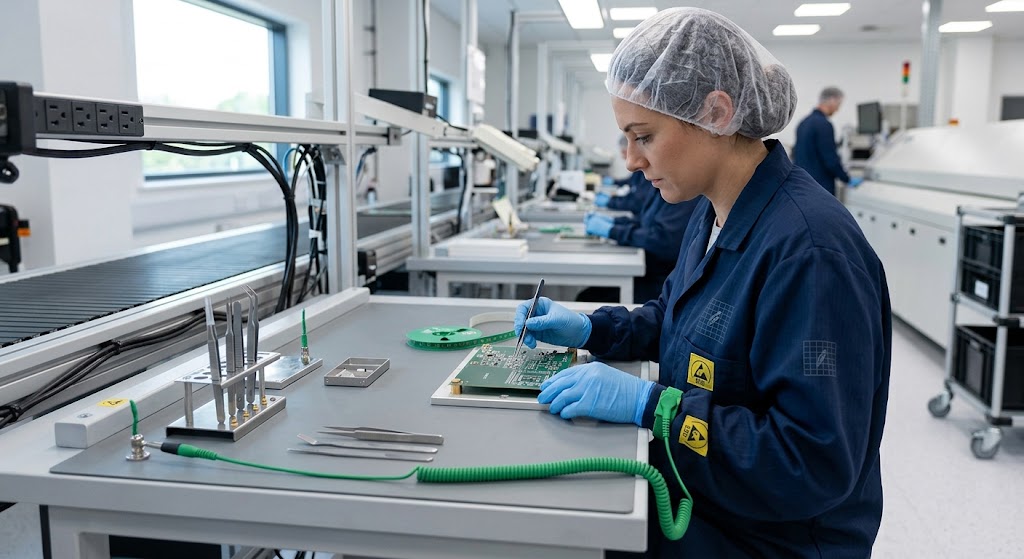
Dry fog suppression in surrounding or transitional environments reduces airborne particulate matter without surface moisture risk.- Contamination sources include construction infiltration, HVAC ingress, and material handling
- Particle contamination at this scale can damage sensitive components
- Surface wetting is not acceptable in these environments
Pharmaceutical and biotech manufacturing
Dust control at API generation points supports two compliance needs at once.- Active pharmaceutical ingredient (API) dust presents occupational exposure and cross-contamination risks
- Supports OSHA permissible exposure limit compliance
- Supports Good Manufacturing Practice (GMP) documentation
Food processing
Dry fog dust suppression here is applied narrowly.- Facilities handling grain, flour, and fine organic materials face respiratory hazard and combustible dust obligations under NFPA 61
- Smart Fog does not make explosion suppression claims
- Application is limited to airborne particulate reduction supporting OSHA housekeeping and occupational exposure control requirements
Mining and Aggregate: Suppression at Transfer Points and Crusher Discharge
Transfer points and crusher discharge are the highest-intensity dust generation points in mining and aggregate operations. These are also the environments where MSHA enforcement and OSHA silica compliance documentation are most actively reviewed. A dust control system configured at these specific generation points, rather than deployed as room-level dilution, delivers targeted suppression where airborne concentrations peak and where engineering control documentation is most directly relevant to compliance outcomes.Warehousing and Bulk Material Handling
Enclosed industrial spaces handling powdered materials, grain, or fine aggregates accumulate fugitive dust on racking, equipment, and floors. OSHA General Industry standards under 29 CFR 1910 govern these environments. Conveyor belt dust control at defined transfer points, combined with room-level suppression where required, reduces both occupational exposure and the housekeeping burden associated with settled particulate on equipment and surfaces.How Smart Fog's Dust Suppression Systems Are Engineered
Producing an equal-sized droplet grid where every droplet carries a slight electrical charge is the operating principle that separates effective dry fog dust suppression from conventional fogging approaches. The charge prevents re-aggregation, keeping droplets evenly distributed through the air column rather than clumping. Because every droplet in the grid is the same size, the system does not produce a mix of oversized droplets that fall and wet surfaces alongside undersized droplets that lack the mass to agglomerate heavier particles. The entire output is optimized for suppression efficiency across the target particle size range. The industrial humidification systems that form the basis of Smart Fog's dust suppression configurations are built for continuous operation without the mechanical complexity that drives maintenance cost in competing approaches. Facilities evaluating on choosing Smart Fog will find the no-moving-parts design particularly relevant to total cost of ownership in demanding dust environments. Under proper system design, Smart Fog dust suppression does not wet surfaces or material. Direct exposure to the fog stream will wet the surface, and this caveat applies to any strong non-wetting claim.System Configuration and Installation
Smart Fog designs and delivers complete engineered systems, not component kits assembled on-site. For dust suppression applications, systems can be configured at specific generation points such as conveyor transfer points, crusher discharge, and loading areas, or deployed as room-level suppression using MS100 custom grid humidification systems for larger enclosed environments. No certified technician is required for installation, which reduces commissioning cost and timeline compared to systems requiring specialized labor.Maintenance, Water Use, and Operational Continuity
The operational characteristics of Smart Fog dust suppression systems are directly relevant to facilities comparing total cost of ownership for a control system running continuously in a demanding environment.- Moving parts: No moving parts in the humidification process, eliminating the mechanical wear points that drive unplanned maintenance in pump-intensive or fan-driven systems.
- Maintenance intervals: Designed to extend up to two years, compared to more frequent service requirements for filter-based or wet suppression systems.
- Water efficiency: Every drop introduced into the air evaporates or agglomerates onto a particle. No runoff is generated, and no drainage infrastructure is required.
- System completeness: The full engineered system is delivered by Smart Fog, not assembled from third-party components, ensuring the design intent is maintained through installation and commissioning.