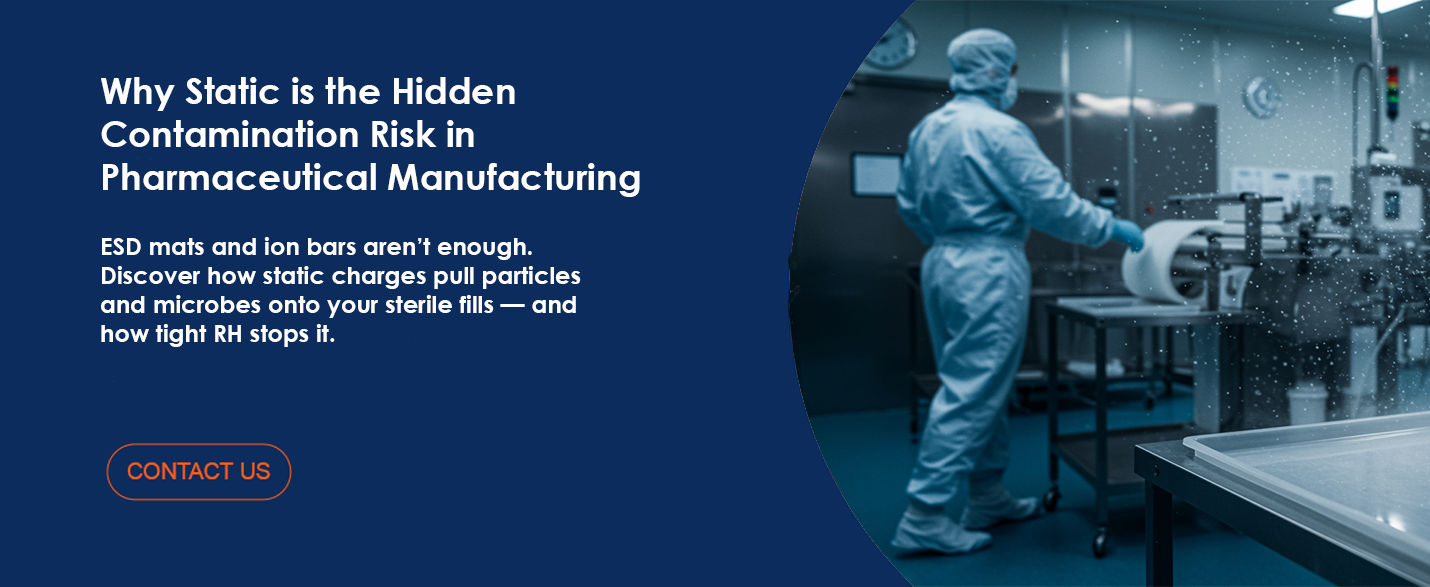
Introduction — The Overlooked Problem: Static in Pharma
When most pharmaceutical facilities talk about static, it’s usually framed around electronics: how to protect automated inspection cameras or keep PLC cabinets safe. In fact, many teams assume that because they’ve installed ESD mats, ion bars on certain lines, and rigorous gowning protocols, static is “handled.”
The truth? Static is one of the most overlooked contamination vectors in modern pharmaceutical manufacturing.
It’s not just about electrical discharge damaging circuits. In cleanrooms, static charges:
- Literally pull airborne particles out of the air. That means dust, fibers, and micro-droplets that might carry microbes.
- Attach them to gowns, fill heads, stoppers, or syringe barrels — right where sterility matters most.
Worse, static problems usually don’t show up in your particle counter logs or routine HVAC checks. That’s because:
- Air quality monitors sit far from many critical surfaces.
- Static problems happen on moving parts — rotating star wheels, stopper bowls, carton chutes — not on stationary HVAC sampling probes.
So your QA logs look clean, right up until a sterility test flags contamination or a customer complaint reveals visible fibers in a finished vial.
In this guide, we’ll show why static is actually a major root cause of contamination in sterile manufacturing, how most “fixes” like ion bars and conductive floors barely scratch the surface, and why stable humidity is the only reliable way to break the physics that drive static risk.
How Static Actually Works — And Why It’s a Contamination Magnet
Most operators think of static in simplistic terms — that dreaded zap when you touch a doorknob after walking across carpet. In reality, static in cleanrooms is more dangerous and harder to spot.
The physics of charged surfaces
Any time dissimilar materials move past each other, electrons get stripped off one surface and accumulate on another. This is called the triboelectric effect. It happens constantly in pharmaceutical plants:
- Syringe barrels sliding down PET or polycarbonate chutes.
- Operators moving across slightly resistive resin floors, even with ESD shoes.
- Packaging films unwinding at high speed off rolls.
These surfaces become charged. Unlike grounded equipment, they hold that charge, creating invisible electrostatic fields.
Charged surfaces pull particles
When a charged surface sits in a cleanroom, it doesn’t just wait to zap someone. It actively attracts oppositely charged particles floating nearby. This is critical because:
- Airborne particles — dust, fibers, microbe-laden droplets — often carry slight static charges themselves, from bouncing off duct walls or moving past other surfaces.
- When they drift near a charged gown, stopper bowl, or fill needle, they’re pulled in like iron to a magnet.
This is why you sometimes see unexplained fibers or micro-particles on otherwise well-maintained lines. They’re not “falling out of dirty air.” They’re being pulled out by physics, right onto your critical sterile surfaces.
The microbial angle
Even worse, many of these particles are biological carriers. Bacteria or fungal spores frequently hitch rides on dust motes or fibers. That means static isn’t just a dust risk — it’s a direct contamination vector that could undermine your sterility assurance level (SAL).
In one sterile syringe line investigation, repeated non-viable particle excursions were traced back to static build-up on PET trays. Despite perfectly filtered air, fibers were literally pulled off operator gowns and onto stopper seats by these trays’ hidden charges.
Why ESD Mats & Ion Bars Don’t Solve Your Real GMP Problem
Facilities often try to mitigate static by installing:
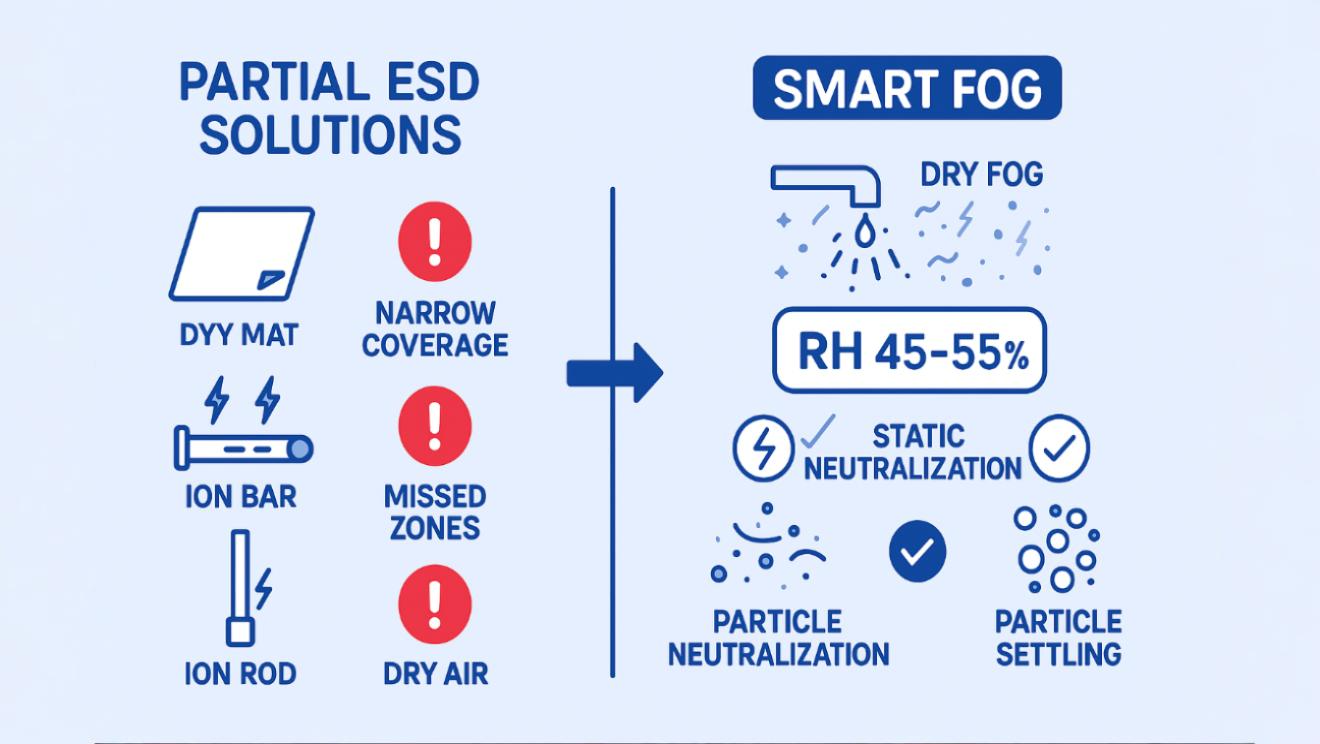
- ESD floors and heel grounders: These reduce static build-up from operator walking but do nothing for moving parts or packaging films.
- Ion bars: These neutralize static in narrow zones, typically a few inches wide, requiring direct line-of-sight.
- Grounding rods: Good for metal contact points, but useless for polymers or gowns.
The problem of local-only fixes
Static isn’t confined to a single spot. It builds wherever materials rub, move, or separate. That means:
- A grounded operator can still load charged PET nests into a machine.
- Ion bars only treat a tiny cross-section of your process path. If packaging films pick up charge two feet upstream, by the time they reach your fill heads, they’re already attracting particles.
RH is the only environment-wide control
Humidity is what changes the physical behavior of static. At RH levels above ~45–50%:
- Water molecules naturally adsorb into polymer surfaces and airborne particles.
- This makes materials slightly conductive, letting charges dissipate harmlessly instead of building up.
- It also makes particles heavier, more likely to settle than drift into charged zones.
This is why static problems spike in winter or dry climates — your cleanroom might hit 35% RH, driving charges that overwhelm your local ESD “fixes.”
Takeaway:
Static control mats, bars, and rods all help, but only in limited zones. The only way to prevent static from becoming a facility-wide contamination magnet is to keep your entire environment inside tight RH windows.
How Smart Fog Controls Static at the Environment Level
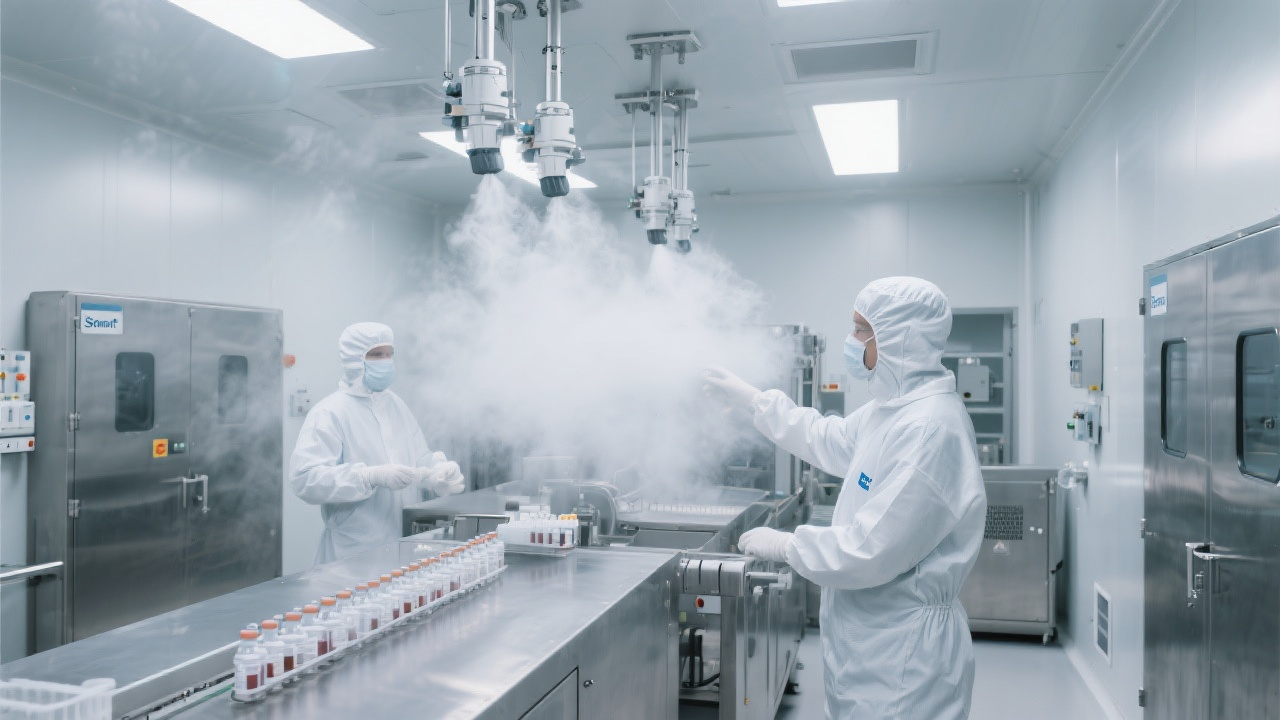
Smart Fog takes a fundamentally different approach by stabilizing humidity across your entire cleanroom space, breaking the physical chain that allows static to build and pull contaminants.
Ultra-fine humidity control
Smart Fog systems produce droplets under 4.2 microns. They evaporate instantly in air, raising relative humidity with zero surface wetting. This keeps your cleanroom consistently in the 45–55% RH range, which physics has long shown to be the sweet spot for static suppression.
- At this RH, polymer surfaces adsorb tiny amounts of water vapor, becoming slightly conductive.
- Charges dissipate harmlessly instead of building to dangerous potentials.
- Airborne fibers and micro-particles gain mass from ambient moisture, making them less prone to floating indefinitely or jumping to charged surfaces.
Room-wide ionisation
But Smart Fog does more than just humidity. As these micro-droplets shear through the air, they naturally generate negative air ions via the Lenard Effect. These ions spread through your process zone, doing critical double-duty:
- Neutralizing residual static on surfaces that might otherwise build hidden charges.
- Causing airborne particles to cluster, making them too heavy to stay aloft — so they settle harmlessly on floors to be picked up by your standard cleaning protocols.
Unlike ion bars that only treat narrow conveyor segments, this happens across your entire cleanroom, every cubic meter under the same protection.
Zero ozone, zero residues
Older ionisation systems sometimes introduced ozone, a direct risk to sensitive APIs and long-term GMP compliance. Chemical anti-stats often left residues that complicated cleaning validations. Smart Fog avoids all this by relying solely on de-ionised water and air physics, certified under UL 2998 for zero ozone production.
The Financial & Compliance Payoff: Fewer QA Surprises, Lower Energy, Longer HVAC Life
Many facilities initially consider Smart Fog to help pass audits or reduce contamination holds. But the financial case quickly becomes overwhelming.
Lower energy and maintenance costs
Because Smart Fog stabilizes humidity right inside your process space, your HVAC systems no longer have to overcool to condense out moisture and then reheat. This means:
- Compressors and fans run smoother, at partial loads.
- Energy bills drop by 10–20% on average, delivering six-figure savings annually for most pharma campuses.
- HVAC components last longer. That means fewer emergency maintenance calls, fewer forced shutdowns, and multi-year deferrals on multi-million-dollar equipment replacements.
Easier audits & stronger buyer confidence
With Smart Fog, you also log stable RH trends and ion levels directly into your BMS. Auditors see tight humidity ranges, reduced static risk, and fewer particle excursions. This makes passing GMP inspections faster and helps you avoid costly post-inspection remediation programs.
It also builds buyer trust. Many major pharma brands and contract manufacturing organizations (CMOs) now assess environmental control records as part of supplier qualification. Stable humidity and documented static control can become a direct competitive advantage that keeps your lines running — and your contracts secure.
FAQs: What Facilities & QA Managers Always Ask
Will Smart Fog make my surfaces or vials wet?
No. Droplets are smaller than 4.2 microns and evaporate instantly. Surfaces stay dry, protecting both sterile fills and sensitive electronics.
Is it validated for sterile manufacturing?
Yes. Used globally in ISO 5–8 environments, Smart Fog is fully documented for GMP compliance with zero ozone or chemical residues that could compromise product stability.
How does it tie into our existing controls?
Smart Fog integrates with your BMS, providing continuous RH and ion data that you can trend just like differential pressures or particle counts. This makes audit prep far simpler.
Does this replace my ESD controls?
No — it complements them. Smart Fog stabilizes the overall environment, ensuring local measures like mats and ion bars don’t have to fight an uphill battle against dry, charge-prone air.
Conclusion — Your GMP Confidence
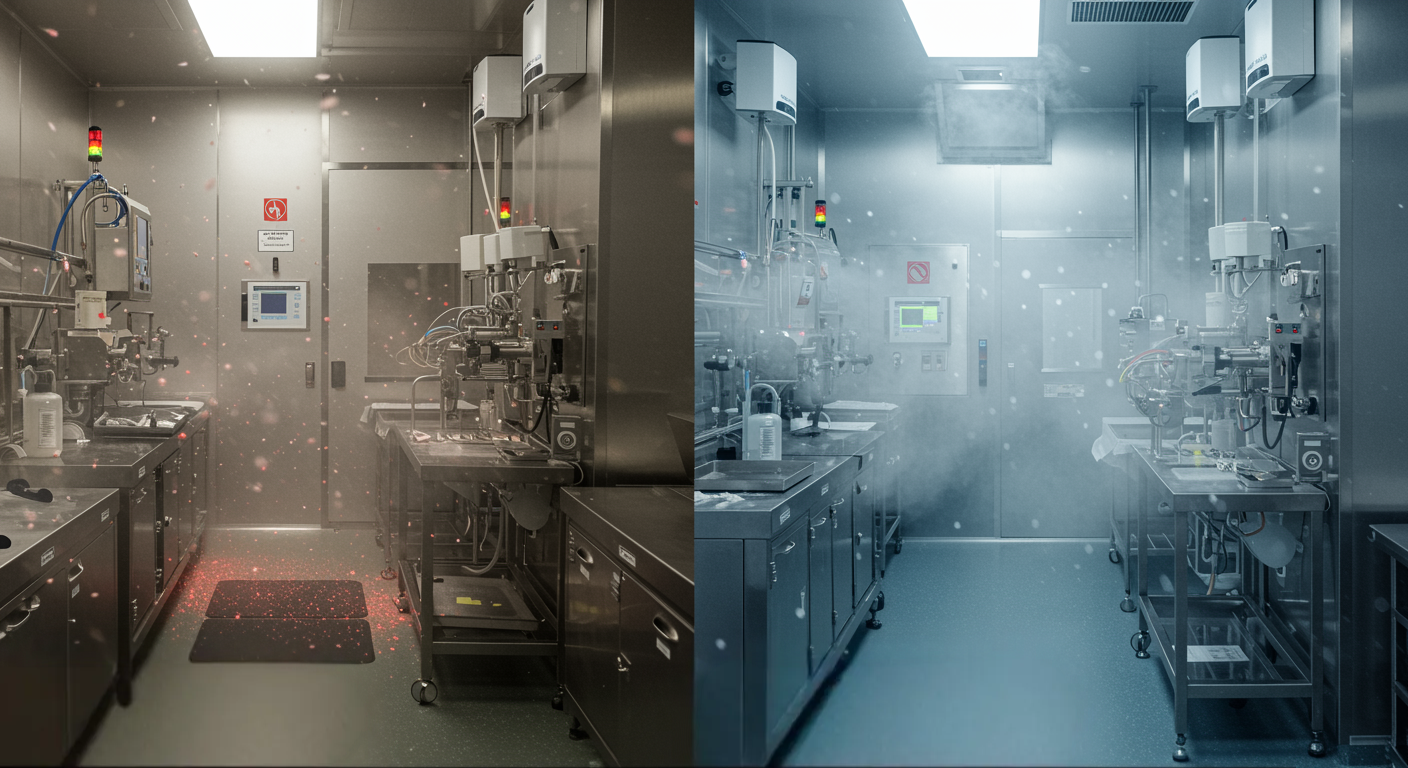
Your pharmaceutical plant is engineered for sterility: stainless fill heads, rigorous gowning, validated HVAC air changes. But if humidity isn’t controlled precisely, your entire process environment becomes a hidden static trap.
- Dry air allows charges to build on gowns, packaging trays, and fill line polymers.
- Those charges actively pull airborne particles — some carrying bacteria or mold spores — onto your critical sterile surfaces.
- Meanwhile, local ion bars and floor mats can’t cover every cubic meter.
Smart Fog changes this.
By holding your environment in the ideal RH range and flooding your process zones with natural negative ions, it stops static from forming, neutralizes existing charges, and ensures particles settle harmlessly. That means:
- Fewer contamination-related QA investigations.
- Fewer emergency HVAC cycles chasing RH swings, saving you power and wear.
- Easier audits, with documented environmental controls that prove you’re safeguarding your sterility assurance levels.
[Book a Smart Fog assessment today and see how stable humidity pays you back — in fewer QA headaches, lower energy bills, and every sterile batch that leaves your door.]