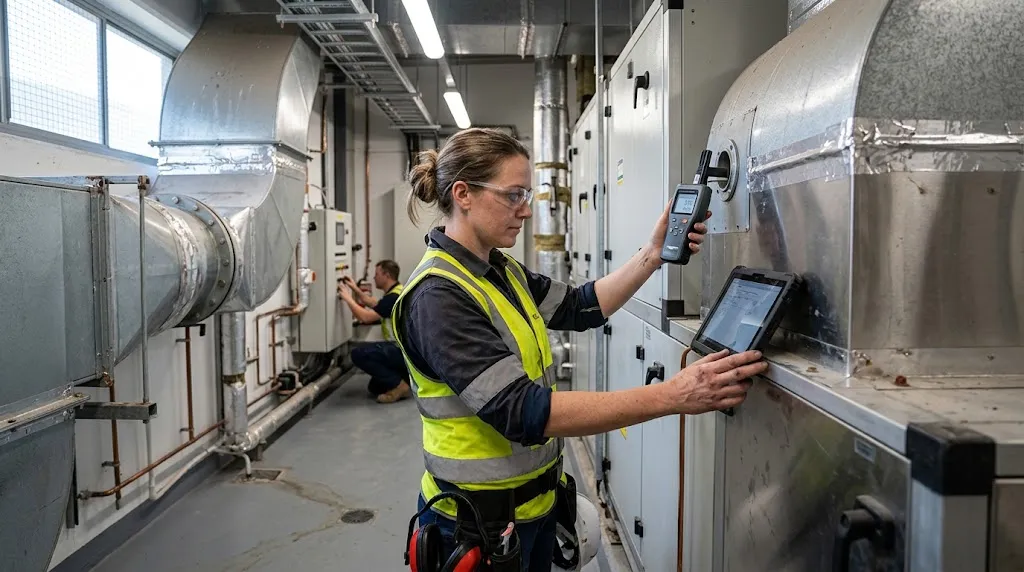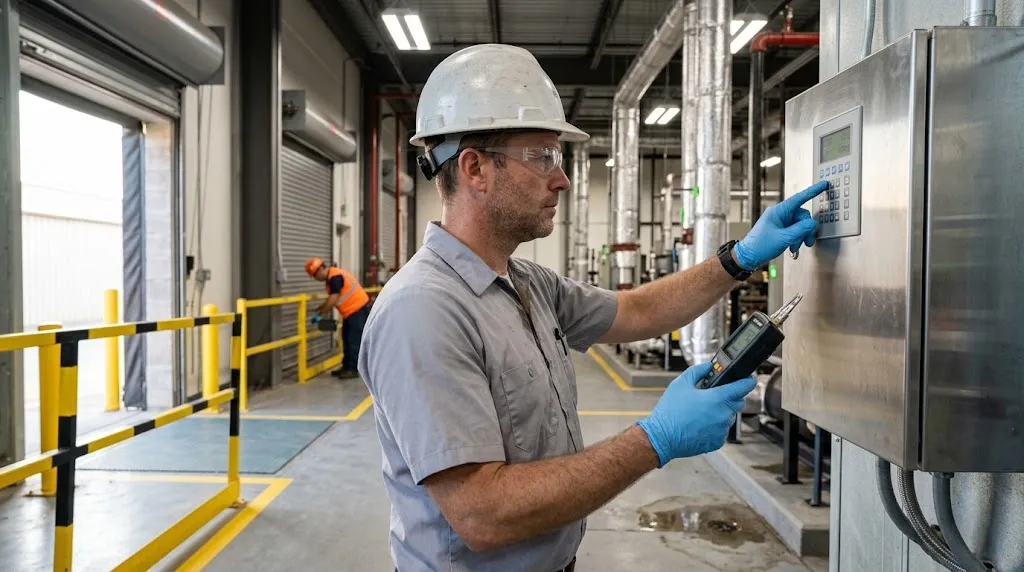


- Humid air usually rises because it is less dense than dry air at the same temperature.
- Relative humidity can still read higher near floors or basements because cooler air increases RH.
- Upper floors often feel more humid because warm air and moisture collect higher in the building.
- Large facilities can develop humidity stratification between floor and ceiling.
- Uniform humidity requires proper airflow, sensor placement, and engineered humidification systems.
Does Humidity Rise or Fall? The Short Answer
At the same temperature and pressure, humid air tends to rise because water vapour is lighter than the main gases in dry air. That basic rule is true, but indoor humidity patterns still depend on temperature, airflow, and how well the space is mixed.Why Water Vapour Makes Air Lighter
Dry air is made up mostly of nitrogen and oxygen. Nitrogen has a molecular weight of about 28, oxygen about 32, while water vapour is about 18, so when water vapour replaces some of those heavier gases, the air becomes less dense. That lower density makes humid air more buoyant than dry air under the same conditions. In simple terms, if two air masses have the same temperature and pressure, the more humid one is lighter and tends to move upward.Why This Feels Counterintuitive
The idea feels backward because people usually connect water with weight. Since liquid water is heavy, it seems natural to assume that adding moisture to air should make the air heavier too. But humidity in air is not liquid water sitting inside the air. It is water vapour mixed with gases, and that vapour is lighter than the nitrogen and oxygen it displaces, which is why humid air tends to rise instead of sink.Relative Humidity vs Absolute Humidity: Why the Answer Gets Complicated
Humid air can rise in physical terms, but humidity readings do not always rise with it in a simple way. That is because relative humidity changes with temperature, while actual moisture content may stay the same.How Temperature Changes RH Without Adding or Removing Moisture
Relative humidity shows how close the air is to saturation at a given temperature. When air warms up, it can hold more water vapour, so the RH drops even if no moisture has been added or removed. When air cools, its moisture-holding capacity falls, so the RH rises even if the actual amount of water vapour stays unchanged. That is why the same air can show one RH reading near a warmer ceiling area and a higher RH reading near a cooler surface lower in the room.Why RH Can Be Higher at Floor Level Without More Moisture Being Present
Floor-level air is often cooler than air higher in the room, especially in basements, crawl-adjacent areas, or spaces with poor mixing. Since cooler air reaches saturation more easily, RH can read higher there even when the actual moisture content is not higher. Here is the difference in simple terms:- Cooler floor-level air can show a higher RH reading.
- Warmer upper-level air can show a lower RH reading.
- The actual moisture content may still be the same in both areas.
- RH changes because temperature changes the air’s moisture-holding capacity.
- A higher RH near the floor does not always mean more moisture is present there.
How Humidity Moves in Buildings and Indoor Spaces
Humidity does not move evenly through a building because air temperature, airflow, and building structure all affect where moisture collects. In real spaces, the answer is rarely just that humidity rises or falls, because different moisture mechanisms can exist at the same time.Humidity Stratification: Why Levels Differ Between Floor and Ceiling
Indoor air does not always mix evenly, especially in taller rooms, multi-level spaces, or areas with weak circulation. Warm air tends to rise, and when that air carries more water vapour, moisture conditions can become different at floor level and ceiling level. This creates humidity stratification, where conditions vary by height instead of staying uniform throughout the room, which is why air distribution and humidity stratification in buildings matter in real indoor environments. In practice, that can mean warmer upper air contains more moisture in absolute terms, while lower and cooler air may still show a higher relative humidity reading.Why Upper Floors Are Often More Humid Than Lower Floors
Upper floors often feel more humid because warm air and the moisture moving with it tend to rise through the building. In homes and other enclosed spaces, that upward movement can concentrate heat and moisture on higher levels, especially when airflow is weak or ventilation is uneven. This is often more noticeable during warm weather, when upper floors gain additional heat from the roof or attic area. Without enough air movement to mix conditions evenly, moisture pockets can build up and leave the upper part of the building feeling warmer, heavier, and more humid.Crawl Spaces, Basements, and Ground-Level Moisture
Ground-level moisture behaves differently from buoyant humid air, which is why crawl spaces and basements need separate explanation. In these areas, moisture often enters through damp soil, seepage, wet materials, or vapour diffusion through the building structure, not simply because humid air sinks or rises. Here is how different building areas usually contribute to moisture movement:- Crawl space: ground evaporation and soil moisture can create a strong upward moisture source.
- Basement: seepage, cool surfaces, and condensation can keep moisture levels consistently high.
- Main living area: cooking, bathing, cleaning, and occupancy usually create moderate but variable indoor moisture.
- Upper floors: rising warm air can carry moisture upward and create accumulation in poorly mixed spaces.
What Humidity Movement Means for Facilities and Controlled Environments
Humidity movement becomes more important in facilities because large spaces are more likely to develop uneven conditions by height and zone. That makes humidity control an engineering issue, not just a comfort issue.Why Humidity Stratification Is a Problem in Large Commercial Spaces
In large commercial and industrial spaces, humidity stratification can create different conditions in different parts of the same room. One area may run too humid, increasing condensation or product risk, while another may run too dry, increasing static risk or affecting material stability. These variations are especially common in warehouses, grow rooms, production areas, and other large-volume environments where air is not mixed evenly. When moisture distribution is uneven, operators cannot assume that one reading represents the full space, and process stability becomes harder to maintain.Where to Place Humidity Sensors in a Facility
Humidity sensors should be placed where they reflect real operating conditions, not where local airflow distorts the reading. Sensors placed too close to supply vents, return paths, doors, exterior walls, or heat-generating equipment can produce readings that do not represent the actual room environment. Here is what good sensor placement usually aims for:- Place sensors in representative occupied or process zones.
- Avoid direct HVAC discharge and localized drafts.
- Avoid immediate proximity to heat sources or exterior thermal influence.
- Measure at more than one height when stratification is possible.
- Compare multiple points instead of relying on a single reading.
Why Uniform Humidity Distribution Requires an Engineered System
Large facilities do not maintain even humidity just because moisture is added somewhere in the building. Uniform control requires the humidity system, airflow pattern, and room geometry to work together so moisture is distributed consistently instead of collecting in high and low pockets. That is why facilities that need reliable environmental control use industrial humidification systems designed around the space itself. In brief, this section is meant to connect engineered distribution with uniform coverage, non-wetting performance, and tight RH control across the full facility rather than at just one point. Here is what an engineered approach is meant to achieve:- More uniform RH from floor to ceiling.
- Fewer stratified pockets of high and low humidity.
- Better alignment with airflow and room geometry.
- More reliable control in large or sensitive spaces.
- Improved consistency for products, materials, and processes.
Where to Place a Humidifier: What the Physics Tells You
Humidifier placement affects how evenly moisture spreads through a space. The goal is not just to add moisture, but to support better mixing, avoid damp pockets, and maintain a more consistent humidity level across the room.Height, Airflow, and Distribution in Residential and Commercial Spaces
A humidifier works best when it is placed where airflow can help distribute moisture instead of trapping it in one area. In residential spaces, that usually means avoiding corners, tight spaces behind furniture, or spots directly against walls where moisture can collect too quickly. For portable units, placement should support open-air movement and steady distribution. Here are the main placement points to follow:- Place the unit on a stable, elevated surface instead of directly on the floor.
- Keep it away from corners and furniture that block airflow.
- Avoid placing it too close to walls, fabrics, or surfaces that can collect excess moisture.
- Do not place it directly beside a strong vent or air stream that disrupts even distribution.
- Use a hygrometer to check whether the room is reaching the intended humidity range.