 Made in USA

- Paper is hygroscopic: when RH drops below 40%, cellulose fibers lose moisture and contract unevenly, producing curl, warping, and brittleness that drives paper feed problems and registration failure.
- Dry air is a poor electrical conductor, so static electricity accumulates on paper stock and cannot dissipate, causing sheet adhesion, multiple-sheet feeds, and electrostatic discharge (ESD) events that interfere with digital press electronics.
- Low humidity accelerates solvent evaporation in ink formulations, shortening the wet-out window on coated substrates and leading to ink adhesion failure, cracking, and mechanical ghosting that repeat at regular intervals in the print.
- Optimal RH for most printing operations is 45 to 55%, but offset lithography, digital toner-based presses, and inkjet processes each carry distinct failure modes and tolerances below that range.
- Winter heating is the primary seasonal driver of critically low RH in print facilities: an HVAC system heating cold outdoor air to indoor temperature can push RH to 15 to 25% without active humidification, as documented in AHRI research on humidifier performance in heating systems.
- A single hygrometer near an HVAC return does not represent conditions at the press. RH variation between zones in a pressroom can exceed 10 to 15%, making multi-point measurement essential for accurate diagnosis.
Why Printing Facilities Are Vulnerable to Low Humidity
Print facilities are structurally exposed to low-humidity conditions in ways that most other industrial environments are not. Large volumes of hygroscopic substrate move through the facility continuously, and both paper and cardboard exchange moisture with ambient air at all times. Any sustained drop in RH draws moisture out of the substrate, and the dimensional consequences appear on press within a single production run.How HVAC Heating Depletes Pressroom Humidity
Cold outdoor air carries very little absolute moisture. When an HVAC humidification systems unit heats that air to indoor temperature without adding moisture, the same amount of water vapor is now spread through a larger volume of warm air, and RH drops sharply. In cold climates, this mechanism routinely pushes indoor RH to 15 to 25% during winter months, well below the 40% minimum at which paper and ink perform within specification. Passive temperature control alone cannot maintain the pressroom environment within safe operating range.Why Paper and Substrates React So Quickly
Paper fibers are cellulose-based and continuously exchange moisture with surrounding air to reach equilibrium. This process is fast enough to produce measurable dimensional change during a pressrun if RH shifts even a few percentage points. Coated stocks and specialty media have different moisture sensitivity profiles than uncoated paper, but all substrate types are affected. Facilities with high ceilings, frequent loading dock door openings, or poorly zoned HVAC face elevated exposure because unconditioned air enters the space and displaces conditioned air near press zones.How Low Humidity Damages Paper and Substrates
Physical damage to paper stock is the most visible consequence of low humidity in a pressroom. The failure modes below are distinct in mechanism and symptom. Press operators can use these descriptions to match what they observe to what the environment is actually doing to the substrate. Paper moisture content also governs ink absorption rate and dot gain, connecting substrate handling failures directly to the ink and color problems covered in the next section.Paper Curl, Warping, and Dimensional Change
When ambient RH drops, moisture evaporates from paper fibers unevenly across a sheet. The side exposed to drier air contracts faster than the opposite side, producing paper curl and warping in a concave pattern toward the dryer side. In multipass offset printing, this curl shifts sheet registration between passes, causing misregistration that is especially visible in tight-tolerance color work. The low humidity causes print quality issues that extend to coated and uncoated stocks equally, though coated papers may show curl at lower absolute moisture loss due to their surface treatment.Electrostatic Buildup and Sheet-Feeding Failures
Static electricity being common in printing rooms is directly tied to ambient moisture. Dry air is a poor electrical conductor, so charge generated by paper movement through a printing press cannot dissipate into the surrounding air. Sheets accumulate charge and attract each other, producing paper misfeeds and jams, multiple-sheet feeds at the feedboard, and ejection errors at delivery. In high-speed digital engines, ESD events from charged paper stock can also interfere with press electronics, triggering faults that appear unrelated to humidity. For more on humidity and static control in industrial printing rooms, maintaining RH above 45% is the most effective preventive measure because it restores air conductivity and allows charge to dissipate before it accumulates on the sheet.How Low Humidity Affects Ink Adhesion and Print Quality
How dry air impacts ink transfer is a mechanism question, not a formulation question. When operators attribute ghosting, fading, or adhesion failure to the ink itself, they often overlook the environmental variable that determines whether any ink formulation can perform within specification: the RH of the pressroom environment at the moment of impression.Ink Drying Rate and Adhesion Failure on Coated Substrates
Ink adhesion depends on the ink remaining fluid long enough to wet the substrate surface before drying begins. Low humidity accelerates solvent evaporation, raises effective viscosity, and shortens ink drying time, reducing the window available for ink to penetrate or bond with the substrate. On coated papers, this results in incomplete ink holdout: ink sits near the surface rather than forming a durable bond, and under folding or finishing operations it cracks or delaminates. On uncoated stock, rapid drying can produce a chalky or faded appearance as ink sits on the fiber surface rather than absorbing into it. Neither defect is caused by ink formulation alone. According to TAPPI paper and substrate moisture research, paper moisture content directly affects ink receptivity, confirming that humidity management is a print quality variable, not just a substrate handling variable.Ghosting, Fading, and Color Inconsistency
Mechanical ghosting is a low-humidity-specific failure mode. When ink dries too quickly on forme rollers between impressions, depleted ink zones repeat at intervals corresponding to roller circumference, producing a ghost image in subsequent prints. Color drift is a related consequence: paper moisture content affects optical density and dot gain, so a press profiled and calibrated at 50% RH will produce measurable color error if RH drops to 30% during a run. For commercial printers working to ISO 12647-2 offset lithography color standard or G7 standards, this color drift is a compliance failure, not simply a quality preference.Humidity Requirements by Printing Process
The generic 40 to 60% RH range cited across the industry is a useful floor, but different printing processes fail in different ways below that range. Facilities running multiple press types need to understand which process sets the most demanding humidity requirement and design climate control in print facilities around that threshold.Offset Lithography
Offset printing operates most reliably between 45 to 55% RH. Fountain solution behavior is humidity-sensitive: when RH drops, water evaporates from the dampening system faster, disrupting the ink-water balance on the plate and affecting ink distribution across the forme rollers. Sheet registration in multipass work also degrades as paper curl and warping increase below 45% RH. The Printing Industries of America identifies pressroom environmental control as a primary variable in achieving consistent lithographic color output across a run.Digital and Toner-Based Printing
Digital toner-based presses require paper moisture content within a specific range for reliable toner fusing. Paper that has lost moisture to dry air becomes stiffer and more resistant to conforming around fuser rollers, which can produce incomplete fusing or toner adhesion failures. Static electricity is a more serious problem in high-speed digital engines than in offset equipment: paper transport systems in these presses depend on precise sheet control, and electrostatically charged sheets cause paper feed problems that trigger false jams and require operator intervention without any apparent press fault. The working RH target for most digital press manufacturers is 45 to 55%.Inkjet Printing
Inkjet processes face a low-humidity failure mode unique to the print head: when ambient RH is low, ink at the nozzle orifice can dry between firing cycles, partially or fully clogging the head. Recovery from clogged heads requires purging cycles that waste ink and extend downtime. In wide-format inkjet, media curl caused by uneven moisture loss is especially damaging because registration tolerances across wide sheet formats are tight. A 2 to 3 mm curl at the lead edge of a wide-format sheet can cause head strikes or substrate-to-head contact, which is a maintenance event with significant cost. The recommended RH range for inkjet is 45 to 55%, with some media manufacturers specifying a tighter 50 to 55% for coated inkjet substrates.Diagnosing Low Humidity as the Root Cause of Print Defects
The symptoms of low humidity overlap with those of press setup errors, ink formulation problems, and substrate defects. Before pursuing corrective actions on press or ink, humidity should be confirmed as either a contributing factor or ruled out. A structured diagnostic approach prevents misattributed corrective actions that waste time and do not resolve the underlying cause.Observable Symptom Checklist
Press operators can work through the following checklist to assess whether low humidity is a likely root cause of observed print quality issues:- Static shock events increase during winter months or following HVAC system changes, without any change in press settings or substrate.
- Multiple-sheet feeds increase at the feedboard without any press adjustment or change in paper stock.
- Paper curl direction is consistent with the heated-air side of the sheet, pointing toward dryer zones in the pressroom.
- Ink adhesion failures are more frequent on coated stock runs than on uncoated stock under the same press conditions.
- Ghosting appears at regular intervals corresponding to forme roller circumference, rather than at random locations on the sheet.
- Color readings drift during a production run without any press changes, particularly on runs beginning in the morning after overnight HVAC cycling.
Where and How to Measure RH in a Pressroom
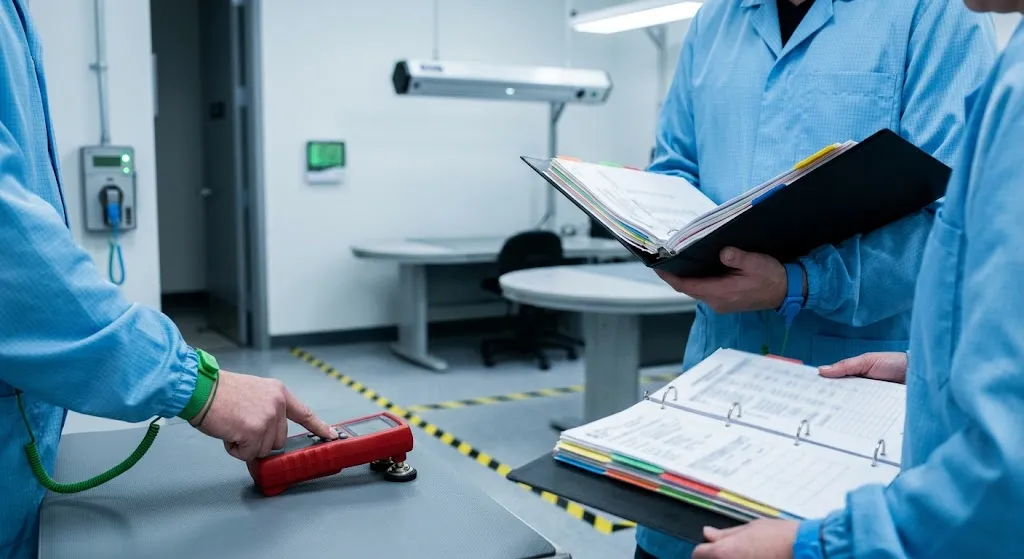
A single hygrometer near an HVAC return or office area will not represent actual RH at the press. Pressroom spaces with high ceilings or poor air circulation can show RH variation between zones exceeding 10 to 15%, meaning a passing reading in one area coexists with a failing condition at the feedboard. A minimum of three monitoring points is needed: near the paper storage area, at the press feedboard, and in the delivery zone. The humidity meters and monitors used should be calibrated electronic instruments with dataloggers, not handheld spot-check devices, to document RH trends across a full shift rather than a single point in time.How Precision Humidity Control Eliminates Low-Humidity Print Defects
Print facilities impose a specific humidification requirement that rules out many common approaches. The system must raise RH without wetting paper stock, press components, printed product, or electrical equipment. This constraint is more restrictive than it appears.Why Print Facilities Require Non-Wetting Humidification
Steam humidification introduces condensation risk near sensitive press electronics and paper storage zones. Conventional misting systems can produce droplets that settle on substrate, press surfaces, or finished printed product, causing quality failures more severe than the humidity problem being corrected. Three specific exposure points define the non-wetting requirement in a pressroom: paper stock in storage and at the feedboard, where any surface moisture changes paper moisture content before impression; press electronics and control systems; and printed product moving through delivery and finishing. An approach to printing facility humidity control that fails on any of these three points is not viable for production use, regardless of its RH output capability.Smart Fog Precision Humidification for Pressroom Environments
Humidification that produces an equal-sized droplet grid using compressed air and water through a proprietary nozzle addresses the non-wetting requirement directly. Each droplet is the same size and carries a slight charge that prevents droplets from re-aggregating, allowing them to self-evaporate fully before reaching any surface. This is the operating principle behind Smart Fog's industrial systems. Under proper system design, surfaces including paper stock, press equipment, and printed product remain dry. The caveat is accurate and important: surfaces under proper system design remain unaffected, but direct exposure to the fog stream will wet a surface. Key performance specifications for pressroom environments:- RH precision: maintains humidity up to 99% RH with plus or minus 1 to 2% precision, holding the pressroom environment within process-specific tolerances across an entire production shift.
- Non-wetting design: self-evaporating droplets absorb into the air before surface contact under proper system design.
- No moving parts: the humidification process contains no moving parts, eliminating a common maintenance failure point.
- Maintenance interval: designed for maintenance intervals extending up to every two years, appropriate for production facilities that cannot tolerate unplanned downtime.
- Continuous operation: engineered for 24/7 industrial operation with no certified technician required for installation.