Textile humidification is a critical production requirement. Manufacturing facilities face significant quality and safety challenges when humidity levels fluctuate outside optimal ranges. Static electricity formation, fiber dimensional instability, and quality consistency problems directly impact yarn production, weaving operations, and finished fabric specifications when relative humidity drops below controlled levels.
This analysis covers the mechanisms by which humidity affects natural and synthetic fiber behavior, the specific static-related failures that occur in textile processing, and the engineering requirements for maintaining consistent production quality. The focus addresses facility managers and production engineers responsible for equipment reliability and product specifications in fabric and yarn manufacturing operations.
Key Takeaways:
- Natural fibers like cotton and wool absorb and release moisture based on ambient humidity, causing dimensional changes that affect fabric consistency and quality measurements.
- Static electricity forms more readily during textile processing when relative humidity drops below 45%, leading to yarn breakage, fabric cling, and material handling difficulties.
- Synthetic fibers generate higher static charges than natural fibers during processing because they have lower moisture absorption capacity and higher electrical resistance.
- Humidity fluctuations cause fiber tension variations during weaving and knitting, resulting in uneven fabric density and quality defects that require rework or material waste.
- Textile dust becomes airborne more easily in dry conditions, creating safety hazards and contaminating finished products with particle deposits.
- Precise humidity control between 50-65% RH eliminates most static-related production interruptions while maintaining fiber dimensional stability across natural and synthetic materials.
How Humidity Affects Textile Manufacturing: Natural and Synthetic Fibers
Fiber behavior changes significantly with ambient humidity levels because different materials interact with moisture through distinct mechanisms. Natural fibers contain hygroscopic properties that allow moisture absorption and release, while synthetic materials maintain lower moisture content and higher electrical resistance during processing.
Understanding these differences becomes critical for production planning because moisture content directly affects fiber dimensions, processing tension, and electrostatic charge generation. Facilities processing both natural and synthetic materials must account for different optimal humidity ranges and static control requirements across fiber types.
The moisture absorption capacity varies dramatically between material categories. Natural fibers can absorb 8-12% of their weight in moisture at standard atmospheric conditions, while synthetic fibers typically absorb less than 1-4% under the same conditions. This difference drives the distinct processing requirements and humidity specifications for each fiber type.
Natural Fiber Moisture Absorption
Cotton, wool, silk, and linen fibers absorb moisture directly from ambient air through their cellular structure and hygroscopic properties. When relative humidity increases, these fibers swell as water molecules bind to cellulose or protein chains within the fiber matrix. When humidity decreases, the fibers release moisture and contract to smaller dimensions.
This dimensional change affects yarn tension during spinning operations and fabric stability during weaving processes. Cotton fibers can experience dimensional changes of 1-3% with humidity variations of 20-30% RH, creating measurable differences in yarn diameter and tensile strength that impact production consistency.
Wool fibers demonstrate even greater moisture sensitivity, with the ability to absorb up to 30% of their dry weight in moisture at 100% relative humidity. The protein structure in wool allows greater moisture penetration than cellulose-based fibers, making humidity control more critical for maintaining dimensional stability in wool processing operations.
Synthetic Fiber Static Generation
Polyester, nylon, acrylic, and other synthetic fibers generate significantly more static electricity during processing because their molecular structure resists moisture absorption. The low moisture content means these materials maintain higher electrical resistance and accumulate charge more readily during mechanical handling, carding, and spinning operations.
According to studies on static charge generation, the charge generation increases exponentially as relative humidity drops below 45%. At 30% RH, synthetic fibers can generate surface voltages exceeding 10,000 volts during normal processing speeds, compared to less than 1,000 volts for natural fibers under identical conditions.
Synthetic fiber static problems compound because the materials cannot dissipate accumulated charge through moisture pathways. Natural fibers use absorbed moisture as a conductive medium to discharge static buildup, but synthetic materials require external humidity in the surrounding air to provide charge dissipation paths through surface moisture films.
Static Electricity Problems in Textile Production
Static electricity formation during textile processing creates specific failure modes that interrupt production and reduce quality consistency. The problems intensify as relative humidity drops because dry conditions prevent charge dissipation through natural moisture pathways on fiber surfaces and processing equipment.
Production facilities experience static-related interruptions most frequently during carding, spinning, weaving, and material handling operations. The severity depends on fiber type, processing speed, equipment design, and ambient humidity levels maintained throughout the production environment.
Static problems compound across processing stages because accumulated charge transfers from fibers to equipment surfaces, creating attraction forces that interfere with normal material flow and handling. The electrical discharge events that occur when static buildup exceeds breakdown thresholds can damage electronic controls and create safety hazards for operators.
Static in Spinning and Carding
Spinning operations generate static electricity as fibers slide against metal surfaces during drawing, twisting, and winding processes. The mechanical friction creates charge separation that accumulates on fiber surfaces and processing equipment, leading to yarn breakage when electrostatic forces exceed fiber tensile strength.
Carding processes create particularly severe static problems because the wire-covered surfaces repeatedly contact and separate from fiber masses, generating high voltage accumulation. Static buildup causes fiber clumping, uneven card loading, and poor fiber alignment that reduces yarn quality and processing efficiency.
The yarn breakage rate increases exponentially when relative humidity drops below 40%. Production data from textile facilities shows breakage rates can increase 300-500% when humidity falls from 50% to 30% RH during synthetic fiber processing, requiring frequent production stops for rethreading and cleanup.
Weaving and Knitting Static Issues
Fabric cling problems occur when static charges cause woven or knitted materials to adhere to machinery surfaces instead of following normal material paths. The electrostatic attraction overcomes the mechanical forces designed to guide fabric movement, creating tension variations and processing interruptions.
Static discharge events during weaving can damage electronic controls on modern looms equipped with computer-controlled warp and filling insertion systems. The high voltage pulses generated during fabric separation events can reset control systems, interrupt programmed patterns, and require manual intervention to restore normal operation.
Knitting operations experience yarn feeding problems when static electricity causes multiple yarns to repel or attract each other during needle selection processes. The charge buildup interferes with proper yarn positioning, creating dropped stitches, tension variations, and fabric defects that require rework or material disposal.
Quality and Dimensional Stability Requirements
Textile quality specifications require dimensional consistency, weight uniformity, and mechanical properties that remain stable throughout production and finishing processes. Humidity fluctuations affect these parameters by changing fiber moisture content, which directly impacts measurable characteristics used for quality control and customer acceptance.
Production facilities must maintain fabric weight per square meter within manufacturing tolerance specifications typically ranging from plus or minus 2% to plus or minus 5% depending on end-use applications. Humidity variations that cause fiber swelling or shrinkage can push finished products outside specification limits, requiring rework or rejection.
The relationship between humidity and quality parameters becomes particularly critical during finishing operations where dimensional stability, shrinkage control, and surface properties are finalized. Facilities that cannot maintain stable humidity during these processes experience higher rejection rates and increased production costs from quality failures.
Fabric Weight and Density Consistency
Fabric weight measurements change directly with fiber moisture content because absorbed water contributes to the total mass per unit area. Cotton fabrics can show weight variations of 3-8% when humidity changes from 40% to 70% RH, potentially shifting products outside commercial tolerances.
The weight variations create problems for facilities selling fabric by weight specifications because the measured values depend on testing conditions for fiber exemptions rather than actual fiber content. Industry standards require conditioning fabrics at 65% plus or minus 2% RH and 70 degrees F plus or minus 2 degrees F before weight measurements, but production facilities must maintain similar conditions to ensure consistent results.
Fabric density measurements also change with humidity because fiber swelling affects yarn diameter and fabric thickness. These dimensional changes impact hand-feel characteristics, draping properties, and performance attributes that customers evaluate for acceptance, according to ASTM D1776 standard conditioning requirements.
Dimensional Stability During Finishing
Shrinkage control during finishing operations requires stable humidity to prevent uncontrolled dimensional changes that occur when fabrics gain or lose moisture during heat setting, dyeing, and chemical treatment processes. Humidity fluctuations can cause differential shrinkage across fabric width or length, creating dimensional distortions.
Heat setting processes typically conducted at elevated temperatures become more critical under varying humidity conditions because the combination of heat and moisture changes affects fiber relaxation and dimensional recovery. Synthetic fabrics require precisely controlled humidity during heat setting to achieve specified shrinkage characteristics and dimensional stability.
Finishing operations that apply chemical treatments, coatings, or dyes can experience consistency problems when humidity varies because moisture content affects chemical penetration, reaction rates, and cure characteristics that determine final product properties and appearance uniformity.
Dust Control and Air Quality in Textile Facilities
Textile processing generates airborne particles from fiber preparation, carding, spinning, and finishing operations that become more problematic under dry atmospheric conditions. Low humidity increases dust suspension time and particle mobility, creating respiratory hazards and product contamination issues that affect both worker safety and production quality.
Proper humidity control reduces airborne particulate concentrations by promoting dust settling through increased particle weight from moisture absorption. The Occupational Safety and Health Administration (OSHA) recognizes humidity control as an engineering approach for reducing textile dust exposure in manufacturing facilities.
Facilities maintaining relative humidity between 50-65% experience measurably lower airborne dust concentrations compared to operations running below 40% RH. The improvement occurs because higher humidity increases particle mass and provides electrostatic charge dissipation that reduces dust suspension forces.
Airborne Dust and Worker Safety
Cotton dust exposure creates respiratory health risks that increase when dry conditions keep particles airborne for extended periods. The OSHA cotton dust standard 29 CFR 1910.1043 establishes permissible exposure limits that become more difficult to maintain when low humidity prevents natural dust settling.
Synthetic fiber processing generates different particle types, but the health concerns remain because small diameter fibers and fiber fragments can penetrate deep into respiratory systems when suspended in dry air. Higher humidity levels promote particle agglomeration and settling that reduces inhalation exposure.
The relationship between humidity and dust control extends beyond compliance because improved air quality reduces cleaning requirements, equipment maintenance, and production interruptions from dust-related problems. Facilities report reduced housekeeping costs and equipment downtime when humidity control systems maintain optimal levels for dust management.
Product Contamination Prevention
Airborne textile dust settles on finished fabrics, creating quality defects and customer complaints when particles embed in fabric surfaces or interfere with dyeing and finishing processes. Static electricity under dry conditions increases dust attraction to fabric surfaces, making contamination problems more severe.
Dust contamination becomes particularly problematic during fabric inspection and packaging operations where finished products receive final quality evaluation. Particles that settle on fabric surfaces during these final stages cannot be removed without additional processing that increases production costs and delivery delays.
Commercial and industrial humidifiers designed for textile applications help maintain the consistent humidity levels required for effective dust control throughout production and finishing areas.
Smart Fog Non-Wetting Textile Humidification
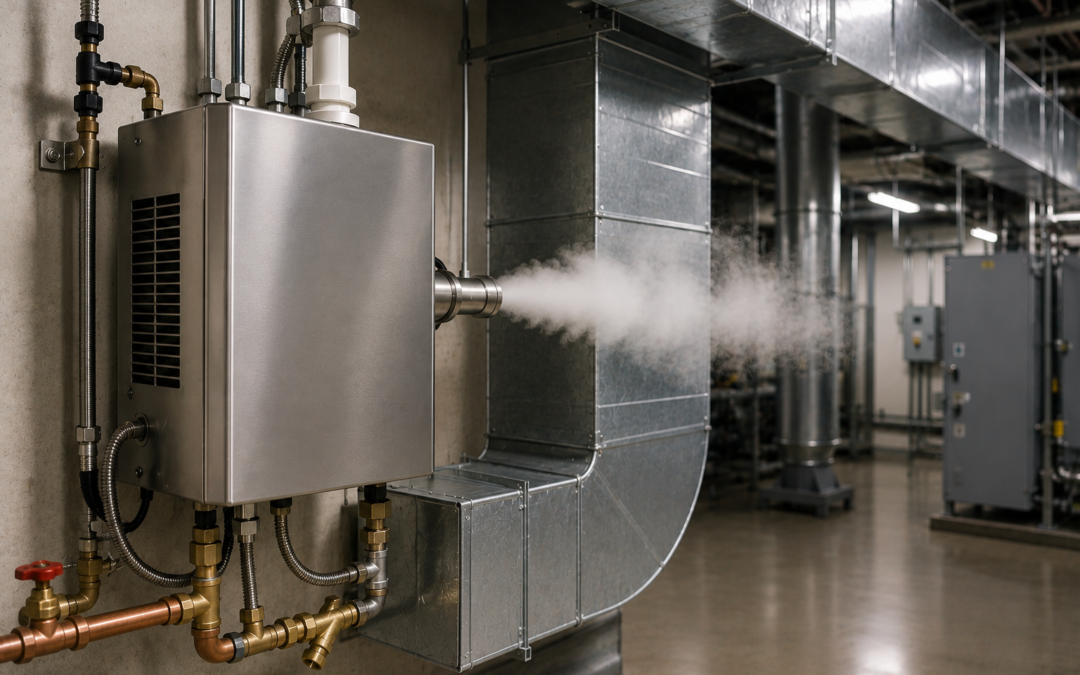
Adiabatic humidification that produces self-evaporating droplets eliminates the surface-wetting risk that affects textile materials, equipment surfaces, and finished products. This technology uses compressed air and water through a proprietary nozzle to create an equal-sized droplet grid where each droplet evaporates completely before reaching any surface under proper system design.
The non-wetting characteristic becomes critical in textile facilities because moisture contact with fibers, fabrics, or processing equipment can cause immediate quality problems, dimensional changes, and production interruptions. Traditional humidification methods that create condensation or surface moisture are incompatible with textile processing requirements.
Smart Fog systems maintain humidity precision up to 99% RH with plus or minus 1-2% accuracy, providing the stable conditions required for static control and quality consistency. The precision eliminates the humidity fluctuations that cause fiber dimensional changes and processing variations that affect production efficiency.
Non-Wetting Technology for Fabric Protection
The self-evaporating droplet technology prevents moisture contact with textile materials, equipment surfaces, racks, ducts, and products throughout the production environment under proper system design. Each droplet maintains the same size and carries a slight charge that prevents re-aggregation, ensuring complete evaporation occurs in the air space rather than on contact surfaces.
This protection extends to finished fabrics during storage and packaging operations where moisture contact would create immediate quality defects, dimensional distortion, or customer rejection. The technology allows humidity control in areas where traditional methods would damage products or interfere with processing operations.
Static electricity control systems using non-wetting humidification maintain the 50-65% RH levels required for static dissipation without creating the surface moisture that would interfere with electrical discharge pathways or equipment operation.
Precision Control for Consistent Production
The plus or minus 1-2% humidity precision eliminates the fluctuations that cause fiber dimensional changes, static electricity variations, and quality inconsistencies throughout textile processing operations. This stability allows facilities to maintain consistent fiber properties and processing conditions that improve production efficiency and reduce quality defects.
Humidity control systems engineered for textile applications operate continuously without the maintenance demands that interrupt production or create humidity variations during system downtime. The no-moving-parts design extends maintenance intervals up to every two years, reducing operational interruptions.
The 100% water efficiency means every drop evaporates into the air rather than creating waste drainage or surface moisture that would require additional facility infrastructure. This efficiency reduces operating costs while providing the precise humidity control required for optimal textile processing conditions.
Final Thoughts
Humidity control in textile manufacturing directly affects production efficiency, quality consistency, and worker safety through mechanisms that influence fiber behavior, static electricity formation, and dust management. Facilities that maintain optimal humidity levels between 50-65% RH experience fewer production interruptions, reduced quality defects, and improved processing reliability across natural and synthetic fiber operations.
The engineering challenge involves providing precise humidity control without creating surface moisture that damages textile materials or interferes with processing equipment. Non-wetting humidification technology addresses these requirements by delivering stable humidity levels while protecting fabrics, machinery, and finished products from moisture contact.
Smart Fog’s self-evaporating droplet technology offers textile facilities the precision humidity control required for static elimination and quality consistency without the surface-wetting risks that traditional methods create. The systems maintain plus or minus 1-2% humidity precision with maintenance intervals extending up to every two years, providing reliable long-term performance for continuous textile manufacturing operations.
Contact Smart Fog engineers to discuss precision humidification requirements for textile manufacturing facilities.
Frequently Asked Questions
What humidity level is best for textile manufacturing facilities?
Textile manufacturing facilities typically require relative humidity between 50-65% RH for optimal performance. This range provides sufficient moisture for static electricity dissipation while maintaining fiber dimensional stability and preventing condensation problems that can damage materials or equipment.
How does low humidity cause yarn breakage in textile production?
Low humidity increases static electricity formation during spinning and carding operations, creating electrostatic forces that exceed fiber tensile strength and cause yarn breakage. Humidity below 40% RH can increase breakage rates by 300-500% in synthetic fiber processing compared to properly controlled conditions.
Why do synthetic fabrics create more static electricity than natural fibers?
Synthetic fibers generate more static electricity because they absorb less moisture than natural fibers, maintaining higher electrical resistance during processing. At 30% RH, synthetic materials can generate surface voltages exceeding 10,000 volts compared to less than 1,000 volts for natural fibers under identical conditions.
What are the main quality problems caused by humidity fluctuations in textile mills?
Humidity fluctuations cause fiber dimensional changes that affect fabric weight, density, and dimensional stability measurements. Cotton fabrics can show weight variations of 3-8% when humidity changes from 40% to 70% RH, potentially pushing finished products outside commercial specifications and requiring rework or rejection.
How does humidity control reduce dust in textile manufacturing?
Higher humidity levels increase textile dust particle weight through moisture absorption and provide electrostatic charge dissipation that reduces dust suspension forces. Facilities maintaining 50-65% RH experience measurably lower airborne dust concentrations compared to operations running below 40% RH.
What makes textile humidification different from other industrial applications?
Textile humidification requires non-wetting technology because moisture contact with fibers, fabrics, or processing equipment causes immediate quality problems and dimensional changes. Traditional humidification methods that create surface moisture or condensation are incompatible with textile processing requirements.
Can humidity control prevent fabric shrinkage during processing?
Proper humidity control helps maintain consistent fiber dimensions and reduces uncontrolled shrinkage during finishing operations. Stable humidity prevents differential moisture absorption that causes dimensional distortions and helps maintain specified shrinkage characteristics during heat setting and chemical treatment processes.
What type of humidification system works best for textile facilities?
Non-wetting adiabatic systems that produce self-evaporating droplets work best for textile facilities because they provide precise humidity control without surface moisture contact. These systems maintain plus or minus 1-2% humidity precision while protecting fabrics and equipment from moisture damage under proper system design.